







































Description
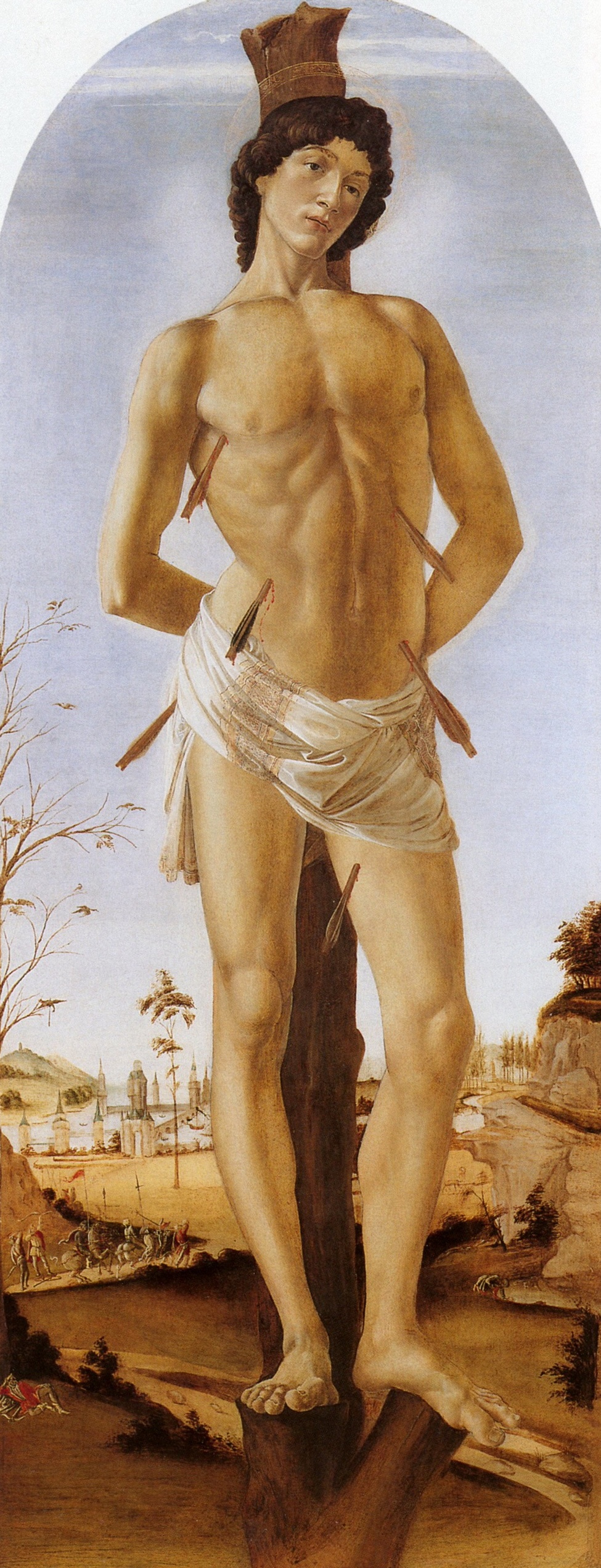
Saint Sebastian is a tall, narrow painting that Sandro Botticelli finished before January 1474 for the Florentine church of Santa Maria Maggiore: the young saint, almost naked but for a white loincloth, stands bound to a bare tree trunk with his hands behind his back and six arrows in his body, and lowers his gaze calmly, high above a landscape with a town and a river. The original, tempera on poplar panel measuring 195 x 75 cm, belongs to the Gemäldegalerie in Berlin. Our painter paints it for you by hand in oil on canvas, in 5 portrait sizes from 30 x 80 to 67 x 181 cm or made to measure. Before it sets off, you receive a photograph of it.
| Title: | Saint Sebastian |
| Other titles: | San Sebastiano (Italian title) · Sveti Sebastijan (Slovene title) |
| Painter: | Sandro Botticelli (c. 1445–1510) |
| Year painted: | 1474 |
| Original size: | 195 cm x 75 cm (height x width) |
| Original technique: | Tempera on poplar panel |
| Painting style: | Early Renaissance |
| Located at: | Gemäldegalerie, Berlin, Germany, inv. 1128 |
| Our reproduction: | Hand-painted in oil on canvas, 5 sizes or made to measure |
Saint Sebastian – Sandro Botticelli
What does Saint Sebastian show?
A single figure fills almost the whole height of the panel. A young man with dark curls stands before a tree trunk that ends just above his head. He tilts his head and looks down past us; a fine gold halo is barely visible.
His hands are tied behind his back. His weight rests on one leg while the other is relaxed, the way ancient statues stand. His bare feet rest on two sawn-off branch stumps, and a white loincloth with a decorated hem is wrapped around his hips.
Six arrows have struck him: two in his right side, two in his left, one in the inside of his left thigh and one high on his right thigh. His face shows no pain.
The horizon sits very low, so the saint towers over the landscape. On the left rises a walled town with towers, small riders with lances before it; on the right a river winds between rocks. A pale blue sky, closed by a round arch, spans it all.
What story does the painting tell?
Sebastian is a Roman saint who, according to tradition, died in the persecution of Christians under Diocletian at the beginning of the 4th century. He is usually shown bound and pierced with arrows.
Botticelli does not paint the shooting itself but the moment after it. The executioners walk away in the background, one already off hunting herons. Departing torturers are a rare subject.
The saint seems almost detached: he bears the arrows in silence, without crying out or struggling. Italian writers often link the painting with the Neoplatonic thought of the Medici circle around Marsilio Ficino and Agnolo Poliziano, where reason lifts a person towards the divine; in that reading the light along his contours brings him closer to the sky. This is an interpretation, not a message Botticelli left in writing.
Why is the painting so famous?
The British art historian Kenneth Clark saw in it something rare in 15th-century Florence: the harmonious repose of classical sculpture. Pollaiuolo and Botticelli, he wrote, painted the nude in energy or ecstatic motion; only here did they achieve a satisfactory nude in repose.
Because of its balanced proportions and classical contrapposto, Saint Sebastian is often called the first male nude of Florentine painting since Donatello’s David.
In 1907 Rainer Maria Rilke published his poem Sankt Sebastian in Neue Gedichte; J. B. Leishman and Jane Davidson Reid have noted how closely it matches this painting in mood. The Wikipedia article, in English, gives the sources.
A little later Piero del Pollaiuolo painted his Martyrdom of Saint Sebastian, now in the National Gallery in London, crowded with archers and crossbowmen. From the same years comes Portrait of a Man with a Medal of Cosimo the Elder, with a young face of the same seriousness.
Where is the original today?
The original hangs in the Gemäldegalerie in Berlin, inventory number 1128.
The panel was painted before January 1474, when it was given to the church of Santa Maria Maggiore in Florence. Giorgio Vasari, in his life of Botticelli, records that it hung on one of the church’s pillars. The date stood on the lost original frame; Alessandro Cecchi suggests it was finished by 20 January, the saint’s feast day.
Its place on a pillar explains the unusually tall, narrow format.
Botticelli, born Alessandro Filipepi around 1445 in the Borgo Ognissanti quarter, was a tanner’s son. In 1474 itself he stayed for some time in Pisa. He died on 17 May 1510.
Saint Sebastian or another Botticelli?
Saint Sebastian is a canvas painting for anyone who would rather have one quiet figure than a crowd. Its slim format goes where a wide painting will not.
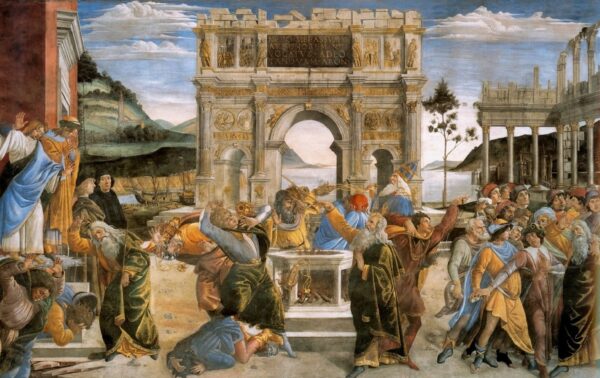
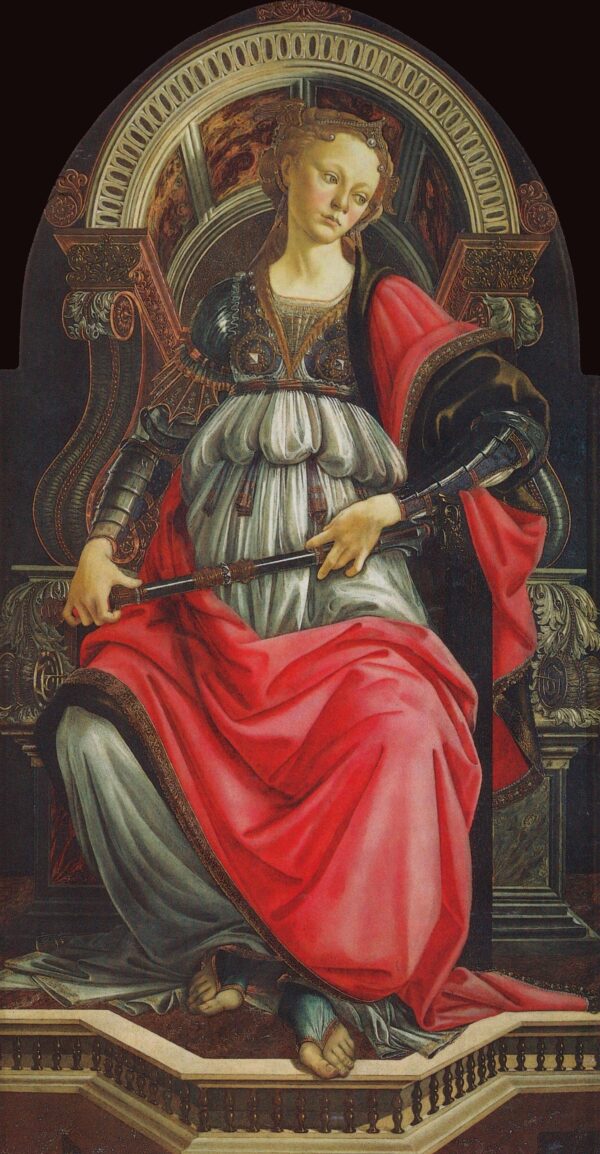
Four years older is Fortitude, according to Wikipedia his earliest documented work: a young woman in armour sits on a marble throne under a similar arch. In 1481 and 1482 he painted the Sistine Chapel fresco we offer as The Temptations of Christ, with Christ and the devil disguised as a hermit. From his late years comes Lamentation over the Dead Christ in Munich, with the dead Christ across the lap of the fainting Virgin.
More famous Botticelli paintings, each one painted to order, wait on our Sandro Botticelli page.
How do we hand-paint Saint Sebastian?
Botticelli’s original is not an oil painting: it is tempera on a poplar panel 195 cm high and 75 cm wide, with a rounded arch at the top. Ours is a Sandro Botticelli reproduction painted by hand in oil on canvas, layer upon layer, so it can travel rolled, stretched on a stretcher bar or framed. We paint the rectangle that the photograph of the original shows, with the corners above the arch just as they appear in it.
The painter first draws the trunk and the outline of the body and fixes the low horizon. Next come sky and landscape, and only then the body: warm skin in thin, translucent layers and soft light along the contours.
Last comes the fine work: the folds and decorated hem of the white cloth, the curls, the delicate gold halo, the feathered arrows, and the little riders far away.
Which size suits which wall?
In short: Saint Sebastian belongs on a narrow, high wall, so choose the size by the height of the room.
We paint it in 5 portrait sizes (width x height): 30 x 80, 40 x 100, 50 x 130, 60 x 150 and 67 x 181 cm. The original measures 75 x 195 cm (width x height), so every one of our sizes is smaller; the largest, 67 x 181 cm, reaches about 90 % of the Berlin panel.
30 x 80 and 40 x 100 cm suit a spot beside a door or a bed. 50 x 130 and 60 x 150 cm fill the wall between two windows, a corridor or a stairwell. As a painting for the living room with a high ceiling it shows best at 67 x 181 cm
Can I order another size, and which frame should I choose?
Yes. The saint always stays whole; we adjust only sky and landscape at the sides, so it remains a complete oil painting reproduction of the scene. Send us the size you have in mind and you will get a price and a date for your Saint Sebastian.
It leaves us rolled in a tube, stretched on a stretcher bar or ready framed. Our workshop in Slovenia does the stretching and framing and packs even the largest size with care. In our 3D app you pick the moulding only; seeing the painting on your own wall is a separate service. A slim dark or gilded frame suits the tall format.
When will your Saint Sebastian arrive?
Saint Sebastian is ready to ship 15 to 45 working days after you confirm your order. When it is finished, we send you a photograph and make any changes you ask for before packing.
Customs never apply to a Saint Sebastian sent within the EU, and each order falls under our returns policy.
For a Sebastian it makes a fine present on his name day, 20 January. Unsure of the size? A wall art voucher leaves that choice to him.
Frequently asked questions
Where can I see the original?
In the Gemäldegalerie in Berlin, inventory number 1128.
How many arrows strike the saint?
Six: two on the right, two on the left and one in each thigh.
Is it a print?
No. It is a hand-painted copy in oil on canvas, brushed by our painter.
How large is the original?
195 x 75 cm (height x width); even our largest size, 67 x 181 cm, is a little smaller.
Is a size outside the list possible?
Yes. Tell us the width and height and we will work out a price and a date.
How long until it ships, and how is it sent?
15 to 45 working days; it travels rolled, stretched or framed.
Does it suit a bedroom or a hallway?
Yes. The narrow format fits beside a door or a wardrobe.
Why is the saint so calm although he is wounded?
Botticelli paints the moment after the martyrdom, when the executioners are already leaving.
- Subject: the young saint bound to a tree trunk, with six arrows, high above a landscape with a town and a river.
- Original: tempera on poplar panel, 1474, 195 x 75 cm, Gemäldegalerie, Berlin.
- Ours: hand-painted in oil on canvas, 5 portrait sizes from 30 x 80 to 67 x 181 cm, or made to measure.
- Worth knowing: the panel once hung on a pillar of the church of Santa Maria Maggiore in Florence, which is why it is so tall and narrow.