







































Description
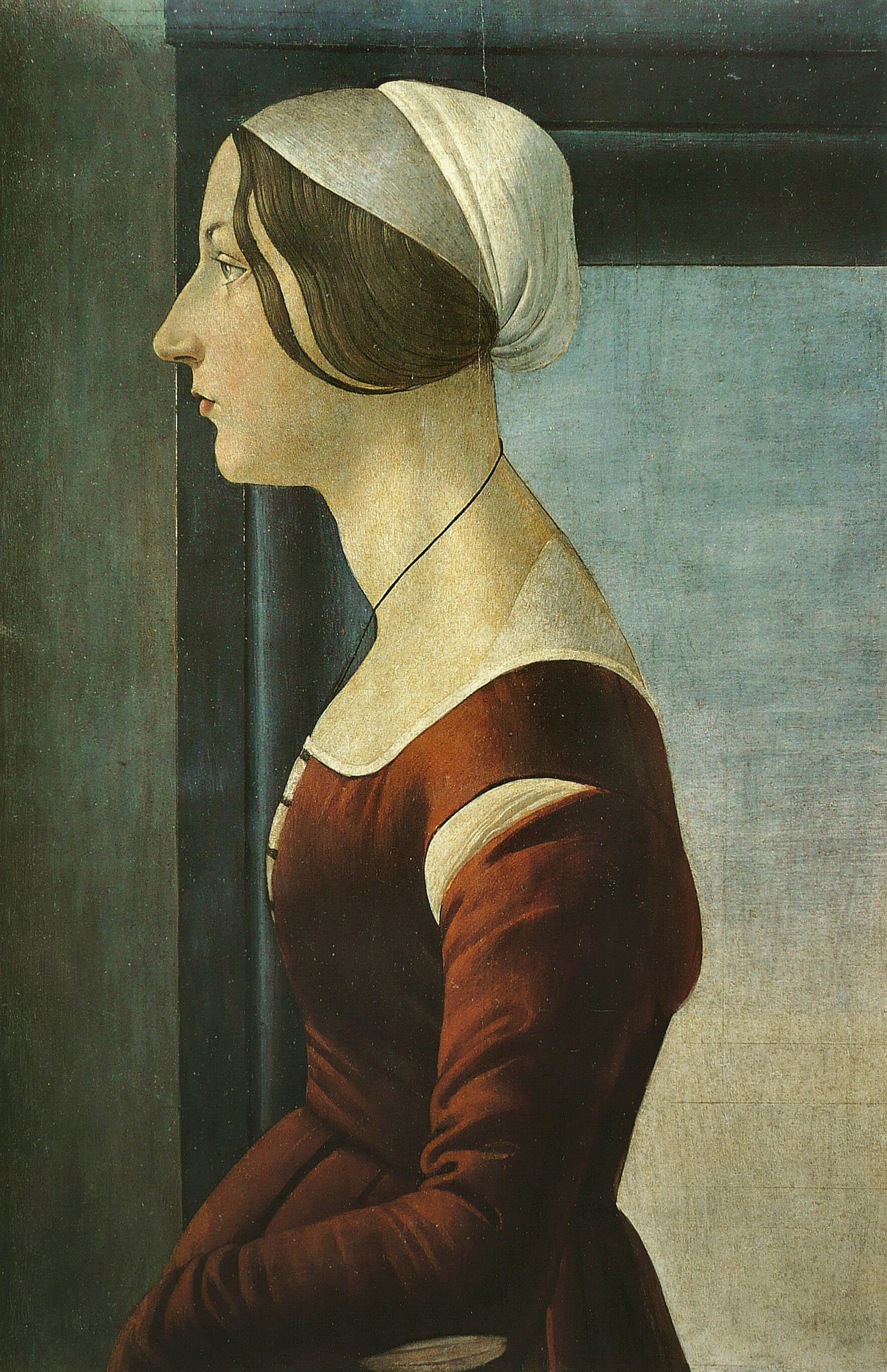
Portrait of a Young Woman is a painting by Sandro Botticelli from around 1475: a young Florentine in strict left profile, a white linen cap over smooth brown hair, with a long neck and a dark red dress, before a window that opens onto a pale blue sky. The original, tempera on a 61 x 40.5 cm wooden panel, belongs to the Galleria Palatina in the Palazzo Pitti, Florence. We paint it by hand in oil on canvas, in 8 upright sizes from 30 x 45 to 128 x 191 cm or made to measure. You receive a photograph of your finished portrait before it leaves us.
| Title: | Portrait of a Young Woman |
| Other titles: | Ritratto di giovane donna (Italian title) · Simonetta (19th-century name) |
| Painter: | Sandro Botticelli (c. 1445–1510) |
| Year painted: | c. 1475 |
| Original size: | 61 cm x 40.5 cm (height x width) |
| Original technique: | Tempera on panel |
| Painting style: | Early Renaissance |
| Located at: | Galleria Palatina (Palazzo Pitti), Florence, Italy |
| Our reproduction: | Hand-painted in oil on canvas, 8 sizes or made to measure |
Portrait of a Young Woman – Sandro Botticelli
What does Botticelli’s Portrait of a Young Woman show?
A young woman stands at a window opening and looks left, so we see only her profile: straight nose, closed lips, a calm eye under a high forehead. Her head rises on a long, softly lit neck.
A white linen cap, knotted at the back, holds her smooth hair, parted in the middle; above the ear a soft wave of brown strands slips out from under it. A thin dark cord circles her neck and vanishes into the neckline.
The dress is dark red, with a deep round neckline, dark laces at the front and white fabric at the upper arm. Behind her stand a grey-green wall and a dark frame, and through the opening a pale blue sky.
Who is the woman in the portrait?
Nobody knows. Scholars have not identified the sitter or agreed on a date: proposals range from 1475 to 1490, and on stylistic grounds several place the panel around 1485.
Nineteenth-century critics called the portrait Simonetta, after Simonetta Vespucci, loved by Giuliano de’ Medici, who died young in a Florence that saw her as the living ideal of female beauty. Beside other presumed likenesses of her, such as Botticelli’s The Birth of Venus or the portrait by Piero di Cosimo, the features look quite different, and the identification is not accepted today.
Other candidates include Clarice Orsini, wife of Lorenzo the Magnificent, and Fioretta Gorini, the lover of Giuliano de’ Medici; none is proven. The low-cut dress, elegant but not lavish, suggests a woman of the Florentine middle class.
Why is this portrait so admired?
The drawing is very fine and built on the outline, one flowing stroke from forehead over nose and chin to neck. The figure is elegant and highly idealised, an idea of beauty more than a record of a face.
The face carries a quiet melancholy typical of Botticelli’s figures, known too from his large mythologies and Madonnas, the famous Botticelli paintings. Scholars compare it with other Florentine portraits of the period, above all the celebrated portrait of a young lady painted by Antonio del Pollaiolo in 1470–1472.
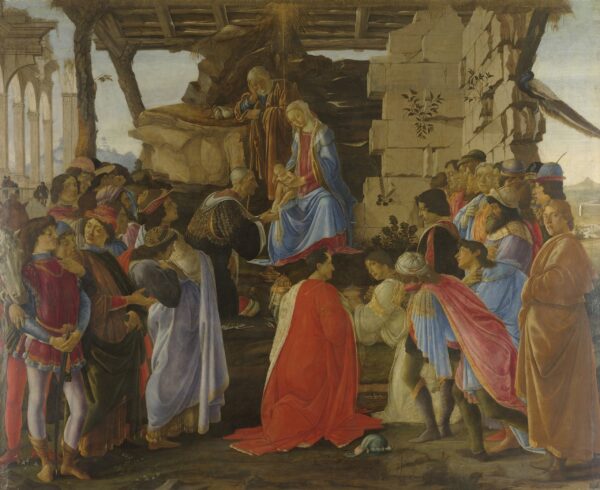
Standing alone, with no story and no companions, she differs from many-figured scenes such as the Adoration of the Magi. More on the portrait and its literature is in the Italian Wikipedia article, written in Italian.
Where is the original, and what is known of its history?
The original belongs to the Galleria Palatina in the Palazzo Pitti, Florence, where the 1912 inventory lists it as number 353. How it entered the collection is not known.
The wooden panel was cut down on all four sides, so the scene now runs almost to the edge. When the Opificio delle Pietre Dure in Florence restored it in 1988, the restorers doubted Botticelli’s authorship; it was later reaffirmed, above all by Serena Padovani, who in the gallery’s latest catalogue also recorded the spoken opinions of Luciano Bellosi, Miklós Boskovits and John Pope-Hennessy.
Botticelli, born Alessandro di Mariano di Vanni Filipepi around 1445, was a tanner’s son from the Florentine district of Ognissanti. Vasari says he first trained as a goldsmith; he learned painting under Filippo Lippi. The Medici were among his patrons, and the 1480s were his most successful decade. He died on 17 May 1510, and his fame faded until the Pre-Raphaelites rediscovered him in the late 19th century.
This portrait or another Botticelli?
This canvas painting suits anyone who prefers one face to a crowd of figures. Its narrow upright format fits between two windows, beside a door or above a chest of drawers.
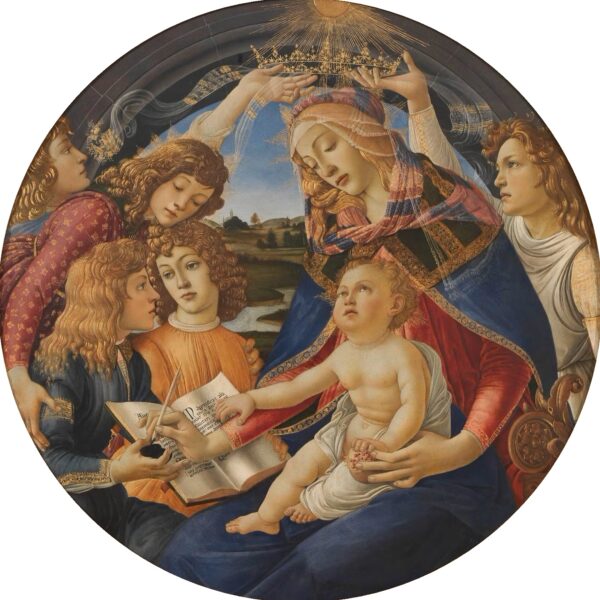
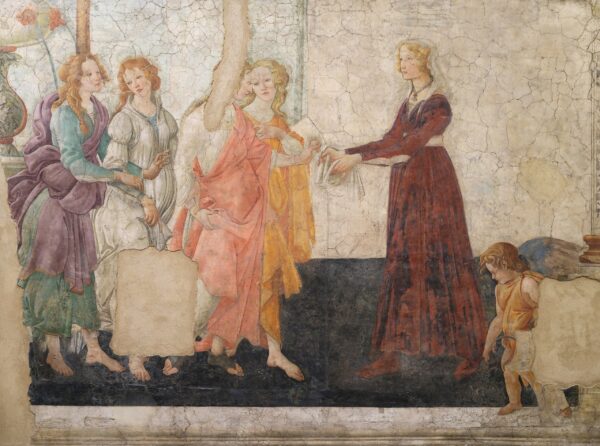
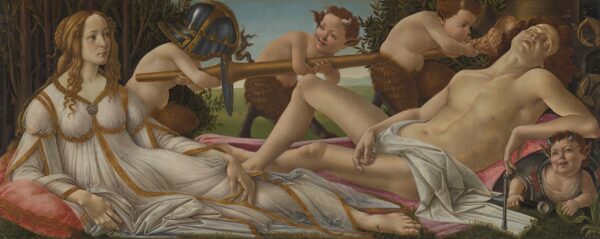
If Botticelli’s young Florentines appeal to you, see Venus and the Three Graces Presenting Gifts to a Young Woman, first painted as a fresco on a villa wall. For mythology there is Venus and Mars; for a round composition with the Virgin, the Madonna of the Magnificat.
Everything we paint to order is on the Sandro Botticelli page; each Sandro Botticelli reproduction can be made to your size.
How do we hand-paint the portrait?
Botticelli’s original is not an oil painting: it is tempera on a wooden panel 61 cm high and 40.5 cm wide. Ours is painted in oil on canvas, so we can send it rolled, stretched on a stretcher bar or framed.
The painter starts with the outline, because in Botticelli everything hangs on line: the profile from forehead to chin, then the long neck, the shoulder and the edge of the dress. Next come the flat background areas, the wall, the window frame and the pale sky, in thin layers.
Then, layer by layer, come the dark red dress, the white cap with its soft shadows and the brown strands of hair; a fine brush adds the cord and laces last. The result is an oil painting reproduction with real body of paint and visible brushstrokes.
Which size for which wall?
In short: smaller sizes for a bedroom, hallway or home office, middle ones above a chest of drawers or bed, the largest for a tall wall in a living room or stairwell.
We paint the portrait in 8 upright sizes (width x height): 30 x 45, 38 x 55, 42 x 65, 57 x 82, 70 x 110, 81 x 120, 100 x 155 and 128 x 191 cm. The original measures 40.5 x 61 cm (width x height): 30 x 45 and 38 x 55 cm are smaller, 42 x 65 cm is about the size of the panel in Florence, and every size from 57 x 82 cm up is larger.
Small sizes suit a narrow wall by a window, a shelf or the space above a desk; 57 x 82 and 70 x 110 cm fill the wall above a bed or a chest of drawers. As a painting for the living room it is strongest at 100 x 155 or 128 x 191 cm, where the face is larger than life.
Can I order a different size or a frame?
Yes. If you need a different ratio, the woman stays whole and we adjust only the wall, the frame and the sky around her, leaving the profile untouched. Send us your custom size; we will quote price and date.
It ships rolled in a tube, or stretched on a stretcher bar or framed by our workshop in Slovenia. The moulding is picked in our 3D app, which only handles the choice of frame; a view of the painting on your own wall is a separate service. A narrow gilded moulding or a dark wooden frame suits it.
When will the painting arrive?
Your portrait is ready for dispatch 15 to 45 working days after we confirm the order. We send you a photograph once it is finished and change anything you wish before packing.
Within Slovenia and the rest of the EU the portrait travels without customs duties; our returns policy covers every order.
The quiet Florentine in profile is a fine gift for a lover of the Renaissance. Unsure about their wall? Give a gift voucher and let them choose the size.
Frequently asked questions
Where can I see the original?
In the Galleria Palatina of the Palazzo Pitti in Florence, number 353 in the 1912 inventory.
Is the woman Simonetta Vespucci?
The name dates from the 19th century; the face differs clearly from her other presumed likenesses, so the sitter remains unknown.
Will I receive a print?
No. You receive a hand-painted copy, every stroke laid on with a brush in oil on canvas.
How large is the original?
61 x 40.5 cm (height x width); our closest size is 42 x 65 cm.
Do you paint the portrait in a size that is not on the list?
Yes. Send us the width and height and we will give you a price and a making time.
How long do painting and delivery take?
15 to 45 working days until dispatch, with a photograph of the painting first.
Does the portrait suit a bedroom, or work as a gift?
Yes. Its calm reds, whites and grey-greens suit a bedroom or hallway, and it makes a thoughtful gift.
Why is the woman painted in profile?
In Renaissance Florence the profile was the usual pose for portraits of people of rank, a convention inherited from the Middle Ages.
- Subject: a young woman in strict left profile, in a white cap and a dark red dress, before a window with a pale sky.
- Original: tempera on panel, c. 1475, 61 x 40.5 cm, Galleria Palatina, Palazzo Pitti, Florence.
- Ours: hand-painted in oil on canvas, 8 sizes from 30 x 45 to 128 x 191 cm, or made to measure.
- Worth knowing: the sitter is unknown; 19th-century critics gave the portrait the name Simonetta.