







































Description
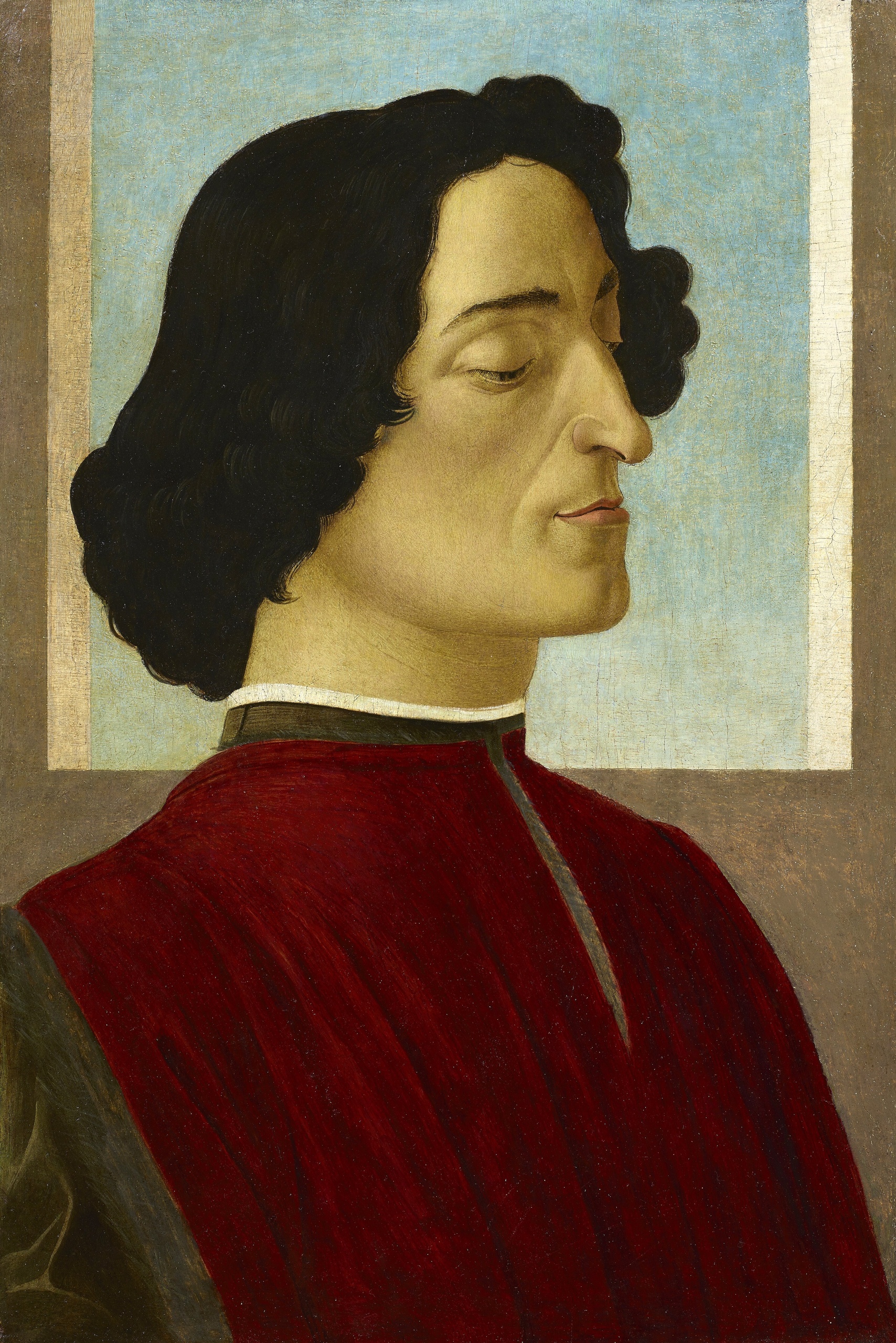
Portrait of Giuliano de’ Medici (Bergamo) is a painting by Sandro Botticelli from about 1478–1480. The young Florentine with dark curls turns his head almost into profile to the right, eyes lowered, dressed in red, with a window behind him opening onto a pale blue sky. Giuliano, the younger brother of Lorenzo the Magnificent, was killed in the Pazzi conspiracy of 1478. The original, tempera on a 54 x 36 cm wooden panel, belongs to the Accademia Carrara in Bergamo and is the smallest of the three surviving versions. Our painter hand-paints it for you in oil on canvas, in 8 portrait sizes from 29 x 46 to 128 x 191 cm or to a custom size, and you receive a photo of the finished painting before dispatch.
| Title: | Portrait of Giuliano de’ Medici (Bergamo) |
| Other titles: | Ritratto di Giuliano de’ Medici (Italian title) · Porträt des Giuliano de’ Medici, Bergamo (German title) |
| Painter: | Sandro Botticelli (c. 1445–1510) |
| Year painted: | c. 1478–1480 |
| Original size: | 54 cm x 36 cm (height x width) |
| Original technique: | Tempera on panel |
| Painting style: | Early Renaissance |
| Located at: | Accademia Carrara, Bergamo, Italy |
| Our reproduction: | Hand-painted in oil on canvas, 8 sizes or made to measure |
Portrait of Giuliano de’ Medici (Bergamo) – Sandro Botticelli
What does the Bergamo portrait show?
We see a young man, shown to the chest, in front of a grey-brown wall. His body faces us, but his head turns sharply to the right, so that the face appears almost in pure profile. Behind his head is a rectangular window whose lower edge lies at the height of his collar.
Through the window there is nothing but sky, light blue and paler still towards the horizon.
Giuliano has thick, curly black hair that falls to the nape of his neck. His forehead has a slight furrow in the middle, the nose is pointed, the chin barely marked, the upper lip thin and the lower one full. The lids are almost closed and the gaze is turned down with an air of melancholy.
He wears a red cloak that the Italian and French descriptions say is trimmed with fur. At the front it opens in a narrow slit, and at the neck a dark collar shows a thin white edge of shirt.
Who was Giuliano de’ Medici?
Giuliano de’ Medici was the younger brother of Lorenzo the Magnificent, who ruled Florence. In 1478 he was killed in the Pazzi conspiracy, which tried, with the help of Pope Sixtus IV and other Italian princes, to end Medici power in the city.
Straight after the conspiracy, Botticelli was called in to paint the conspirators, condemned in their absence, as hanged men on the wall of the Palazzo Vecchio, on the side of the Dogana gate.
He certainly painted Giuliano at least once during his life, and perhaps once or more after his death, drawing on the death mask and other likenesses. The French article points to the almost closed eyelids as a hint of this.
Why are the three Giuliano portraits so well known?
Three versions of this portrait survive: in Berlin, in Bergamo and in Washington. All share the same pose, the head turned almost into profile and the lowered eyes, but they differ in size and background.
Although the smallest, the Bergamo version is usually named as the first of the series, because its design sits between the more complex Washington version and the plain one in Berlin.
We offer the Berlin version as the painting Portrait of Giuliano de’ Medici. The largest is the Portrait of Giuliano de’ Medici (Washington), with a turtledove on a dead branch and a half-open door, both often read as signs of mourning.
The authorship of all three is disputed, and scholars have not agreed which one served as the model for the others, since the state of the paint surface does not allow a firm judgement. You can read more in the Italian Wikipedia article, which is written in Italian.
Where is the original today?
The wooden panel, now in the Accademia Carrara in Bergamo, Lombardy, is 54 cm high and 36 cm wide and dates from about 1478–1480, just before the 1480s, which became Botticelli’s most successful decade.
Sandro Botticelli was born Alessandro di Mariano di Vanni Filipepi around 1445 in the Borgo Ognissanti quarter of Florence, the son of a tanner. According to Vasari he first trained as a goldsmith; his teacher in painting was Filippo Lippi.
He lived almost all his life in the same neighbourhood; his only long stays elsewhere were in Pisa and in Rome, where he worked in the Sistine Chapel. He died on 17 May 1510 and was buried in Ognissanti; after long neglect the Pre-Raphaelites rediscovered him in the late 19th century.
This portrait or another Botticelli painting?
As a canvas painting, the Bergamo portrait suits anyone who prefers a single face against a calm ground to a crowded scene. Its upright format fits a narrow wall, the space beside a bookcase or a home office.
If you like Botticelli’s portraits of men, also look at the Portrait of a Young Man (Florence) or the Portrait of a Man with a Medal of Cosimo the Elder, in which a man holds up the medal of Cosimo the Elder.
Our Sandro Botticelli page gathers more famous Botticelli paintings, from portraits like this one to Madonnas.
How do we hand-paint the Giuliano portrait?
The Bergamo original is not an oil painting but tempera on a wooden panel, 54 x 36 cm (height x width).
This Sandro Botticelli reproduction is hand-painted in oil on canvas, in several successive layers, so we can ship it rolled, stretched on a stretcher bar or framed.
The painter first divides the surface: the grey-brown wall, the window with the sky and the outline of the half-figure. Then come the blue of the sky, which lightens towards the sill, and the large red area of the cloak with its folds and the slit at the front.
The head takes the most time: thin layers for the skin, then the pointed nose, the full lower lip and the almost closed lids, and last, with a fine brush, the curls and the white edge of the collar.
Which size for which wall?
In short: the small sizes for a narrow wall or above a shelf, the middle ones for a study or hallway, the large ones for the living room or a stairwell.
We paint the portrait in 8 portrait sizes (width x height): 29 x 46, 38 x 55, 42 x 65, 57 x 82, 70 x 110, 81 x 120, 100 x 155 and 128 x 191 cm. The original measures about 36 x 54 cm (width x height). 29 x 46 cm is smaller, 38 x 55 cm is about the same size, and every size from 42 x 65 cm up is larger than the panel in Bergamo.
As a painting for the living room it comes into its own from 70 x 110 cm, when the curls and red folds can be made out from the sofa.
Can I order another size, and which frame should I choose?
Yes. For a different ratio we keep the face, hair and collar whole and adjust the sky in the window, the grey wall or the lower part of the cloak. Even then this oil painting reproduction keeps Giuliano’s profile against the window. Send us the custom size you need and we will tell you the price and timing.
The Bergamo portrait goes out rolled in a tube, on a stretcher bar or in a frame. Our workshop in Slovenia does the stretching and framing and packs every order with care.
You choose the moulding in our 3D frame app; seeing the painting on your own wall is a separate service. A dark wooden frame or a slim gilded one suits the red cloak and the blue sky.
When will your Bergamo portrait arrive?
Your portrait is ready to ship 15 to 45 working days after we confirm the order. Before packing it we send you a photograph of the finished painting, and any change you ask for is made before dispatch.
No customs duties apply within Slovenia and the EU, and our returns policy covers the portrait like every other order.
A portrait of the young Medici makes a fine gift for anyone who loves the Renaissance or the history of Florence. Not sure which wall it is for? A gift voucher lets the recipient pick the painting and size.
Frequently asked questions
Which museum holds the original?
The Accademia Carrara in Bergamo, northern Italy.
Who is the sitter?
Giuliano de’ Medici, the younger brother of Lorenzo the Magnificent, who died in 1478.
Is this a print?
No. It is a hand-painted copy, made with a brush in oil on canvas by our painter.
How big is the original?
54 x 36 cm (height x width), the smallest of the three versions.
Can you paint it in another size?
Yes. Tell us the width and height and we will send you the price and timing.
How many days does the portrait need, and how is it sent?
It takes 15 to 45 working days until dispatch, and Giuliano travels rolled, stretched or framed.
Does it suit a study or a bedroom?
Yes. The calm blue ground and a single face keep a room quiet.
Why are Giuliano’s eyes lowered?
Some link this to a death mask as a possible model for one version, but it is not proven.
- Subject: Giuliano de’ Medici almost in profile, in a red cloak, before a window with a pale blue sky.
- Original: tempera on panel, c. 1478–1480, 54 x 36 cm, Accademia Carrara, Bergamo.
- Our painting: hand-painted in oil on canvas, 8 sizes from 29 x 46 to 128 x 191 cm or custom.
- Good to know: two further versions are in Berlin and Washington; the Bergamo one is the smallest.