







































Description
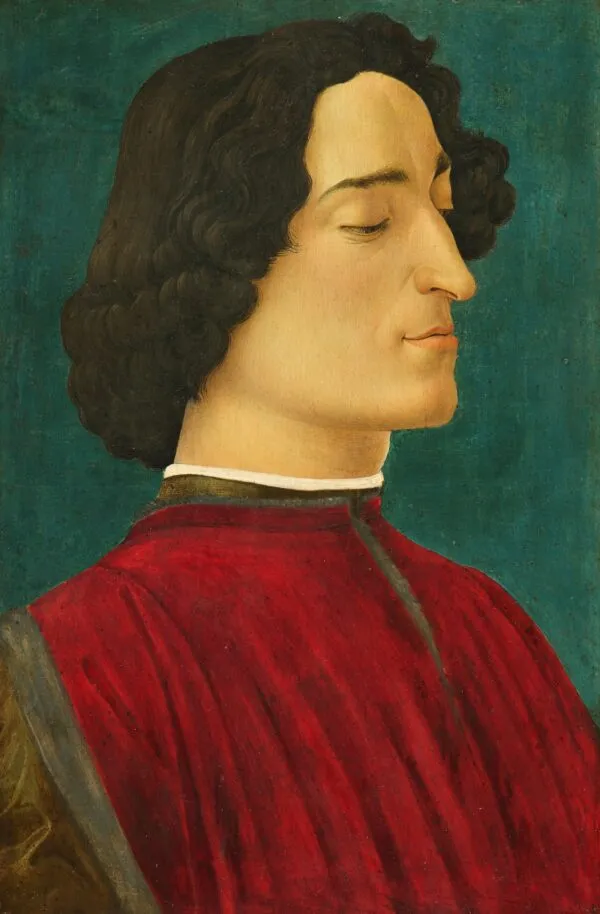
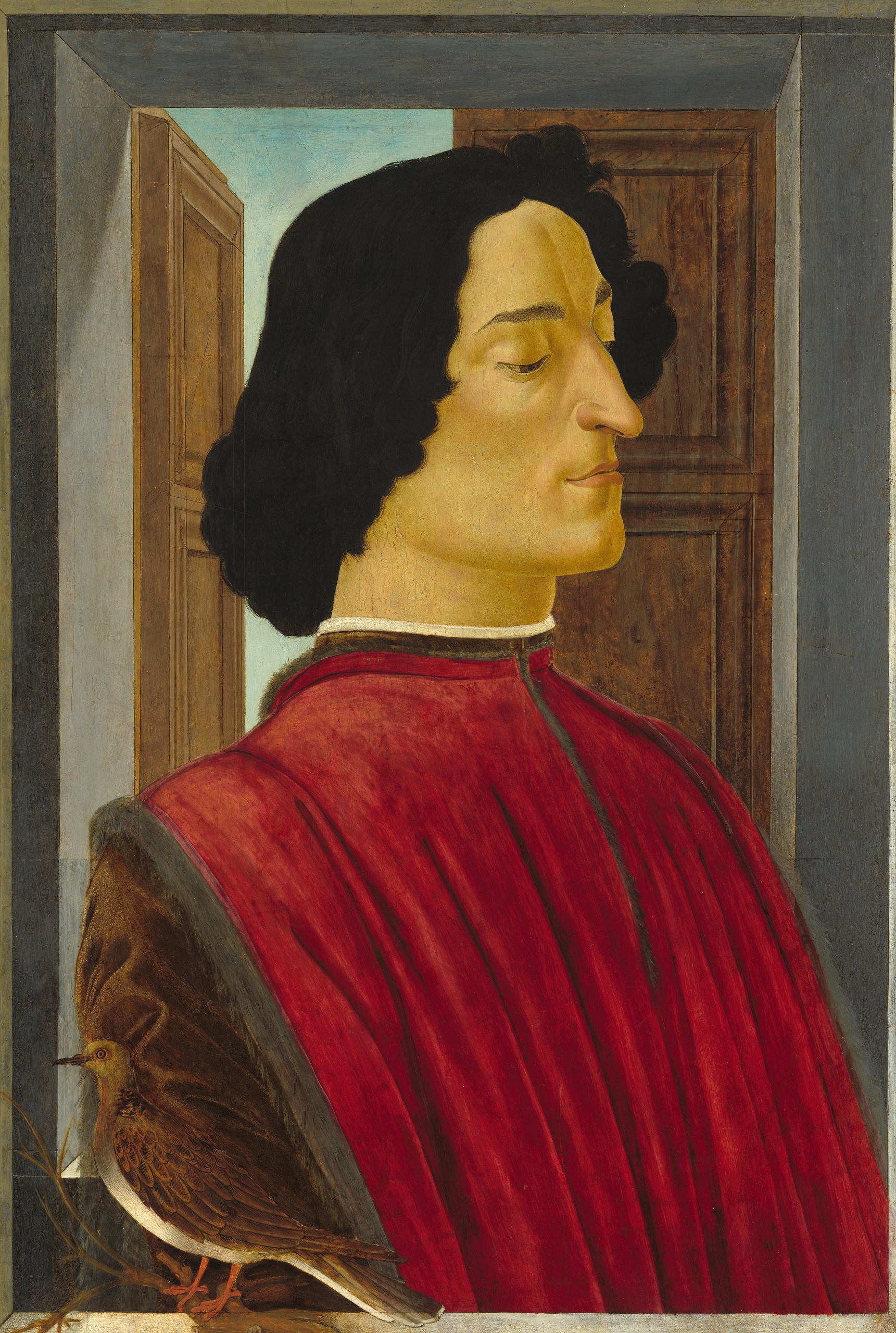
Portrait of Giuliano de’ Medici (Washington) was painted by Sandro Botticelli around 1478, the year the Pazzi conspirators stabbed the younger brother of Lorenzo the Magnificent to death in Florence Cathedral. Giuliano is turned almost into profile, eyes half closed, in a fur-trimmed red tunic; behind him an open shutter shows a pale blue sky, and a turtledove sits on a dead twig. The original, tempera on poplar panel, 75.6 x 52.6 cm, belongs to the National Gallery of Art in Washington. Our painter paints it for you by hand in oil on canvas, in 8 portrait-format sizes from 30 x 45 to 128 x 191 cm or made to measure, and you receive a photograph of the finished portrait before it ships.
| Title: | Portrait of Giuliano de’ Medici (Washington) |
| Other titles: | Ritratto di Giuliano de’ Medici (Italian title) · Porträt des Giuliano de’ Medici (German title) |
| Painter: | Sandro Botticelli (c. 1445–1510) |
| Year painted: | c. 1478 |
| Original size: | 75.6 cm x 52.6 cm (height x width) |
| Original technique: | Tempera on poplar panel |
| Painting style: | Early Renaissance |
| Located at: | National Gallery of Art, Washington, D.C., USA |
| Our reproduction: | Hand-painted in oil on canvas, 8 sizes or made to measure |
Portrait of Giuliano de’ Medici (Washington) – Sandro Botticelli
What does the Washington portrait of Giuliano show?
We look in through a narrow stone frame, as if through a window, at a young man shown to the chest. His head is turned three-quarters to the right, almost into profile, and his raised chin gives him a self-assured, somewhat haughty air.
His hazel eyes are lowered and only half open, unusual in portraits of the time. The skin is pale yellow, a deep crease marks the forehead, the nose is long and pointed, the narrow lips pale pink, and black hair falls in soft waves to the neck. He wears a red velvet tunic trimmed with fur over a brown shirt, as wealthy citizens then did.
Behind him a stone wall frames a window with two wooden shutters: one stands wide open onto a light blue sky, the other stays shut. At the lower left a turtledove sits on a dead twig on the stone ledge, leaning towards the left edge while Giuliano turns right.
What do the turtledove and the half-open window mean?
Giuliano di Piero de’ Medici was the second son of Piero de’ Medici and the younger brother of Lorenzo the Magnificent, who ruled Florence from 1469 to 1492. Handsome, charming and fond of hunting and festivities, he had little appetite for power, and the Florentines loved him.
In April 1478 he was murdered in the Pazzi conspiracy: during Mass in the cathedral Lorenzo escaped, but Giuliano died under many knife wounds.
Because his eyes are lowered in all three versions, the German article allows the reading of a memorial portrait made after the murder. The half-open window would then mark the passage from life to death, or the hope of immortality. The dove is explained through Aristotle: after its mate dies it stays faithful and settles only on dry branches, a sign of mourning and loyalty, perhaps of the loyalty of the Medici supporters too.
If it was painted before 1478, it may instead show him mourning Simonetta Vespucci, his lady at the tournament of 1475, who died in 1476. Who commissioned it is unknown.
Why is this version the most highly regarded?
Botticelli’s portrait of Giuliano survives in three versions: in Washington, Bergamo and Berlin. The Washington one is the largest and, according to the German article, the most important, with the richest space and detail; only this one has the turtledove.
We offer the Berlin version as the painting Portrait of Giuliano de’ Medici, with the same pose against a plain blue-green ground and no window. The smallest is Portrait of Giuliano de’ Medici (Bergamo), with a beige window, a higher sill and no shutters.
The order in which they were made is debated. The prevailing view puts Bergamo first; in Washington Botticelli smoothed the eyelid folds and the shadows under the eyes and turned the head slightly, perhaps to make the face more alive. The German Wikipedia article, written in German, describes all three in detail.
Where is the original today?
The original hangs in the National Gallery of Art in Washington. The collector Samuel H. Kress, who acquired it in 1949, gave it to the museum in 1952.
Earlier owners included Ferdinando I de’ Medici, Grand Duke of Tuscany, and from around 1796 the Tacoli family of Florence and Modena, through whom it passed by marriage to the Bellincini Bagnesi. In 1940 it was sold to the Venetian industrialist Vittorio Cini, who probably sold it around 1948 to the New York gallery of Georges Wildenstein.
This portrait or another Botticelli?
This canvas painting suits anyone who prefers one face and the story behind it to a crowded scene. Its upright format fits a study, a library or a hallway with classic furniture.
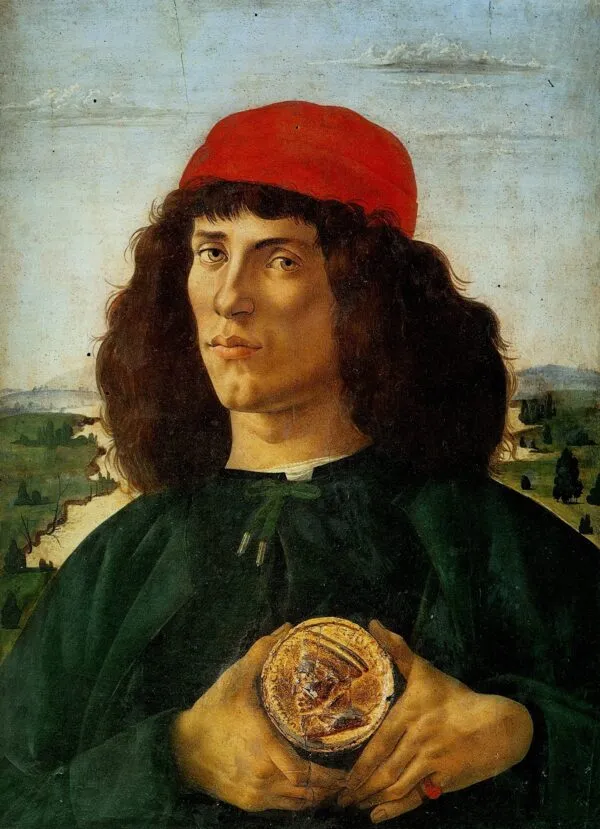
If you like Botticelli’s portraits of men, also look at Portrait of a Man with a Medal of Cosimo the Elder and Portrait of a Young Man Holding a Roundel, two more upright portraits.
You will find everything we paint by this artist on the Sandro Botticelli page, with the famous Botticelli paintings we make to order.
How do we hand-paint the Washington Giuliano?
The original is not an oil painting: Botticelli painted it in tempera on a poplar panel measuring 75.6 x 52.6 cm. Tempera dries quickly, so one layer can follow another almost at once, but that takes great experience.
Our version is painted by hand in oil on canvas, layer by layer, so we can send it rolled, stretched on a stretcher bar or framed. The painter first lays in the stone frame, the window and the shutters, then the line of the profile that carries the whole portrait.
Then come the large areas of red tunic, black hair, grey stone and blue sky, and last the details: the fur trim, the white collar, the dove’s feathers, the dry twig and the grain of the shutters.
Which size suits which wall?
In short: small sizes for a study or hallway, middle ones above a chest of drawers, the largest for a tall living-room wall.
We paint the portrait in 8 portrait-format sizes (width x height): 30 x 45, 40 x 55, 45 x 65, 59 x 81, 72 x 105, 80 x 120, 105 x 145 and 128 x 191 cm. The original measures 52.6 x 75.6 cm (width x height). The first three sizes are smaller than it, 59 x 81 cm is a little larger, and all the rest are much larger than the panel in Washington.
At 45 x 65 cm Giuliano suits a spot beside a bookcase or above a desk. As a painting for the living room he comes into his own from 72 x 105 cm up.
Which frame should you choose, and can you have another size?
We are glad to paint another size. With other proportions Giuliano’s profile and the dove stay whole; we adjust the sky and the stone ledge, and the oil painting reproduction still shows the entire portrait. Send us the size you need for a price and timing.
Stretching on the stretcher bar and framing are done by our workshop in Slovenia, which also packs every painting with care. You choose the frame in our 3D app, which is for choosing the moulding only; seeing the portrait on your own wall is a separate service. A dark wood or gilded frame suits the red tunic.
When will your Giuliano arrive?
The portrait ships 15 to 45 working days after your order is confirmed. Before packing we send you a photograph of the finished work and make any change you ask for.
Giuliano reaches you in Slovenia or any other EU country without customs, and our returns policy covers him too.
It makes a fine gift for someone who loves Florence. Not sure of the size? Give a gift voucher and let them choose.
Frequently asked questions
Where can I see the original?
At the National Gallery of Art in Washington, to which Samuel H. Kress gave it in 1952.
What does the bird at the lower left mean?
It is a turtledove on a dead twig, often read as a sign of mourning and loyalty.
Is it a print?
No. It is a hand-painted copy, made by our painter with a brush in oil on canvas.
How big is the original?
75.6 x 52.6 cm (height x width); our 59 x 81 cm size is a little larger.
Can I order Giuliano in a size outside the list?
Yes. Tell us the width and height, and we will quote the price and timing for your Sandro Botticelli reproduction.
How long will I wait for the portrait, and how does it travel?
Giuliano leaves us 15 to 45 working days after you order, rolled in a tube, stretched or framed.
Is it suitable as a gift or for a bedroom?
Yes. The calm profile and the warm red work well in a bedroom, a library or a study.
How does the Washington version differ from the other two?
It is the largest and the only one with the turtledove on the dead branch and the open shutter.
- Subject: Giuliano de’ Medici in profile with half-closed eyes, in a red tunic, before a window with an open shutter and a turtledove on a dead twig.
- Original: tempera on poplar panel, c. 1478, 75.6 x 52.6 cm, National Gallery of Art, Washington.
- Ours: hand-painted in oil on canvas in 8 sizes from 30 x 45 to 128 x 191 cm or made to measure.
- Worth knowing: it is the largest of the three versions and the only one with the dove.