







































Description
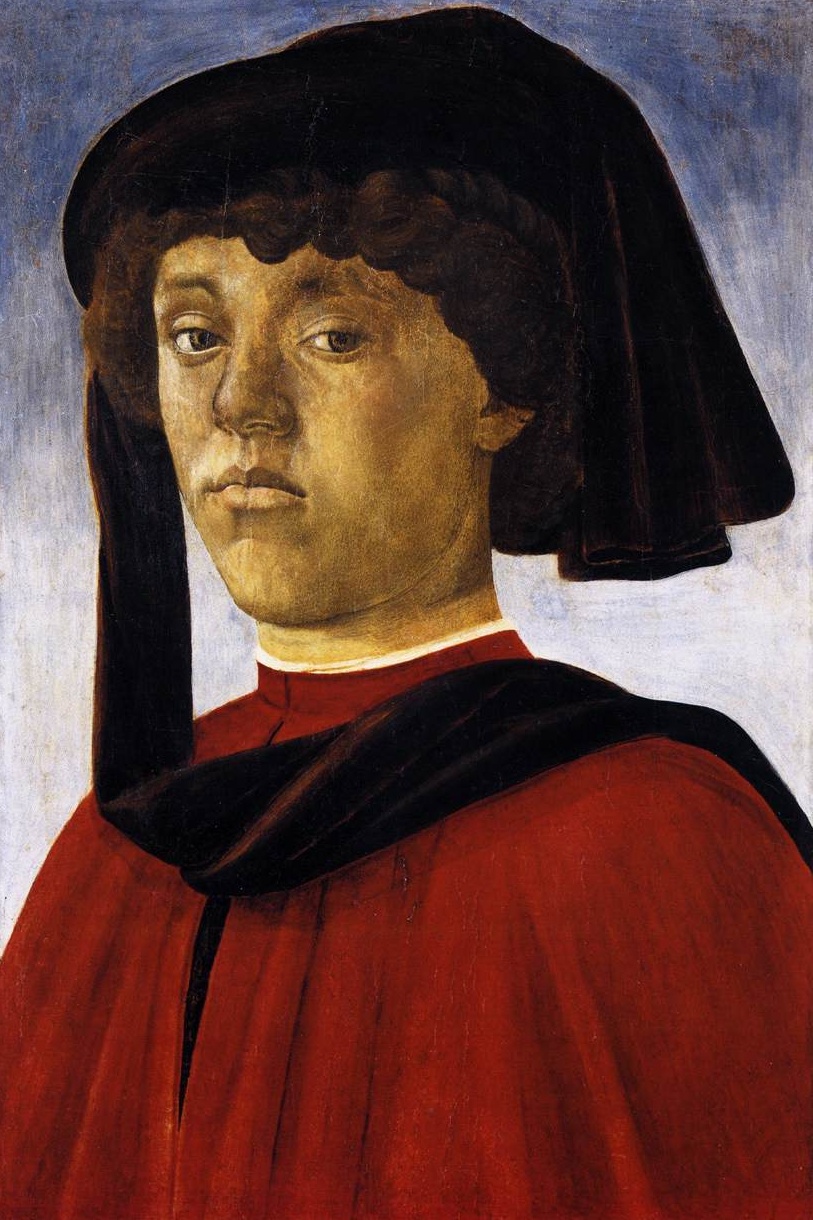
Portrait of a Young Man (Florence) was painted by Sandro Botticelli between 1470 and 1475: a young man with brown curls, in a large black cap whose band of cloth falls over his shoulder and a red coat, turns three quarters to the left and looks us straight in the eye against nothing but a pale blue sky. The original, tempera on panel measuring 51 x 33.7 cm, belongs to the Palatine Gallery of the Palazzo Pitti in Florence. Our painter paints it for you by hand in oil on canvas, in 6 portrait sizes from 29 x 46 to 64 x 95 cm or made to measure. Before the portrait is sent, we email you a photograph of the finished painting.
| Title: | Portrait of a Young Man (Florence) |
| Other titles: | Ritratto di giovane (Italian title) · Portret mladeniča (Firence) (Slovene title) |
| Painter: | Sandro Botticelli (c. 1445–1510) |
| Year painted: | 1470–1475 |
| Original size: | 51 cm x 33.7 cm (height x width) |
| Original technique: | Tempera on panel |
| Painting style: | Early Renaissance |
| Located at: | Palatine Gallery, Palazzo Pitti, Florence, Italy |
| Our reproduction: | Hand-painted in oil on canvas, 6 sizes or made to measure |
Portrait of a Young Man (Florence) – Sandro Botticelli
What does the portrait from the Palazzo Pitti show?
Botticelli paints the young man down to the chest. His shoulders turn to the left, his head a little less, and his eyes come straight back to us. Behind him is only a pale blue, slightly grey sky that lightens towards the bottom.
On his head sits a large black cap that swells softly above the forehead and, on the right, hangs almost to the shoulder. From its left edge a long dark band of cloth drops down, slides across the chest and wraps around the shoulders.
He wears a wide red coat fastened high at the neck, above which a thin white shirt edge shows. The face has large dark eyes, a strong nose, full lips and a round chin, and the skin has a warm olive tone.
Because we see him slightly from below, the young man looks lofty, almost aristocratic. Botticelli does not build depth with soft shading but with a clear, calm line: cap, hair and coat are drawn so firmly that the third dimension nearly disappears.
Who is the young man, and what does the portrait tell us?
The sitter’s name is unknown, and so is the place where the panel first hung. Italian writers have suggested he might be Lorenzo il Popolano, a cousin of Lorenzo de’ Medici, but this remains a guess.
His clothes say more than a name would. The red coat was the dress of a wealthy Florentine citizen, and with it went the cap with the long band falling to the shoulders. His gaze alone carries the tension: he calmly looks us up and down.
Why does this portrait matter so much?
It is one of the first known three-quarter portraits in Western European art, showing the sitter turned at an angle instead of in strict profile. Italian painters took the pose from Flemish painting, and in the second half of the 15th century it began to replace the humanist profile portrait.
To see what came before, look at the Portrait of Giuliano de’ Medici, where the young Medici appears in profile with lowered eyes. The young man in the Palazzo Pitti turns his head and looks at us, which was then something new.
The panel is much darker than Botticelli’s other works, even after it was cleaned in 1935. The painter corrected his drawing several times on the band over the shoulder, changes that scholars count among the signs that the work is his.
A short account of the painting is given in the English Wikipedia article, which is written in English.
Where is the original today?
The original hangs in the Palatine Gallery of the Palazzo Pitti in Florence, where it has been recorded since 1829.
Old inventories listed the portrait as a work by Andrea del Castagno, and it was the art historian Adolfo Venturi who first put forward Botticelli’s name, placing it in the painter’s early years; later scholars confirmed his attribution.
Sandro Botticelli, born Alessandro di Mariano di Vanni Filipepi, came into the world around 1445 in the Ognissanti district of Florence, the son of a tanner. According to Vasari he first trained as a goldsmith and then learned to paint under Filippo Lippi. He died in Florence in 1510.
This portrait or another Botticelli?
This canvas painting is the right choice if you prefer a single face with a strong gaze to a scene with many figures. Its few colours, red, black and pale blue, suit almost any room.
Botticelli painted a second unknown young man. The Portrait of a Young Man (London) in the National Gallery is smaller; its sitter faces us full on and wears a small red cap. The Florence sitter, by contrast, is turned three quarters and wears a black cap and a red coat.
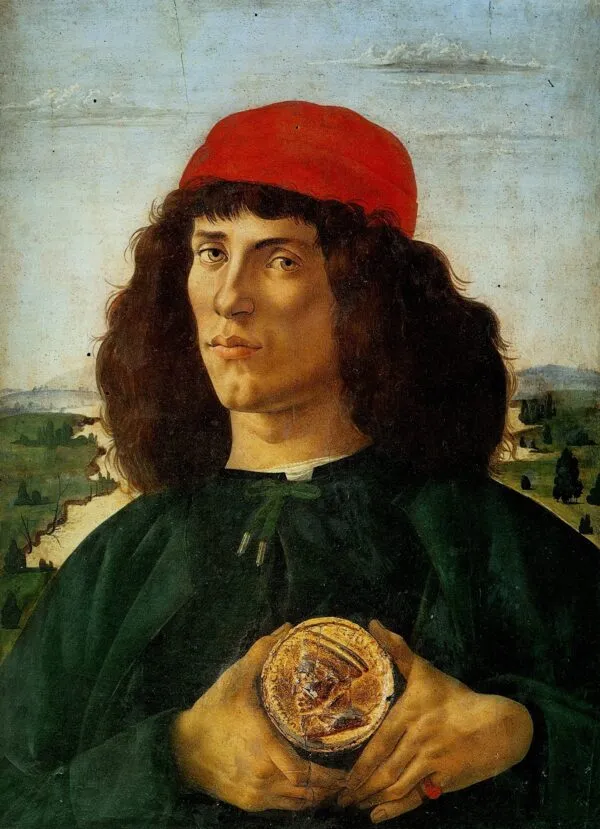
Among the famous Botticelli paintings we paint to order there are other male portraits too. The man in the Portrait of a Man with a Medal of Cosimo the Elder holds a large gold medal in both hands, while the Portrait of a Young Man Holding a Roundel shows a youth with a small round medallion bearing a bearded saint.
The whole range, with Madonnas, mythologies and portraits, is gathered on the Sandro Botticelli page.
How do we hand-paint this portrait?
The original is not an oil painting: Botticelli painted it in tempera on a wooden panel of 51 x 33.7 cm. Our painter recreates it in oil paint on canvas, layer upon layer, so the portrait can travel rolled, stretched on a stretcher bar or framed.
Since drawing is almost everything here, the painter first traces head, cap, band and shoulders with a fine line, then lays in the sky and the red coat. The dark cap follows, every fold kept distinct, then the curls, and last the face, whose eyes must meet yours as directly as in Florence.
The result is an oil painting reproduction that keeps the serious, darker tone of the original and its sharp outline.
Which size works on which wall?
In short: small sizes for a shelf or narrow wall, middle ones for a bedroom or study, the largest for the living room.
We paint the portrait in 6 portrait sizes (width x height): 29 x 46, 38 x 55, 42 x 65, 48 x 75, 57 x 82 and 64 x 95 cm. The original measures 33.7 x 51 cm (width x height). The 29 x 46 cm size is a little smaller, 38 x 55 cm comes very close to it, and every size from 42 x 65 cm upwards is larger than the panel in Florence.
As a painting for the living room it works best at 57 x 82 or 64 x 95 cm, where the curls and coat folds read from the sofa.
Can I have another size, and which frame suits it?
Yes. The background is an even sky, so for other proportions we widen or narrow it and the young man stays whole. A Sandro Botticelli reproduction in your own size thus keeps the full structure of the portrait; just send us your custom size for a quote.
It ships rolled in a tube, or stretched and framed by our workshop in Slovenia. The moulding for the young Florentine is picked in our 3D app, while a view of the painting on your own wall is a separate service.
When will your Portrait of a Young Man arrive?
Our painter needs 15 to 45 working days from your order confirmation until the young man is ready to leave. Before dispatch you receive a photograph of the finished painting, and if you would like anything changed, we do it before packing.
No customs apply to this portrait inside Slovenia or anywhere else in the EU, and our returns policy covers every order.
A calm, composed face makes a fine gift for anyone who loves Florence and the Renaissance. If you do not know the recipient’s walls, a gift voucher lets them choose painting and size.
Frequently asked questions
Where does the original of the portrait hang?
In the Palatine Gallery of the Palazzo Pitti, Florence.
Who is the young man in the painting?
His name is unknown; one suggestion links him to Lorenzo il Popolano, a cousin of Lorenzo de’ Medici.
Is this a print?
No, it is a hand-painted copy: our painter puts the curls, folds and gaze on the canvas with a brush.
How big is the original?
51 x 33.7 cm (height x width); our 38 x 55 cm size comes very close to it.
Can the Pitti young man be painted in a size off the list?
Yes, we adapt the background sky to your width and height and quote you.
How long until the portrait ships, and how is it packed?
15 to 45 working days until dispatch; the portrait arrives rolled, stretched or framed.
Is it suitable for a bedroom or a study?
Yes. A single face in restrained colours suits quiet rooms.
Why is the young man turned three quarters?
The pose came to Italy from Flemish painting; this portrait is among the first of its kind in Western Europe.
- Subject: a young man in a black cap and red coat, turned three quarters, before a pale blue sky.
- Original: tempera on panel, 1470–1475, 51 x 33.7 cm, Palatine Gallery, Palazzo Pitti, Florence.
- Our painting: hand-painted in oil on canvas, 6 sizes from 29 x 46 to 64 x 95 cm or made to measure.
- Good to know: old inventories gave it to Andrea del Castagno; Adolfo Venturi was the first to name Botticelli.