







































Description
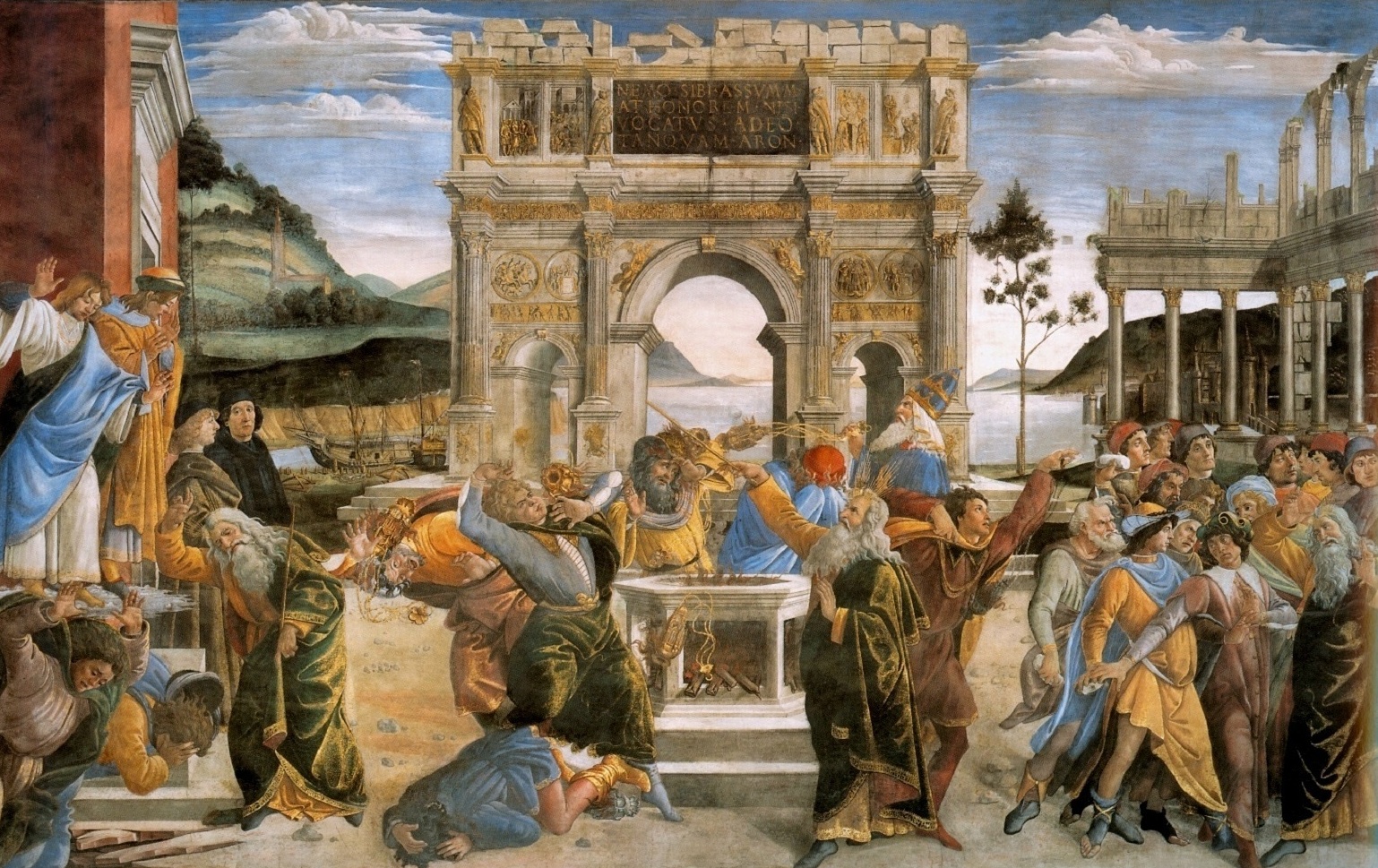
The Punishment of the Rebels is the fresco Sandro Botticelli painted in 1481–1482 on a wall of the Sistine Chapel in the Vatican: before a great triumphal arch modelled on the Arch of Constantine, Moses punishes Korah, Dathan and Abiram, who had challenged his authority and that of Aaron. The original measures 348.5 x 570 cm. Our painter hand-paints it in oil on canvas in 3 landscape sizes from 90 x 55 to 116 x 68 cm, or to your size. Before your painting is dispatched, we send you a photograph of it.
| Title: | The Punishment of the Rebels |
| Other titles: | Punizione dei ribelli (Italian title) · Punishment of the Sons of Korah |
| Painter: | Sandro Botticelli (c. 1445–1510) |
| Year painted: | 1481–1482 |
| Original size: | 348.5 cm x 570 cm (height x width) |
| Original technique: | Fresco |
| Painting style: | Early Renaissance |
| Located at: | Sistine Chapel, Vatican City, Rome |
| Our reproduction: | Hand-painted in oil on canvas, 3 sizes or made to measure |
The Punishment of the Rebels – Sandro Botticelli
What does The Punishment of the Rebels show?
The scene is set in a wide square under a blue sky. In the middle stands a three-opening arch with gilded reliefs and a Latin inscription on a dark panel. A ruined colonnade rises on the right, a reddish wall on the left, and between them lies water with ships.
In front of the arch stands an eight-sided altar with a fire burning inside it. Behind it the high priest, in a blue robe and the papal tiara, swings a censer. Men with golden censers are thrown backwards. Before the altar Moses, white-bearded in an olive-green cloak, points at the rebels.
On the right a crowd of men in colourful clothes and caps presses together. Some raise their arms as if to throw stones; a younger man steps in front of the old man at the far right.
On the left Moses, rod in hand, appears once more as judge. The ground opens and the rebels sink into it; above them two young men are spared.
What story does the fresco tell?
The story comes from the Book of Numbers, chapter 16. On the journey out of Egypt, Korah, Dathan and Abiram rise against Moses and Aaron and deny their authority over the people. They offer incense without being called to do so, and God punishes them.
Botticelli joins three events in one scene, read from right to left. On the right the rebels try to stone Moses, and Joshua places himself between them. In the centre divine fire scatters the priests. On the left the earth swallows the leaders, while the sons of Korah are spared.
The scene belongs to a cycle in which the walls of the chapel set the life of Moses beside the life of Christ, as a sign of continuity between the Old and the New Testament.
The fresco is often read as a warning that no one should doubt the authority of the pope over the Church, which was constantly being questioned at the time. That is why Aaron wears the papal tiara, and the opposite wall shows the Delivery of the Keys to Saint Peter.
Why is the fresco so well known?
It is one of the three frescoes Botticelli painted, helped by numerous assistants, in the Sistine Chapel for Pope Sixtus IV.
The arch in the background is modelled closely on the Arch of Constantine in Rome, a late antique monument. Instead of the real inscription it carries a warning from Scripture.
The painters of the chapel agreed on a common scale, rhythm and landscape, and they added gold so that the walls would shine by torchlight and candlelight.
The liveliest passages are the twisting priests at the altar. English Wikipedia describes the work under the title Punishment of the Sons of Korah; its article in English explains the inscription.
Where is the original today?
The original has stayed where it was made, on the wall of the Sistine Chapel in the Vatican. You can only see it there.
On 27 October 1480 Botticelli left for Rome with other Florentine painters. The journey was part of a reconciliation between Lorenzo de’ Medici and Pope Sixtus IV. The Florentines were at work in the chapel by the spring of 1481.
Botticelli painted three scenes. On 17 February 1482 his contract was renewed for further scenes, but three days later his father died. He went home to Florence.
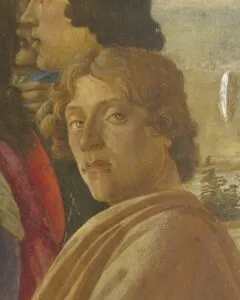
The painter was born Alessandro di Mariano di Vanni Filipepi in Florence around 1445, the son of a tanner, and trained with Filippo Lippi. He died on 17 May 1510.
The Punishment of the Rebels or another Botticelli?
The Punishment of the Rebels is a canvas painting for anyone who loves large narrative scenes, ancient architecture and Bible stories. Its wide format suits the wall above a sofa.
Botticelli painted two more frescoes in the chapel. The painting The Trials of Moses tells of Moses as a young man in a green landscape, and the painting The Temptations of Christ shows the devil and Christ above a crowd in front of a temple.
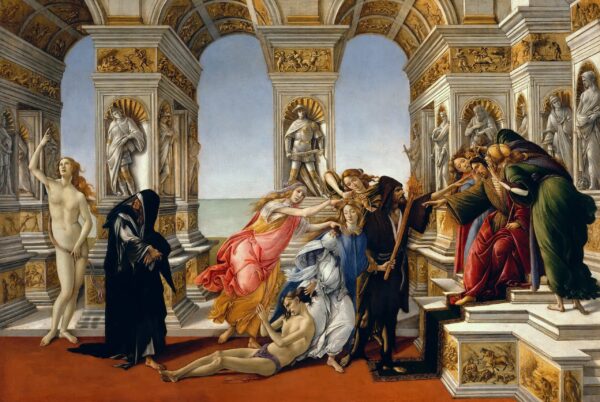
If a stern lesson in an ancient setting appeals to you, look at the Calumny of Apelles, with its allegories in a marble hall, or at the Portrait of Giuliano de’ Medici, a profile of the younger brother of Lorenzo de’ Medici.
All the other famous Botticelli paintings we paint to order are gathered on the Sandro Botticelli page.
How do we hand-paint The Punishment of the Rebels?
The original is a fresco, not a work on canvas: Botticelli laid the colours into the fresh plaster of the chapel wall, and the scene measures 348.5 x 570 cm. Ours is an oil painting reproduction, hand-painted in oil on canvas layer by layer, so it can travel rolled, stretched on a stretcher bar or framed.
Our sizes are all far smaller, so the painter copies the whole scene as the photograph shows it, not a detail.
First he draws the architecture and places the groups, then lays in the sky, the water and the square. Robes, faces, beards and hands follow. Last come the gold lights on the censers, reliefs and hems, and the letters of the inscription.
Which size for which wall?
In short: 90 x 55 cm for a hallway or above a desk, 100 x 63 cm above a chest of drawers or a bed, 116 x 68 cm for the wall above the sofa.
We paint The Punishment of the Rebels in 3 landscape sizes (width x height): 90 x 55, 100 x 63 and 116 x 68 cm. The fresco in the Vatican measures about 570 x 348.5 cm (width x height), so all our sizes are far smaller.
At 90 x 55 cm it suits a narrow wall or a study. As a painting for the living room it works best at 100 x 63 or 116 x 68 cm, where you can read the inscription from the armchair.
Can I order another size, and which frame should I choose?
Yes. For different proportions we keep the arch and all three groups whole and adjust the sky, the square or the buildings at the edges, so even then this Sandro Botticelli reproduction tells the whole story. Send us your custom size and we will reply with the price and the time it takes.
It travels rolled in a tube, stretched or already framed. Our workshop in Slovenia takes care of the stretcher bar and the frame, and packs every painting carefully. The moulding is chosen in our 3D app; a view on your own wall is a separate service.
When will your Punishment of the Rebels arrive?
Your painting is ready to ship 15 to 45 working days after we confirm the order. When it is finished we send you a photograph, and any change you ask for is made before packing.
It travels within Slovenia and to other EU countries without customs, and every purchase is covered by our returns policy.
For lovers of Rome or the Bible it is a fine gift; if you do not know their wall, give a gift voucher and let them choose the painting and the size.
Frequently asked questions
Where can I see the original fresco?
In the Sistine Chapel in the Vatican, on its own wall.
Who is the man in the tiara beside the altar?
He is Aaron, the brother of Moses and high priest; Botticelli gave him the papal tiara.
Is this a print or a photo on canvas?
No. It is a hand-painted copy: our painter paints every figure, stone and gold light with a brush.
How big is the fresco?
About 348.5 x 570 cm (height x width); our largest size, 116 x 68 cm, is far smaller.
Can I have the fresco in a size that is not on the list?
Yes. Tell us the width and height and we will send the price and time.
How long does it take and how is it delivered?
15 to 45 working days until dispatch; rolled, stretched on a stretcher bar or framed.
Does it suit a study or a library?
Yes. Its architecture and calm greens and golds sit well with bookshelves.
What does the inscription on the arch mean?
It follows Hebrews 5:4: no one takes the honour of the priesthood for himself, but only he who is called by God, as Aaron was.
- Subject: Moses and Aaron before an arch modelled on the Arch of Constantine, rebels with censers at the altar and the ground opening beneath the leaders.
- Original: fresco, 1481–1482, 348.5 x 570 cm, Sistine Chapel, Vatican.
- Our painting: hand-painted in oil on canvas, 3 landscape sizes from 90 x 55 to 116 x 68 cm or made to measure.
- Good to know: the scene reads from right to left.