







































Description
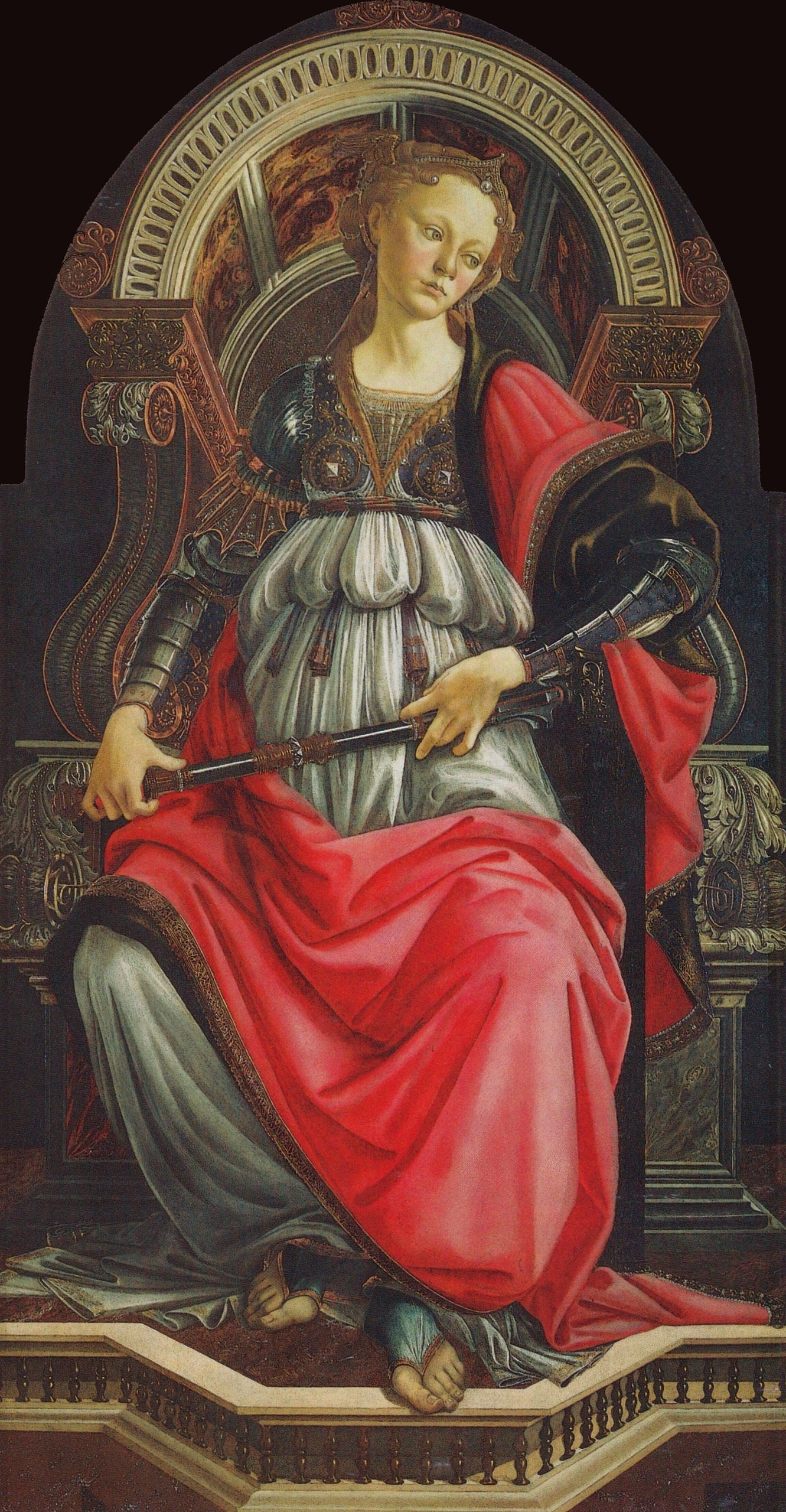
Fortitude is the painting Sandro Botticelli finished in 1470 as one of seven Virtues for the tribunal hall of the Mercanzia, the merchants’ court of Florence: a young woman in armour, wrapped in a red cloak, sits on a carved marble throne beneath a round arch and holds a long baton across her lap. It is his first recorded public work. The original, tempera on a poplar panel 167 cm high and 87 cm wide, hangs in the Uffizi Gallery in Florence. Our painter paints it by hand in oil on canvas, in 6 portrait sizes from 40 x 75 to 100 x 195 cm or made to measure. Before Fortitude leaves our workshop, we send you a photograph of the finished painting.
| Title: | Fortitude |
| Other titles: | Fortezza (Italian title) · Trdnost (Slovene title) |
| Painter: | Sandro Botticelli (c. 1445–1510) |
| Year painted: | 1470 |
| Original size: | 167 cm x 87 cm (height x width) |
| Original technique: | Tempera on poplar panel |
| Painting style: | Early Renaissance |
| Located at: | Uffizi Gallery, Florence, Italy, inv. 1890 no. 1606 |
| Our reproduction: | Hand-painted in oil on canvas, 6 sizes or made to measure |
Fortitude – Sandro Botticelli
What does Fortitude show?
A young woman with fair, softly curling hair sits at the centre, a pearl diadem set in her hair. Her gaze slips down and to the side, past us, and her pale face is the brightest point of the panel.
Over a white dress gathered below the bust she wears metal armour: a dark breastplate with round bosses and guards on both arms. With both hands she holds a dark baton with a decorated grip across her knees. Her red cloak has slipped from one shoulder and falls in broad folds down to the step.
The throne is carved stone, dressed with scrolls, acanthus leaves and rosettes. Above her head curves an arch ringed with oval openings; behind her back run slabs of red-veined marble. Below runs an angled platform with a low balustrade.
The top of the original panel is arched, which is why both upper corners in the photograph are dark.
What does the woman in armour stand for?
To a fifteenth-century audience the Virtues joined philosophical and religious ideas. In the Renaissance such personifications regained a classical, idealised form.
Virtue was often shown as a woman sitting or standing on a rectangular block, to stress her stability, and that is exactly how Botticelli paints her. Yet her body turns slightly: one arm carries the weight of her upper body and one foot is set a little forward, as if about to rise.
Soft drapery against hard metal plays femininity against masculinity. The red of her cloak can be read as a sign of the strength that overcomes hardship.
Oddly for a figure of courage, she does not look warlike. Her expression is reserved, almost absent, as so often with Botticelli’s women. Some readers see the faint bluish shadow under her eyes as a hint that she has already known misfortune.
Why is the painting so famous?
Fortitude is held to be Sandro Botticelli’s first recorded masterpiece. He was about twenty-five when he finished it.
The commission was a prestigious one. The Mercanzia settled business disputes between Florentine merchants and carried great weight in the city’s economy, so many painters wanted the job.
The other six Virtues came from the workshop of Piero del Pollaiuolo, who protested against Botticelli’s involvement, which limited the young painter to this single figure. He had the backing of Tommaso Soderini, one of the Mercanzia commissioners, after which the painters’ guild amended its statutes against outside interference.
The woman may be Lucrezia Donati, though this remains a suggestion. The Wikipedia article on Fortitude, written in English, covers the commission in more detail.
Where is the original today?
Fortitude belongs to the Uffizi Gallery in Florence, where it carries inventory number 1890 no. 1606. The cycle moved there after the court’s heritage passed to the Chamber of Commerce in 1777.
The same museum holds the rest of the set from Pollaiuolo’s workshop: Charity, Faith, Temperance, Prudence, Hope and Justice. Those are painted on cypress; Botticelli’s panel is poplar, the more usual wood in Tuscany.
The panels hung high, above eye level. Fortitude came first in the line of seven; perhaps that is why her gaze seems to watch over the other Virtues.
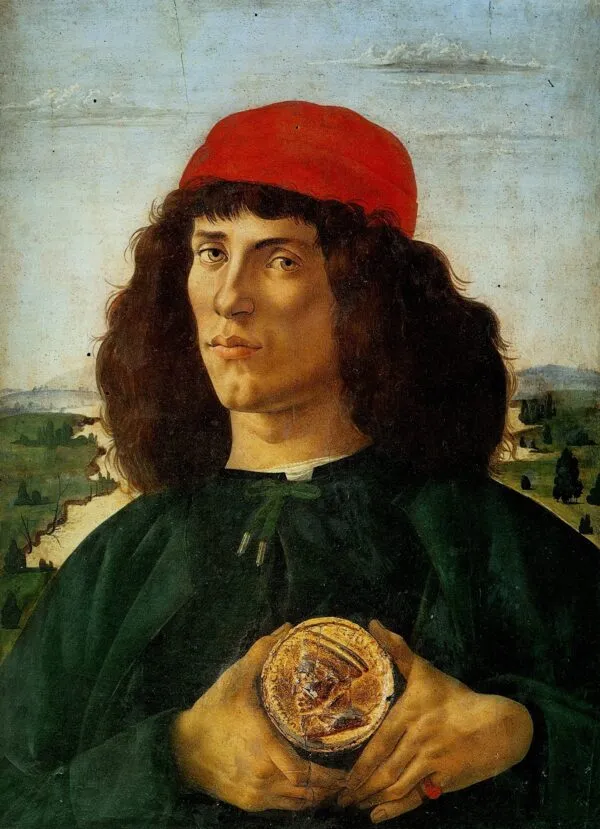
Botticelli, born Alessandro di Mariano di Vanni Filipepi around 1445, spent his whole life in the Ognissanti quarter of Florence. He trained with Filippo Lippi, and the Medici were among his patrons. Around 1474–1475 he painted the Portrait of a Man with a Medal of Cosimo the Elder, which is also in the Uffizi.
Fortitude or another Botticelli?
Fortitude is a canvas painting for anyone who prefers one calm, dignified figure to a crowded scene. Almost twice as tall as it is wide, it suits a narrow wall or the space between two windows.
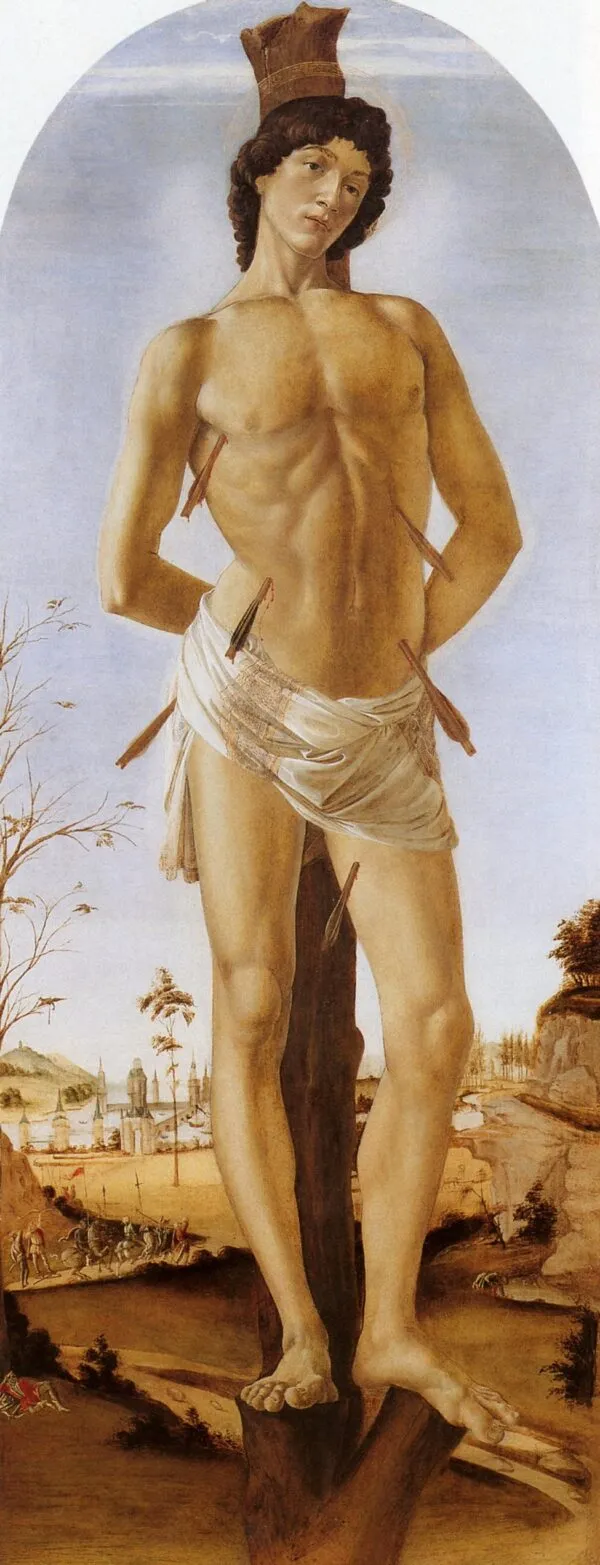
If an armed woman appeals to you, look at Pallas and the Centaur, where the goddess holds the centaur by his hair. Saint Sebastian shares the tall, arch-topped format; it is four years later and also on poplar. For a young, composed face in profile, see the Portrait of Giuliano de’ Medici.
More famous Botticelli paintings, from mythologies to Madonnas and portraits, are on our Sandro Botticelli page.
How do we hand-paint Fortitude?
Botticelli’s original is not an oil painting. It is tempera, pigment bound with egg yolk, on a poplar panel measuring 167 x 87 cm. Ours is a Sandro Botticelli reproduction in oil on canvas, built up layer by layer, so it can be rolled, stretched on a stretcher bar or framed.
The original panel is arched at the top. We paint the rectangle the photograph shows, with the two dark corners above the arch.
The painter first lays in the throne, the arch with its oval openings and the platform with its balustrade, then places the figure. Next come the large areas of colour: red cloak, white dress, dark metal and reddish marble.
Last come the face, the pearls of the diadem, the gold hems and the carved foliage of the throne.
Which size suits which wall?
In short: small sizes for a narrow wall, middle ones beside a door, the largest for a tall living-room wall.
We paint Fortitude in 6 portrait sizes (width x height): 40 x 75, 46 x 84, 60 x 110, 70 x 130, 80 x 150 and 100 x 195 cm. The original measures 87 x 167 cm (width x height). Every size up to 80 x 150 cm is therefore smaller, and 100 x 195 cm is a little larger than the panel in Florence.
40 x 75 and 46 x 84 cm suit a pier between windows, a bedroom or an entrance hall. From 60 x 110 cm up she fills a corridor wall, and as a painting for the living room she comes into her own at 80 x 150 or 100 x 195 cm.
Can I have another size, and which frame suits it?
Yes. For other proportions we keep the figure and the throne whole and adjust only the dark ground at the edges or the platform below, so you still get a complete oil painting reproduction. Send us your own measurements and we will price Fortitude and give you a delivery date.
Fortitude can reach you rolled in a tube, stretched on a stretcher bar or ready framed. Our workshop in Slovenia does the stretching and framing and packs the canvas carefully for the journey.
In our 3D app you compare mouldings and choose the frame; viewing the painting on your own wall is a separate service. A gilded frame flatters the red cloak.
When will your Fortitude arrive?
Fortitude is ready to ship 15 to 45 working days after you confirm the order. When it is finished, we send you a photograph and make any changes before packing.
Within Slovenia and the rest of the European Union there are no customs duties, and our returns policy applies to every order.
A figure of courage and constancy makes a thoughtful gift for someone starting a new chapter. If you do not know their walls, give a gift voucher and let them pick the painting and the size.
Frequently asked questions
Where does the original of Fortitude hang?
In Florence, at the Uffizi Gallery, where its inventory number is 1890 no. 1606.
What is the woman holding?
A dark baton with a decorated grip, laid across her lap.
Is it a print?
No. It is a hand-painted copy; our painter makes every brushstroke in oil paint.
How large is the original?
167 x 87 cm (height x width); our 100 x 195 cm size is a little larger.
Can you paint Fortitude in a size that is not on the list?
Yes. Write to us with the width and height you want; we will quote.
How long does Fortitude take to paint, and how is it sent?
15 to 45 working days until dispatch, sent rolled, stretched or framed.
Will Fortitude suit a bedroom or a study?
Yes. The calm figure and warm red sit well beside a desk, in a bedroom or in a hallway.
Who modelled for the woman?
Nobody knows for certain; one suggestion is Lucrezia Donati.
- Subject: a young woman in armour and a red cloak on a marble throne beneath an arch, a baton across her lap.
- Original: tempera on poplar panel, 1470, 167 x 87 cm, Uffizi Gallery, Florence.
- Ours: hand-painted in oil on canvas, 6 sizes from 40 x 75 to 100 x 195 cm, or made to measure.
- Worth knowing: it is the only one of the cycle’s seven Virtues that Botticelli painted, and his first recorded public work.