



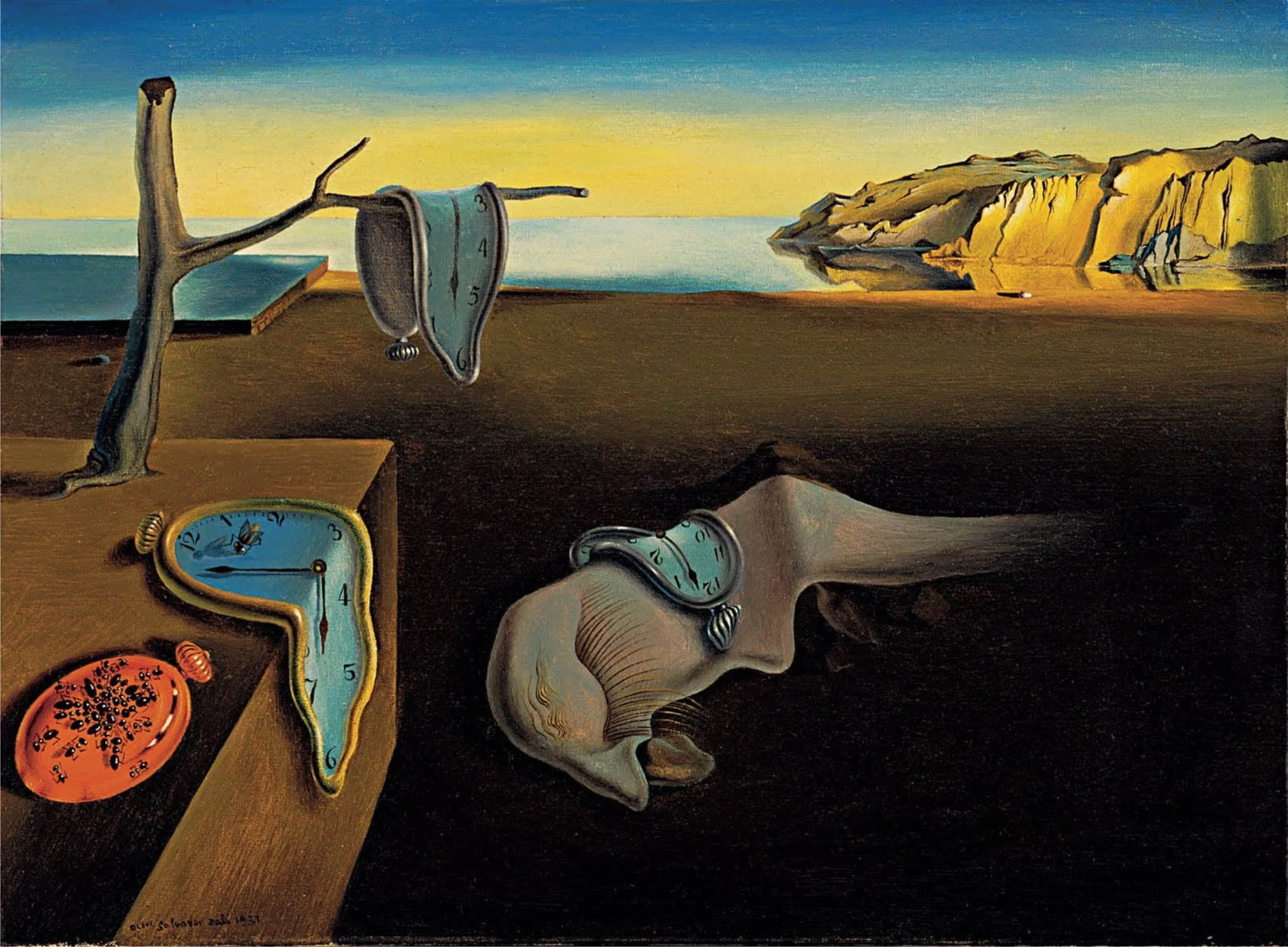
The Persistence of Memory (Spanish La persistencia de la memoria) is Salvador Dalí’s best-known painting and an icon of Surrealism. The melting clocks on a deserted shore have become a universal emblem of time slipping away. Read on to learn where the original hangs, what the soft watches meant to Dalí and how a hand-painted reproduction of The Persistence of Memory on canvas is made. We have also placed The Persistence of Memory on our list of the most famous paintings of all time.
Where is the original? In New York – and smaller than you think
The original hangs in the Museum of Modern Art (MoMA) in New York, which received it as an anonymous gift back in 1934. The most surprising thing is its scale: the painting measures only 24 × 33 centimetres – barely more than a sheet of A4 paper. That is exactly why so many people choose a reproduction in a larger format for their home, one that gives the motif the space it deserves on the wall.
The story: Camembert and the Catalan coast
Dalí painted it in 1931, at just 27. By his own account, the soft watches were inspired by the remains of a very ripe Camembert melting on the table after dinner. The coast in the background is not invented: these are the rocks of Cap de Creus near Port Lligat in Catalonia, where Dalí lived and which appear in many of his paintings. Dalí’s life and his surrealist years are covered in our profile of Salvador Dalí.
Meaning: time that melts, and ants that devour
Hard pocket watches – a symbol of precision and order – melt like cheese: in dreams and in memory time is not rigid but soft and elastic. Ants swarm over the single watch that does not melt, the orange one, Dalí’s constant sign of decay and passing. Surrealism achieves its purpose here: a vision you cannot forget, even though it cannot be fully explained.
Is there a sequel to the painting?
Yes – Dalí returned to the motif in 1952–1954 with The Disintegration of the Persistence of Memory: the scene is flooded, the landscape floats above the surface of the water, and the original elements break apart into rectangular blocks drifting in space. That version hangs in the Dalí Museum in St. Petersburg, Florida.
How a hand-painted reproduction is made
Our painter paints the reproduction in oils on canvas – with the smooth, almost invisible strokes with which Dalí achieved his famous “hand-painted dream photographs”, and with precise transitions of light on the shore and in the sky – with a depth that print cannot achieve. Because the original is so small, only a reproduction in a larger format truly opens the motif up. We stretch the painting on a stretcher frame, and you choose the frame in the 3D preview on the product page.
Frequently asked questions
Where does the original of The Persistence of Memory hang?
In the Museum of Modern Art (MoMA) in New York, since 1934.
How big is the painting really?
Surprisingly small: 24 × 33 centimetres, barely more than a sheet of A4. That is why a reproduction on canvas is often ordered in a larger format.
What do the melting clocks mean?
By Dalí’s own account they were inspired by a melting Camembert. In meaning they portray time that is not rigid in dreams and memory – it flows, stretches and slips away.
Can I buy a hand-painted reproduction of this painting?
Yes, in our online gallery you can order a hand-painted reproduction of The Persistence of Memory on canvas in the size of your choice.Before delivery you receive a photo of the painting for approval – on request we adjust it (colours, details) and ship only once you approve.