







































Description
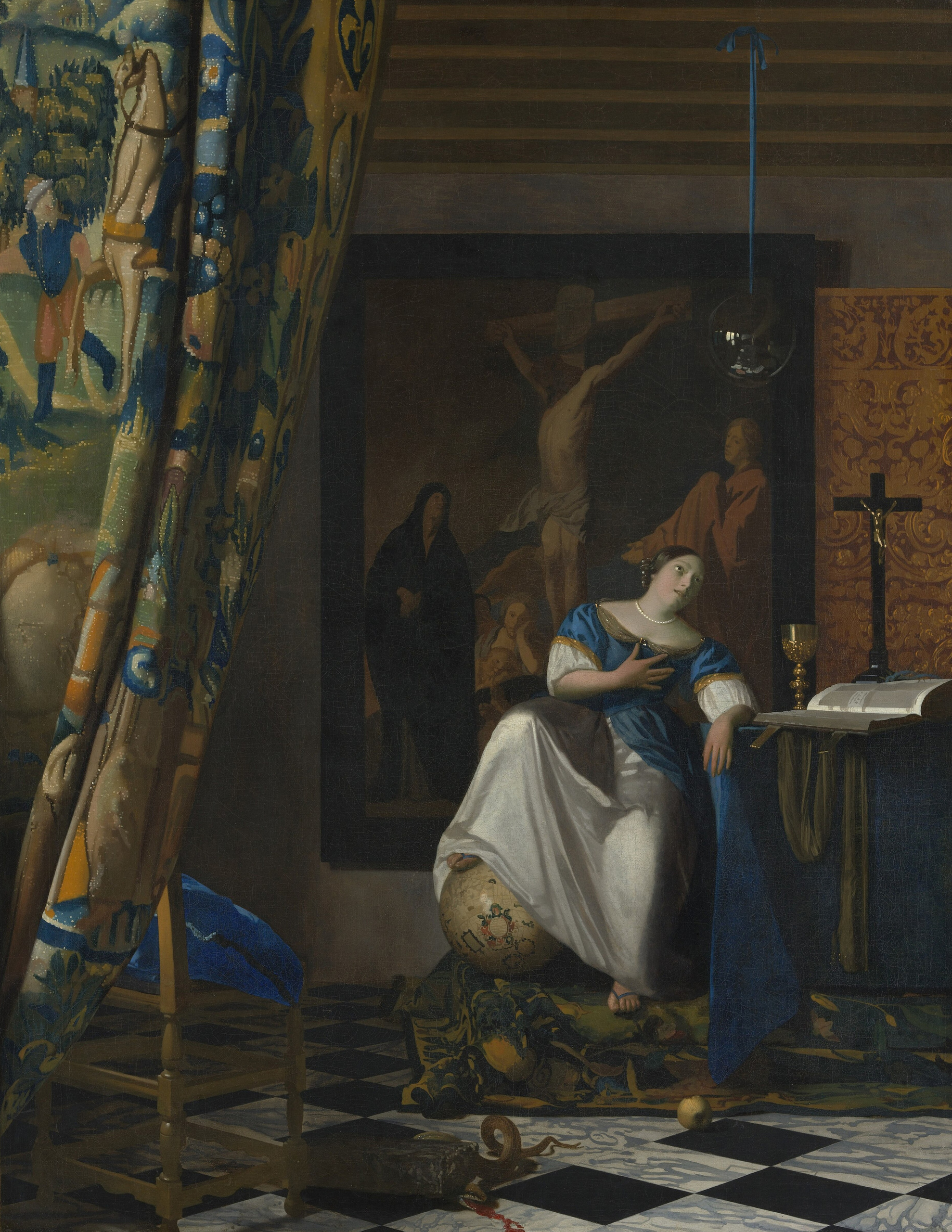
Allegory of the Catholic Faith is a painting by Johannes Vermeer from about 1670–1672: a woman in white and blue satin, the personification of Faith, sits on a raised platform with her right foot on a terrestrial globe and her hand on her heart, gazing up at a glass sphere that hangs from the ceiling. The original, oil on canvas, is 114.3 cm high and 88.9 cm wide and has belonged to the Metropolitan Museum of Art in New York since 1931. Our painter paints it by hand to order in oils on canvas, in one of 8 portrait sizes from 40 x 49 to 142 x 190 cm or made to measure, and before dispatch we send you a photograph of the finished painting.
| Title: | Allegory of the Catholic Faith |
| Other titles: | The Allegory of Faith · Allegorie op het geloof |
| Painter: | Johannes Vermeer (1632–1675) |
| Year painted: | c. 1670–1672 |
| Original size: | 114.3 cm x 88.9 cm (height x width) |
| Original technique: | Oil on canvas |
| Painting style: | Baroque, Dutch Golden Age |
| Located at: | The Metropolitan Museum of Art, New York (acc. no. 32.100.18) |
| Our reproduction: | Hand-painted oil on canvas, 8 sizes or made to measure |
Allegory of the Catholic Faith – Johannes Vermeer
What does Allegory of the Catholic Faith show?
The setting is a typical Vermeer room: a black and white marble floor and a heavy fabric pulled aside on the left. The woman sits on a platform one step above the floor, in a fine white and blue satin dress with gold trimmings, a pearl necklace at her throat.
Her right foot rests on a terrestrial globe and her right hand on her heart, and she looks up adoringly at a glass sphere hung from the ceiling on a blue ribbon.
Her left arm rests on a table with a gold chalice, a large book topped by a crown of thorns and a dark-wood crucifix set against a gilt-leather screen.
On the dim back wall hangs a large painting of Christ on the Cross. In the foreground lie an apple and a snake squashed by a cornerstone, and at the left a multicoloured woven hanging is drawn back at the bottom.
What do the symbols in the painting mean?
Most of the symbols come from Cesare Ripa’s Iconologia, an emblem book translated into Dutch in 1644 by D. P. Pers. Ripa dresses Faith in white, for light and purity, and in blue, which he links to heaven.
In Ripa, the hand on the breast shows that the virtue lives in the heart. The cornerstone crushing the snake stands for Christ, the snake for the Devil, and the apple Eve gave to Adam for original sin. Ripa says Faith has the world under her feet, and Vermeer took him literally: the globe has been identified as one made by Hendrick Hondius.
The glass sphere, the crucifix and the Crucifixion are Vermeer’s additions. According to Eddy de Jongh, the sphere probably comes from a 1636 emblem book by the Jesuit Willem Hesius, which likens its reflection of the world to the mind’s power to believe in God.
Ripa’s Faith holds the chalice and book; Vermeer moved them to the table, which Arthur K. Wheelock Jr. reads as Eucharistic and Selena Cant as the Catholic Mass. The painting on the back wall follows a Crucifixion by Jacob Jordaens from about 1620.
Why does this painting stand apart in Vermeer’s work?
Together with The Art of Painting, this is Vermeer’s only history painting in the ranking of genres of his day. The two share almost the same perspective and a colourful woven hanging at the left, pulled aside like a curtain.
Many art historians count it among his less successful works, finding the ecstatic pose and the crushed snake out of place in a Dutch room. Walter Liedtke defends its realistic globe and reflections; since the light on her dress has no source, he reads the woman as a symbol, not a real person.
Its iconography and reception are covered in the Wikipedia article (in English).
Where is the original of Allegory of the Catholic Faith?
The original is in New York, at the Metropolitan Museum of Art, which has owned it since 1931 under accession number 32.100.18.
Its first owner is unknown: perhaps a Catholic in Delft, perhaps the city’s Jesuits. The first owner on record was Herman Stoffelsz van Swoll, a Protestant postmaster; after his death it was auctioned in Amsterdam in 1699.
In 1899 Abraham Bredius bought it in Berlin and lent it for years to Dutch museums; in 1928 he sold it to Michael Friedsam of New York, who bequeathed it to the museum.
Allegory of the Catholic Faith or another Vermeer?
Allegory of the Catholic Faith is a canvas painting for rooms where people like to pause and think: a library, a home office or a dining room.
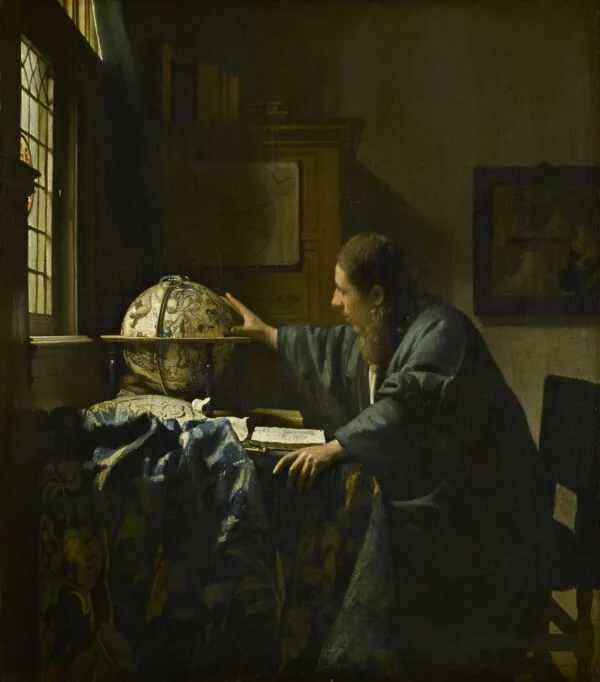
If you want Vermeer on a religious subject, see Christ in the House of Martha and Mary. Another woman in blue satin with a painting on the wall behind her is A Young Woman Seated at a Virginal, and the world of learning and science opens in The Astronomer.
Every one of the famous Vermeer paintings we paint to order is listed on the Johannes Vermeer page.
How does our painter paint your Allegory of the Catholic Faith?
First he lays out the perspective of the room: the black and white tiles, the edge of the platform and the table. He then builds the dark back wall and the large Crucifixion in warm browns and olive tones.
He models the white satin in several layers, from greyish shadows to bright highlights on the folds, and deepens the blue skirt with thin glazes. Last come the reflection in the sphere, the chalice, the crown of thorns and the pattern of the hanging.
What you receive is a Vermeer reproduction carrying real brush marks, which no print has. As with every oil painting reproduction, the daylight changes it: in the morning the white satin shines, and in the evening the gilded ground behind the crucifix comes forward.
Which size for which wall?
In short: 40 x 49 or 45 x 60 cm for a narrow wall or a hallway, 58 x 75 or 66 x 83 cm above a chest of drawers or in a home office, 80 x 108 or 100 x 135 cm above a sofa or a dining table, and 117 x 145 or 142 x 190 cm for a tall wall, a stairwell or a hall.
All 8 sizes are portrait (width x height): 40 x 49, 45 x 60, 58 x 75, 66 x 83, 80 x 108, 100 x 135, 117 x 145 and 142 x 190 cm. The nearest to the original is 80 x 108 cm, which is 8.9 cm narrower and 6.3 cm shorter.
As a painting for the living room above a sofa, 80 x 108 or 100 x 135 cm gives the best balance; hang it with the lower edge 20 to 25 cm above the backrest.
Can I choose another size or a frame?
Yes. At roughly 7 : 9, it can be painted in an unlisted size without losing the snake or the glass sphere. Send us the width and height you have in mind, and we reply with a price and a date.
It can travel rolled, stretched on a stretcher bar or framed. Our workshop in Slovenia handles the stretching and framing, as it does for every painting we send. You pick the frame in our 3D application, which is for choosing the frame only; seeing the painting on your own wall is a separate service.
When will Allegory of the Catholic Faith arrive?
We start painting as soon as you confirm the order, and the painting is ready to ship in 15 to 45 working days. Before it leaves, you receive a photograph of the finished work, and if you want a correction, we make it.
Within Slovenia and the rest of the EU the parcel travels without customs, and our returns policy covers every order.
It is a thoughtful gift for a confirmation, a church wedding or a lover of Christian art. To leave size and frame to them, give a wall art voucher instead.
Frequently asked questions
Where does the original hang?
At the Metropolitan Museum of Art in New York.
What is the woman looking at?
A glass sphere on a blue ribbon; one reading links it to the mind’s ability to believe in God.
Will I receive a print?
No, you receive a hand-painted copy, made with brush and oil colours on canvas.
How large is the original?
It is 114.3 cm high and 88.9 cm wide; our nearest size is 80 x 108 cm.
Can I order it in another size?
Yes, we paint it to the measurements you give us and quote the price first.
How long will I wait?
From 15 to 45 working days until dispatch; there is no customs inside the EU.
Would it suit a dining room or a home office?
Yes, its dark ground and calm figure suit a dining room, a library or a home office.
What does the snake under the stone mean?
In Ripa, the snake is the Devil and the cornerstone is Christ, who defeats it.
- Subject: the personification of Faith in white and blue satin, one foot on a globe, looks up at a glass sphere.
- Original: c. 1670–1672, oil on canvas, 114.3 x 88.9 cm, Metropolitan Museum of Art, New York.
- Ours: oil on canvas, hand-painted to order, in 8 portrait sizes from 40 x 49 to 142 x 190 cm or a size you choose.
- Worth knowing: with The Art of Painting, it is Vermeer’s only history painting.