







































Description
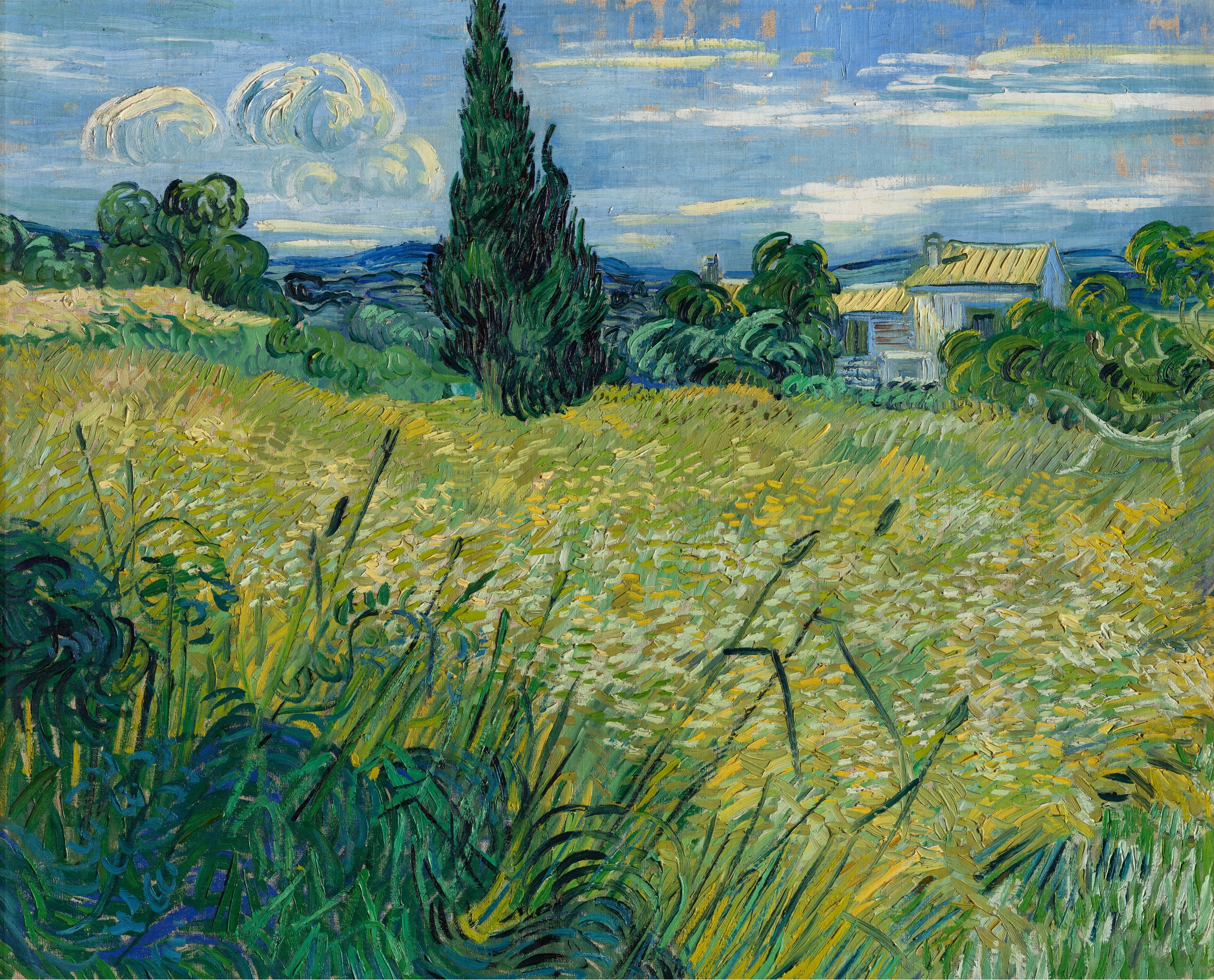
Green Wheat Field with Cypress is the landscape Vincent van Gogh painted in June 1889 near Saint-Rémy-de-Provence: a field of green wheat, touched with yellow where it begins to ripen, filling the lower two thirds of the canvas, a dark cypress rising left of centre, a small house with a yellow roof among the trees on the right, blue hills behind and white clouds in a blue sky. The original, oil on canvas, measures 73 x 92.5 cm and is in the National Gallery Prague. We paint it by hand in oil on canvas, in 17 sizes from 45 x 38 to 190 x 151 cm or to your own measurements, and send you a photograph of the finished painting for approval before dispatch.
| Title: | Green Wheat Field with Cypress |
| Other titles: | Champ de blé vert avec cyprès · Green Wheat · Green Field · Zelené obilí |
| Painter: | Vincent van Gogh (1853–1890) |
| Year painted: | June 1889, Saint-Rémy-de-Provence |
| Original size: | 73 cm x 92.5 cm |
| Original technique: | Oil on canvas |
| Painting style: | Post-Impressionism |
| Located at: | National Gallery Prague, Prague (inv. O 3208) |
| Our reproduction: | Hand-painted oil on canvas, 17 sizes or made to measure |
Green Wheat Field with Cypress – Vincent van Gogh
What does Green Wheat Field with Cypress show?
The wheat field takes up almost the whole lower part of the canvas. It is painted in long, wavy strokes of green, yellow-green and pale yellow. In the foreground tall blades and stems in deep blue-green lean in from the bottom edge, some carrying dark ears. Further back on the left lies a strip of field that has already turned yellow.
Left of centre a single cypress rises from the field almost to the top of the canvas, dark green and tapering, with round green trees beside it. On the right, half hidden among dark trees, stands a small house with a yellow roof. Behind them runs a line of blue hills, and above them a blue sky streaked with white, with curling white clouds at the top left and a long band of cloud on the right.
How did Van Gogh describe Green Wheat Field with Cypress in his letter?
The English Wikipedia article on Green Wheat Field with Cypress quotes his letter to his sister Wil of 16 June 1889, written a few days after he had been allowed out of the asylum to paint in the open air. Of this wheat field he wrote: ‘… that depicts a field of yellowing wheat surrounded by brambles and green bushes. At the end of the field a little pink house with a tall and dark cypress tree that stands out against the distant purplish and bluish hills, and against a forget-me-not blue sky streaked with pink.’
In the same sentence he wrote that the pure tones of the sky contrast with the already heavy, scorched ears, ‘whose tones are as warm as the crust of a loaf of bread’. In early July 1889 he also sent his brother Theo an ink drawing of the composition with a letter; according to Wikipedia that drawing is now in the Morgan Library & Museum in New York.
Why does Green Wheat Field with Cypress feel so calm?
The National Gallery Prague writes that, unlike the artist’s other late paintings, this one gives a balanced and peaceful impression, though his impasto and relief are still there.
Wikipedia quotes the art historian Ronald Pickvance to the same effect: ‘with no spatial distortions, no excessively heightened color tonalities, and no revolutionary symbolism, this landscape affirms its normality within an Impressionist convention’. Wikipedia adds that, to Van Gogh, wheat fields symbolized the cycle of life and death.
Where is the original today?
The original is in the National Gallery Prague, which records it as Green Wheat by Vincent van Gogh, painted in June 1889 during his stay at the Saint-Paul de Mausole asylum near Saint-Rémy, under the inventory number O 3208. In Prague it is known by its Czech title, Zelené obilí, which means green wheat.
Wikipedia gives its catalogue numbers as F719 and JH1725 and writes that, like many of his landscapes of that time, it was painted on a standard size 30 canvas, and that Van Gogh probably sent it to Theo in September 1889.
Green Wheat Field with Cypress or A Wheat Field with Cypresses – which is which?
They are two different paintings from the same summer at Saint-Rémy in 1889. A Wheat Field with Cypresses shows ripe yellow wheat, tall cypresses on the right and a sky of swirling white clouds, and its first version belongs to The Metropolitan Museum of Art in New York. The painting on this page is the one in Prague: the wheat is still mostly green, a single cypress stands left of centre and a small house sits among the trees on the right.
Three more paintings from Saint-Rémy go well with it. Cypresses, from 1889, brings the dark trees close and makes them the whole subject. Irises shows a bed of blue-violet irises in the asylum garden, painted in May 1889, and Road with Cypress and Star, from May 1890, sets a cypress on a country road between a star and a crescent moon. Choose this field for a calm green landscape under a blue sky, A Wheat Field with Cypresses for golden wheat and a restless sky.
How is our hand-painted Green Wheat Field with Cypress made?
The painter first sketches the line of the hills, the outline of the cypress, the house and the edges of the field, and checks the proportions against the original. Then comes the blue sky with its white streaks and curling clouds, after it the hills, the trees and the house, then the cypress, and last the wide field in long wavy strokes with the dark blades of the foreground on top. Our oil painting reproduction is painted by hand on canvas, with real impasto: the paint goes on thickly, so the brushstrokes stand up from the canvas as they do in the original and catch the light.
On our version the relief shows most in the long strokes of the wheat, in the dense dark strokes of the cypress and in the curling clouds. A print is completely flat; on our painting every brushstroke stands out in real paint.
Every painting is a hand-painted copy made for your order, so no two are quite the same.
Which size for which wall?
Short answer: 45 x 38 or 55 x 45 cm for a narrow wall in a hallway or beside a door, 90 x 70 or 105 x 83 cm above a chest of drawers or a bed, and 150 x 120 or 160 x 127 cm above a sofa or on a large wall.
There are 17 sizes: 45 x 38, 50 x 40, 55 x 45, 60 x 50, 65 x 49, 70 x 60, 80 x 60, 90 x 70, 95 x 78, 105 x 83, 120 x 100, 140 x 105, 150 x 120, 160 x 127, 170 x 134, 180 x 142 and 190 x 151 cm (width x height). The original is 92.5 cm wide and 73 cm high, so our 90 x 70 and 95 x 78 cm sizes come closest to it, while 105 x 83, 160 x 127 and 190 x 151 cm keep almost exactly its proportions. The greens and yellows of the field and the blue sky look best on a white, cream or light grey wall and sit well with natural wood. A painting for the living room should cover about two thirds of the width of the furniture below it.
Hang it with the centre of the canvas about 150 cm above the floor. Above a sofa, a bed or a sideboard, leave 20 to 30 cm between the top of the furniture and the bottom of the canvas.
What if I need a custom size or a frame?
If none of the 17 sizes fits your wall, we paint it to measure in any width and height you need. Send us the width and height you want and we will quote you a price and a delivery time. Every painting we make is mounted on a wooden stretcher, ready to hang.
Our 3D app shows each of our frame profiles on this painting, so you can compare gold, silver, black, white and natural wood. The app is for choosing the frame only. To see the painting on your own wall, use our separate room placement service. A gold frame picks up the yellow of the ripening wheat and the roof, while a natural wood or a dark one goes with the deep green of the cypress.
How does delivery work, and what is the guarantee?
Every painting is made to order in our studio in Slovenia, so allow 15 to 45 days depending on the size you choose. We ship it on its stretcher, carefully packed (and framed, if you chose a frame), across the EU with no customs duty. Before dispatch we send you a photograph of the finished painting to approve. Our returns policy applies to every order.
You will find more of Van Gogh’s famous works among all our Vincent van Gogh paintings, and more about the painter in our article on Vincent van Gogh. If it is a present and you are not sure of the size, a wall art voucher lets the recipient choose.
Frequently asked questions
Where is the original Green Wheat Field with Cypress today?
In the National Gallery Prague, in the Czech Republic. The museum records it as Green Wheat by Vincent van Gogh, painted in June 1889 near Saint-Rémy, inventory number O 3208, and in Prague it goes by the Czech title Zelené obilí.
When and where did Van Gogh paint Green Wheat Field with Cypress?
In June 1889, near Saint-Rémy-de-Provence in the south of France, while he was a patient at the asylum of Saint-Paul de Mausole. On 16 June 1889 he wrote to his sister Wil that he had just finished it, a few days after he had been allowed out of the asylum to paint in the open air.
Is Green Wheat Field with Cypress the same painting as A Wheat Field with Cypresses?
No, they are two different canvases from the summer of 1889 at Saint-Rémy. The one in Prague shows mostly green wheat, a single cypress left of centre and a small house on the right. A Wheat Field with Cypresses, whose first version is in New York, shows ripe yellow wheat with cypresses on the right under swirling clouds.
What did Van Gogh write about Green Wheat Field with Cypress?
He described it to his sister Wil on 16 June 1889 as a field of yellowing wheat surrounded by brambles and green bushes, with a little pink house at the end of the field and a tall, dark cypress standing out against distant purplish and bluish hills and a forget-me-not blue sky streaked with pink.
Is there a drawing of Green Wheat Field with Cypress?
Yes. In early July 1889 Van Gogh sent his brother Theo an ink drawing of the same composition with a letter. According to Wikipedia, the drawing, catalogued as F1548 and JH1726, is now in the Morgan Library & Museum in New York.
How big is the original Green Wheat Field with Cypress?
73 cm high and 92.5 cm wide, a landscape format that Wikipedia calls a standard size 30 canvas. Our 90 x 70 and 95 x 78 cm sizes come closest to the original. There are 17 sizes from 45 x 38 to 190 x 151 cm, and we also paint it to measure in any proportions.
Which size of Green Wheat Field with Cypress suits a living room?
Above a sofa, choose 150 x 120 or 160 x 127 cm, so that the canvas painting covers a good part of the width of the sofa and the cypress reads clearly from across the space. On a narrower wall or above a sideboard, 90 x 70 or 105 x 83 cm works well. For a very large wall, choose our largest size, 190 x 151 cm.
Does your Green Wheat Field with Cypress have the raised brushstrokes of the original?
Yes. We paint it in impasto, building up each brushstroke in thick oil, so the surface is raised like Van Gogh’s original. You see this best in the long wavy strokes of the wheat, in the dense dark strokes of the cypress and in the curling white clouds, where the relief catches the light from the side.
- Subject: a field of green wheat near Saint-Rémy in June 1889, with a dark cypress left of centre, a small house with a yellow roof among trees on the right, blue hills and white clouds in a blue sky.
- Original: June 1889, Saint-Rémy-de-Provence, oil on canvas, 73 x 92.5 cm, National Gallery Prague.
- Ours: a Van Gogh reproduction painted by hand in oil on canvas, in 17 sizes from 45 x 38 to 190 x 151 cm or made to measure.
- Worth knowing: each painting is made to order, so allow 15 to 45 days, and our 3D app lets you try every frame on this painting before you order.