







































Description
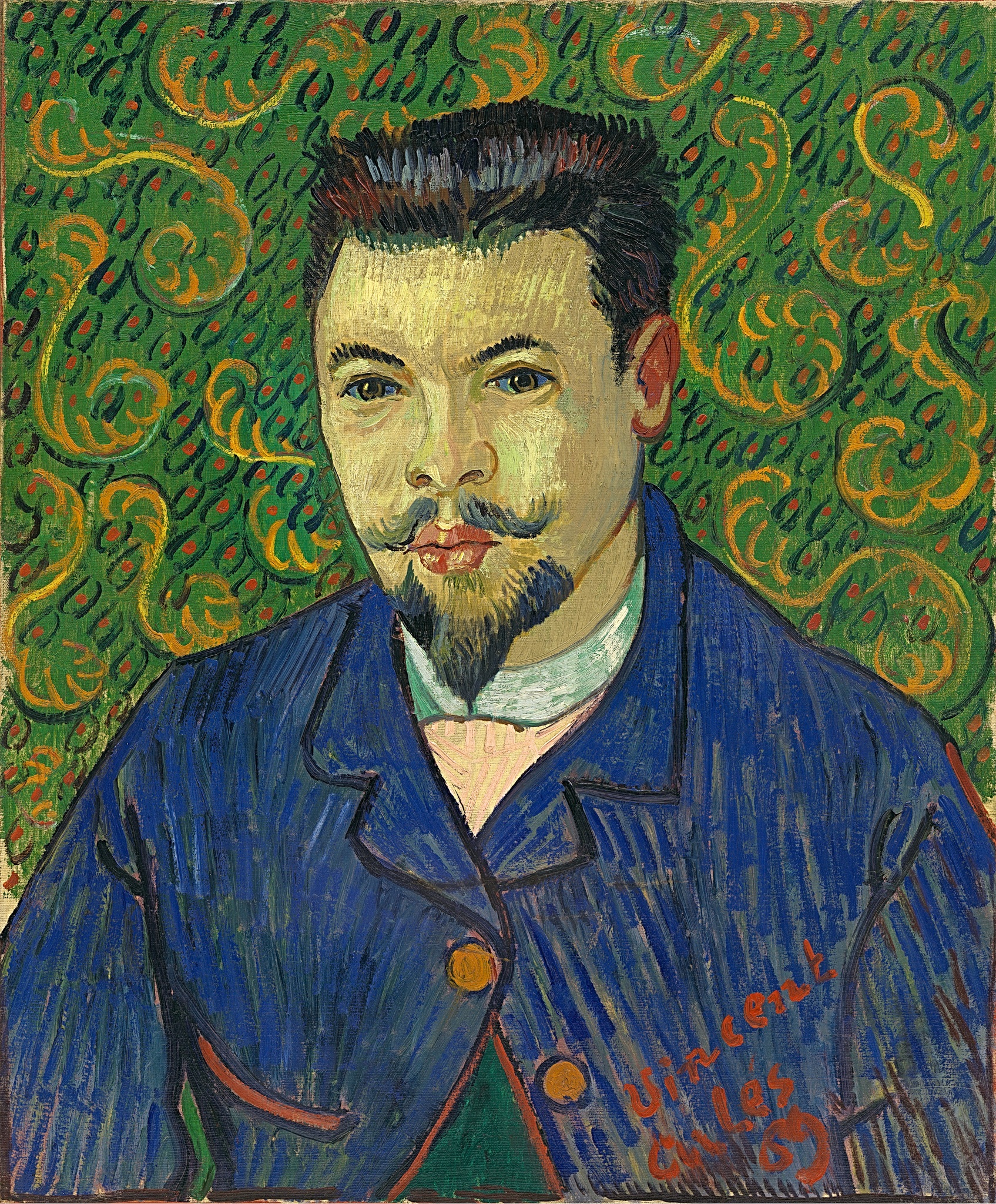
Portrait of Dr. Félix Rey is the head-and-shoulders portrait Vincent van Gogh painted in Arles in January 1889 of the doctor who had treated him at the town’s hospital: a man with dark, upswept hair, a curled moustache and a small pointed beard, in a blue jacket, against a green ground covered with yellow and orange scrolls. The original, oil on canvas, measures 64 x 53 cm and is in the Pushkin Museum in Moscow. We paint it by hand in oil on canvas, in 16 sizes from 40 x 50 to 135 x 160 cm or to your own measurements, and send you a photograph of the finished painting for approval before dispatch.
| Title: | Portrait of Dr. Félix Rey |
| Other titles: | Portrait of Doctor Rey · Portrait du docteur Rey |
| Painter: | Vincent van Gogh (1853–1890) |
| Year painted: | January 1889, Arles |
| Original size: | 64 cm x 53 cm |
| Original technique: | Oil on canvas |
| Painting style: | Post-Impressionism |
| Located at: | Pushkin Museum, Moscow (inv. no. Ж-3272) |
| Our reproduction: | Hand-painted oil on canvas, 16 sizes or made to measure |
Portrait of Dr. Félix Rey – Vincent van Gogh
What does Portrait of Dr. Félix Rey show?
A man is seen from the chest up, facing us almost straight on, his head turned very slightly to the side. His dark hair is cut short and brushed upwards. The face is pale yellow with touches of green and pink, outlined in places with thin strokes of red along the nose, the cheek and the ear. A thin moustache ends in two upturned points, and a small pointed beard sits under the lower lip.
He wears a white collar and a buttoned blue jacket, painted in long dark lines that run down the cloth. Two orange buttons and a red edge along the jacket stand out against the blue, and a little dark green shows where the jacket opens. Behind him the whole ground is green, filled with short dark dashes and broad yellow and orange curls that wind across it like a wallpaper pattern. In the lower right corner the signature and date are written in red.
Why did Van Gogh paint Dr. Félix Rey?
Because Rey had looked after him. Félix Rey was a doctor at the hospital in Arles who treated Van Gogh after he cut off part of his own ear; the Pushkin Museum calls him an assistant at the hospital where the painter had been taken. Van Gogh left the hospital on 7 January 1889 and most probably painted the portrait in the days that followed.
It was a gift. The English Wikipedia article on the painting dates it to between 7 and 17 January 1889, because on 17 January Van Gogh wrote to his brother Theo that he had given the portrait to its subject as a keepsake. The museum writes that Rey himself saw it simply as a gesture of gratitude from a former patient.
What does Portrait of Dr. Félix Rey mean?
It is a portrait of a real person, and according to the Pushkin Museum people who knew Rey thought it a strong likeness. In the museum’s reading, the simple composition and the bright, dissonant colours stress the sitter’s physical strength and his self-confidence.
Wikipedia places the painting in the Japanese-influenced style of that period, which shows in the flat, decorative ground: the curls behind Rey do not describe a real wall, they fill the space with pattern and push the face and the blue jacket forward. The museum also notes that he painted it after a period of mental illness.
Where is the original today?
The original is in the Pushkin State Museum of Fine Arts in Moscow, known as the Pushkin Museum, which lists it as Portrait of Doctor Rey, 1889, oil on canvas, 64 x 53 cm, under the inventory number Ж-3272. According to the museum, it belonged to Sergei Shchukin until 1918, then to the State Museum of New Western Art, and it has been in the Pushkin Museum since 1948.
The museum writes that Rey, who had no interest in art, first put the painting in the attic, and that it was later used to plug a hole in a henhouse. In 1900, it says, the painter Charles Camoin, a friend of Henri Matisse, found it in Rey’s backyard. Wikipedia dates his purchase from Rey to April 1901 and follows the canvas through Marseille and Paris, where Ambroise Vollard sold it for 150 francs, until in 1908 Eugène Druet sold it to Shchukin for 4,600 francs. After the October Revolution the Soviet state took the collection over. Wikipedia adds that the sitter’s name was then forgotten until Jacob Baart de la Faille identified Rey again in 1924.
Portrait of Dr. Félix Rey or another Van Gogh – which should you choose?
Van Gogh painted several people from Arles, and four of those portraits are in our range besides this one. Portrait of Joseph Roulin shows the postman of Arles in his uniform. Self-Portrait with Bandaged Ear shows the painter himself, with the bandage over the ear that Rey treated. L’Arlésienne is a portrait of a woman of Arles, and The Zouave shows a young soldier in a red fez.
Choose Dr. Rey for a single face in strong blue and green against a lively patterned ground, the Roulin portrait for a bearded sitter in a uniform, and the self-portrait if you want Van Gogh himself on the wall.
How is our hand-painted Portrait of Dr. Félix Rey made?
The painter first draws the head, the collar, the shoulders and the outline of the jacket, and checks the proportions against the original. Then comes the green ground with its dark dashes, after it the yellow and orange scrolls, then the blue jacket in long lines, the face with its yellow, green and red touches, and last the hair, the moustache, the beard, the buttons and the red signature. Our oil painting reproduction is painted by hand on canvas, with real impasto: the paint goes on thickly, so the brushstrokes stand up from the canvas as they do in the original and catch the light.
On this painting the relief shows most in the curling scrolls of the background, in the long strokes of the blue jacket and in the upswept hair. A print is completely flat; on our painting every brushstroke stands out in real paint.
Every painting is a hand-painted copy made for your order, so no two are quite the same.
Which size for which wall?
Short answer: 40 x 50 or 55 x 66 cm for a narrow wall in a hallway, a study or a consulting room, 75 x 90 or 80 x 100 cm above a chest of drawers or a desk, and 100 x 120 or 110 x 130 cm above a sofa or on a large wall.
There are 16 sizes: 40 x 50, 55 x 66, 60 x 70, 64 x 80, 70 x 85, 75 x 90, 80 x 100, 85 x 105, 90 x 110, 93 x 115, 100 x 120, 105 x 125, 110 x 130, 120 x 140, 127 x 150 and 135 x 160 cm (width x height). The original is 53 cm wide and 64 cm high, so our 55 x 66 cm size is almost exactly the size of the original, and 105 x 125 cm is close to twice its size. As an upright portrait it also suits a narrow wall between two doors or windows. A painting for the living room should cover about two thirds of the width of the furniture below it.
Hang it with the centre of the canvas about 150 cm above the floor, so the doctor’s eyes are close to your own. Above a sofa, a bed or a sideboard, leave 20 to 30 cm between the top of the furniture and the bottom of the canvas.
What if I need a custom size or a frame?
If none of the 16 sizes fits your wall, we paint it to measure in any width and height you need. Send us the width and height you want and we will quote you a price and a delivery time. Every painting we make is mounted on a wooden stretcher, ready to hang.
Our 3D app shows each of our frame profiles on this painting, so you can compare gold, silver, black, white and natural wood. The app is for choosing the frame only. To see the painting on your own wall, use our separate room placement service. A gold frame picks up the yellow scrolls and the orange buttons, while a dark wood or black one deepens the blue of the jacket.
How does delivery work, and what is the guarantee?
Every painting is made to order in our studio in Slovenia, so allow 15 to 45 days depending on the size you choose. We ship it on its stretcher, carefully packed (and framed, if you chose a frame), across the EU with no customs duty. Before dispatch we send you a photograph of the finished painting to approve, and we correct anything that is not right. Our returns policy applies to every order.
You will find more of Van Gogh’s famous works among all our Vincent van Gogh paintings, and more about the painter in our article on Vincent van Gogh. If it is a present and you are not sure of the size, a wall art voucher lets the recipient choose.
Frequently asked questions
Where is the original Portrait of Dr. Félix Rey today?
In the Pushkin Museum in Moscow. The museum lists it as Portrait of Doctor Rey, 1889, oil on canvas, 64 x 53 cm, under the inventory number Ж-3272. It arrived there in 1948 from the State Museum of New Western Art, which had taken over the collection of Sergei Shchukin, who bought the painting in Paris in 1908.
When and where did Van Gogh paint the Portrait of Dr. Félix Rey?
In January 1889, in Arles in the south of France. Wikipedia narrows it to between 7 January, when Van Gogh left the hospital in Arles, and 17 January, when he wrote to his brother Theo that he had given the portrait to the doctor as a keepsake. The Pushkin Museum also dates it to January 1889.
Who was Dr. Félix Rey?
The doctor who treated Van Gogh at the hospital in Arles after he cut off part of his ear. The Pushkin Museum describes him as an assistant at that hospital and writes that he had no interest in art. Van Gogh painted him shortly after leaving the hospital and gave him the finished portrait.
Did Dr. Félix Rey like his portrait?
Apparently not much. Van Gogh gave it to him as a keepsake, but the Pushkin Museum writes that Rey, who had no interest in art, saw it only as a gesture of gratitude from a former patient, put it in the attic, and that it was later used to plug a hole in a henhouse.
How was the Portrait of Dr. Félix Rey found again?
Through the painter Charles Camoin. The Pushkin Museum writes that Camoin, a friend of Henri Matisse, found the portrait in Rey’s backyard in Arles in 1900. Wikipedia says Camoin was stationed in Arles with an infantry regiment in April 1901, met Rey and bought the painting from him, and that the dealer Ambroise Vollard later sold it for 150 francs.
How did the Portrait of Dr. Félix Rey get to Moscow?
Through the collector Sergei Shchukin. According to Wikipedia, the Paris dealer Eugène Druet sold it to him in 1908 for 4,600 francs. The Pushkin Museum records that it stayed with Shchukin until 1918, then belonged to the State Museum of New Western Art, and has been in the Pushkin Museum since 1948.
How big is the original Portrait of Dr. Félix Rey?
64 cm high and 53 cm wide, according to the Pushkin Museum: a medium upright format. Our 55 x 66 cm size is almost exactly the size of the original. If you want the doctor larger, there are 16 sizes up to 135 x 160 cm, and custom sizes in any proportions.
Which size of the Portrait of Dr. Félix Rey suits a living room?
Above a sofa, choose 100 x 120 or 110 x 130 cm, so that the canvas painting holds its own on a large wall and the green and yellow ground reads from across the room. On a narrower wall, beside a bookcase or above a sideboard, 64 x 80 or 80 x 100 cm works well. For a very high wall, choose our largest size, 135 x 160 cm.
Does your Portrait of Dr. Félix Rey have the raised brushstrokes of the original?
Yes. We paint our Dr. Rey in impasto: the paint goes on thickly, so the brushstrokes stand up from the canvas as on Van Gogh’s original. You see it best in the yellow and orange curls of the background, in the long lines of the blue jacket and in the brushed-up hair, where the relief catches the light from the side.
- Subject: Dr. Félix Rey, the doctor who treated Van Gogh in Arles, in a blue jacket and white collar against a green ground with yellow and orange scrolls.
- Original: January 1889, Arles, oil on canvas, 64 x 53 cm, Pushkin Museum, Moscow.
- Ours: a Van Gogh reproduction painted by hand in oil on canvas, in 16 sizes from 40 x 50 to 135 x 160 cm or made to measure.
- Worth knowing: our 3D app shows every frame profile on this portrait, so you can choose the frame before you order.