


Description
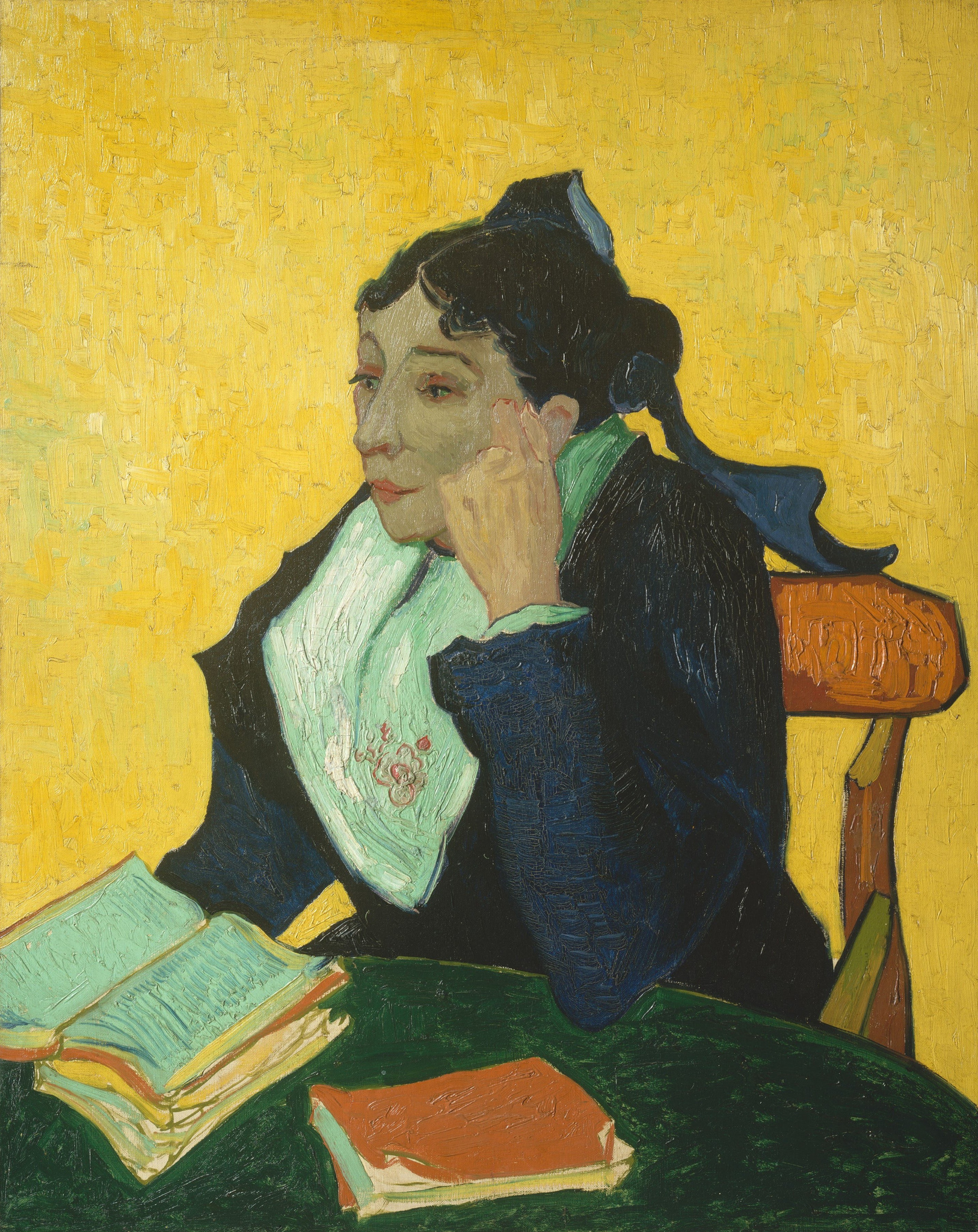
L’Arlésienne (Madame Ginoux with Books) is Vincent van Gogh’s portrait of Marie Ginoux, who ran the Café de la Gare in Arles with her husband: she sits at a green table with her chin on her hand, books in front of her, against a flat yellow ground. The original, dated 1888–89, measures 91.4 x 73.7 cm and belongs to The Metropolitan Museum of Art in New York. We paint it by hand in oil on canvas, in 16 sizes from 40 x 50 to 127 x 160 cm or to your own measurement, and send you a photograph of the finished work for approval before dispatch.
| Title: | L’Arlésienne (Madame Ginoux with Books) |
| Other titles: | L’Arlésienne: Madame Joseph-Michel Ginoux · Portrait of Madame Ginoux · L’Arlesiana |
| Painter: | Vincent van Gogh (1853–1890) |
| Year painted: | 1888–89, Arles |
| Original size: | 91.4 cm x 73.7 cm |
| Original technique: | Oil on canvas |
| Painting style: | Post-Impressionism |
| Located at: | The Metropolitan Museum of Art, New York (inv. 51.112.3) |
| Our reproduction: | Hand-painted oil on canvas, 16 sizes or made to measure |
L’Arlésienne (Madame Ginoux with Books) – Vincent van Gogh
What does L’Arlésienne (Madame Ginoux with Books) show?
A woman in her forties sits at a green table, turned three-quarters towards us, and rests her chin on her left hand. Her dark hair is tied with a blue ribbon, her dress is a deep blue-black, and over it she wears a white fichu with a green sheen and a small red flower. Behind her rises the orange back of a wooden chair. On the table lie books: a stack with one volume lying open, and a closed red book in front. The edge of the canvas cuts through one of them, as if the scene had been caught by surprise.
Everything else is yellow. Van Gogh painted the background as one flat, strong field of colour, so that the dark figure stands out against it like a silhouette. The blues of the dress and the green of the table hold the yellow in balance, and the half-circle of the table gives the scene depth. She is not looking at us but past us, thoughtful and calm.
Who was Madame Ginoux?
Marie Ginoux, born Marie Julien in Arles in 1848, married Joseph-Michel Ginoux in 1866. Together they ran the Café de la Gare at 30 Place Lamartine. Van Gogh lodged there from May to the middle of September 1888, before he moved into the house he had furnished for himself, the one he painted as The Yellow House. The interior of their café is the subject of his The Night Café.
Until the autumn the relationship was mostly that of a lodger and his landlords. Then Paul Gauguin arrived in Arles, and in the first days of November 1888 Madame Ginoux agreed to sit for both painters. She died in Arles in 1911.
What does L’Arlésienne mean?
L’Arlésienne simply means “the woman from Arles”. Madame Ginoux sat in the local dress of the town, the dark costume with a light fichu at the neck, so the portrait is both a likeness of one woman and an image of Arles itself. The large flat areas of colour and the firm outlines show what Van Gogh and Gauguin were studying at the time: Japanese prints, with their simplified forms.
Van Gogh thought about portraits in exactly these terms. In June 1890 he wrote to his sister Wil that he wanted to paint portraits “which will appear as revelations to people in a hundred years’ time”, not through a photographic likeness but through colour that renders character. In this version the books are part of that: they turn a café owner into a woman lost in thought.
Where does the original hang?
The original belongs to The Metropolitan Museum of Art in New York, which lists it as L’Arlésienne: Madame Joseph-Michel Ginoux (Marie Julien, 1848–1911), oil on canvas, 91.4 x 73.7 cm, dated 1888–89, under the accession number 51.112.3. It came to the museum in 1951 as a bequest of Sam A. Lewisohn and is part of its European Paintings collection.
The other versions are in other cities, so the books are the quickest way to tell that this is the New York painting. More about the whole group of portraits, with Gauguin’s drawing and the later versions, is on Wikipedia.
Which L’Arlésienne is this, and which Arles paintings go with it?
Van Gogh painted Madame Ginoux several times. At the sitting in November 1888 Gauguin made a charcoal drawing while Van Gogh painted a full-size portrait that he said he “knocked off in one hour”: that first version, on coarse burlap, shows gloves and an umbrella on the table and is now in the Musée d’Orsay in Paris. For the second version, the one on this page, he used ordinary primed canvas and replaced the gloves and umbrella with three books. In February 1890, in Saint-Rémy, he painted further portraits of her from Gauguin’s drawing; one is in the Kröller-Müller Museum, one with a pink background in the São Paulo Museum of Art, and the one he meant for Madame Ginoux herself was lost.
For a wall from the same months in Arles there is Café Terrace at Night, with its yellow awning under a starry sky, and Bedroom in Arles, his own room in the Yellow House on the same square. Choose L’Arlésienne if you want a calm portrait of one person; choose The Night Café if you want her café itself.
How is our hand-painted L’Arlésienne made?
The painter first draws the figure, the chair and the curve of the table and checks the proportions against the original, because the likeness depends on the tilt of the head on the hand. Then come the yellow ground in short, dense strokes, the blue-black dress with its dark contours, the green table and the books, and last the face, the hands and the white fichu. Our oil painting reproduction is painted by hand in oil on canvas with real impasto: the paint goes on thickly, so the brushstrokes stand up from the canvas as they do in the original and catch the light.
Here the relief shows best in the yellow background, which Van Gogh built up with visible strokes rather than painting it smooth. A print shows only a flat surface; on our painting the strokes are real.
Every painting is a hand-painted copy made for your order, so no two are quite the same. Before dispatch we photograph it, sending you the photograph to approve.
Which size for which wall?
Short answer: 70 x 90 or 74 x 94 cm above a desk, a sideboard or an armchair in a reading corner, 80 x 100 or 90 x 110 cm above a sofa, and 120 x 150 cm for a large empty wall. The upright format suits a narrow wall, the space between two windows, a library or a hallway.
There are 16 sizes: 40 x 50, 49 x 60, 50 x 62, 54 x 65, 60 x 70, 64 x 80, 70 x 90, 74 x 94, 80 x 100, 85 x 105, 90 x 110, 100 x 120, 105 x 125, 109 x 135, 120 x 150 and 127 x 160 cm (width x height). The original is 73.7 cm wide and 91.4 cm high; our 74 x 94 cm size is the closest to it, so the portrait on your wall is almost exactly as large as it is in New York. A painting for the living room should cover about two thirds of the width of the furniture below it; an upright canvas can be narrower when it hangs above a slim piece of furniture or a bookcase.
Hang it with the centre of the canvas about 150 cm above the floor. Above a sofa or a desk, leave 20 to 30 cm between the furniture and the bottom edge.
What if I need a custom size or a frame?
If none of the 16 sizes fits your wall, we paint it to measure. We recommend keeping the proportions close to the original, otherwise the figure gets squeezed or stretched. Send us the width and height you want and we will quote a price and a lead time. Every painting we make is stretched over a wooden stretcher and ready to hang.
For the moulding, use our 3D application: it shows each of our frame profiles on this subject, so you can compare gold, silver, black, white and natural wood – the application is for choosing the frame only. Seeing the painting on your own wall is our separate room placement service. A strong yellow ground takes a dark wood or a black profile well, which frames it the way the dark dress frames the face; a warm gold profile makes it richer.
How does delivery work, and what is the guarantee?
Every painting is made to order in our studio in Slovenia, so allow 15 to 45 days depending on the size you choose. We ship it stretched and protected, framed if you chose a frame, across the EU with no customs. Before dispatch you receive a photograph of the finished work to approve, and we correct anything that is not right. Our returns policy applies to every order.
More famous Van Gogh paintings are in the Vincent van Gogh gallery, and there is more about the painter in our article on Vincent van Gogh. As a gift, a woman with her books suits someone who reads a lot or has a study of their own; if you are not sure of the subject or the size, a wall art voucher lets the recipient choose.
Frequently asked questions
Where does the original L’Arlésienne with books hang?
In The Metropolitan Museum of Art in New York, under the accession number 51.112.3. The museum received it in 1951 as a bequest of Sam A. Lewisohn. The first version, with gloves and an umbrella on the table instead of books, belongs to the Musée d’Orsay in Paris, so the two paintings are on different continents.
When did Van Gogh paint L’Arlésienne?
The first sitting took place in Arles in the first days of November 1888, when Madame Ginoux posed for Van Gogh and Gauguin together. The version with books followed as a second painting, which is why The Metropolitan Museum of Art dates it 1888–89. Further portraits of her followed in February 1890 in Saint-Rémy.
Who is the woman in L’Arlésienne?
She is Marie Ginoux, born Marie Julien in Arles in 1848, who ran the Café de la Gare on Place Lamartine with her husband Joseph-Michel Ginoux. Van Gogh lodged at their café in the summer of 1888, and its interior is the subject of The Night Café. She agreed to sit for him and Gauguin in November 1888.
What does the title L’Arlésienne mean?
It means “the woman from Arles”. Madame Ginoux posed in the local dress of the town, with the dark costume and the light fichu at the neck, so the title names her by her town rather than by her name. The portrait is at once a likeness of one woman and Van Gogh’s image of the women of Arles.
How many versions of L’Arlésienne did Van Gogh paint?
Wikipedia counts a group of six similar portraits. Two were painted in Arles in 1888: the first with gloves and an umbrella, now in Paris, and this one with books, now in New York. The others followed in February 1890 in Saint-Rémy, painted from Gauguin’s charcoal drawing, and one of those was lost.
What is the difference between the two L’Arlésienne paintings of 1888?
The first version, painted in about an hour on coarse burlap, shows gloves and an umbrella on the table and hangs in the Musée d’Orsay. The second, on ordinary primed canvas, replaces them with three books and hangs in New York. The pose, the yellow ground and the green table are the same in both.
Why is the background of L’Arlésienne yellow?
The flat yellow ground is typical of Van Gogh’s months in Arles, when he used strong, unmixed colour. Against it the blues and blacks of the dress stand out sharply, and the large plain areas recall the Japanese prints he and Gauguin admired. The yellow makes a quiet, seated figure look strong and present.
How much is Van Gogh’s L’Arlésienne worth?
Our painting is not the original, but the originals have a known market history. On 2 May 2006 the 1890 version that Van Gogh had given to his brother Theo sold at Christie’s in New York for more than 40 million dollars. The version with books in New York is museum property and is not for sale.
Does your L’Arlésienne have the raised brushstrokes of the original?
Yes. We paint our L’Arlésienne in impasto: the paint goes on thickly, so the brushstrokes stand up from the canvas as on Van Gogh’s original. You see it best in the yellow background, the folds of the dark dress and the white fichu, where the relief catches the light. A print cannot have this relief, because its surface is flat, which is why a canvas painting like this one looks different from every angle.
- Subject: Madame Ginoux of Arles at a green table, her chin on her hand, books in front of her, against a yellow ground.
- Original: 1888–89, Arles, 91.4 x 73.7 cm, The Metropolitan Museum of Art, New York.
- Ours: a Van Gogh reproduction painted by hand in oil on canvas, in 16 sizes from 40 x 50 to 127 x 160 cm or made to measure.
- Worth knowing: you receive a photograph of the finished work for approval before dispatch.