







































Description
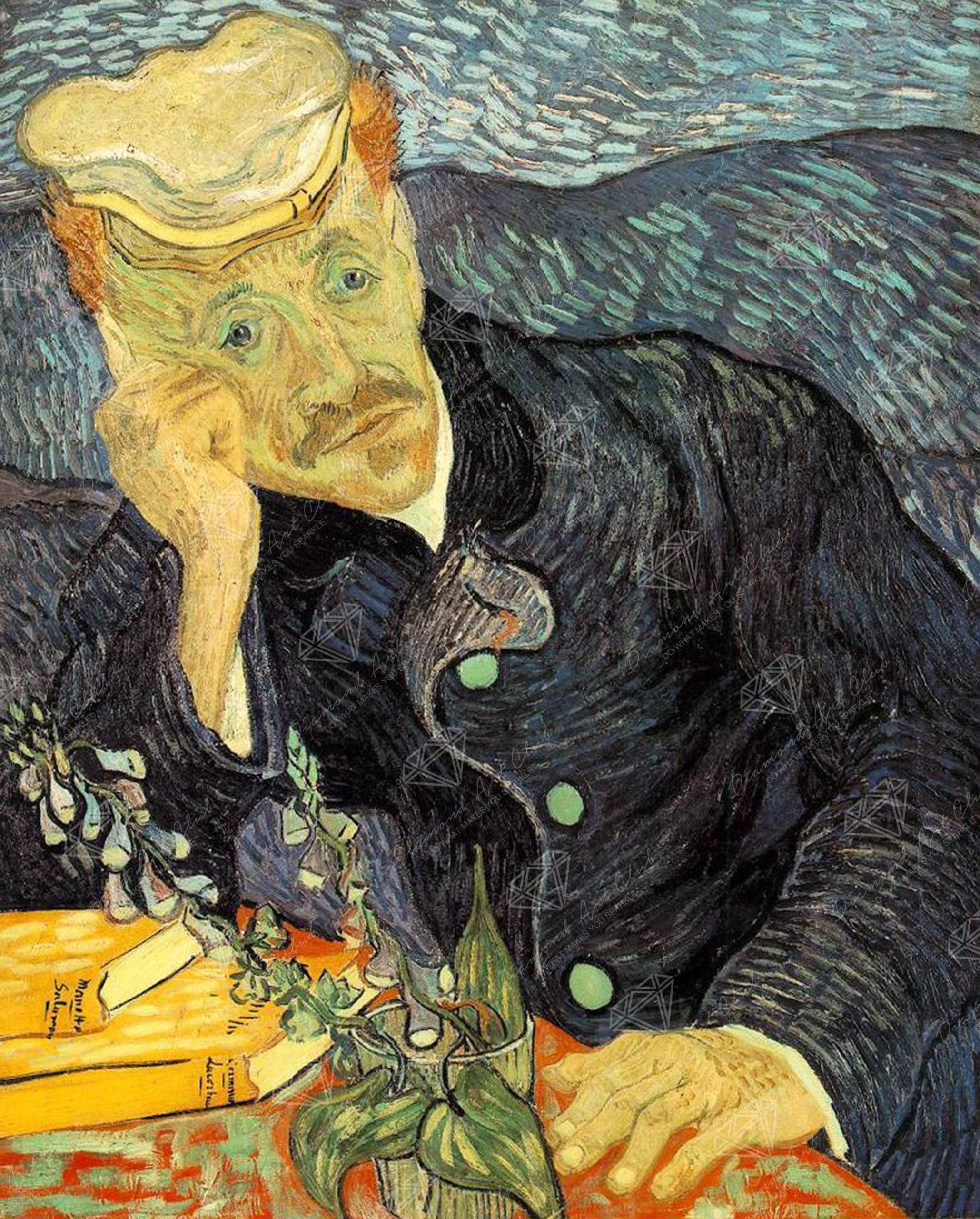
Portrait of Dr. Gachet is the portrait Vincent van Gogh painted in June 1890 in Auvers-sur-Oise of Dr Paul Gachet, the doctor who looked after him in the last months of his life: a man in a white cap and a dark blue coat, his head resting on his hand, at a red table with two yellow books and a sprig of foxglove, before blue hills. The original first version, 67 x 56 cm, is in a private collection. We paint it by hand in oil on canvas, in 17 sizes from 40 x 50 to 160 x 205 cm or to your own measurement, and send you a photograph of the finished work for approval before dispatch.
| Title: | Portrait of Dr. Gachet |
| Other titles: | Portrait du docteur Gachet · Portret van Dr. Gachet |
| Painter: | Vincent van Gogh (1853–1890) |
| Year painted: | June 1890, Auvers-sur-Oise |
| Original size: | 67 cm x 56 cm |
| Original technique: | Oil on canvas |
| Painting style: | Post-Impressionism |
| Located at: | Private collection, location not made public (first version) |
| Our reproduction: | Hand-painted oil on canvas, 17 sizes or made to measure |
Portrait of Dr. Gachet – Vincent van Gogh
What does Portrait of Dr. Gachet show?
Dr Gachet sits half-length and leans his right elbow on a red table, resting his head on his hand. He wears a white cap over red hair and a dark ultramarine coat with large green buttons. His face is pale and tired, the eyes look past us, and the mouth droops slightly. His other hand lies flat on the table.
On the table lie two yellow books, and beside them stands a glass with sprigs of purple foxglove. Behind him the background is divided by a wavy line: below, blue hills in a lighter blue than his coat; above, a sky laid on in short curving strokes.
Who was Dr Gachet, and why did Van Gogh paint him?
Paul Gachet was a homoeopathic doctor who was also an artist himself. In May 1890 Van Gogh left the asylum at Saint-Rémy and moved to Auvers-sur-Oise, a village near Paris, where Gachet cared for him in the last months of his life. His first impression of the doctor was not favourable, but he later called him a true friend and something like another brother.
In June 1890 Gachet sat for him. Gachet also introduced him to etching, and the only etching Van Gogh ever made is a portrait of the doctor, from the same year.
What does Portrait of Dr. Gachet mean?
Van Gogh explained it himself. To his sister he described the doctor’s melancholy expression, which, in his words, might well seem like a grimace to those who see it. In an unfinished letter to Paul Gauguin from about 17 June 1890, which was found among his papers and never sent, he wrote that he had a portrait of Dr Gachet with the deeply sad expression of our time; the letter can be read in full at the Van Gogh Letters project, where the editors identify the work as this first version.
So the portrait is not only a likeness of one man but an image of an age, as Van Gogh saw it. The foxglove is a medicinal plant from which digitalis is extracted to treat certain heart complaints, and it may be a nod to Gachet’s work as a physician. The two yellow books on the table are novels.
Where is the original today, and how did it get there?
The first version is in a private collection, and its location has not been made public. After the painter’s death it was sold for 300 francs, and before the First World War it was acquired by the Städel museum in Frankfurt. In 1937 the Nazis confiscated it, and it was sold on to Franz Koenigs.
On 15 May 1990 it was sold at Christie’s in New York for 82.5 million US dollars, 75 million plus a 10 percent commission, to the Japanese businessman Ryoei Saito; at that moment it was the most expensive painting ever sold. Saito died in 1996, and since then nothing has been made public about where the painting is or who owns it. When the Städel wanted to show it in an exhibition in 2019, it could not be found, so the museum hung its original empty frame instead. The full story is told in the Wikipedia article on the painting.
Which version is which, and what else to hang beside it?
Van Gogh painted Dr Gachet twice in June 1890, both times in oil on canvas and in the same size, but the two versions differ in colour and style. The one we paint is the first version: the two yellow books are on the table and the foxglove stands in a glass. In the second version, in the Musée d’Orsay in Paris, the books are missing; Gachet’s heirs gave it to the French state with the rest of his collection. Because the yellow novels appear only in the first version, the letters are read as referring to it.
Two self-portraits make a natural pair with the doctor: Self-Portrait as an Artist, from his Paris years, and Self-Portrait with Bandaged Ear, painted in Arles in 1889. L’Arlésienne shows Madame Ginoux in the same pose, her head on her hand at a table with books. Wheat Field with Crows was painted in Auvers-sur-Oise in 1890 too.
How is our hand-painted Portrait of Dr. Gachet made?
The painter first draws the figure, the tilt of the head, the hand under the cheek and the edge of the table, and checks the proportions against the original, because in a portrait a few millimetres change the expression. Then come the blue coat and the hills, the red table, the books and the foxglove, and last the face and hands. Our oil painting reproduction is painted by hand in oil on canvas with real impasto: the paint goes on thickly, so the brushstrokes stand up from the canvas as they do in the original and catch the light.
On this portrait the relief matters most in the coat, laid on in long curving strokes, in the waves of the background and in the cap. A print shows only a flat surface; on our painting the strokes are real.
Every painting is a hand-painted copy made for your order, so no two are quite the same. Before dispatch we photograph it, sending you the photograph to approve.
Which size for which wall?
Short answer: 56 x 67 cm for the original size above a desk or a chest of drawers, 80 x 100 or 90 x 110 cm above a sofa, and 125 x 165 or 160 x 205 cm for a large empty wall. The upright format suits a study, a living room, a hallway or a doctor’s practice.
There are 17 sizes: 40 x 50, 50 x 60, 56 x 67, 59 x 80, 66 x 80, 70 x 85, 73 x 95, 80 x 100, 81 x 110, 90 x 110, 100 x 120, 95 x 155, 100 x 185, 125 x 165, 140 x 165, 120 x 240 and 160 x 205 cm (width x height). Three of them, 95 x 155, 100 x 185 and 120 x 240 cm, are much taller and narrower than the original, so the composition is adapted to fit them. The original is 56 cm wide and 67 cm high, so our 56 x 67 cm size shows the doctor exactly as large as Van Gogh painted him. The deep blue of the portrait works on a white, cream or warm grey wall, and on a terracotta one that repeats the red table. A painting for the living room should cover about two thirds of the width of the furniture below it.
Hang it with the centre of the canvas about 150 cm above the floor, so that the doctor’s face is roughly at eye level, leaving 20 to 30 cm between the furniture and the bottom edge.
What if I need a custom size or a frame?
If none of the 17 sizes fits your wall, we paint it to measure. Keep the proportions close to the original, otherwise the face and the figure get squeezed or stretched. Send us the width and height you want and we will quote a price and a lead time. Every painting we make is stretched over a wooden stretcher and ready to hang.
For the moulding, use our 3D application: it shows each of our frame profiles on this subject, so you can compare gold, silver, black, white and natural wood – the application is for choosing the frame only. Seeing the painting on your own wall is our separate room placement service. A gold frame picks up the yellow books and warms the blue, and a dark frame makes the portrait quieter.
How does delivery work, and what is the guarantee?
Every painting is made to order in our studio in Slovenia, so allow 15 to 45 days depending on the size you choose. We ship it stretched and protected, framed if you chose a frame, across the EU with no customs. Before dispatch you receive a photograph of the finished work to approve, and we correct anything that is not right. Our returns policy applies to every order.
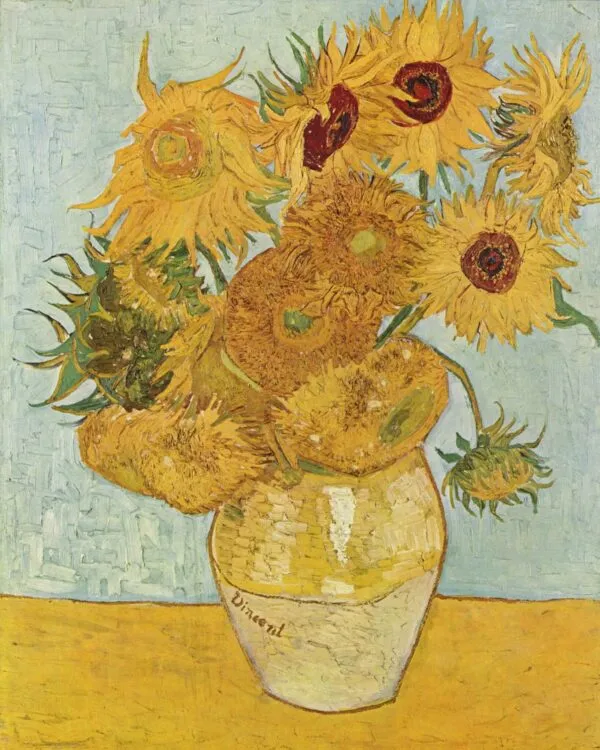
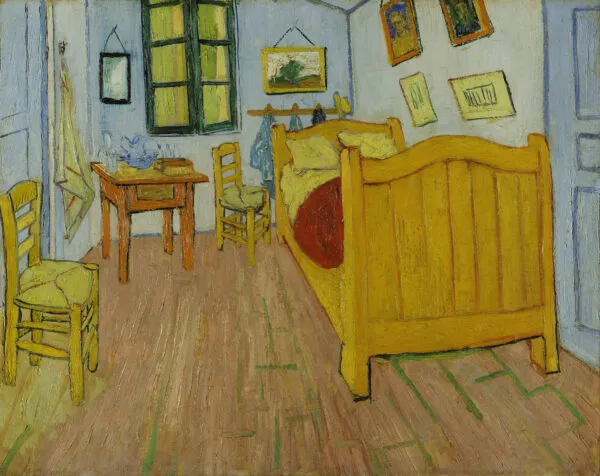
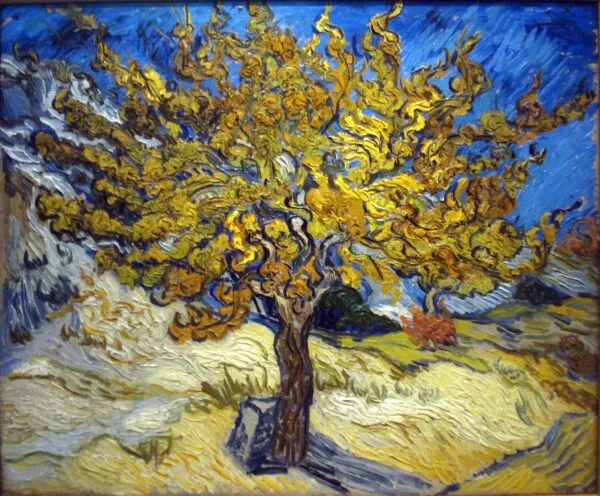
More famous Van Gogh paintings are in the Vincent van Gogh gallery, and there is more about the painter in our article on Vincent van Gogh. If you are giving it as a present and are not sure of the size, a wall art voucher lets the recipient choose.
Frequently asked questions
Where is Van Gogh’s Portrait of Dr. Gachet today?
The first version is in a private collection, and its location has not been made public since its owner Ryoei Saito died in 1996. In 2019 the Städel in Frankfurt could not find it for an exhibition and showed its empty frame. The second version, without the yellow books, hangs in the Musée d’Orsay in Paris.
How much did Portrait of Dr. Gachet sell for in 1990?
For 82.5 million US dollars. It was sold at Christie’s in New York on 15 May 1990, at 75 million dollars plus a 10 percent commission, to the Japanese businessman Ryoei Saito. At that moment it was the most expensive painting ever sold. Almost a century earlier, after Van Gogh’s death, it had changed hands for 300 francs.
When and where was Portrait of Dr. Gachet painted?
In June 1890 in Auvers-sur-Oise, the village near Paris where Van Gogh spent the last months of his life. It is oil on canvas, 67 cm high and 56 cm wide. He painted it a few weeks after arriving in the village, and in the same month he painted the second version.
Who was the man in Portrait of Dr. Gachet?
Dr Paul Gachet, a homoeopathic doctor in Auvers-sur-Oise who was also an artist and who looked after Van Gogh in the last months of his life. Van Gogh was not impressed at first, but later called him a true friend and something like another brother. Gachet also introduced him to etching.
What is the meaning of Portrait of Dr. Gachet?
Van Gogh wanted the face to carry the mood of his time. In an unfinished letter to Paul Gauguin from June 1890 he wrote of the deeply sad expression of our time, often quoted in English as the heartbroken expression of our time. To his sister he called the expression melancholy, adding that some might take it for a grimace.
What is the flower in Portrait of Dr. Gachet?
It is foxglove, the purple flowering plant in the glass on the table. Foxglove is a medicinal plant from which digitalis is extracted to treat certain heart complaints, so it may be a nod to Gachet’s work as a physician. In the first version it stands in a glass beside two yellow books.
How many versions of Portrait of Dr. Gachet are there?
Two paintings, both from June 1890 and in the same size: the first, with the yellow books and the foxglove in a glass, in a private collection, and the second, without the books, in the Musée d’Orsay in Paris. Van Gogh also made an etching of the doctor in 1890, the only etching he ever made.
Which size of Portrait of Dr. Gachet should I choose?
For the original size, choose 56 x 67 cm, which suits a canvas painting above a desk or a chest of drawers. Above a sofa, 80 x 100 or 90 x 110 cm keeps the face at a readable size, and for a large wall there are formats up to 160 x 205 cm. We also paint it to your own measurement.
Does your Portrait of Dr. Gachet have the raised brushstrokes of the original?
Yes. We paint our copy in impasto: the paint goes on thickly, so the brushstrokes stand up from the canvas as on Van Gogh’s original. You see it best in the long curving strokes of the dark blue coat, in the waves of the hills and the sky, and in the cap, where the relief catches the light. A print cannot have this relief, because its surface is flat.
- Subject: Dr Paul Gachet in a white cap and blue coat, his head on his hand, at a red table with yellow books and foxglove.
- Original: June 1890, Auvers-sur-Oise, 67 x 56 cm, first version, private collection.
- Ours: a Van Gogh reproduction painted by hand in oil on canvas, in 17 sizes from 40 x 50 to 160 x 205 cm or made to measure.
- Worth knowing: you receive a photograph of the finished work for approval before dispatch.