







































Description
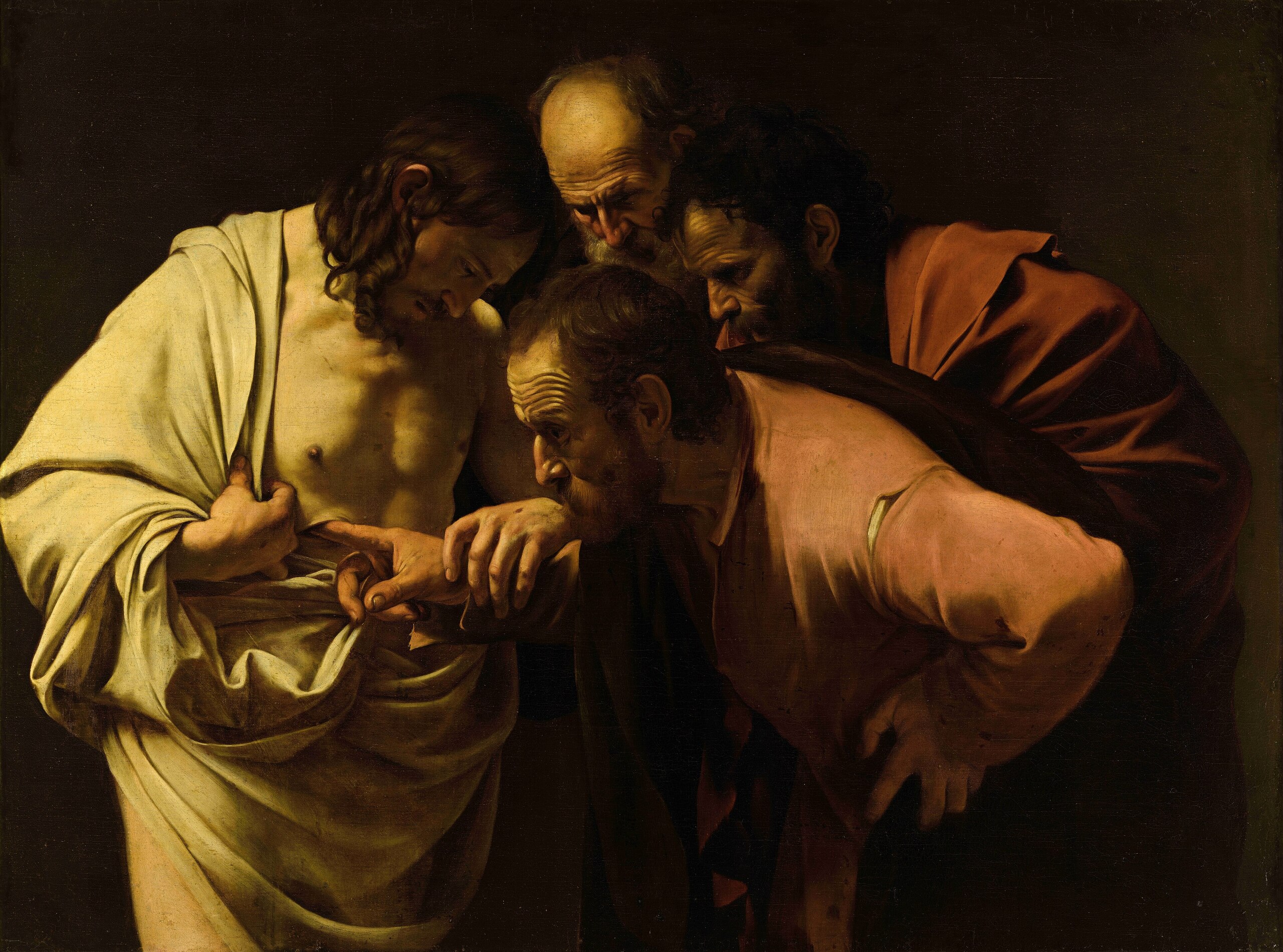
The Incredulity of Saint Thomas is a painting by Caravaggio from about 1601–1602: the risen Christ, in a white mantle that leaves his chest bare, takes the apostle Thomas by the wrist and guides his finger into the wound in his side, while Thomas bends in close and two more apostles lean forward behind him. The original, oil on canvas, is 107 cm high and 146 cm wide and hangs in the Sanssouci Picture Gallery in Potsdam. Our painter paints it for you by hand in oil on canvas in 6 landscape sizes, from 130 x 91 to 240 x 180 cm, or to a size you give us, and before it ships we show you the finished painting in a photograph.
| Title: | The Incredulity of Saint Thomas |
| Other titles: | Incredulità di san Tommaso · Der ungläubige Thomas |
| Painter: | Michelangelo Merisi da Caravaggio (1571–1610) |
| Year painted: | c. 1601–1602 |
| Original size: | 107 cm x 146 cm (height x width) |
| Original technique: | Oil on canvas |
| Painting style: | Baroque, tenebrism |
| Located at: | Sanssouci Picture Gallery, Potsdam |
| Our reproduction: | Hand-painted oil on canvas, 6 sizes or made to measure |
The Incredulity of Saint Thomas – Caravaggio
What does The Incredulity of Saint Thomas show?
Four men, painted at half length, are pressed close together against a dark, empty background. Christ stands on the left with his white mantle drawn back, so that his chest and the wound in his side are bare.
With one hand he holds the mantle aside; with the other he grips Thomas by the wrist and leads his finger straight into the wound. Thomas is bent forward at the waist, his other hand planted on his hip, his forehead furrowed and his eyes wide, fixed on the place he is touching. His robe is torn at the shoulder, and Wikipedia even mentions the dirt under his fingernails.
Behind him two more apostles lean into the scene, probably Peter and John. The four heads close into a tight cross at the centre of the canvas, and the light comes from the left, catching Christ’s bowed head, his shoulder and his uncovered side.
What does the story of Thomas tell?
The scene comes from chapter 20 of the Gospel of John, and it is the episode that gave English the phrase “doubting Thomas”. Thomas was not with the others when the risen Jesus first appeared to the apostles, and he said he would not believe until he had put his own finger into the wounds. A week later Jesus came again and invited him to do just that.
Caravaggio paints the moment the doubt ends. Christ has no halo and the light falls on real skin, which Wikipedia reads as a stress on the bodily reality of the risen Christ. Shadow lies over Thomas, yet as he touches the wound he moves into the light.
The gospel closes the episode with the words of Jesus: blessed are those who have not seen and yet have believed. Another meeting with the risen Christ, this time at a table, is the subject of The Supper at Emmaus.
Why is the painting so gripping?
Because it brings you within arm’s reach. The canvas is horizontal, the figures are cut off at the hip and pushed right to the front, so you stand where a fifth apostle would stand.
Because Caravaggio paints the apostle not as a dignified saint but as a working man of his own day, with a torn robe and rough hands.
And because its example travelled far. Painters from the Netherlands came to Rome to see Caravaggio’s work, and Wikipedia lists Rembrandt and Rubens among the artists in whose painting his influence shows. A detailed reading of the composition is in the English Wikipedia article.
Where can you see the original of The Incredulity of Saint Thomas?
In Potsdam, just outside Berlin, in the Sanssouci Picture Gallery. It was painted around 1601–1602 for the Roman collector Vincenzo Giustiniani, as the 17th-century biographer Giovanni Pietro Bellori records.
It later passed into the Prussian royal collection and came through the Second World War undamaged. That is why you look for it today in Germany rather than in Italy, where it was made.
The Incredulity of Saint Thomas or another Caravaggio?
This is a dense, tense canvas painting for a study, a dining room or the wall opposite an armchair, where it can hold your gaze. If the instant when belief arrives all at once appeals to you, see The Conversion on the Way to Damascus as well, where Saul falls from his horse in a blaze of light.
For a calmer, worldly scene with three figures around a table there is The Cardsharps, and for a tall, wide wall Death of the Virgin, whose original stands 369 cm high.
The Caravaggio page gathers the famous Caravaggio paintings our painters make to order. Thomas stands out among them because everything happens in so little space: four heads, two hands, one wound.
How does our painter paint your Saint Thomas?
Every Thomas is painted to order, layer upon layer, in oil on canvas. The painter first lays in the dark ground and the broad shapes of the four heads, so that the cross of faces sits in the right place, and only then starts to build up the light.
Next come the glow on Christ’s chest and in the folds of the white mantle, then the furrowed brows of the apostles and the split seam at Thomas’s shoulder. The hands take the longest: Christ’s fingers around the wrist, and Thomas’s forefinger at the wound.
Your Caravaggio reproduction will show visible brushstrokes in the light passages and, in the dark ones, a depth that no print reaches. That is why an oil painting reproduction of this scene looks different under a lamp in the evening than by day: the faces come out of the dark even more sharply.
Which size for which wall?
In short: 130 x 91 or 150 x 105 cm above a sofa or a dining table, 167 x 120 or 196 x 137 cm for a large living-room wall, a hallway or an office, and 220 x 155 or 240 x 180 cm for a very large wall in a hall, a lobby or a church.
You can choose from 6 landscape sizes (width x height): 130 x 91, 150 x 105, 167 x 120, 196 x 137, 220 x 155 and 240 x 180 cm. The smallest size is 130 x 91 cm; the closest to the original is 150 x 105 cm, which is 4 cm wider and 2 cm lower.
As a painting for the living room above a three-seater sofa, 150 x 105 cm works best, because the four heads then read clearly from the far end of the room. Hang the centre of the canvas at eye level, or a little lower above a dining table, so the scene is easy to see from a chair.
Can I have another size or a frame?
Yes. The heads and hands are gathered in the middle, so the composition adapts easily to other landscape sizes without losing anything important at the edges. Tell us the width and height you need and we will send you a price and a production time.
Your Thomas can travel rolled, stretched on a stretcher bar or framed; the stretching and framing are done by our workshop in Slovenia. The frame is chosen in our 3D app, which exists for frame choice alone, while a view of the painting on your own wall is a separate service.
A plain frame of dark wood suits the dark background, while a slim gold moulding brings out the warm light on Christ’s skin.
How and when does the painting arrive?
We start painting as soon as your order comes in, and within 15 to 45 working days the painting is ready to travel. Before dispatch we send you a photograph of the finished Thomas and, if needed, make further adjustments. No customs are charged anywhere in the EU, Slovenia included, and our returns policy applies to each order.
The Incredulity of Saint Thomas makes a fine gift for someone named Thomas, or for anyone who cares about the story of doubt and faith. If you would like the recipient to pick the size, a wall art voucher lets them do it.
Frequently asked questions
Where can I see the original?
In Potsdam, in the Sanssouci Picture Gallery.
Why does Thomas touch the wound?
He had said he would not believe in the resurrection until he touched the wounds himself; Christ invites him to.
Is it a print?
No. Every Thomas we send is a hand-painted copy, made with a brush and oil paints.
How big is the original?
It measures 107 cm in height and 146 cm in width; our nearest size is 150 x 105 cm.
Who are the other two apostles?
According to Wikipedia, probably Peter and John, looking over Thomas’s shoulder.
Does it suit a dining room or a study?
Yes. The scene is gathered and free of violence, and it holds up to long, close looking.
Can I order a size that is not listed?
Yes. Give us the width and height and we will reply with a price and a date.
How long does it take?
Usually 15 to 45 working days; we send a photograph of the finished Thomas before it ships.
- Subject: the risen Christ guides the apostle Thomas’s finger into the wound in his side, while two more apostles lean in.
- Original: c. 1601–1602, oil on canvas, 107 x 146 cm, Sanssouci Picture Gallery, Potsdam.
- Ours: your Thomas, painted by hand in oil on canvas, in 6 landscape sizes from 130 x 91 to 240 x 180 cm or made to measure.
- Worth knowing: it was painted for the collector Vincenzo Giustiniani and survived the Second World War undamaged.