







































Description
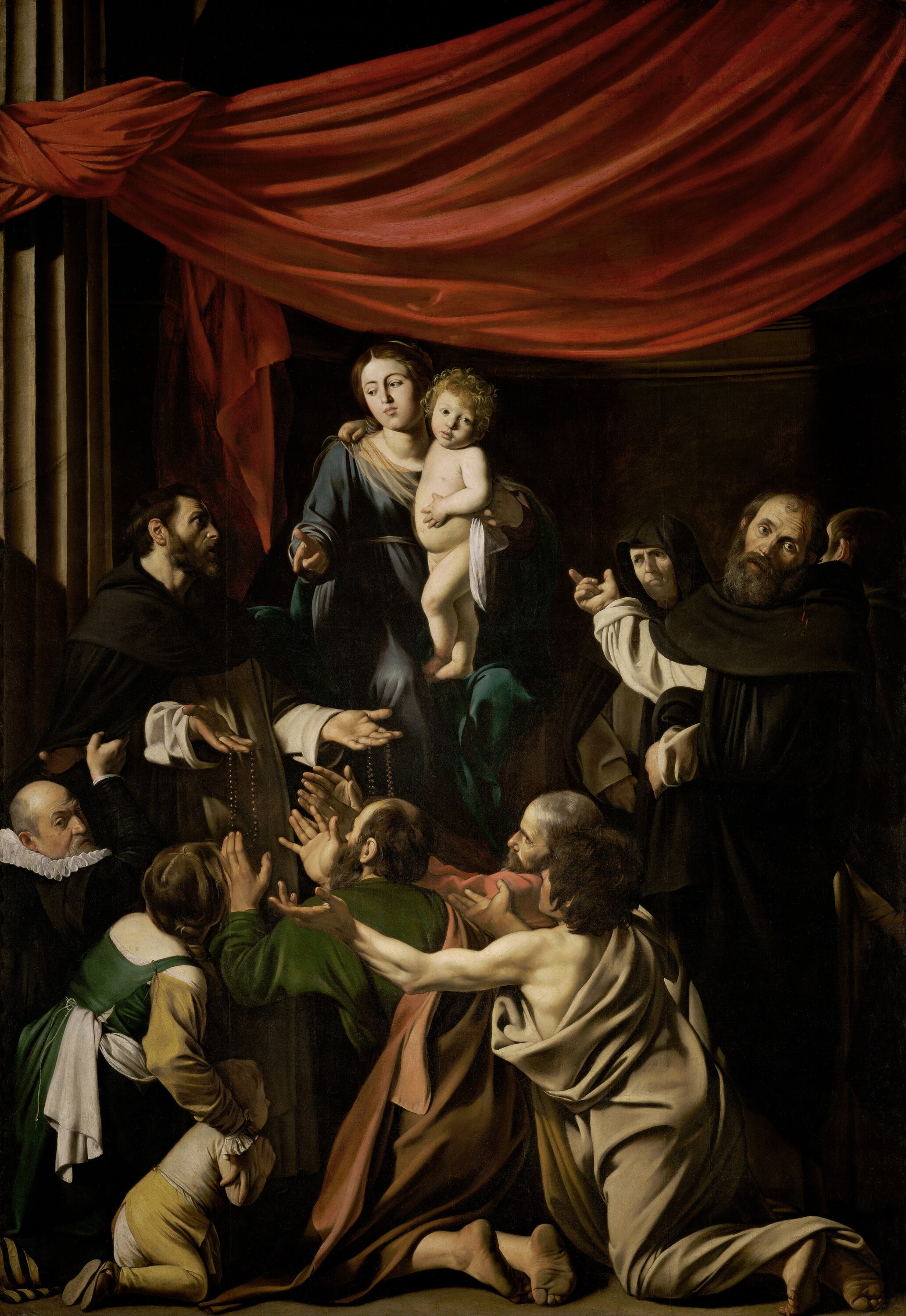
The Madonna of the Rosary is an altarpiece Caravaggio finished in 1607: beneath a vast red curtain the Virgin sits enthroned with the Christ Child on her lap, Saint Dominic in his black-and-white habit holds out rosaries, and below him a crowd of barefoot poor people kneel and stretch their hands up towards him. The original, oil on canvas, is 364.5 cm high and 249.5 cm wide and belongs to the Kunsthistorisches Museum in Vienna. Our painter paints it by hand for you in oil on canvas in 6 portrait sizes, from 90 x 130 to 160 x 240 cm, or to measurements you choose, and you see a photograph of the finished work before we ship it.
| Title: | The Madonna of the Rosary |
| Other titles: | Madonna del Rosario · Die Rosenkranzmadonna |
| Painter: | Michelangelo Merisi da Caravaggio (1571–1610) |
| Year painted: | 1607 |
| Original size: | 364.5 cm x 249.5 cm (height x width) |
| Original technique: | Oil on canvas |
| Painting style: | Baroque, tenebrism |
| Located at: | Kunsthistorisches Museum, Vienna |
| Our reproduction: | Hand-painted oil on canvas, 6 sizes or made to measure |
The Madonna of the Rosary – Caravaggio
What does The Madonna of the Rosary show?
The canvas is more than three and a half metres tall and crowded with people. A heavy red drape closes it at the top, swelling almost like a sail, and a thick column rises on the left. Under the drape the Virgin sits high on a throne, holding the naked Child, and with a wave of her hand she seems to give her assent to the saint below.
Beside her stands Saint Dominic, in a white habit under a black cloak, lifting strings of rosary beads as if about to hand them out. To his right is Saint Peter Martyr, with a large scar on his forehead, and behind him more Dominican friars.
At the bottom a knot of ordinary people kneel, barefoot, palms open, reaching for Dominic. At the far left a man in black with a white ruff shelters under the hem of the saint’s cloak and looks straight out of the painting at you: he is the donor, painted in among the faithful.
What do the rosaries mean in this scene?
The painting is about grace passing downward from hand to hand: from the Virgin to Dominic, and from Dominic to the people who ask him for help.
The Feast of the Rosary was established in 1571, after the Battle of Lepanto. Wikipedia notes that the presence of Saint Dominic and Saint Peter Martyr points to a Dominican church as the intended home, although the commissioner remains uncertain.
Some identify the donor as Nicholas Radulovic, a rich merchant of Ragusa, today’s Dubrovnik. Others, perhaps more plausibly, link the altarpiece to Luigi Carafa-Colonna and his family chapel in San Domenico Maggiore in Naples; the great column would then be a nod to the Colonna family.
Why does this altarpiece stand apart among Caravaggio’s works?
Wikipedia calls it the only painting by Caravaggio that could be called a standard Baroque altarpiece: the Virgin enthroned at the top, saints in the middle, the faithful below.
Yet he fills that scheme with his own kind of people. The kneeling poor, painted from live models, are closest to you, and their bare feet and outstretched hands come right up to the front edge of the canvas. Another altarpiece on a similar scale, also devoted to the Virgin, is Death of the Virgin.
Wikipedia also points to Peter Martyr’s scar: Caravaggio himself carried a similar head wound after a brawl with Ranuccio Tommasoni a few months earlier. Who ordered the work is discussed at length in the Wikipedia entry, in English.
Where is the original of The Madonna of the Rosary?
In Vienna, in the Kunsthistorisches Museum, where it is catalogued as GG 147.
According to Wikipedia, Caravaggio most likely painted it between 8 January and mid-July 1607, after finishing The Seven Works of Mercy and before he left for Malta. On 15 September that year the painter Frans Pourbus the Younger told his employer, Vincenzo I Gonzaga, Duke of Mantua, that it was for sale in Naples.
Something may have gone wrong with the original commission, because the painting reached the market very quickly. A group of Flemish buyers that included Rubens acquired it, took it to Antwerp and offered it to the Dominican church there.
The Madonna of the Rosary or another Caravaggio?
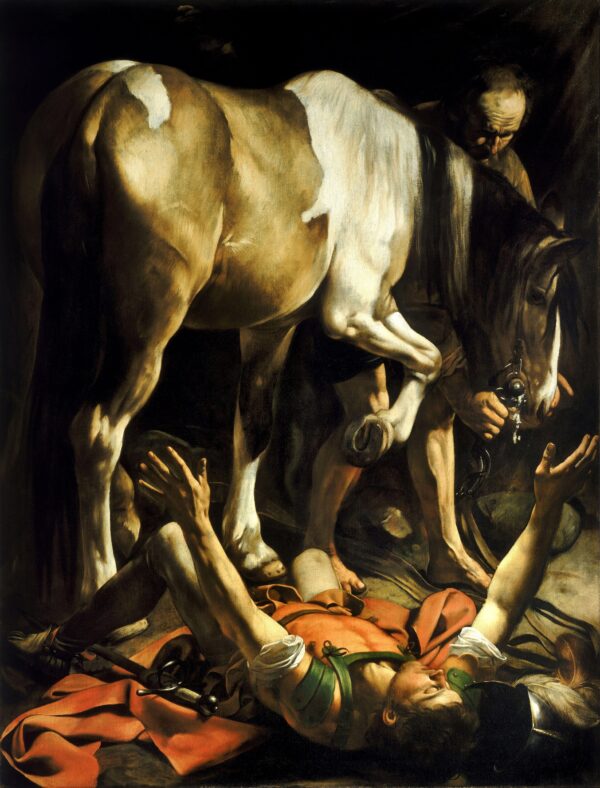
This is a canvas painting for a tall wall: a stairwell, a high-ceilinged hall, a meeting room or a parish space. If you want another Caravaggio with the Virgin and Child, look at The Adoration of the Shepherds of 1609, where Mary lies on the straw in a bare stable.
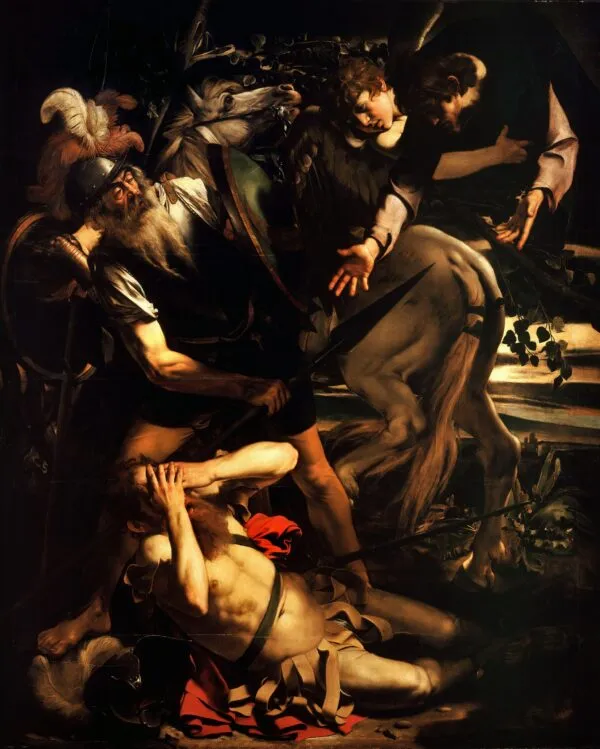
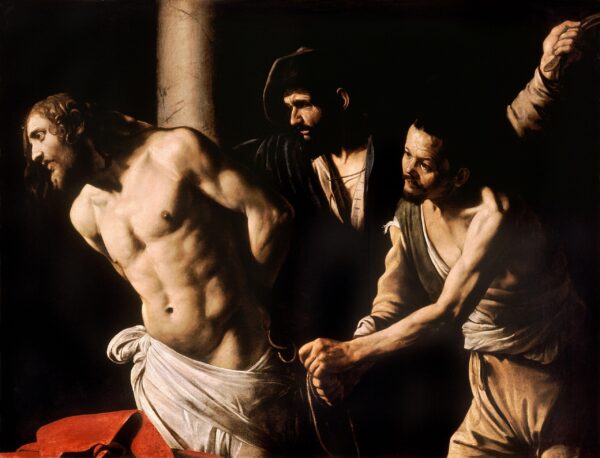
The same theme returns in Nativity with Saint Francis and Saint Lawrence, whose original was stolen in 1969 and has never been found. For a scene without heavenly figures, where Christ calls a tax collector away from his table, choose The Calling of Saint Matthew.
The Caravaggio shelf gathers the famous Caravaggio paintings we paint to order. The Madonna of the Rosary is the one among them built like a classic altar, in three tiers, from the throne down to the kneeling crowd.
How does our painter paint your Madonna of the Rosary?
Your Madonna is painted to order in oil on canvas, one layer over the next. The painter first blocks in the large masses, the red drape, the column, the throne and the dark group at the bottom, so that the three tiers of the composition sit where they should.
Then the light is built up over faces and hands. The longest work goes into the open palms of the poor, the beads in Dominic’s fingers and the donor’s white ruff glowing out of his black clothes.
The result is a Caravaggio reproduction with real brushwork: the strokes show in the lit passages, and in the shadows the paint gains depth. An oil painting reproduction like this one lets the red curtain almost glow under an evening lamp.
Which size for which wall?
In short: 90 x 130 or 99 x 151 cm for a narrow wall between windows or in a hallway, 114 x 165 or 130 x 181 cm for a free wall in a living area, and 142 x 213 or 160 x 240 cm for a stairwell, a lobby or a wall at least three metres high.
There are 6 portrait sizes (width x height): 90 x 130, 99 x 151, 114 x 165, 130 x 181, 142 x 213 and 160 x 240 cm. The original is larger than all of them: our biggest size, 160 x 240 cm, is 89.5 cm narrower and 124.5 cm lower.
As a painting for the living room, 114 x 165 cm works well above a low sideboard or bench, leaving some space below the ceiling. Hang it so that the faces of the kneeling crowd are roughly at eye level.
Can I order a custom size, and which frame suits it?
Yes. The composition is upright and arranged in three tiers, so it transfers well to other portrait formats. Send us the width and height you want and we reply with a price and a production time.
We ship rolled, stretched on a stretcher bar or framed; the stretching and framing are done by our workshop in Slovenia. In our 3D app you choose only the frame, while seeing the painting on your own wall is a separate service.
A broad gold frame suits the red drape; plain dark wood suits a modern room.
When and how will my painting arrive?
We begin as soon as your order is confirmed, and the canvas is ready to travel within 15 to 45 working days. Before dispatch you receive a photograph of the finished Madonna, and if you would like something changed, we change it. There are no customs within Slovenia or the rest of the EU, and our returns policy covers every order.
It makes a thoughtful gift for a parish, a convent, someone named Mary or a family who prays the rosary. If the recipient should choose the size, give a wall art voucher instead.
Frequently asked questions
Where is the original kept?
In Vienna, at the Kunsthistorisches Museum, inventory number GG 147.
Who is Dominic handing the rosaries to?
To the faithful kneeling below him; Wikipedia says the work was meant for a Dominican church.
Who is the man in black on the left?
The donor, sheltering under Dominic’s cloak and looking out at the viewer; who exactly he was is not certain.
Is this a print?
No. Every Madonna of the Rosary we send is a hand-painted copy in oil paint on canvas.
How large is the original?
It is 364.5 cm high and 249.5 cm wide, larger than our biggest size of 160 x 240 cm.
Will it fit a home with an ordinary ceiling?
Yes. At 90 x 130 or 99 x 151 cm it suits a normal wall in a flat or a house.
Can you paint a size that is not on the list?
Yes, tell us the width and height and we send you a price and an expected date.
How long does it take to make?
15 to 45 working days from your order; a photograph of the finished painting reaches you before dispatch.
- Subject: the Virgin and Child enthroned, Saint Dominic with rosaries, Saint Peter Martyr, Dominican friars and barefoot kneeling faithful.
- Original: 1607, oil on canvas, 364.5 x 249.5 cm, Kunsthistorisches Museum, Vienna.
- Ours: painted by hand in oil on canvas in 6 portrait sizes from 90 x 130 to 160 x 240 cm, or made to measure.
- Worth knowing: soon after it was painted, a group of Flemish buyers including Rubens bought it and took it to Antwerp.