







































Description
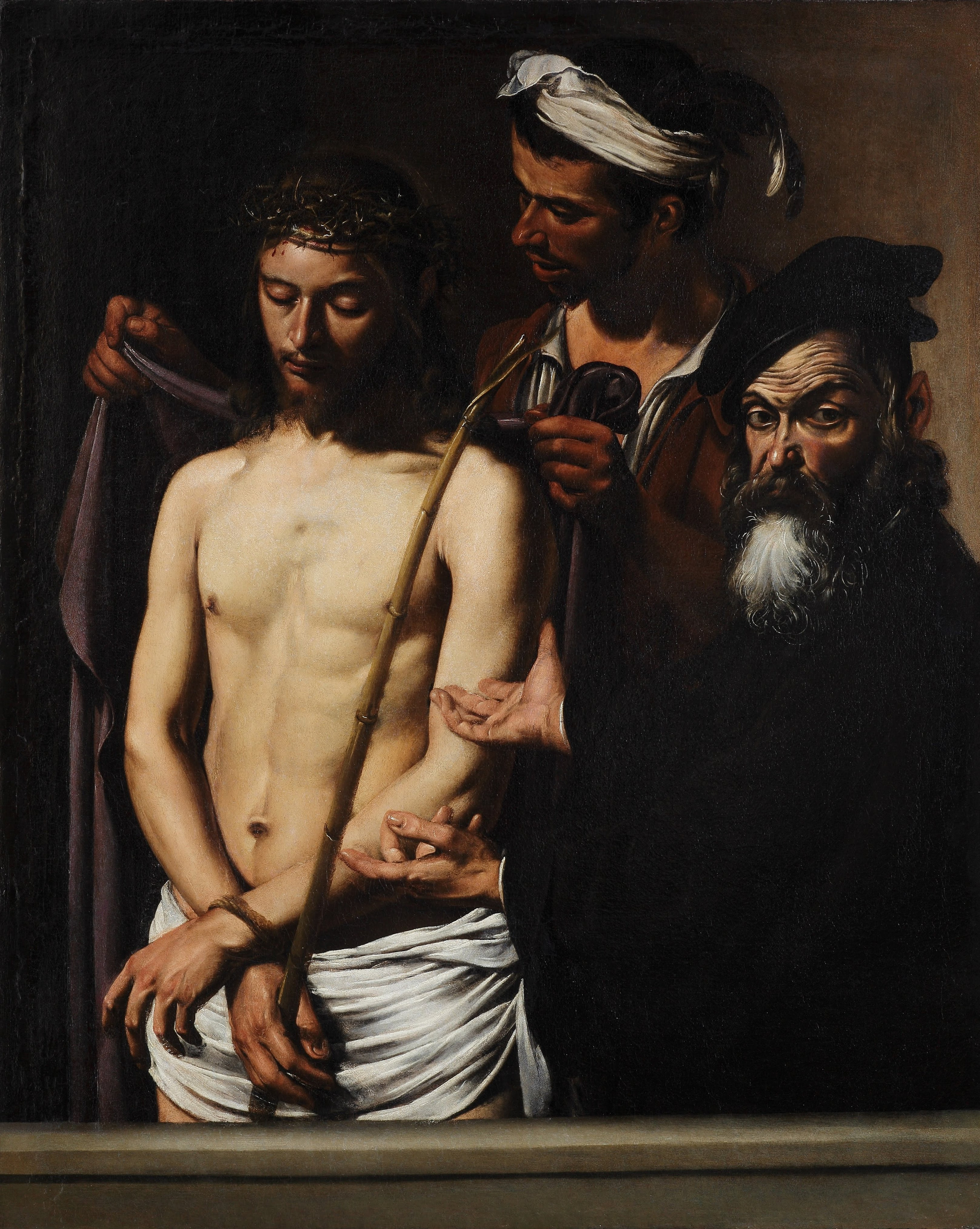
Ecce Homo is a painting by Caravaggio from about 1605–1606, though the dating is debated: Christ, crowned with thorns, bare to the waist and with his hands bound, stands with his eyes lowered while a tormentor behind him lifts a red cloak onto his shoulders, and on the right Pontius Pilate, dressed in black and wearing a hat, faces us and gestures towards him. The original, oil on canvas, is 128 cm high and 103 cm wide and hangs in the Palazzo Bianco in Genoa. Our painter paints it for you by hand in oil on canvas in 8 portrait sizes, from 43 x 53 to 150 x 195 cm, or to your own measurements, and before it ships we send you a photograph of the finished painting.
| Title: | Ecce Homo |
| Other titles: | Ecce Homo di Genova · Ecce Homo (Genoa) |
| Painter: | Michelangelo Merisi da Caravaggio (1571–1610) |
| Year painted: | c. 1605–1606 (1609 according to John Gash) |
| Original size: | 128 cm x 103 cm (height x width) |
| Original technique: | Oil on canvas |
| Painting style: | Baroque, tenebrism |
| Located at: | Palazzo Bianco, Genoa, Italy |
| Our reproduction: | Hand-painted oil on canvas, 8 sizes or made to measure |
Ecce Homo – Caravaggio
What does Ecce Homo show?
The canvas is upright and the background almost uniformly dark: no architecture, no crowd, no landscape. Everything happens in a narrow strip just in front of us, where three half-length figures press close together.
Christ wears the crown of thorns; he is bare to the waist and his hands are tied. His eyes are lowered and he looks at no one. Behind him a tormentor raises a red cloak onto his shoulders, as though dressing him as a king.
At the right edge stands Pontius Pilate, in black, with a hat on his head. He turns towards us and points at Christ, as if speaking to whoever stands before the canvas. The light falls on Christ’s bare body, the brightest part of the painting, while Pilate’s black clothes almost melt into the dark.
What do the words Ecce homo mean?
In Latin they mean “Behold the man”. In the Gospel of John (19:5) Pilate speaks these words as he shows the scourged Christ to the crowd. According to Wikipedia, Caravaggio combined that moment with the one just before it, when the tormentors mockingly robed Christ, already crowned with thorns, like a king.
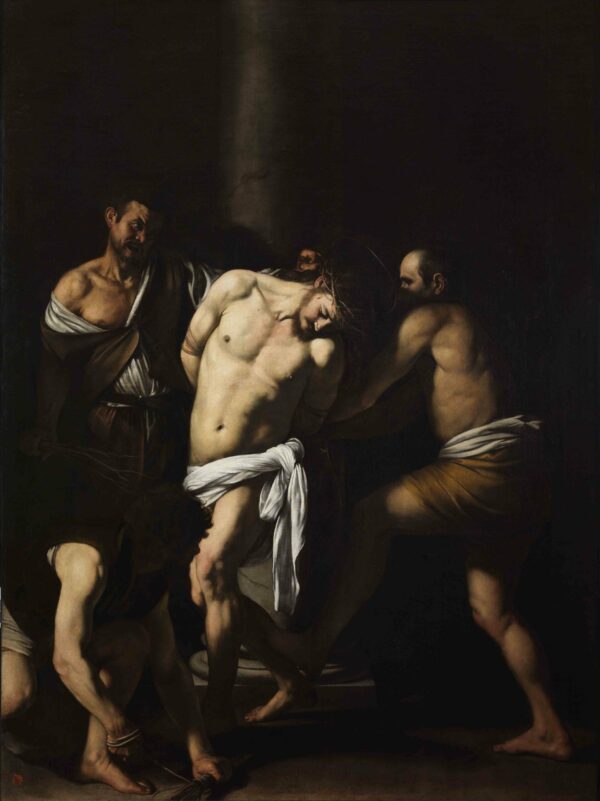
Before this Christ was scourged, and Caravaggio shows that scene in The Flagellation of Christ and in Christ at the Column.
Why is this Ecce Homo so well known?
Because of the story that comes with it. According to Giambattista Cardi, nephew of the painter Cigoli, Cardinal Massimo Massimi commissioned the same subject from three painters, Cigoli, Caravaggio and Domenico Passignano, without telling any of them about the others. Cardi claimed the cardinal liked Cigoli’s version best; Passignano’s has never resurfaced.
The contract for Caravaggio’s version was signed on 25 June 1605, with delivery due at the beginning of August. Whether he met the deadline is uncertain: that summer, in trouble with the law, he fled to Genoa until the end of August, the very city where the painting hangs today.
His mature Roman style shows too: the figures are close, modelled by strong light, with no depth or background. He did not paint the tormentor as a grotesque, as convention had it, but as a man in whom cruelty is mixed with pity. Pilate seems almost neutral, perhaps even sympathetic, and is dressed as an official of Caravaggio’s own time. The English Wikipedia article goes into this in more detail.
Where is the original, and how did it get there?
The original belongs to the Palazzo Bianco in Genoa, inventory number PB1638. Until the Second World War it hung in a stairwell of the nautical school in Genoa, listed in the inventory as a copy by Leonello Spada.
During the war it was moved and for a time was thought lost. In 1953 Caterina Marcenaro, Genoa’s Director of Fine Arts, rediscovered it in the Palazzo Ducale, and in 1954 she and Roberto Longhi first attributed it to Caravaggio.
The attribution is still argued over. In 1954 the restorer Pico Cellini worked on it heavily in Rome and added a narrow band of new cloth to all four edges, which makes it harder to judge what comes from the painter’s own hand. Sebastian Schütze disputes the attribution, while Anna Orlando, who oversaw the 2003 restoration, and Lorenzo Pericolo regard it as a genuine Caravaggio.
Ecce Homo or another Caravaggio?
Ecce Homo is a canvas painting for people drawn to quiet, contemplative sacred art: a study, a library, an entrance hall or a place set aside for prayer.
If you want a scene from the same stretch of the Passion, look at The Crowning with Thorns, where the tormentors are still pressing the crown onto Christ’s head. For a lighter mood there is The Inspiration of Saint Matthew of 1602, a bright scene in which an angel in white dictates the Gospel to the evangelist.
All the famous Caravaggio paintings we can paint for you are listed on the Caravaggio page.
How does our painter paint your Ecce Homo?
Every Ecce Homo is painted to order, in oil on canvas and in several layers. The painter starts with a dark underpainting and then lays in the three figures, so that Christ’s body, the red cloak and Pilate’s black clothes sit in the right balance from the first hour.
Then he builds up the light. Christ’s skin gets warm, soft transitions, the cloak a deep, full red, the crown of thorns sharp dark points. Particular care goes into Christ’s bound hands and into Pilate’s face, which looks straight out at us.
This Caravaggio reproduction has visible brushstrokes in the lit passages and, in the dark, a depth that shifts with the daylight. As an oil painting reproduction it has nothing of a print about it: the paint lies on the canvas in layers, and under a lamp Christ’s body glows out of the dark ground.
Which size for which wall?
In short: 43 x 53 or 55 x 66 cm for a niche or a narrow wall, 60 x 78 or 78 x 95 cm between two windows or in a hallway, 85 x 110 or 110 x 135 cm above a chest of drawers or a sofa, and 120 x 155 or 150 x 195 cm for a tall wall or a staircase.
We paint Ecce Homo in 8 portrait sizes (width x height): 43 x 53, 55 x 66, 60 x 78, 78 x 95, 85 x 110, 110 x 135, 120 x 155 and 150 x 195 cm. The closest to the original is 110 x 135 cm, which is 7 cm wider and 7 cm taller.
As a painting for the living room it belongs on a calm wall with no shelves or television beside it; there 85 x 110 cm shows all three faces clearly without crowding the room.
Can I have a different size or a frame?
Yes. The figures reach almost to the edges, so we adapt the composition to other proportions with care, keeping Pilate’s hand and Christ’s bound hands whole. Send us the width and height you want and we will come back with a price and a production time.
You can receive the painting rolled, stretched on a stretcher bar or framed. Our workshop in Slovenia stretches and frames each Ecce Homo before it leaves. You pick the frame in our 3D app, which is for choosing the frame only; seeing the painting on your own wall is a separate service.
When and how will Ecce Homo arrive?
We begin once your order arrives, and the painting is ready to travel within 15 to 45 working days. Before dispatch we send you a photograph of the finished painting, and if anything is not as you would like, we correct it. Shipping within Slovenia and the rest of the EU involves no customs, and every order is covered by our returns policy.
Ecce Homo is a thoughtful gift for someone who loves sacred art or the history of painting. To let the recipient decide on the size, give a wall art voucher instead.
Frequently asked questions
Where can I see the original?
In the Palazzo Bianco in Genoa, under inventory number PB1638.
What does the title mean?
“Behold the man”: in the Gospel of John these are the words with which Pilate shows Christ to the crowd.
Is it a print?
No. It is a hand-painted copy: our painter puts every brushstroke onto the canvas in oil.
How big is the original?
128 cm high and 103 cm wide; our nearest size is 110 x 135 cm.
Is it really by Caravaggio?
Roberto Longhi, Anna Orlando and Lorenzo Pericolo attribute it to him; Sebastian Schütze doubts it.
Is it suitable for a bedroom?
It sits better in a study, a hallway or a quiet corner of the home, since it is a serious scene from the Passion.
Can you paint it in another size?
Yes, any size: tell us the width and height and we will quote a price and a delivery date.
How long do painting and delivery take?
It is ready in 15 to 45 working days, and you get a photograph of it before it ships.
- Subject: Pilate shows the crowd the scourged Christ, crowned with thorns, as a tormentor drapes a red cloak over his shoulders from behind.
- Original: c. 1605–1606 (dating debated), oil on canvas, 128 x 103 cm, Palazzo Bianco, Genoa.
- Ours: painted by hand in oils on canvas; 8 portrait sizes from 43 x 53 to 150 x 195 cm, or a size you choose.
- Worth knowing: until the Second World War the painting hung in the stairwell of a nautical school, catalogued as a copy.