Description
| Year of creation: | 1874 |
| Original size: | 79.7 cm x 60 cm |
| Painting style: | Impressionism |
| Original technique: | Oil on canvas |
| Located: | National Gallery of Art, Washington (Paul Mellon Collection) |
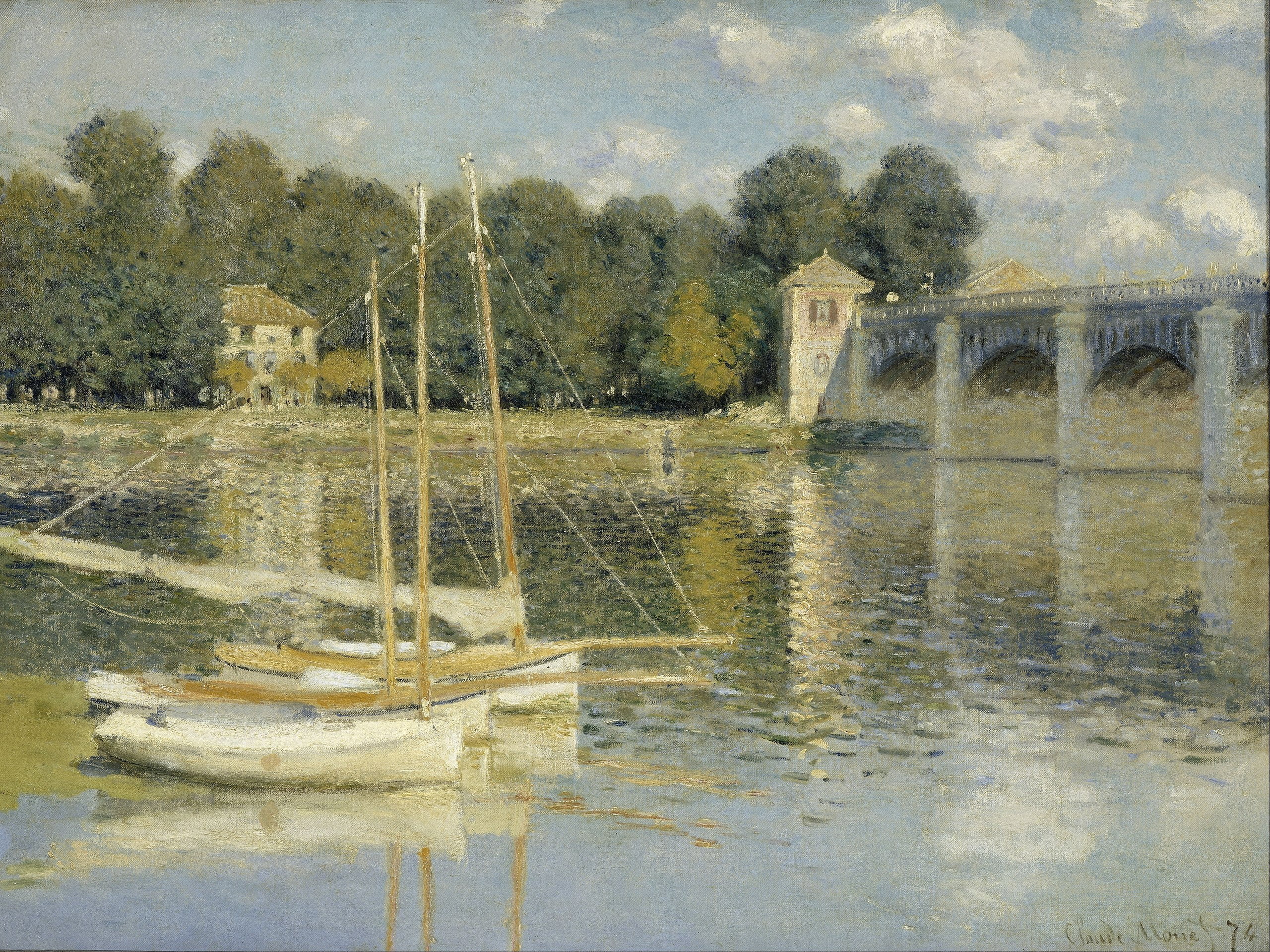
The Bridge at Argenteuil is a hand-painted oil reproduction of Monet’s 1874 work: a stone road bridge crosses the Seine on the right, and two moored sailing boats with bare masts lie in front of it.
The Bridge at Argenteuil, 1874 – Claude Monet
What is on the canvas
The canvas lies landscape. On the right a stone road bridge with square piers and shallow
arches crosses the river; a pale parapet runs along the top and narrows towards the right edge
in perspective. At the near end of the bridge stands a square toll house with a pink-cream
facade and a dark hipped roof. In the foreground on the left two sailing boats lie moored, with
bare and very tall masts; the nearer hull is white, the second carries a dark waterline, and
ropes fall diagonally between them. Behind them the far bank runs with a dense line of
green-grey trees and a pale two-storey house with a brown-red roof. The lower half is taken by
water, painted in short horizontal dashes; long vertical reflections fall beneath the piers and
masts. Above stands a pale blue sky with cumulus. The canvas is signed at the lower right.
Horizontal and vertical
The scene is built from two opposing directions: the horizontals of bridge, parapet and water
surface against the verticals of masts, piers and reflections. It is that crossing that holds
the work together, even though the motif itself is quiet. The water is not painted as a surface
but as a run of short strokes that lengthen into vertical bands beneath the piers — the
reflection is made of the same strokes as the ripples, only turned. This oil on canvas
reproduction comes from the years when Monet had already given up smooth finishing while
keeping the firm drawing of architecture: the bridge is exact, the water is not.
The motif in Monet’s work
Monet painted Argenteuil repeatedly and from both banks. The other bridge of the same place,
the railway one, is
The Railway Bridge at Argenteuil,
where industrial structure takes over from sailing. Water without architecture is offered by
Fishing Boats at Sea and
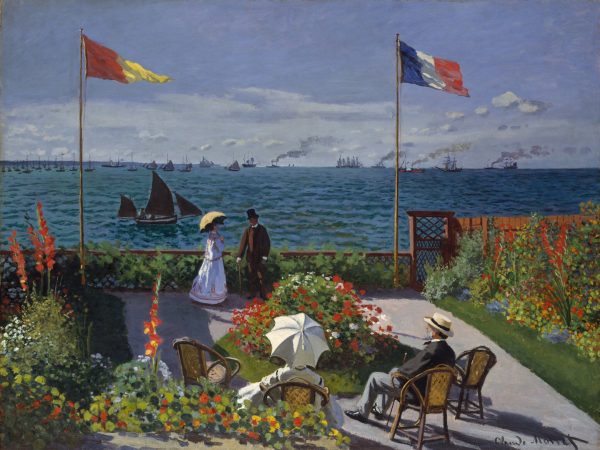
Terrace at the Seaside, Sainte-Adresse.
How far Monet later broke the stroke apart on water is shown by
Impression, Sunrise.
Museum and record
The original is held by the National Gallery of Art in Washington, in the
Paul Mellon Collection, under accession number 1983.1.24. The record lists it
as oil on canvas measuring 79.7 x 60 cm and gives the year as 1874. The year is
not only a line in the record: at the lower right, beside the signature, the number 74
is painted in, so the work confirms its own date.
How it behaves on a wall
The landscape format, close to 4 : 3, asks for a wide wall. Because the upper third is light
and empty, the motif also takes a lower hang, for instance above a low chest of drawers.
40 x 30 cm and 50 x 40 cm suit a hallway or an office. 60 x 40 cm and 70 x 50 cm are usual above
a desk. 80 x 60 cm comes closest to the size of the original, which measures
79.7 x 60 cm, and is therefore the most faithful choice. 90 x 70 cm, 120 x 90 cm and
150 x 110 cm are for broad walls where the bridge can stretch its full length. As wall decor it
stays quiet and does not compete with the furniture beneath it.
Hand-painted, not a print
This hand-painted canvas art is made with a brush rather than a printer. A print lays colour
in an evenly thin film, so stone piers and moving water come out equally smooth. Applied by hand
the bridge is painted in quiet, broad areas while the water goes on in hundreds of short strokes
standing above the weave. Light returns differently from those two surfaces, so on the wall too
the water reads livelier than the architecture — a print cannot do that, because everything on
it is the same thickness. Being handwork, each copy differs a little, so a fine art reproduction
of this kind stays a single object.
Custom sizes, frame, ordering and lead time
If none of the eight sizes fits, we paint to the size you set, keeping the ratio of the sides.
A 3D application is available for the frame — it is for frame selection only and
does not place the work in your room; the separate visualisation service does that. The lead
time is 15 to 45 days, because the work is painted to order, and before dispatch
we send you a photograph of the finished piece for approval. Further reproductions on canvas and
famous paintings on canvas are in the
Claude Monet gallery.
- Subject: stone road bridge over the Seine, a toll house beside it, two moored sailing boats in front.
- Technique: oil on canvas; the bridge in quiet areas, the water in hundreds of short strokes.
- Sizes: landscape format, eight sizes from 40 x 30 cm to 150 x 110 cm; 80 x 60 cm is closest to the original.
- Worth knowing: beside the signature at the lower right the number 74 is painted in — the work carries its own year.