







































Description
| Title: | Blue Water Lilies |
| Other titles: | Nymphéas bleus · Blaue Seerosen · Ninfee blu |
| Painter: | Claude Monet (1840–1926) |
| Year painted: | between 1916 and 1919 (the museum does not date it to a single year) |
| Original size: | 200 cm x 204 cm |
| Original technique: | Oil on canvas |
| Painting style: | Impressionism |
| Located at: | Musée d’Orsay, Paris (accession no. RF 1981 40) |
| Our reproduction: | Hand-painted oil on canvas, eleven square sizes from 50 x 50 to 200 x 200 cm or made to measure |
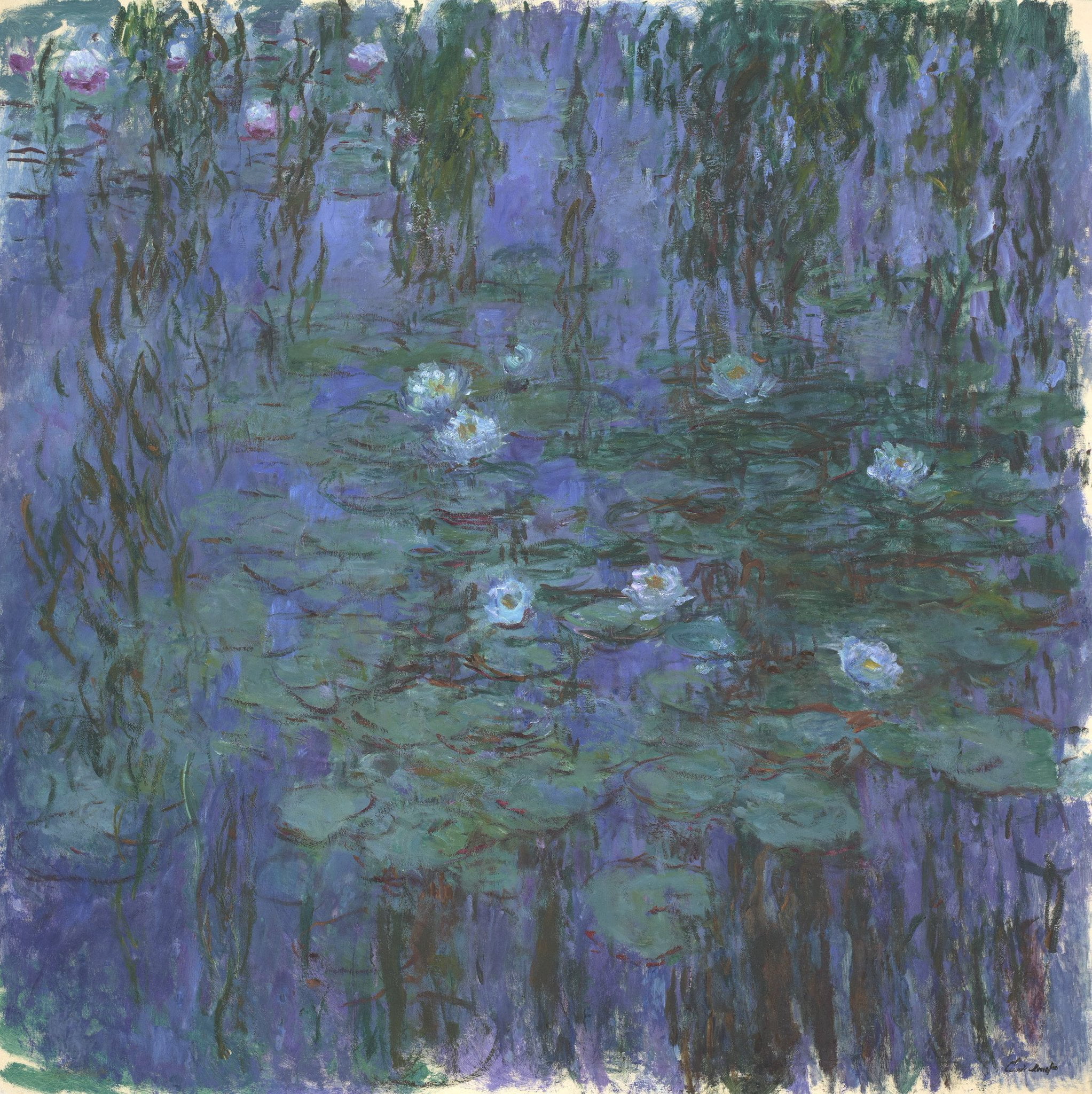
Blue Water Lilies is Monet’s view straight down into the water garden at Giverny: no horizon and no sky, only the surface with blossoms, pads and the vertical reflections of willow branches. The original is held by the Musée d’Orsay in Paris under accession number RF 1981 40 and dated between 1916 and 1919. With us it is made as a hand-painted oil painting reproduction on canvas, in eleven square sizes or to your own measurements, with a photograph of the finished work sent for approval before dispatch.
Blue Water Lilies – Claude Monet
What is shown?
The water garden at Giverny, which Monet had made in 1893 and in which he grew white water lilies. There are no people in the scene and no named figures — it is not a portrait but a crop of the water surface. From the 1910s until his death in 1926 this pond was very nearly his only subject. The museum record does not date the work to a single year but between 1916 and 1919, and that is how we give it too.
What is on the canvas?
The canvas is almost square and the view looks down rather than ahead: Monet left out the horizon and the sky, so there is neither bank nor edge for the eye to hold on to. Only the surface remains. As an oil painting reproduction that is an unusual thing to hand a painter: without an edge there is nothing to measure the drawing against. Across it the lily pads are spread — flattened ovals in green and blue-green that shrink and crowd toward the upper edge. Among them stand a few white blossoms with a yellowish centre and a barely pink rim. The water is violet-blue, and vertical dark green strokes fall across it: the reflections of the willow branches above the pond, painted as long, faintly wavering lines. Because of them the surface reads at once as a plane and as depth.
Why is this painting important?
Because it belongs to Monet’s last great undertaking and shows how far he pushed the motif. The late water lilies were made as large canvases meant to surround the viewer; eight such compositions Monet gave to France the day after the Armistice of 11 November 1918, and to his own plans they were installed in 1927 in two oval rooms at the Musée de l’Orangerie. This canvas is not part of that cycle, but it comes from the same years and the same idea: a painter who abandoned the horizon and painted nothing but water.
What does the painting mean?
It has no narrative and no event. Because the horizon is missing, the usual agreement about where we stand is missing too — the viewer is above the water and in it at once. The blossoms lie on the surface, the willow reflections fall vertically through it, and the eye moves continually between the two readings. As an impressionist painting this is not a scene but a state: light on water at a particular hour, which is why this Monet reproduction holds a large wall so easily. That is exactly why it stays calm at a large size, where a narrative motif would become demanding.
Which of Monet’s water lilies is this?
Monet painted the water garden again and again, so it is useful to know which canvas you are looking at. This is the Orsay version: almost square, 200 x 204 cm, without horizon or sky, with violet-blue water and vertical willow reflections, dated between 1916 and 1919, accession number RF 1981 40. Other versions of the motif in our collection are Water Lilies, The Water Lily Pond (Japanese Bridge), Weeping Willow and Water Lilies I.
How is our hand-painted version made?
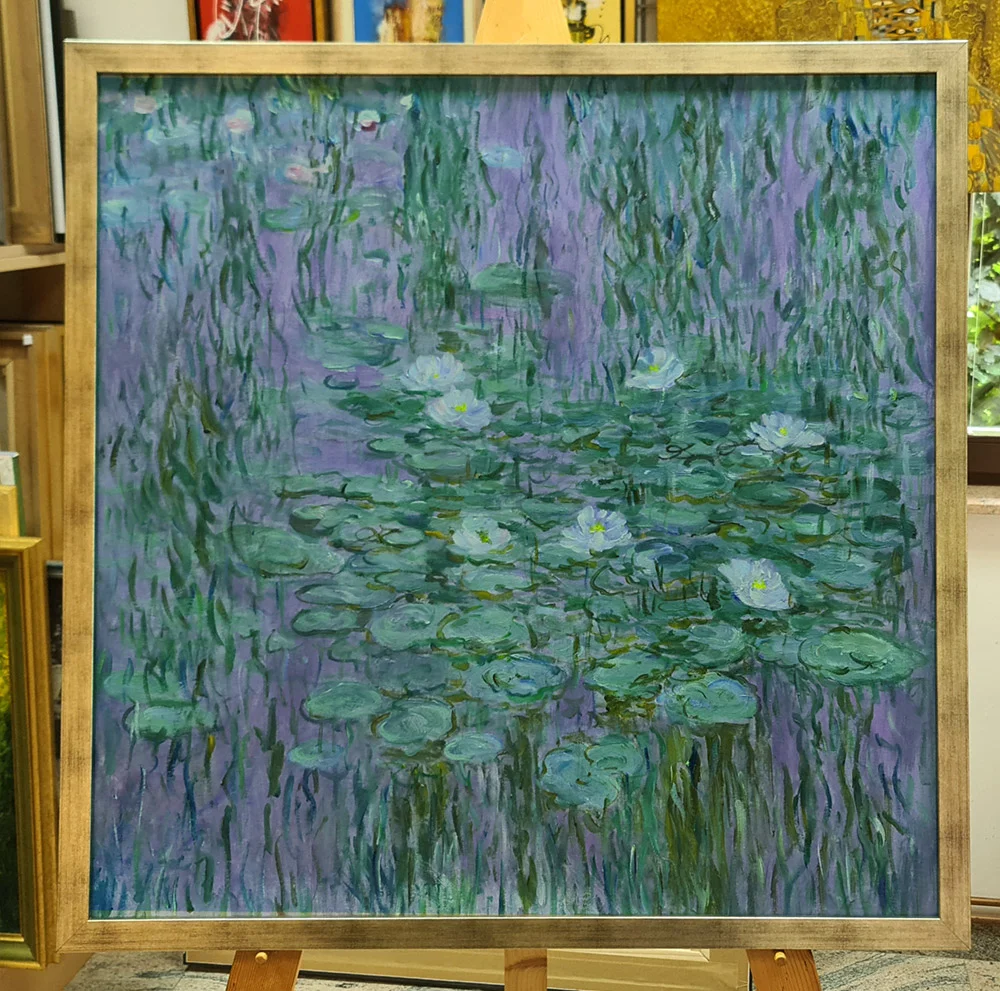
The painter works with a brush and oil colour, not a printer, and builds the surface in two layers: first the broadly laid violet-blue water, then the pads and blossoms as a denser body of paint above it. In the first photograph the finished canvas stands framed in a gold moulding on the easel in our workshop, shot head on, so you can see how the square format sits with a frame. That relief is precisely what a print cannot give you, because there is nothing on it to cast a shadow. Every copy is made individually, so no two canvases are quite alike; as a hand-painted copy each is its own work, and every canvas painting that leaves the workshop is photographed in daylight first.
In the 59-second video under the description the brush is at work: white paint is laid onto a lily blossom, filmed close up, and the same shot shows the weave of the canvas under the paint.
Which size for which wall?
If you are unsure which: 100 x 100 cm. Our ladder is square while the original measures 200 x 204 cm and is therefore almost square — our largest size, 200 x 200 cm, is only four centimetres shorter than it. 50 x 50 and 60 x 60 cm belong in a hallway or between two windows; 70 x 70 and 80 x 80 cm sit well above a chest of drawers; 90 x 90 and 100 x 100 cm are the usual choice above a sofa. From 120 x 120 cm upward you are into large walls and tall rooms, where a motif without a horizon gets the room to work like a window into water. Because the scene is quiet and low in contrast it reads better on a calm wall; as a painting for living room walls it settles the room instead of asserting itself. As impressionist wall art the square is also forgiving, because it forces the furniture in no particular direction.
How high to hang the painting: the centre at eye level, roughly 145–150 cm from the floor; above a sofa 15–25 cm above the back. The square format also tolerates hanging a little lower.
Custom size, stretcher and frame
If none of the eleven sizes suits your wall, we paint to your measurements; that is our painting made by order. Because the original is almost square we keep the square ratio on custom sizes too, so the pads are never stretched. Every copy is delivered stretched on a wooden stretcher and ready to hang. For the moulding, use our 3D application: it shows every one of our frame profiles on this subject, so you can compare gold, silver, black, white and natural wood before deciding — the application is for choosing the frame only. If you want to see how it will look on your own wall, that is our separate room-placement service.
Delivery and guarantee
Every copy is made to order in our studio in Slovenia, so allow 15 to 45 days depending on the size you choose; the large squares sit at the upper end of that range. We ship it stretched and protected for transport, framed if you chose a frame, across the EU with no customs. Before dispatch you receive a photograph of the finished work to approve, and our returns policy applies to every order. The full range is in the Claude Monet gallery, and the painter’s life is set out in our Claude Monet article.
If the painting is a gift and you are unsure of the size, there is a voucher: the recipient chooses the size and the subject.
Frequently asked questions
Where is the original?
At the Musée d’Orsay in Paris, under accession number RF 1981 40. The museum record lists it as oil on canvas, 200 x 204 cm.
What is the work about, in one sentence?
A surface without a horizon: blossoms on the water and willow reflections in it, light instead of a scene.
Why did Monet paint water lilies?
Because the pond was his own creation: from 1899 until his death in 1926 he painted the water garden at Giverny about 250 times, chasing the changing light on the water.
Is the original for sale, and what is it worth?
No. The original is in a museum collection and is not for sale, so it has no market price. Monet’s major canvases are among the most expensive paintings ever sold at auction: one of his Haystacks paintings (Meules, 1890) sold at Sotheby’s in May 2019 for 110.7 million dollars.
- Subject: the water garden at Giverny without horizon or sky — blossoms on the surface and vertical willow reflections, between 1916 and 1919
- Original: 200 x 204 cm, oil on canvas, Musée d’Orsay, Paris (inv. RF 1981 40)
- Our version: hand-painted in oil on canvas, eleven square sizes from 50 x 50 to 200 x 200 cm
- Worth knowing: no horizon and no sky — the viewer is above the water and in it at the same time