
Description
| Title: | Fruit Trees |
| Painter: | Claude Monet |
| The original: | not securely identified |
| Our reproduction: | Hand-painted oil on canvas, twelve sizes or made to measure |
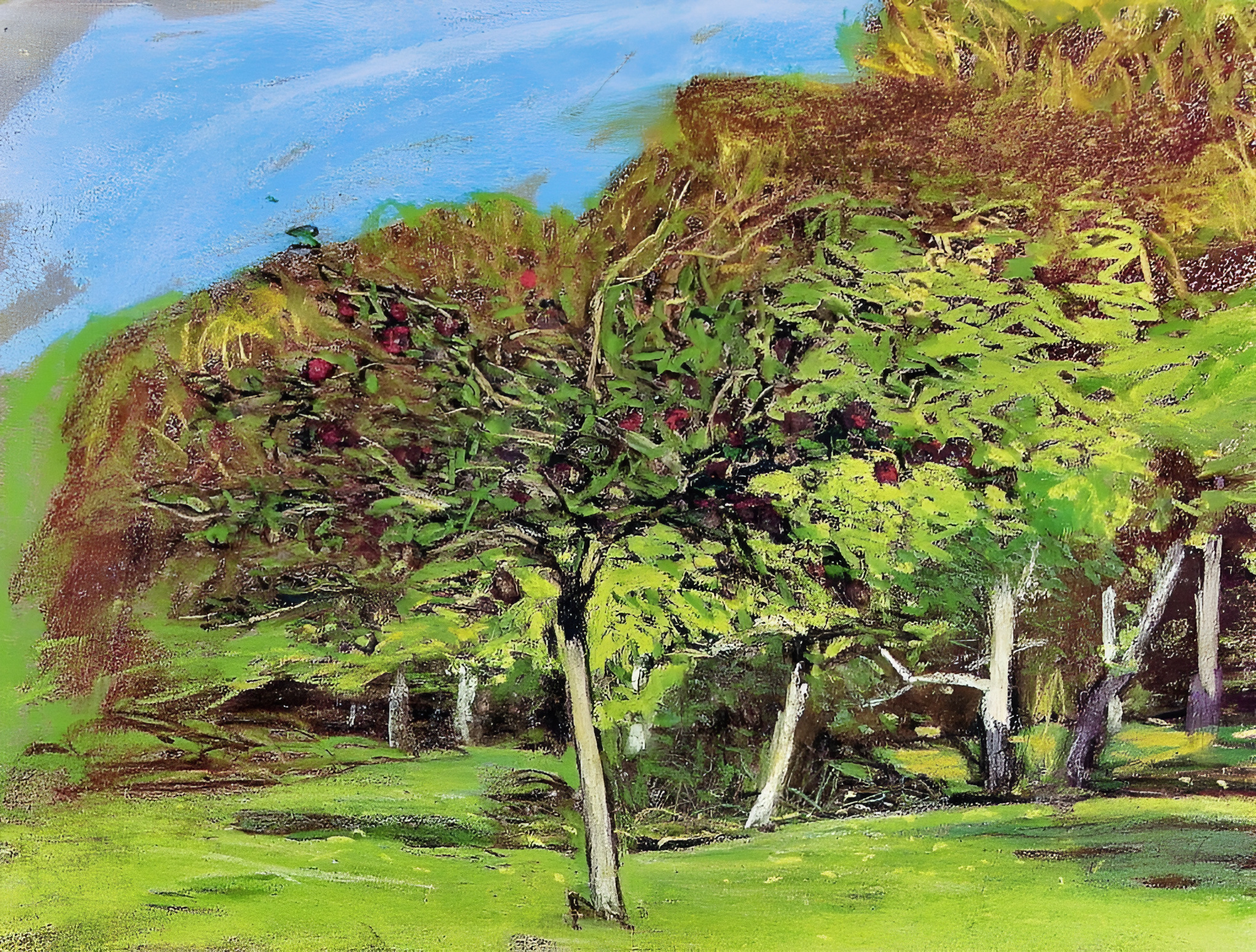
Fruit Trees is a hand-painted copy of a study by Monet: a low fruit tree with a wide-spreading crown and dark red fruit stands in front of a bank of dense foliage, with a band of bright green grass running below it. We paint it in twelve sizes or to your own measurement, oil on canvas, with a photograph of the finished work sent for approval before dispatch. Which of Monet’s canvases of fruit trees is the original of this particular reproduction is not established, so you will find neither a year nor a museum here.
Fruit Trees – Claude Monet
What is shown?
At the centre stands a low fruit tree with a pale, almost white trunk that forks near the top. The crown spreads wider than it is tall, in yellow-green and dark green strokes, with dark red fruit scattered among them — a few dozen dots the eye reads as fruit at once, because they are the only warm colour in the whole green mass. Behind the tree and to the right a bank of dense foliage rises in olive, ochre and rust, closing completely in the top right corner. On the left the same bank falls away and brown-red earth shows beneath it; among the foliage to left and right stand eight or more pale, thin trunks. The lower fifth is a band of bright green grass with darker shadows, and at the top left there is a wedge of blue sky with a pale grey bar of cloud. There is nothing else on this canvas.
How was the work made?
Landscape in format, and made quickly — this is a study, not a show piece. The stroke is very free, thin and dry throughout, and the grain of the ground shows through the colour even in the dark passages. That granular, dry mark is exactly why the work looks quick: the colour is not worked but dragged across, and where the tool skipped, a gap was left that nobody closed. What the original was made with we do not claim here: a mark like that allows a dry medium as readily as thinly applied oil, and our source will not settle it. Our own canvas painting repeats those marks in oil.
Why is this a study and not a landscape?
Because it is not finished and never meant to be. The tree is not drawn and then coloured in; it is assembled out of the directions of the foliage. The strokes turn the way the branches grow, and the eye builds a crown out of them although no single stroke is a leaf. The fruit is only dots. The bank behind is one single mass, without a drawn trunk anywhere except those eight or more pale ones. This is a note made in one afternoon, not the description of a place, and that is exactly why it holds up in a room where an exact landscape would look harsh.
Deliberately not stated here
Monet painted fruit trees again and again — at Vétheuil, at Giverny, in blossom and in fruit — and the surviving canvases differ in size, in framing and in year. Which of them is the original of this particular reproduction is not established, so you will find no year here, no collection name, no inventory number — and no size for the original either. We say what is visible on the canvas, and nothing beyond it.
Other fields and gardens by Monet
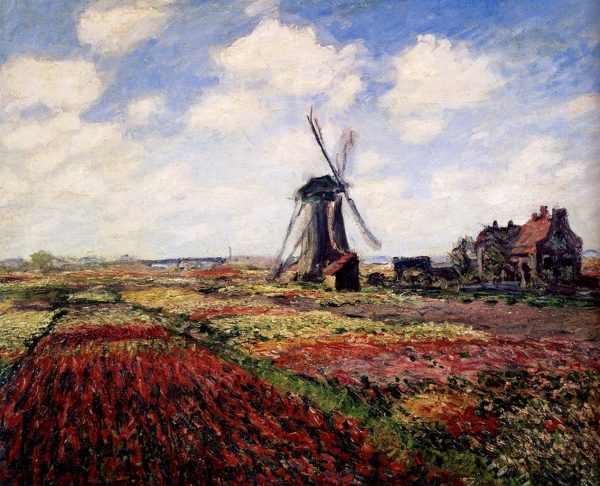
If what draws you to this subject is precisely that — a field or a garden with no story, only colour and a time of day — there are four related canvases in our range. A poppy field with tiny figures: Poppies near Argenteuil. A field in flower, where the bands of colour run into the distance: Field of Tulips in Holland. A garden with white dresses, large and upright: Women in the Garden. And a corner of a garden, the closest of the four to this one in how much it takes in: Corner of the Garden at Montgeron. All four are larger and more finished than this study; an impressionist painting this sparing is the exception among them.
How is our hand-painted version made?
The difficulty of this subject is not the drawing but the restraint. The painter has to stop exactly where it would be easiest to carry on: the crown must stay a mass with a direction and must not become a heap of leaves, and the fruit must stay dots and must not become apples. So the work goes in order — the bank behind first, because it decides how light the crown may be, then the crown in two greens, then the grass, and only last the red dots, of which there are the fewest. Put them on too early and they get covered in green and the work starts again. An oil painting reproduction of this kind is often quicker than a large canvas but less forgiving: with colour this thin, corrections cannot be hidden.
Which size for which wall?
Short answer: 50 x 40 cm above a chest of drawers or in a hallway, 100 x 80 cm above a sofa in the living room, 150 x 110 cm for a large empty wall. Our sizes our sizes go well beyond it — at the large sizes the painter does not multiply the strokes but enlarges them, so the impression of quick work survives. A painting for living room walls looks right at about two thirds of the sofa width. This is impressionist wall art that lies wide and low, so it sits well above longer, low furniture and less well between tall shelves.
How high to hang the painting: put the centre of the canvas about 150 cm above the floor. Because the subject is wide and low, it sits better a little lower than an upright work would; higher than that and it seems to float.
Made to measure, stretcher and frame
If none of the twelve sizes suits, we paint to measure — send the width and the height and we will quote a price and a lead time. The canvas is stretched over a wooden stretcher and the edges are painted, so it does not look unfinished without a frame. Because the subject is wide and quiet, a narrow dark moulding suits it better than a broad gilt one; at the largest sizes we can send the canvas rolled in a tube for you to stretch on site — just say so in advance so we can prepare the stretcher separately.
Delivery and guarantee
We ship to sixteen countries in the European Union, among them Slovenia, Croatia, Austria, Germany, Italy and Hungary, wrapped in protective film and packed in a rigid box. Before dispatch we send a photograph of the finished work; if something on it is wrong, it is corrected before the piece leaves the workshop. Lead time is longer at the large sizes. You will find every Monet reproduction we paint in the Claude Monet gallery, and we write about painting and about choosing a subject on the blog.
If the painting is a gift and you are unsure of the size, there is a gift voucher: the recipient chooses the size and the subject.
Frequently asked questions
Why is the fruit so hard to see?
Because on the original it is only dots. Monet did not paint it as fruit but as the one warm colour in a green mass, and that sparingness is what makes the eye read it. Too many, or too large, and the subject loses its balance.
Is the original signed?
On the source we work from no signature is clearly legible, so we do not add one. If you would like one, say so with the order and the painter will paint it at the lower right.
Where did Monet paint fruit trees?
Mostly in two places: at Vétheuil, where the house he rented from 1878 to 1881 stood in an orchard, and later at Giverny, whose garden had itself been an orchard before he transformed it.
What does the painting show?
A low fruit tree with a wide crown and dark red fruit in front of dense foliage, above a band of bright green grass.
- Hand-painted. Oil on canvas, no print and nothing applied by machine.
- Twelve sizes or made to measure. From 29 x 22 to 150 x 110 cm, and others by arrangement.
- A photograph before dispatch. You see the work finished before it leaves the workshop.
- No invented data. We give no year, collection, inventory number or size for the original, because this canvas is not securely identified.