Description


| Title: | Terrace at the Seaside, Sainte-Adresse |
| Other titles: | Garden at Sainte-Adresse · Jardin à Sainte-Adresse |
| Painter: | Claude Monet (1840–1926) |
| Year painted: | 1867 |
| Original size: | 129.9 cm x 98.1 cm |
| Original technique: | Oil on canvas |
| Painting style: | Impressionism |
| Located at: | Metropolitan Museum of Art, New York (inv. 67.241) |
| Our reproduction: | Hand-painted oil on canvas, eight sizes or made to measure |
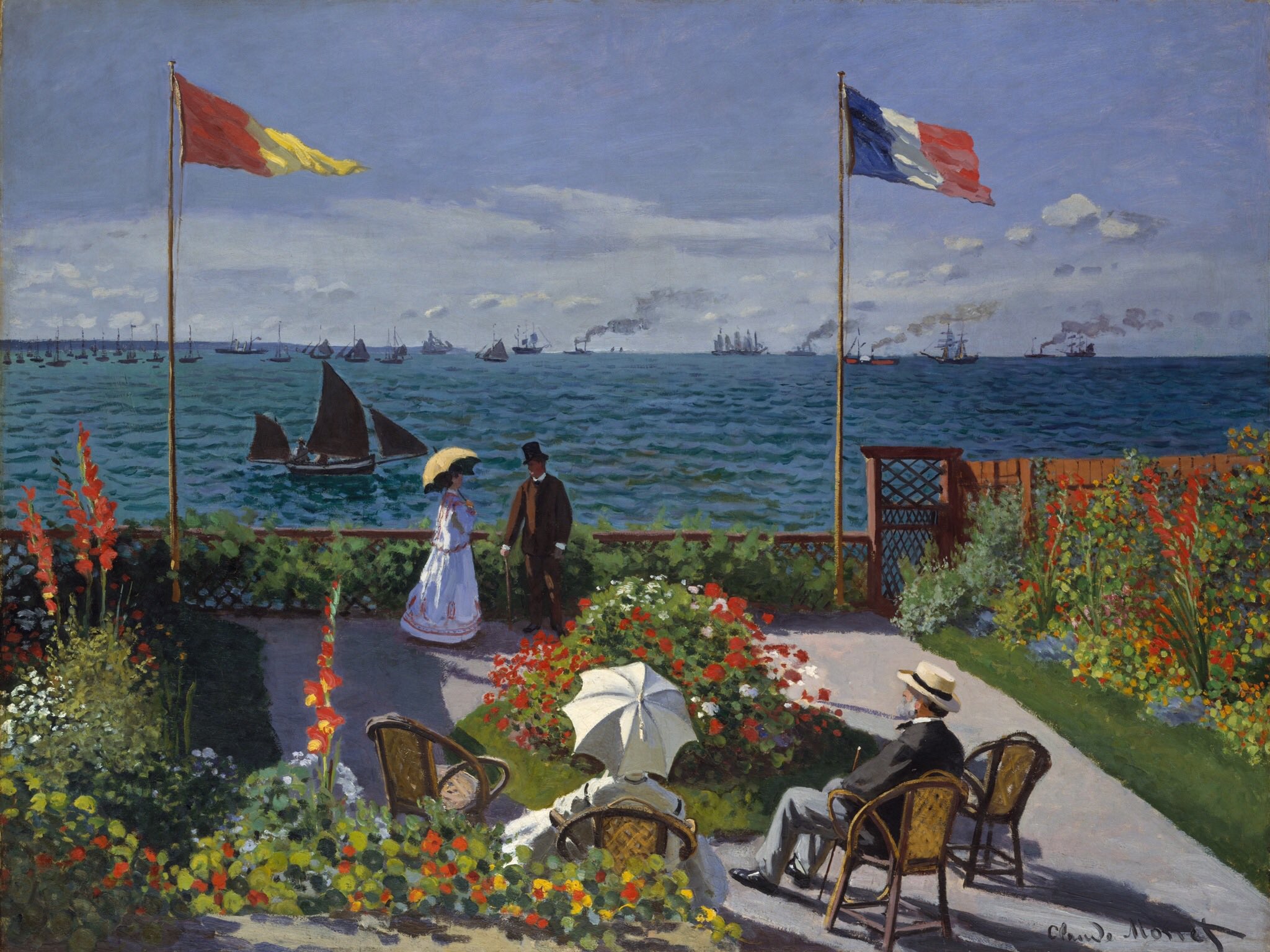
Terrace at the Seaside, Sainte-Adresse is a hand-painted oil painting after Monet’s canvas of 1867: a garden terrace above the sea, two flags on tall poles, the sea full of sailing boats and steamers, and beds of gladioli and nasturtiums below. The original measures 129.9 x 98.1 cm and hangs in the Metropolitan Museum in New York. We paint it in eight sizes or to your own measurement, with a photograph of the finished work sent for approval before dispatch.
Terrace at the Seaside, Sainte-Adresse – Claude Monet
What is shown?
The terrace is seen from above, so the ground tilts towards the viewer and the sea takes the whole upper half. Two flags fly from tall poles: the left one red and yellow, the right the French tricolour, both strained the same way. The sea is densely populated — a line of sailing boats and steamers with a plume of smoke along the horizon, and nearer in, a boat with a dark, almost black sail crossing the canvas slowly. Two people stand at the railing: a woman in white with a yellow parasol and a man in a top hat. In the foreground two more are seated on the terrace, a man in a straw hat in a wicker chair and a second figure in white, seen from behind, under a white parasol. Left and right are the beds: tall red gladioli, low orange and yellow nasturtiums, a few white flowers among them. Nothing in particular happens in this canvas painting, and yet an unusual number of things are happening at once.
Why are the colours so strong?
Because Monet did not mix them towards grey. The red gladiolus sits directly beside green, the orange nasturtium beside blue water, and neither pair is calmed by a tone in between — which is why the scene feels like a summer noon rather than like the depiction of one. The sea is not one blue but a band of turquoise at the horizon and a darker green-blue below, laid in short horizontal strokes you can count one by one. A painting like this is therefore always two things at once: up close a run of separate strokes, from three metres a quiet terrace with a view of the sea.
What does the museum say about this canvas?
The Metropolitan Museum records it under inventory number 67.241, dates it to 1867, and gives the technique as oil on canvas with the measurement 98.1 x 129.9 cm — that is 129.9 cm wide and 98.1 cm high. The museum bought it in 1967, a hundred years after it was made, and the acquisition line says it was purchased with special contributions and with funds given or bequeathed by friends of the Museum. Today it hangs in gallery 818 and the museum’s record marks it as one of the highlights of the collection. An impressionist painting from this year is still early: Monet was twenty-seven. The same year, the same size and the same inventory number are given by the catalogue record for this canvas as well.
What does our version look like?
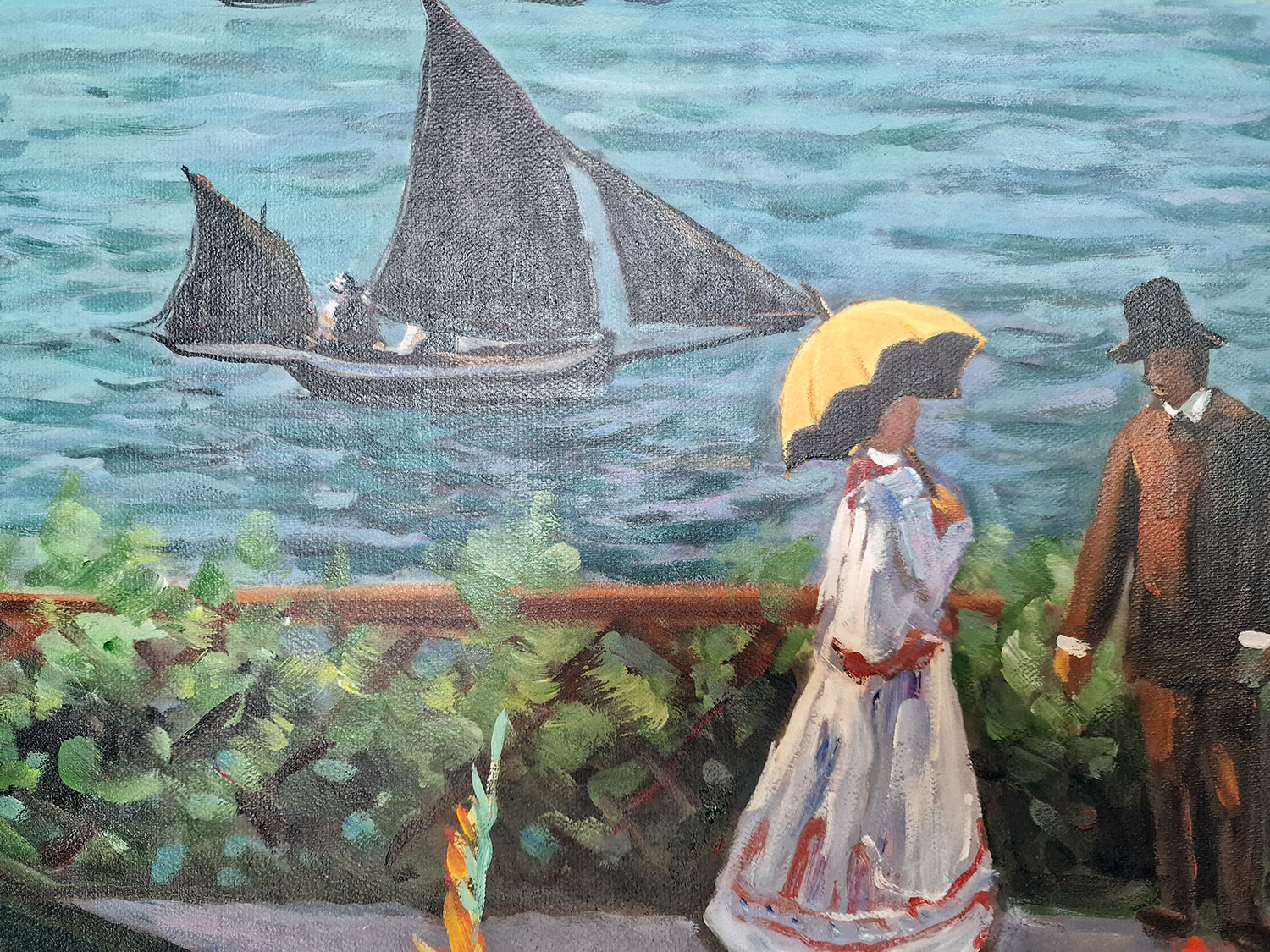
In the first photograph the finished work stands against a wall, seen face on, so the whole canvas is visible and you can judge how much of it is sea and how much is flower bed. The second and third photographs are the same canvas at an angle, from the left and from the right: the light crosses the surface that way, and the paint is seen to stand above the weave rather than lie flat in it. The fourth photograph is a close detail — the boat with the dark sail, the woman with the yellow parasol and the man in the top hat — where the weave of the canvas and each separate stroke can be seen. The oil painting reproduction you receive is made the way the one in those photographs was made; a work this size takes several days and each one comes out a little different.
Which years does this subject come from?
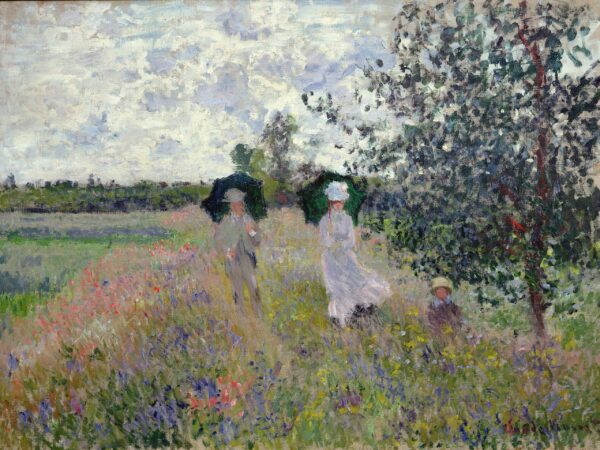
From Monet’s early years, when he still painted people and not only water. The same summer and the same place: The Beach at Sainte-Adresse. The summer before, he had put the same idea — figures in a garden, painted outdoors — into a large upright canvas, Women in the Garden. The garden table after lunch is The Luncheon. And the poppy field with tiny figures is Poppies near Argenteuil. Monet’s painting of a single woman in white under a parasol, beside a round bed of red flowers at Sainte-Adresse in 1867, is Woman in the Garden.
How is our hand-painted version made?
This subject is demanding because of the number of small things in it. The painter begins with the sea and the sky, because they set the light for everything else, then places the terrace and the two flags, which must strain the same way or the scene loses its wind. Only then come the beds, and those are painted back to front: the dark green first, then the red gladioli, and last the orange nasturtiums, which are the lightest and the easiest to spoil. The figures are small and are made in a few strokes — work them too far and they become portraits, and the scene stops moving.
Every piece is a hand-painted copy, oil on canvas, made to order. The fourth photograph shows the strokes standing above the surface and the weave of the canvas coming through in places; a print is smooth.
Which size for which wall?
Short answer: 130 x 98 cm above a sofa, which is also the original’s size rounded to whole centimetres; 90 x 70 cm for a smaller wall; 150 x 110 cm for a large open one. A painting for living room walls should take up about two thirds of the width of the sofa. This is impressionist wall art in a wide format, full of small things, so it takes closeness well: in a dining room or a hallway, where you pass it every day, you will still be finding something a year later.
How high to hang the painting: put the centre of the canvas about 150 cm above the floor. Because the scene is seen from above it also sits well a little lower — looking down then meets the work’s own point of view.
Made to measure, stretcher and frame
If none of the eight sizes suits, we paint to measure — send the width and the height and we will quote a price and a lead time. The canvas is stretched over a wooden stretcher and the edges are painted, so the work does not look unfinished without a frame. Warm pale wood or a narrow gilt moulding suits this subject; a broad dark frame closes it and takes the distance out of the sea.
Delivery and guarantee
We ship to sixteen countries in the European Union, among them Slovenia, Croatia, Austria, Germany, Italy and Hungary, wrapped in protective film and packed in a rigid box. Before dispatch we send a photograph of the finished work; if something on it is wrong, it is corrected before the piece leaves the workshop. Lead time is longer at the large sizes. You will find our other Monet reproduction subjects in the Claude Monet gallery, and we write about painting and about choosing a subject on the blog.
If the painting is a gift and you are unsure of the size, there is a gift voucher: the recipient chooses the size and the subject.
Frequently asked questions
Where is the original?
In the Metropolitan Museum in New York, under inventory number 67.241, in gallery 818. The museum bought it in 1967.
What year is it from?
1867. The year comes from the museum itself; Monet was twenty-seven at the time.
Why do you call it Terrace at the Seaside when the museum calls it a Garden?
Because both names are in circulation. The museum records it as Garden at Sainte-Adresse, in French Jardin à Sainte-Adresse; here it has always been Terrace at the Seaside. It is the same canvas, and both names are in the table above.
Who are the people on the terrace?
The Metropolitan Museum identifies them only as probably members of Monet’s family: his father, Adolphe, seated in the panama hat, and relatives from the Lecadre family, among them his cousin Jeanne-Marguerite at the fence.
- Hand-painted. Oil on canvas, no print and nothing applied by machine.
- Eight sizes or made to measure. From 60 x 45 to 150 x 110 cm, including 130 x 98 cm, the closest to the original — 1 mm wider and 1 mm shorter.
- Photograph before dispatch. You see the work finished before it leaves the workshop.
- Figures from the museum. Year, size, technique and inventory number are given as the Metropolitan Museum of Art records them.