








Description
| Title: | Women in the Garden |
| Other titles: | Femmes au jardin · Frauen im Garten |
| Painter: | Claude Monet (1840–1926) |
| Year painted: | about 1866, signed lower right |
| Original size: | 205 cm x 255 cm |
| Original technique: | Oil on canvas |
| Painting style: | Impressionism |
| Located at: | Musée d’Orsay, Paris (inv. RF 2773) |
| Our reproduction: | Hand-painted oil on canvas, eight sizes or made to measure |
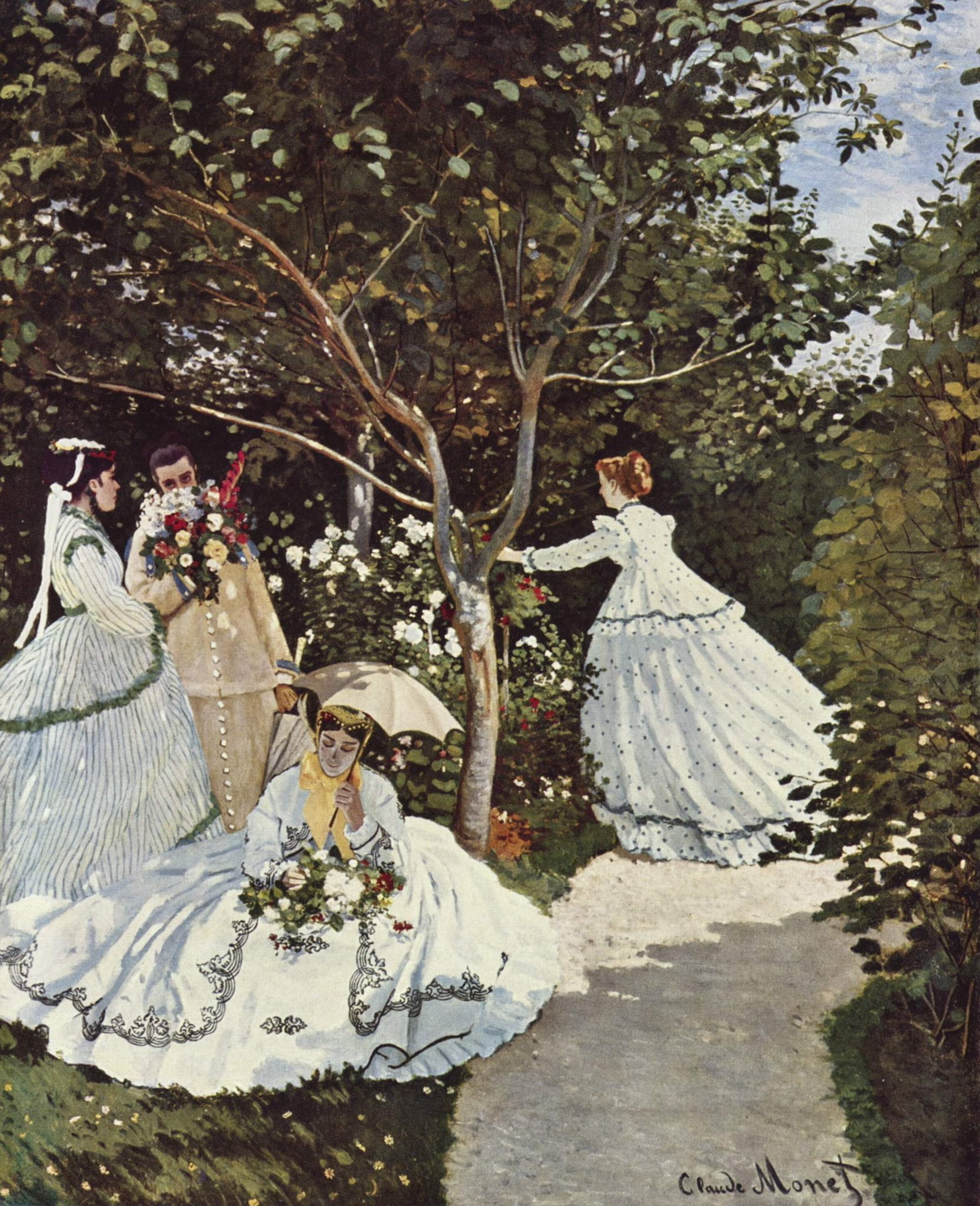
Women in the Garden is Monet’s large canvas of about 1866: four women in white summer dresses in the shade of a tree, one seated on the grass with her skirt spread out, one walking away along the gravel path. The original, 2.55 metres high, hangs in the Musée d’Orsay in Paris. We make it as a hand-painted copy in oil on canvas, in eight sizes or to your own measurement, with a photograph of the finished work sent for approval before dispatch.
Women in the Garden – Claude Monet
What is shown?
A summer morning in a garden, four women and no story at all. On the left a woman stands in a white dress with fine green stripes; behind her a second in cream with a row of white buttons holds a bunch of red and yellow flowers right in front of her face. In the foreground a third sits on the grass, her white skirt with its embroidered scrolls spread across the lower third of the canvas, a yellow bow at her throat, a small posy in her hand and a pale parasol behind her. On the right a fourth, in a white dress with dark spots, walks away along the path and reaches up to a branch. There is no story in this canvas painting: there is light, cloth and shade.
What is on the canvas?
The format is upright and 2.55 metres high, which is unusual for a garden subject — a size like that was then reserved for history painting and portraits of important people. A young tree with a pale trunk stands at the centre; above and behind it a dense dark green, with a piece of blue sky showing through at the top right. The white dresses are the real event: they are not painted white but in greys, blues and yellows, because they are in shade, while the sun falls only in scattered patches. This is impressionist painting built on one simple idea — that shadow is not grey but coloured. The canvas is signed at the lower right.
Why was the canvas so large?
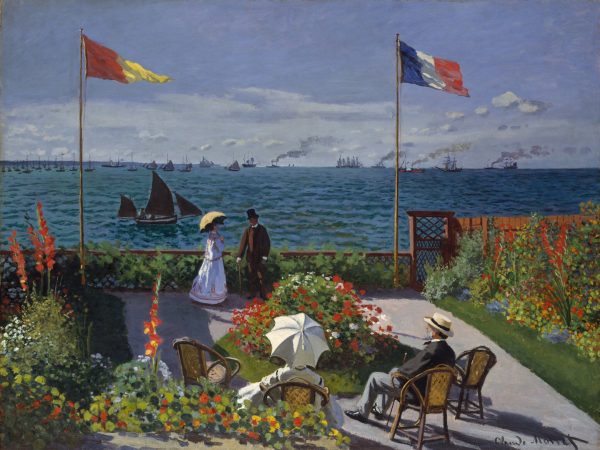
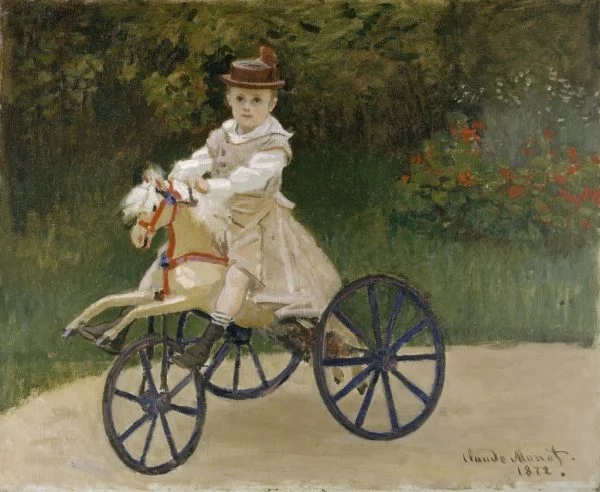
Because Monet wanted an everyday scene to have the scale that belonged to history painting. He painted it outdoors, in the garden, and the museum sets out what that took: working in the open air meant digging a trench in the ground and lowering the canvas into it on a pulley, so that the upper part could be painted from the same viewpoint as the lower. The challenge, the museum says, was double — the open air, and a large format that a garden subject was not then given. The following summer he repeated the same idea — figures in a garden, painted outdoors — smaller and lighter: Garden at Sainte-Adresse in the Metropolitan Museum — we paint that same canvas under the title Terrace at the Seaside, Sainte-Adresse.
What happened to it afterwards?
The canvas was finished in the studio, and the Salon jury refused it in 1867: besides the absence of a subject, it objected to the visible brushwork, which it read as carelessness. The way back to the painter, and on to the state, the museum lists line by line. In May 1867 his friend Frédéric Bazille bought it from him; after Bazille’s death it stayed with his parents until 1876, when they passed it to Édouard Manet in exchange for a Renoir portrait of their son. The same year it passed from Manet to Monet, in exchange for a canvas by Manet, and it stayed with him forty-five years — between 1882 and 1887 on deposit with the dealer Durand-Ruel. In 1921 the French state bought it, and bought it from Monet, for the Musée du Luxembourg: “purchase from Claude Monet, 1921”. A work the Salon had turned away entered the national collection from the hand of the painter himself — and reached the Musée d’Orsay only in 1986, a hundred and twenty years after it was made.
Who are the women?
The museum answers this plainly: Camille Doncieux, then Monet’s companion and later his wife, posed for the three figures on the left. The fourth, the one on the path, goes unnamed. The faces are imprecise and, in the museum’s words, cannot be read as portraits. Monet was not painting people but fabric, light and shade, and whoever copies it has to preserve exactly that: the faces soft, the dresses precise. Camille returns three more times in our range, twice in life: The Luncheon and Woman with a Parasol. The woman with a parasol of 1886 is no longer her but Suzanne Hoschedé: Woman with a Parasol (Facing Left). And last of all, Camille Monet on Her Deathbed. Monet’s painting of a single woman in white under a parasol, beside a round bed of red flowers at Sainte-Adresse in 1867, is Woman in the Garden.
How is our hand-painted version made?
This is among the most demanding subjects people order, and not because of its size: the white dresses have to be painted without white. The painter lays in the dark green first, because that decides how light the dresses may be, then the dresses in grey-blue and yellowish tones, and only last the separate patches of sun, which are the only true white on the canvas. If the white goes on too early the scene flattens and the shade disappears. Get that order right and an oil painting reproduction holds the light; get it wrong and it flattens the way a print does.
Which size for which wall?
Short answer: 120 x 150 cm for a living room, 80 x 100 cm for a smaller wall, 160 x 200 cm for a large open one. There is also 205 x 255 cm, the size of the original — that is a work for a stairwell or a tall room, not for an average one. A painting for living room walls looks right at about two thirds of the width of the sofa below it. This is impressionist wall art that is tall rather than wide, so give it height: it hangs better above low furniture than between shelves.
How high to hang the painting: put the centre of the canvas about 150 cm above the floor. At large upright sizes the bottom edge should not sit higher than 90 cm, or it reads as hung too high.
Made to measure, stretcher and frame
If none of the listed sizes suits, we paint to measure — send the width and the height and we will quote a price and a lead time. The original measures 205 x 255 cm, a ratio of about 1 : 1.24. The canvas is stretched over a wooden stretcher and the edges are painted, so it does not look unfinished without a frame. At the largest sizes we can send the canvas rolled in a tube for you to stretch on site; say so in advance and we will prepare the stretcher separately.
Delivery and guarantee
We ship to sixteen countries in the European Union, among them Slovenia, Croatia, Austria, Germany, Italy and Hungary, wrapped in protective film and packed in a rigid box. Before dispatch we send a photograph of the finished work; if something on it is wrong, it is corrected before the piece leaves the workshop. Lead time is longer at the large sizes. Every other Monet reproduction we paint is in the Claude Monet gallery, and we write about painting and about choosing a subject on the blog.
If the painting is a gift and you are unsure of the size, there is a wall art voucher: the recipient chooses the size and the subject.
Frequently asked questions
Where is the original?
In the Musée d’Orsay in Paris, under inventory number RF 2773. The French state bought it from Monet in 1921 for the Musée du Luxembourg; it was assigned to the Musée d’Orsay only in 1986.
What year is it from?
The museum dates it “about 1866” and adds in its own record that the dating is uncertain and may be 1867. We write the same, because the museum asserts no exact year.
Why are the dresses grey rather than white?
Because they are in shade. Monet painted white fabric in shadow in greys, blues and yellows, and saved pure white for the patches of sun. That decision is exactly why the work reads as sunlit even though most of the canvas is in shade.
What does the painting mean?
It is about light rather than the women: Monet wanted to paint large figures out of doors in full sunlight, and Camille posed for most of the four women.
- Painted by hand. Oil on canvas, no print and no machine application.
- Eight sizes or made to measure. From 80 x 100 to 205 x 255 cm, including the size of the original.
- A photograph before dispatch. You see the finished work before it leaves the workshop.
- Figures from the museum. Dating, size and inventory number are given as the Musée d’Orsay records them, “about” included.