







































Description
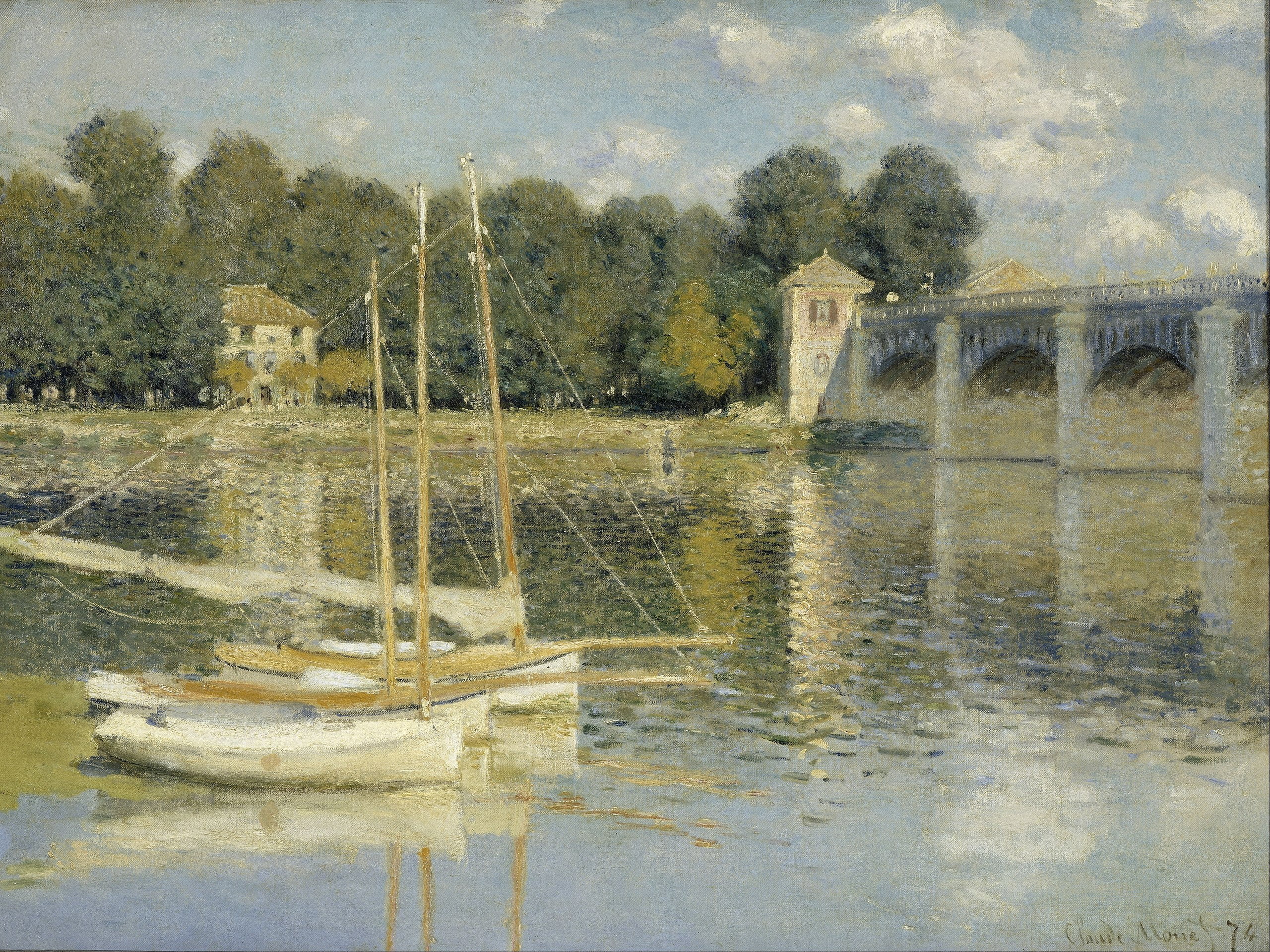
Bridge at Argenteuil is a hand-painted oil painting after Monet’s view of the Seine of 1874: a stone road bridge crosses the river on the right, a pink toll house stands at its near end, and two moored sailing boats with bare masts lie in the left foreground. The original measures 80 x 60.3 cm, is oil on canvas, and is held by the Musée d’Orsay in Paris under inventory number RF 1937 41. We paint it in eight sizes or to your own size, with a photograph of the finished work sent for approval before dispatch.
| Title: | Bridge at Argenteuil |
| Other titles: | Le Pont d’Argenteuil · Le Pont d’Argenteuil et les barques · The Argenteuil Bridge |
| Painter: | Claude Monet (1840–1926) |
| Year painted: | 1874; signed and dated lower right, »Claude Monet 74« |
| Original size: | 80 cm x 60.3 cm |
| Original technique: | Oil on canvas |
| Painting style: | Impressionism |
| Located at: | Musée d’Orsay, Paris (inv. RF 1937 41) |
| Our reproduction: | Hand-painted oil on canvas, eight sizes or made to measure |
Bridge at Argenteuil – Claude Monet
What is shown?
There is no sitter. The subject is a place: a stretch of the Seine at Argenteuil, where Monet lived and worked through the eighteen-seventies. The leading figure is the road bridge and the water beneath it. The only human presence is a tiny figure on the far bank, given no face; the record names nobody, so neither do we.
What is on the canvas?
The format is landscape. On the right a stone road bridge crosses the river: heavy square piers stand in the water, low arches span between them, a pale balustrade narrowing towards the edge. At the near end stands a square toll house, pink-cream, with a dark hipped roof. Two moored sailing boats lie in the left foreground, the nearer hull white, both masts bare and unusually tall. Behind, the far bank runs with a dense grey-green line of trees, out of which rises a pale two-storey house with a brown-red roof.
The lower half is water, in short horizontal strokes of blue, green, ochre and white; under the piers and masts those strokes turn vertical and stretch into long reflections. Above is a pale blue sky with cumulus. The canvas is signed and dated lower right, closing on the figures 74, set with the same fine brush tip as the name. Monet had given up smooth finishing by then but still held a firm drawing in the architecture: the bridge is measured, the water is not.
Why does this painting matter?
Argenteuil was to Impressionism what an academy was to other movements. Monet lived and worked on this river until 1878, and it was here that the open-air method we call en plein air took shape. The painter’s effort goes into what changes: the light on the water.
It matters also for what it declines to do. The bridge is not treated as a monument and is not central; it is pushed into the right third and cut by the edge of the canvas, as it would look to someone who had not troubled to find a better vantage point. That was new in 1874: an impressionist painting offered a view not arranged for the viewer.
What does the painting mean?
The scene is built from two opposing directions. The horizontals – balustrade, water, bank – run left to right; the verticals – masts, piers, reflections – cut across them. That crossing holds the view together, although nothing happens in it. The tension comes not from an event but from a mesh of directions.
The second layer is in the substance. Stone is fixed and Monet paints it once; water is never the same and he paints it a hundred times. The reflection under a pier is not a shadow but an object in its own right, made of the same short strokes as the waves. A canvas painting made by us has to keep that difference, or the view sinks into decoration.
How did the canvas reach the Musée d’Orsay?
The museum record is short and unambiguous: the work entered the French public collections in 1937 as the bequest of Antonin Personnaz (»Legs Antonin Personnaz, 1937«). Personnaz collected the Impressionists; on his death the collection passed to the State and the work received the number RF 1937 41. The museum says no more, so we add neither previous owners nor prices.
Two canvases from the same year: which do we have?
Monet painted two canvases of the Argenteuil road bridge in 1874, and telling them apart is harder than it looks. Ours is the Paris canvas (RF 1937 41), number 311 in Wildenstein. The other is held by the National Gallery of Art in Washington as 1983.1.24, catalogued as 312. Both measure about 60 x 80 cm, both are oil on canvas of 1874, both signed »Claude Monet 74«, and the catalogue numbers are consecutive.
Composition is what separates them. On ours, two moored boats with tall bare masts stand in the foreground, the bridge opens right, the pink toll house beside it. On the Washington canvas a dark barge stands centrally under two masts, a white sail to the left, far more sky, emphatically blue water. Anyone comparing only the data cannot separate them; anyone looking cannot confuse them. That is why we confirmed the identity by looking, not by reading the record alone.
There is no third bridge: The Railway Bridge at Argenteuil is a different structure in the same place, iron-built and carrying a train. Water without a bridge is offered by The Basin at Argenteuil and The Promenade near Argenteuil, the reach downstream by The Seine at Bougival. All of it sits in the Monet collection, and we write about the painter’s Seine years in the Claude Monet blog. The crowded bathing place on the Seine near Bougival, painted in the summer of 1869 with boats, strollers and swimmers, is Bathers at La Grenouillère.
How is our hand-painted version made?
This view stands or falls on the relation between the firm and the loosened. The architecture comes first: piers, arches and balustrade set with a straight edge and a ground cool enough that stone stays stone. Only then the water, built the other way about – short horizontal touches, no mixing on the canvas, so blue, green and ochre fuse only in the viewer’s eye. The reflections come last.
The masts are the riskiest stroke: two long, almost straight lines pulled in a single movement, or you can see where the hand stopped. The oil painting reproduction with this subject is therefore made in a set order, and takes longer at larger sizes. A hand-painted copy has nowhere to hide an error here. We have no studio photographs of this subject yet; they will be taken when the work is next painted.
Which size for which wall?
Short answer: 80 x 60 cm is the size closest to the original — the same width, 3 mm shorter; 90 x 70 cm above a chest of drawers, 120 x 90 cm above a sofa, 150 x 110 cm for a large open wall. Because the original measures 80 x 60.3 cm, our 80 x 60 cm is as close to its proportions as a size can be. Impressionist wall art with this subject carries larger formats well.
The smallest sizes, 40 x 30 cm and 50 x 40 cm, suit a hallway or narrow wall; there the fine strokes merge, but the bridge stays legible. The 60 x 40 cm and 70 x 50 cm sizes work in an office or bedroom. As a painting for living room walls, 120 x 90 cm tells best, the reflections opening to their full height.
How high to hang the painting: the centre of the canvas about 150 cm from the floor. Because the reflections fall towards the lower edge, hung too high the view loses its water – half the work.
Custom sizes, stretcher bar and frame
If your wall asks for a ratio not on the list, we make a painting made to order – the subject is not stretched; the framing is reconsidered, so bridge and boats keep their places. The canvas is mounted on a wooden stretcher, edges painted, ready to hang. For the frame we use an application in which you see the subject in the chosen profile. Choosing a frame and the separate service of visualising the work on your wall are two different things.
Delivery and guarantee
We paint to order, so the work is not held in stock. When the canvas is finished and dry we send an image for approval; only then does it go out. We deliver across the European Union in rigid packaging, mounted on its stretcher. If anything is wrong on arrival we put it right or paint it again.
If the painting is a gift and you are unsure of the size, there is a gift voucher: the recipient chooses the size and the subject.
Frequently asked questions
Where is the original?
In the Musée d’Orsay in Paris, under RF 1937 41. The museum lists it as Le Pont d’Argenteuil, with the addition et les barques.
Is anyone in the scene?
Almost nobody. A single tiny figure stands on the far bank, in a few strokes and given no face.
What is the painting about, in one sentence?
That a new stone bridge over the Seine can be a subject worth a canvas, and that the water beneath it is the more interesting.
What year is it from?
1874. Monet was living at Argenteuil then and painted the road bridge over the Seine several times that year.
- Subject. A stone road bridge over the Seine at Argenteuil, a pink toll house beside it, two moored sailing boats with tall bare masts.
- Original. Oil on canvas, 80 x 60.3 cm, 1874, Musée d’Orsay, inv. RF 1937 41, Wildenstein 311, bequest of Antonin Personnaz 1937.
- Ours. Eight sizes or made to measure, from 40 x 30 to 150 x 110 cm; 80 x 60 cm is as wide as the original and 3 mm shorter.
- Worth knowing. Monet painted a second canvas of the same bridge that year, now in Washington; the data almost coincide, the views do not. Our Monet reproduction follows the Paris canvas.