




Description
| Title: | Impression, Sunrise |
| Other titles: | Impression, soleil levant · Impressione, levar del sole · Impresija, sončni vzhod |
| Painter: | Claude Monet (1840–1926) |
| Year painted: | 1872, signed lower left, the date 72 added later |
| Original size: | 65 cm x 50 cm |
| Original technique: | Oil on canvas |
| Painting style: | Impressionism |
| Located at: | Musée Marmottan Monet, Paris (accession no. 4014) |
| Our reproduction: | Hand-painted oil on canvas, eight sizes from 40 x 30 to 150 x 110 cm or made to measure |
Impression, Sunrise is Monet’s view of the harbour at Le Havre, painted in November 1872 from the window of a hotel room: a small orange sun stands over the misty basin, and below it a column of short orange strokes breaks up across the water. The original is held by the Musée Marmottan Monet in Paris under accession number 4014. With us it is made as a hand-painted oil painting on canvas, a Monet reproduction in eight sizes or to your own measurements, with a photograph of the finished work sent for approval before dispatch.
Impression, Sunrise – Claude Monet
What is shown?
The harbour at Le Havre at daybreak. Monet stayed at the Hôtel Amirauté in November 1872 and painted the motif from the window of his room, which looked onto the outer basin. There is no portrait in the scene and no named people: the only human figure is the rower in the foreground, whom the museum record does not name. What is shown is a place and an hour — an industrial harbour at the moment the sun rises high enough to separate from the haze.
What is on the canvas?
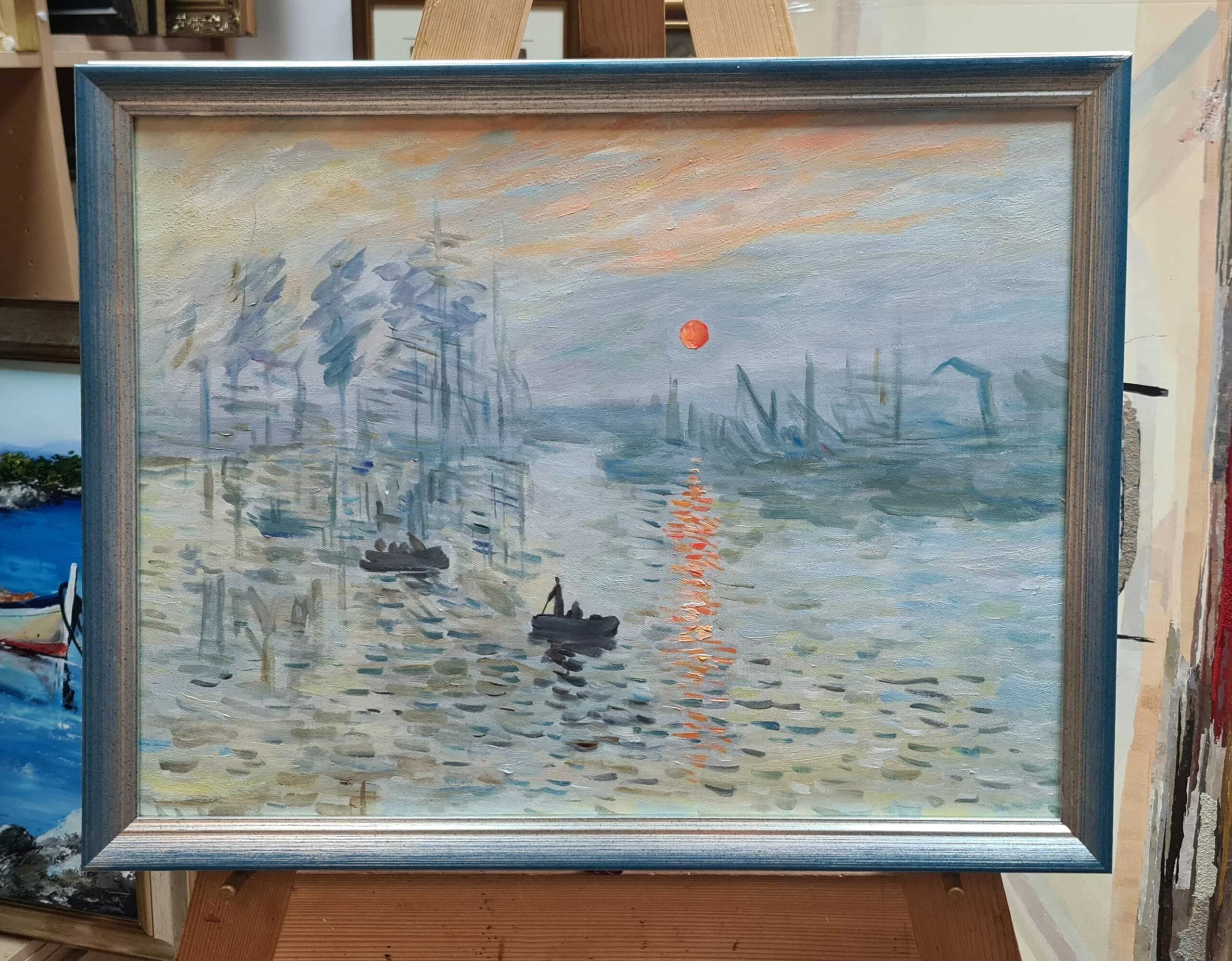
The canvas is horizontal. Through the morning haze you see the basin: everything in blue-grey and pale greenish tones except the sun. It is a small orange-red disc to the right of centre, set high enough to stand clear of the mist. Below it runs a vertical column of short orange strokes — the reflection is not painted as a continuous line but as a series of separate dabs that spread apart toward the viewer. Two dark boats lie in the foreground; a figure with an oar stands in the nearer one, the second sits a little behind and to the left. On the left, masts, yards and cranes of moored ships rise in vertical blue-grey strokes that dissolve into vapour at the top. On the right the same motif repeats, more blurred still. As a canvas painting the water is built from horizontal dashes of blue, grey and pale yellow.
Why is this painting important?
Because the name of a whole period came out of it. The work hung in the first exhibition of the Société anonyme des artistes peintres, sculpteurs et graveurs, held from 15 April to 15 May 1874 in the former studio of the photographer Nadar at 35 boulevard des Capucines in Paris. On 25 April 1874 the critic Louis Leroy published a piece in the satirical paper Le Charivari titled L’Exposition des impressionnistes, taking the word straight from Monet’s title — in mockery. The label stuck. The work was first the evidence that something had been left too unfinished, and only afterwards the starting point of Impressionism.
What does the painting mean?
It does not tell a story; it stops a state of light. What is striking is that the sun is not the brightest point here — in brightness it nearly matches the haze around it and separates almost entirely by colour. That is exactly why the scene reads as a fleeting impression rather than a view under strong light. The motif is not romantic: cranes, chimneys and moored ships of a working harbour stand in the background. As an impressionist painting it is a note about air and hour, not about the harbour as a subject.
Is this the Marmottan version or the Getty one?
Monet painted the harbour at Le Havre at sunrise more than once, and the two works are regularly confused. This is the Marmottan version: 65 x 50 cm, dated 1872, accession number 4014. The sister work Sunrise (Marine) at the J. Paul Getty Museum is a little smaller, 50.2 x 61 cm, and the museum dates it to the spring of 1873. If the scene you remember has a small orange sun with a broken reflection and two dark boats in the foreground, you are on the right page. Monet’s other sea and coast works in our collection are Fishing Boats at Sea, Fishing Boats on the Beach at Étretat, Terrace at the Seaside, Sainte-Adresse and The Railway Bridge at Argenteuil.
How is our hand-painted version made?
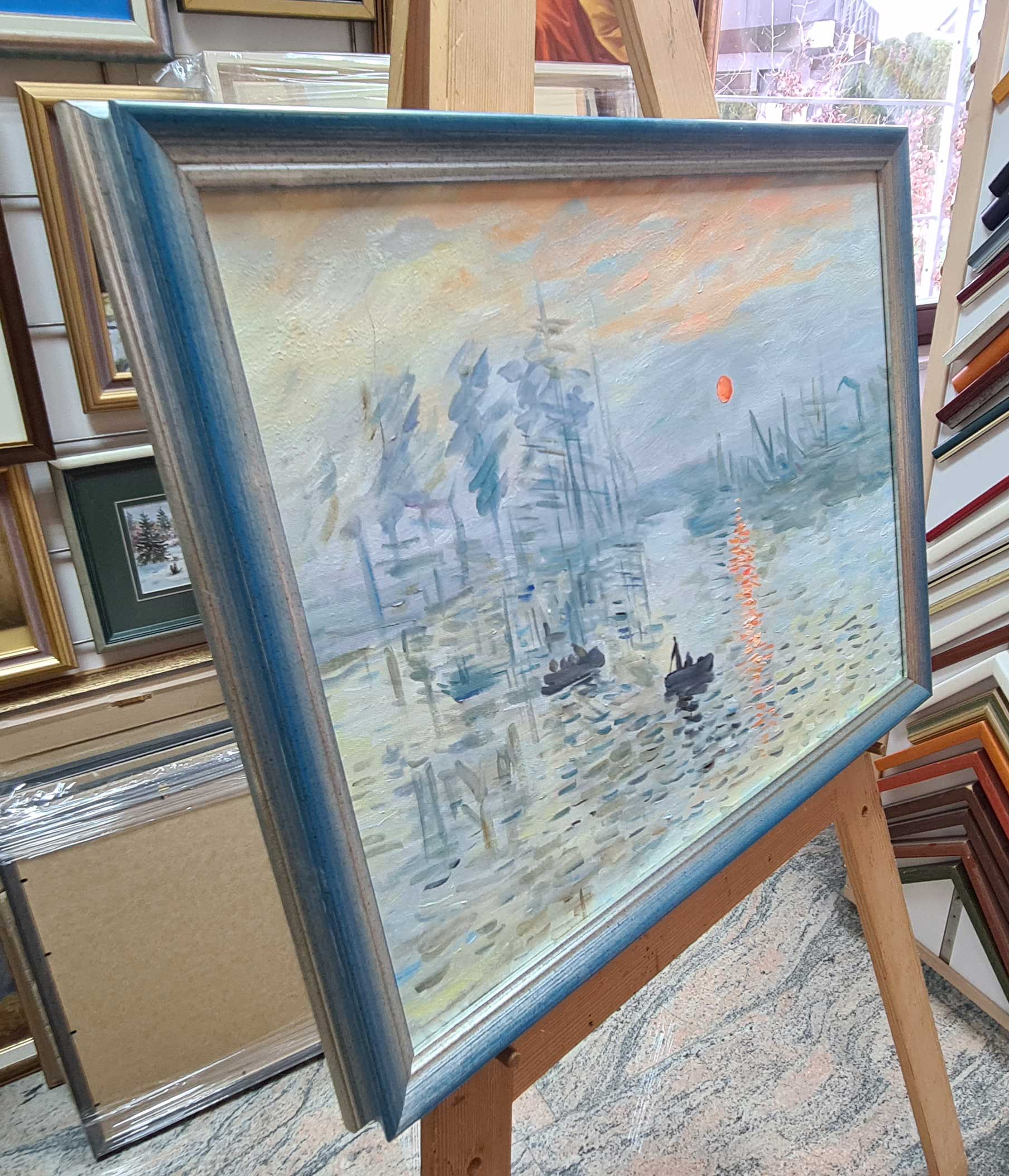
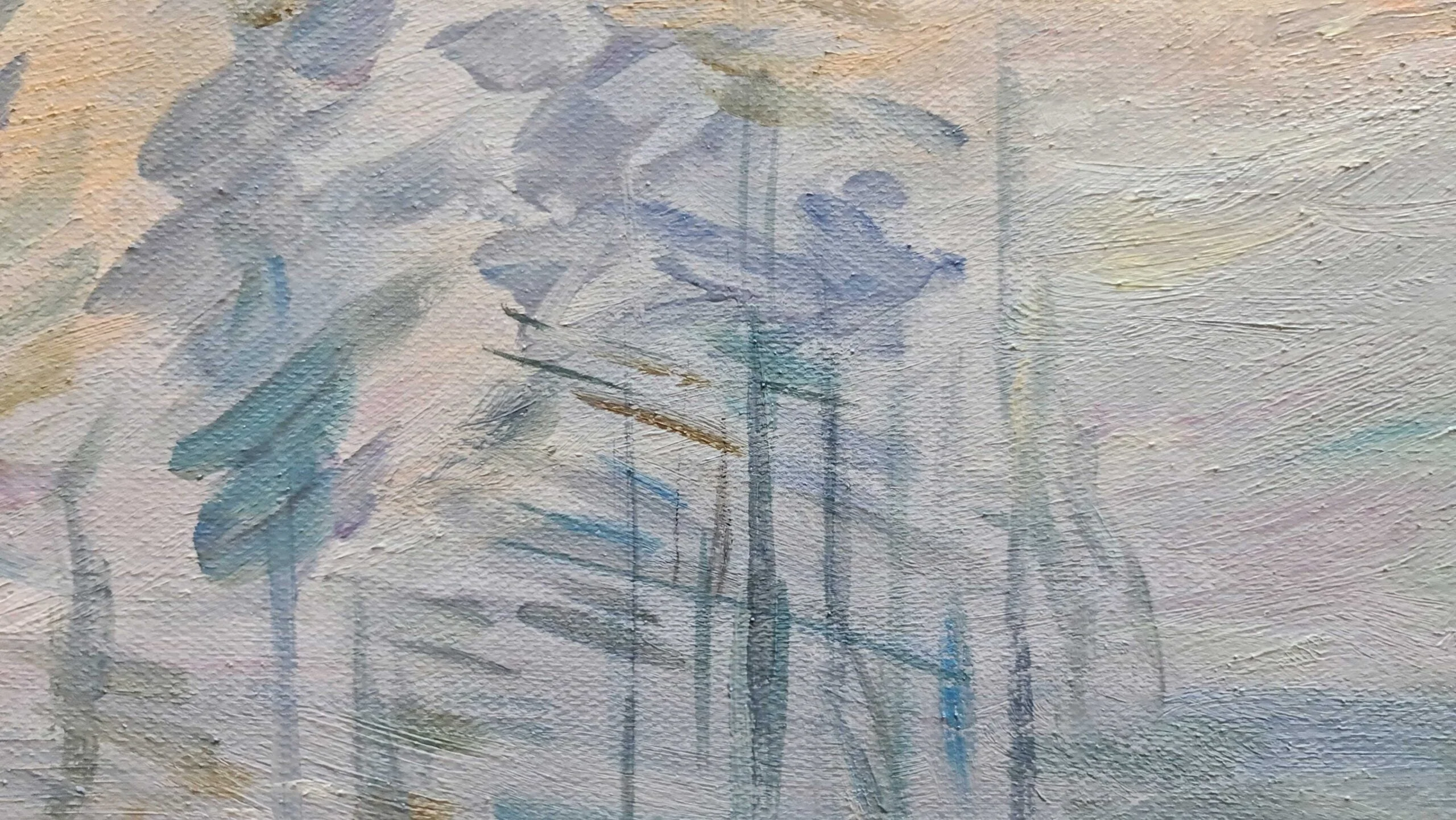
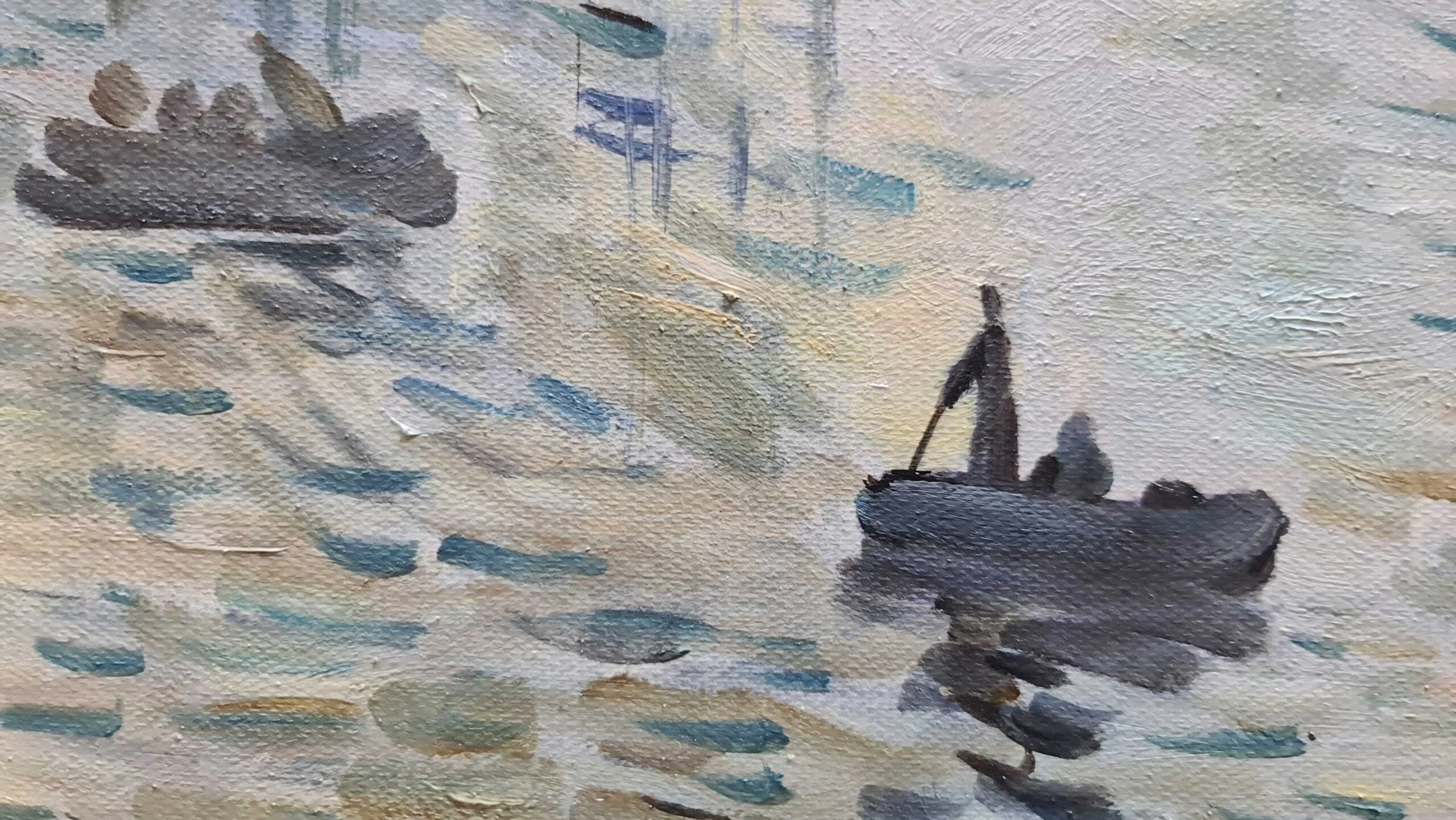
The painter works with a brush and oil colour, not a printer, and builds the surface the way the original does: thin and blurred in the haze, denser and more distinct in the reflection. In the first photograph the finished canvas stands framed on the easel in our workshop, shot head on; in the second the same work is taken from the left at a sharp angle, so the profile and depth of the moulding show, and with them the way light breaks across the paint. The third photograph is a macro of the left-hand side of the harbour: masts and cranes are drawn with a fine brush over a blurred blue-grey ground, and the weave of the canvas shows through the thin passages. The fourth shows both boats and the water close up — short strokes of blue, green and ochre stand side by side and do not blend. That is precisely what a print cannot give you, because there is nothing on it to cast a shadow. Every copy is made individually, so no two canvases are quite alike; as a hand-painted copy each one is its own work, and every oil painting reproduction we ship is photographed in daylight first.
Which size for which wall?
If you are unsure which: 63 x 48 cm. That is our size closest to the original — which measures 65 x 50 cm, so both sides are two centimetres shorter, and the ratio, 0.762, is seven thousandths from the original’s 0.769. The format is horizontal and therefore wants a wide wall rather than a tall one. 40 x 30 and 50 x 40 cm belong in a hallway, on a narrow wall between doors, or in a group; 70 x 50 and 80 x 60 cm sit well above a chest of drawers or a desk; 90 x 70 cm works above a sofa, the usual painting for living room walls. 120 x 90 and 150 x 110 cm are for wide walls and tall rooms where the reflection has room to open out. Because the scene is quiet and low in contrast, it reads better on a calm, lighter wall than on a dark one. The second photograph shows how the framed work stands in a real room. As impressionist wall art this motif settles a room instead of asserting itself in it.
How high to hang the painting: the centre at eye level, roughly 145–150 cm from the floor; above a sofa 15–25 cm above the back. The horizontal format also tolerates hanging a little lower.
Custom size, stretcher and frame
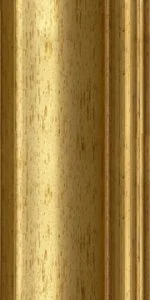
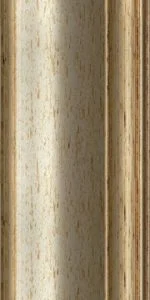
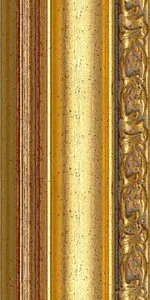
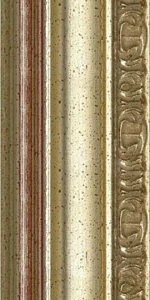
If none of the eight sizes suits your wall, we paint to your measurements and keep the original’s side ratio so the harbour is never squeezed; that is our painting made by order. Every copy is delivered stretched on a wooden stretcher and ready to hang. For the moulding, use our 3D application: it shows every one of our frame profiles on this subject, so you can compare gold, silver, black, white and natural wood before deciding — the application is for choosing the frame only. If you want to see how it will look on your own wall, that is our separate room-placement service.
Delivery and guarantee
Every copy is made to order in our studio in Slovenia, so allow 15 to 45 days depending on the size you choose. We ship it stretched and protected for transport, framed if you chose a frame, across the EU with no customs. Before dispatch you receive a photograph of the finished work to approve, and our returns policy applies to every order. The full range is in the Claude Monet gallery, and the painter’s life is set out in our Claude Monet article.
If the painting is a gift and you are unsure of the size, there is a voucher: the recipient chooses the size and the subject.
Frequently asked questions
Where is the original?
At the Musée Marmottan Monet in Paris, under accession number 4014. The museum record lists it as oil on canvas, 65 x 50 cm without the frame.
What is the work about, in one sentence?
A note on light and air at daybreak over a working harbour: the sun separates by colour, not by brightness.
What year is it from?
It is dated 1872 beside the signature. It was first shown in 1874 in Paris, at the first Impressionist exhibition.
Why did Monet paint Impression, Sunrise?
In the port of Le Havre, where he grew up, he wanted to catch the passing impression of the morning light rather than a detailed view. That is why he called it an “impression” in the exhibition catalogue.
Where did Monet paint it?
In the port of Le Havre in Normandy, from a window above the harbour, looking at ships and chimneys in the morning haze.
Is the original for sale, and what is it worth?
No. The original is in a museum collection and is not for sale, so it has no market price. Monet’s major canvases are among the most expensive paintings ever sold at auction: one of his Haystacks paintings (Meules, 1890) sold at Sotheby’s in May 2019 for 110.7 million dollars.
- Subject: the harbour at Le Havre at daybreak, an orange sun and a broken reflection, two boats in the foreground — November 1872
- Original: 65 x 50 cm, oil on canvas, Musée Marmottan Monet, Paris (inv. 4014)
- Our version: hand-painted in oil on canvas, eight sizes from 40 x 30 to 150 x 110 cm; 63 x 48 cm is the closest to the original
- Worth knowing: the sun is almost as bright as the haze around it — it separates by colour, not by light