


Description

| Year of creation: | 1906 |
| Original size: | 94.1 cm x 89.9 cm |
| Paint style: | Impressionism |
| Original technique: | Oil on canvas |
| Located: | Art Institute of Chicago, USA |
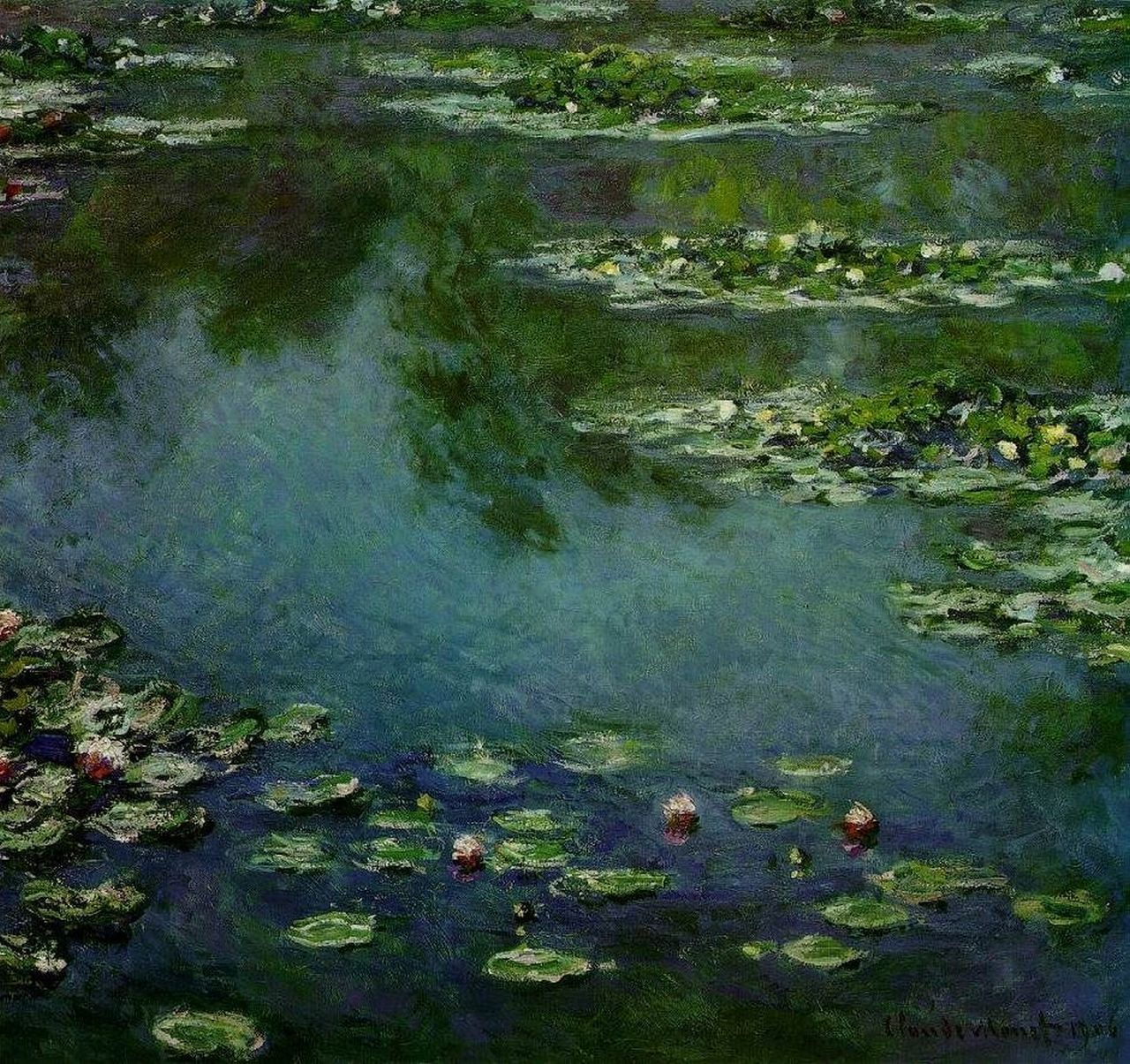
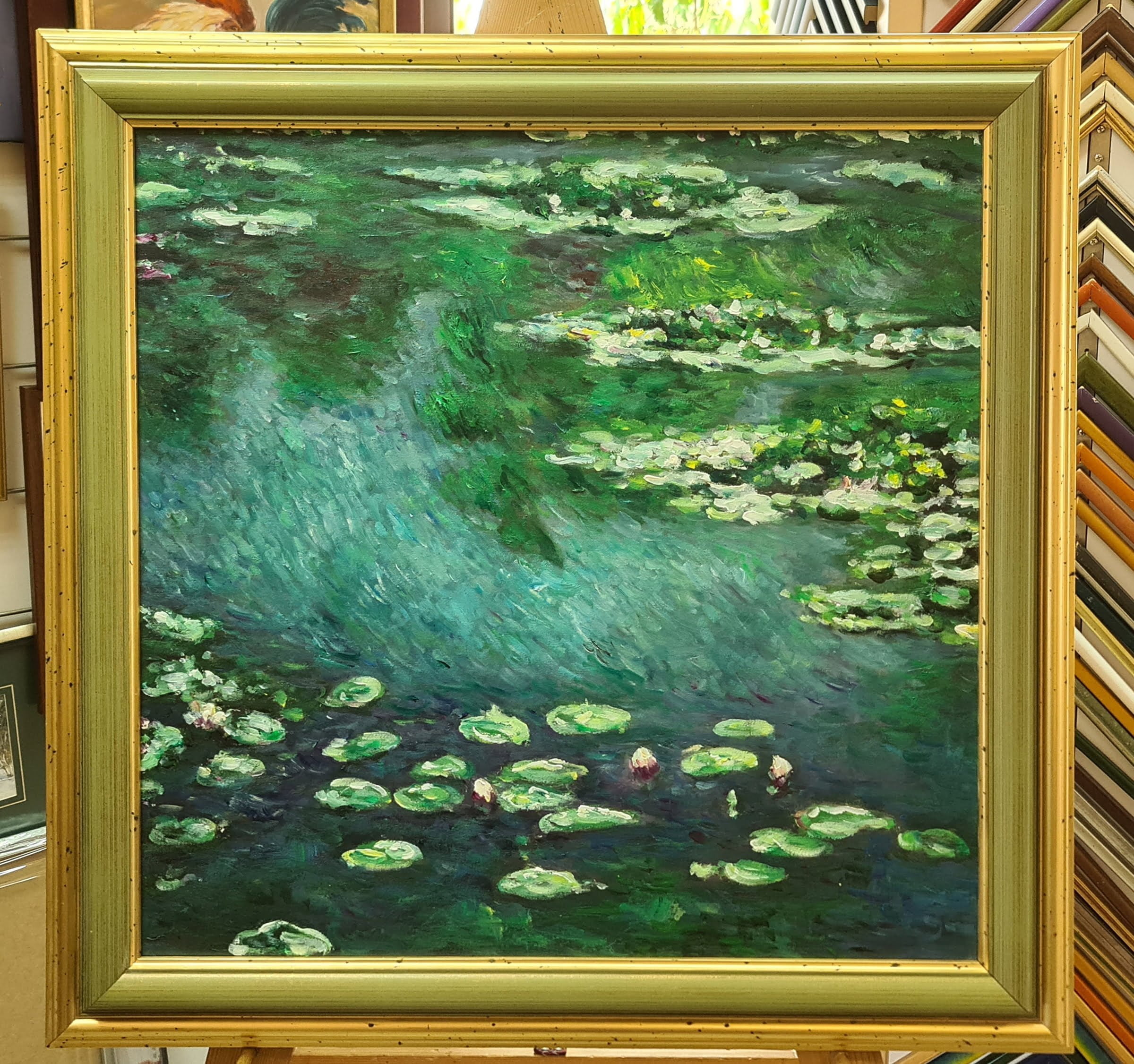
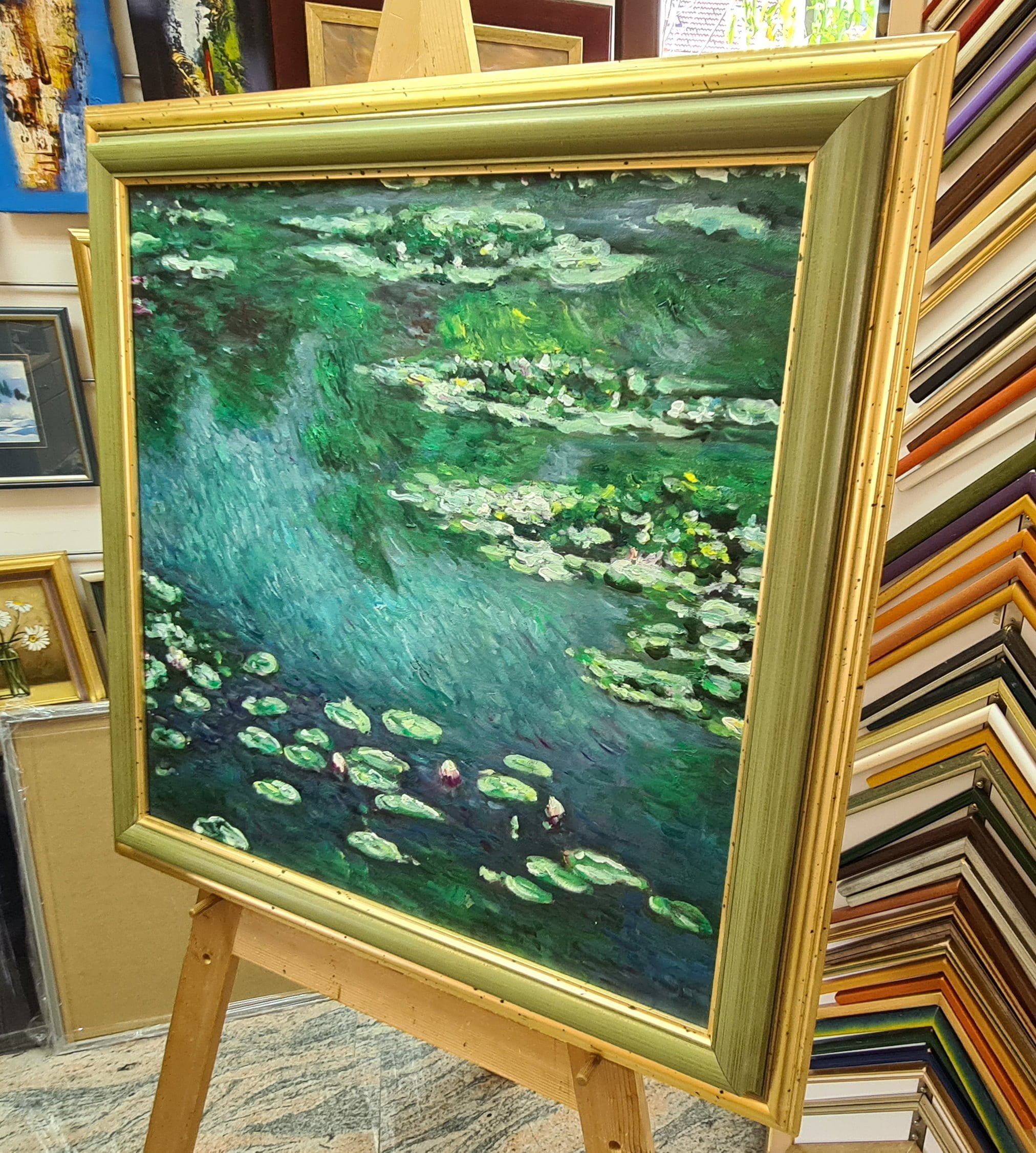
Water Lilies is a hand-painted oil reproduction of Monet’s work of 1906: the almost square canvas holds nothing but the surface of the water — dense islands of lily pads at the upper right, and a broad band of open blue-green water across the middle.
Water Lilies, 1906 – Claude Monet
What is on the canvas
The canvas is almost square, and there is no sky, no bank and no horizon — only the surface
of the water, seen from above. The upper right third is filled with dense islands of lily pads,
laid in light green and cream patches with yellow accents; the pads lie in horizontal drifts
that press closer together towards the top edge. At the upper left the water is darker, almost
pine green, with a few pale pads and small pink flecks. Across the middle runs a broad
diagonal band of open water from the lower left corner towards the right; it is laid in
long, slightly curved strokes of blue-green and turquoise and reads as a slow current. In the
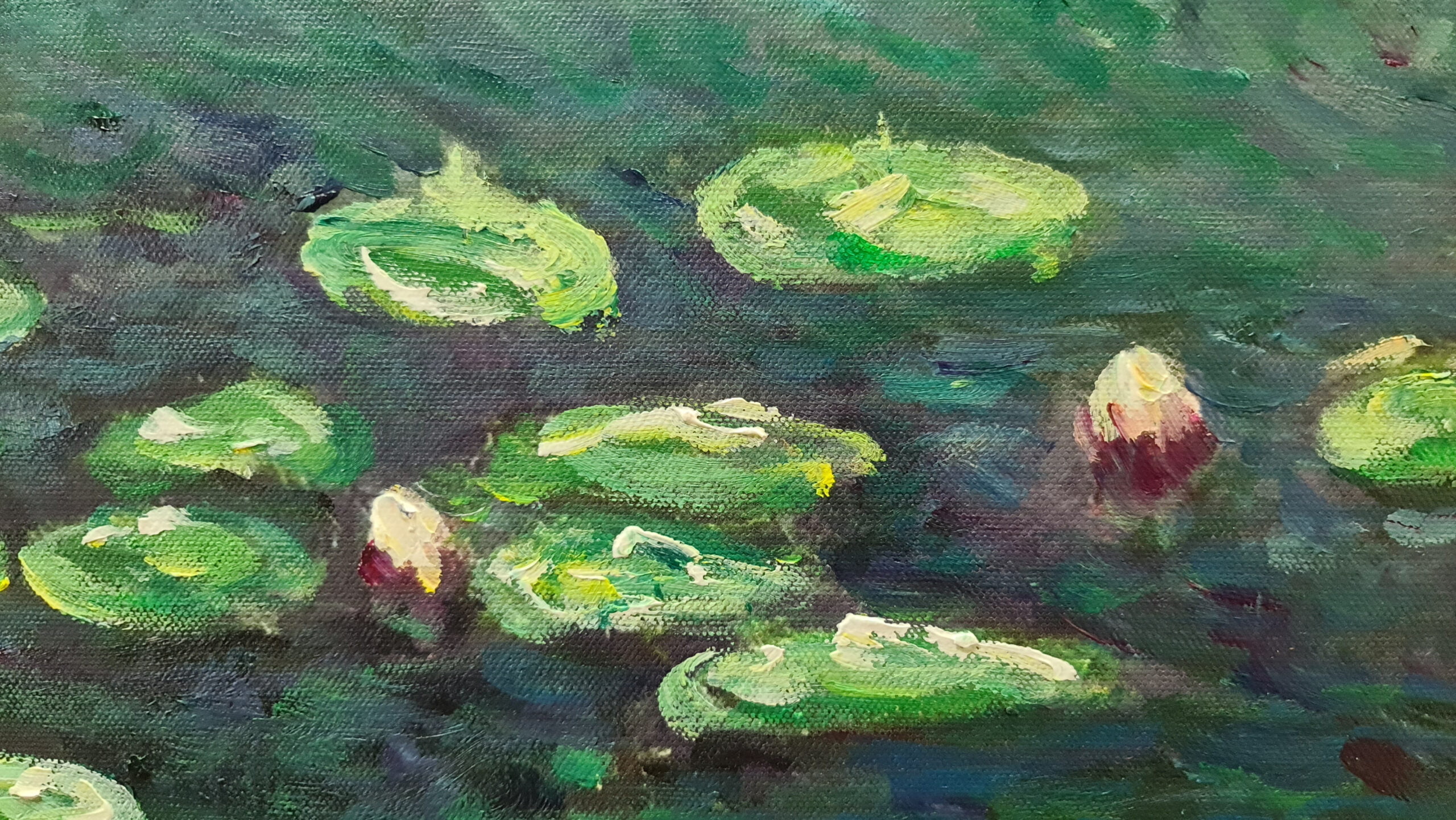
lower third single round pads float, much larger than those above, and among them stand five or
six reddish pink buds. Along the bottom edge and in the left corner the water darkens into
blue-violet.
Depth without a horizon
With no bank and no sky, the scene offers not one line by which the eye could measure a
distance. Depth is carried by the size of the pads alone: broad and separate at the bottom,
small and crowded at the top. Colour does the same work — the lower edge is cool and dark, the
upper edge light. This oil on canvas reproduction is therefore a surface rather than a
landscape: the subject is the plane of the water, not a view. The brushwork follows the same
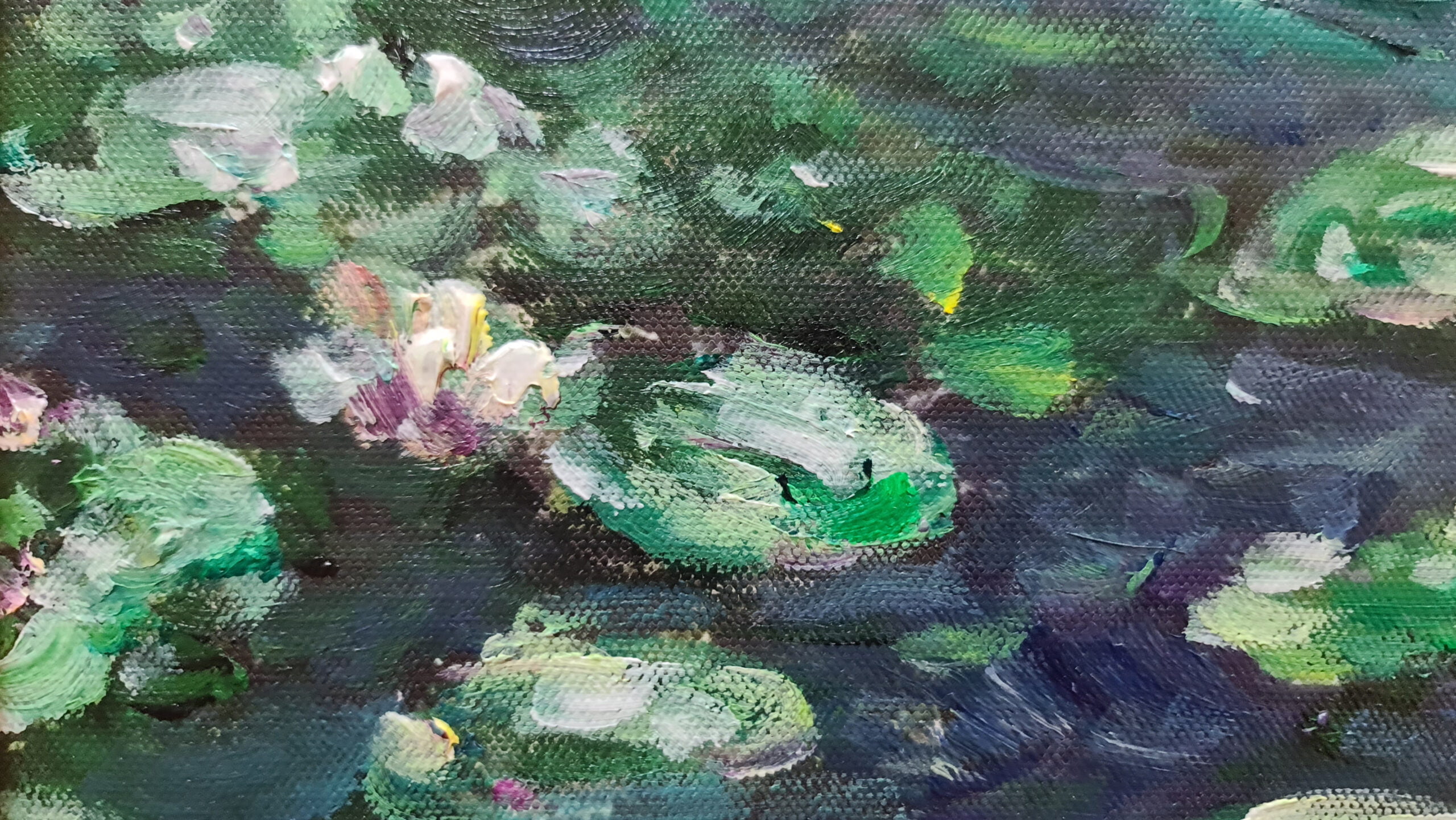
reasoning. The pads are set down in short, thick touches and the open water in long dragged
strokes, so that two different speeds of the brush meet on one canvas.
The subject among Monet’s works
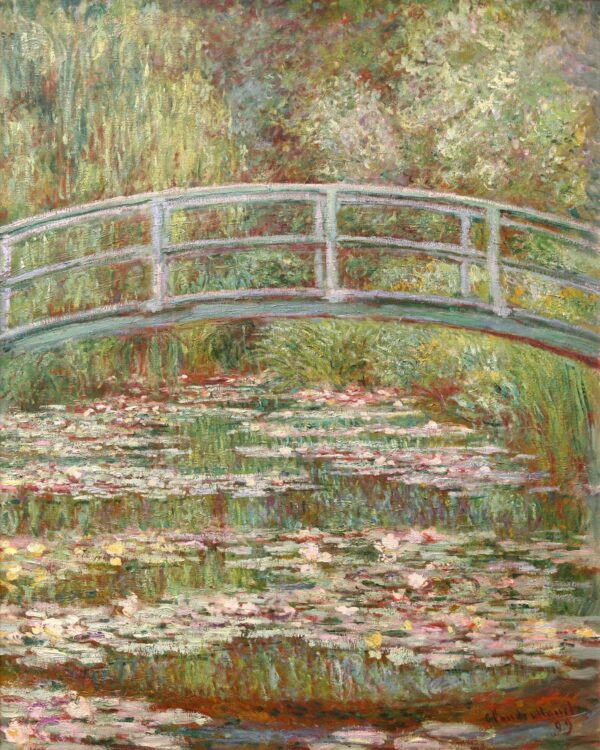
Monet painted the pond at Giverny for more than twenty years. When architecture entered the
scene the result was
The Water Lily Pond (Japanese Bridge),
where the bridge closes the view at the top. Without the bridge but still with a bank, there is
The Water Lily Pond.
How far Monet later pushed colour on its own is shown by
The Water Lilies – Green Reflections
and Blue Water Lilies.
Museum and record
The original is held by the Art Institute of Chicago under accession number
1933.1157, in the Mr. and Mrs. Martin A. Ryerson Collection. The record enters
it as oil on canvas measuring 94.1 x 89.9 cm and gives the year as 1906. The
accession number begins with 1933 although the work was made almost thirty years earlier: the
Chicago collector Martin A. Ryerson bought it in 1914, and it reached the museum only with his
bequest in 1933. It hangs today in Gallery 243.
How it works on the wall
The format is almost square, which sets it apart from most subjects: it does not ask for a
wide wall but for a quiet surface. Eight sizes are offered. 50 x 50 cm, 60 x 60 cm, 70 x 70 cm
and 80 x 80 cm are square and suit a hallway, a staircase or a narrow wall between two doors.
93 x 88 cm is the closest to the original, which measures 94.1 x 89.9 cm, and
is therefore the most faithful choice. 110 x 100 cm, 130 x 120 cm and 150 x 140 cm are meant for
large walls, where the water takes the whole field of view. Because the range of colour is dark
and green, hand-painted canvas art of this kind lives best on a light wall and in enough light;
above dark furniture it closes up. As wall decor it competes with nothing, because it tells no
story — it is a surface you look at for longer than you meant to.
Hand-painted, not printed
This fine art reproduction is made with a brush, not a printer. A print lays the colour in an
evenly thin film, so the pads and the open water come out equally smooth. Applied by hand, the
pads stand above the canvas in thick touches while the open water stays thin and dragged. Light
is returned differently by those two surfaces, so walking past the wall the pads catch the light
before the water does — a print cannot do that, because there everything is the same thickness.
Because it is handwork, every copy differs a little.
Custom sizes, frame, ordering and lead time
If none of the eight sizes fits, we paint to the size you set, keeping the ratio of the sides.
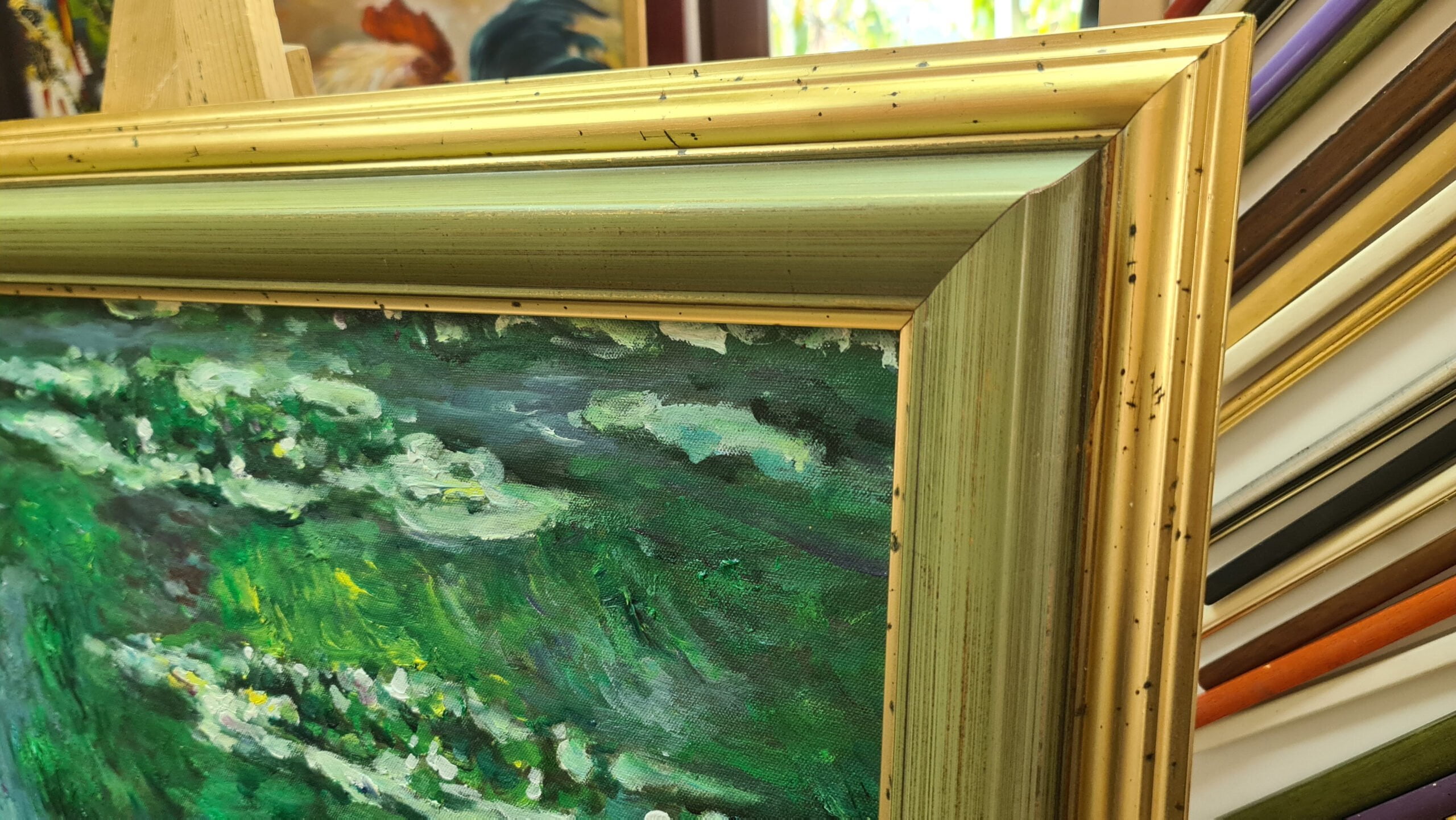
A 3D application is available for the frame — it is for frame selection only and
does not place the work in your room; the separate visualisation service does that. The lead time
is 15 to 45 days, and for the largest sizes usually nearer the upper end, because
the work is painted to order. Before dispatch we send you a photograph of the finished piece for
approval. Further reproductions on canvas and famous paintings on canvas are in the
Claude Monet gallery.
- Subject: nothing but the surface of the water — islands of lily pads at the upper right, a broad diagonal band of open water across the middle.
- Technique: oil on canvas; pads in short thick touches, open water in long dragged strokes.
- Sizes: almost square format, eight sizes from 50 x 50 cm to 150 x 140 cm; 93 x 88 cm is the closest to the original.
- Worth knowing: there is no sky and no bank — depth is carried by the size of the pads alone, which grow smaller towards the top.