







































Description
| Title: | Water Lilies |
| Other titles: | Nymphéas · Lokvanjeve rože · Les nymphéas, paysage d’eau |
| Painter: | Claude Monet (1840–1926) |
| Year painted: | 1906 |
| Original size: | 94.1 cm x 89.9 cm |
| Original technique: | Oil on canvas |
| Painting style: | Impressionism |
| Located at: | Art Institute of Chicago, Chicago, USA (inv. no. 1933.1157) |
| Our reproduction: | Hand-painted oil on canvas, eight sizes from 50 x 50 to 150 x 140 cm or made to measure |
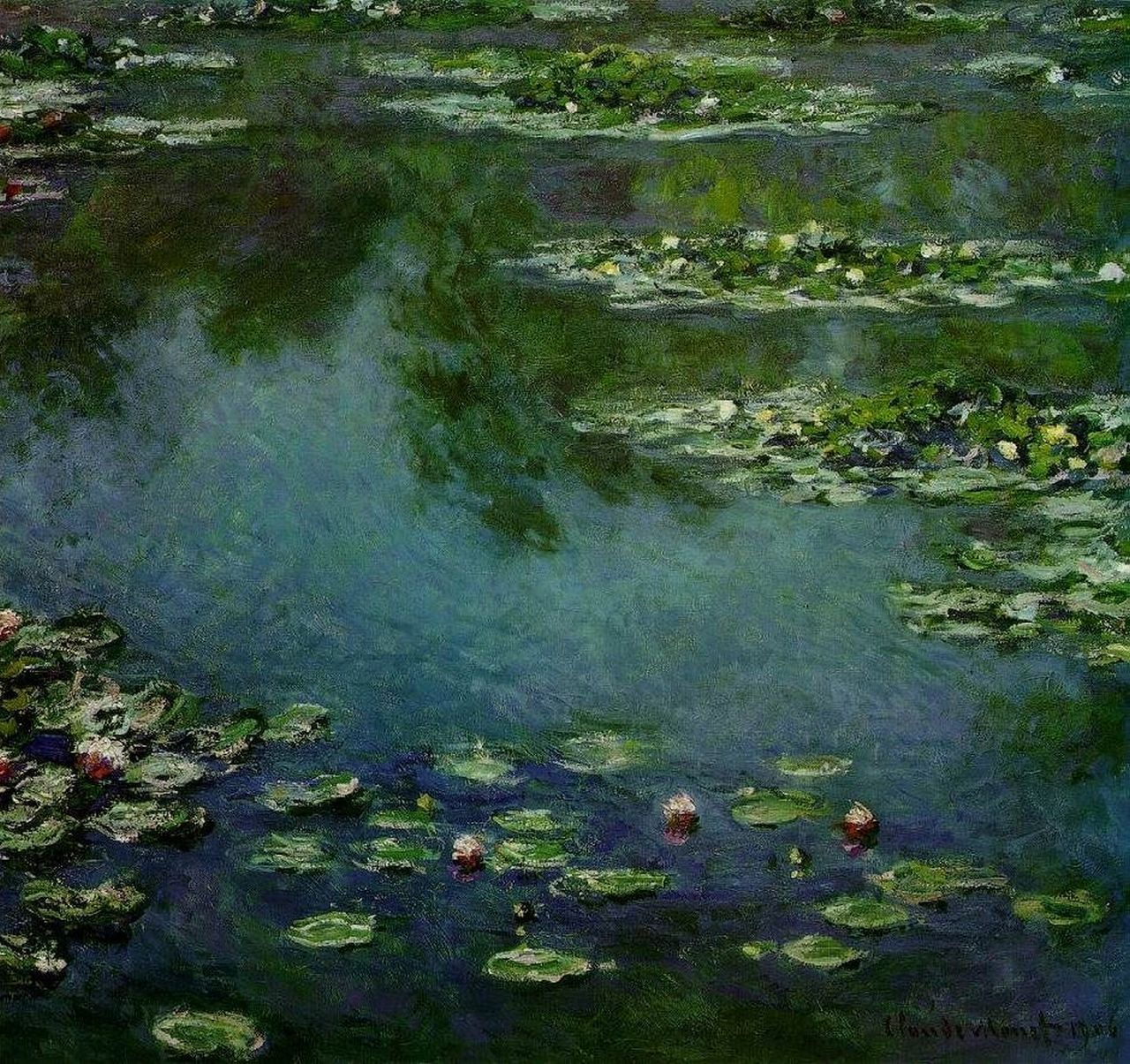
Water Lilies is Monet looking straight down into the water garden at Giverny: no sky, no bank and no horizon, only the surface with islands of lily pads and a broad diagonal band of open water. The original is held by the Art Institute of Chicago under accession number 1933.1157 and dated 1906. We make it as a hand-painted reproduction in oil on canvas, in eight sizes or to your own measurements, with a photograph of the finished work sent to approve before dispatch.
Water Lilies, 1906 – Claude Monet
What is the painting of?
The water garden Monet laid out for himself at Giverny in 1893 and planted with water lilies. There are no people on the canvas, no bank and no story — the subject is the surface of the pond, seen from above. From the late 1890s until his death in 1926 it was very nearly his only theme. The museum record dates the work to 1906 and lists it as oil on canvas, 94.1 x 89.9 cm. As a canvas painting that is an unusual decision: there is nothing but water for the eye to hold on to.
What is on the canvas?
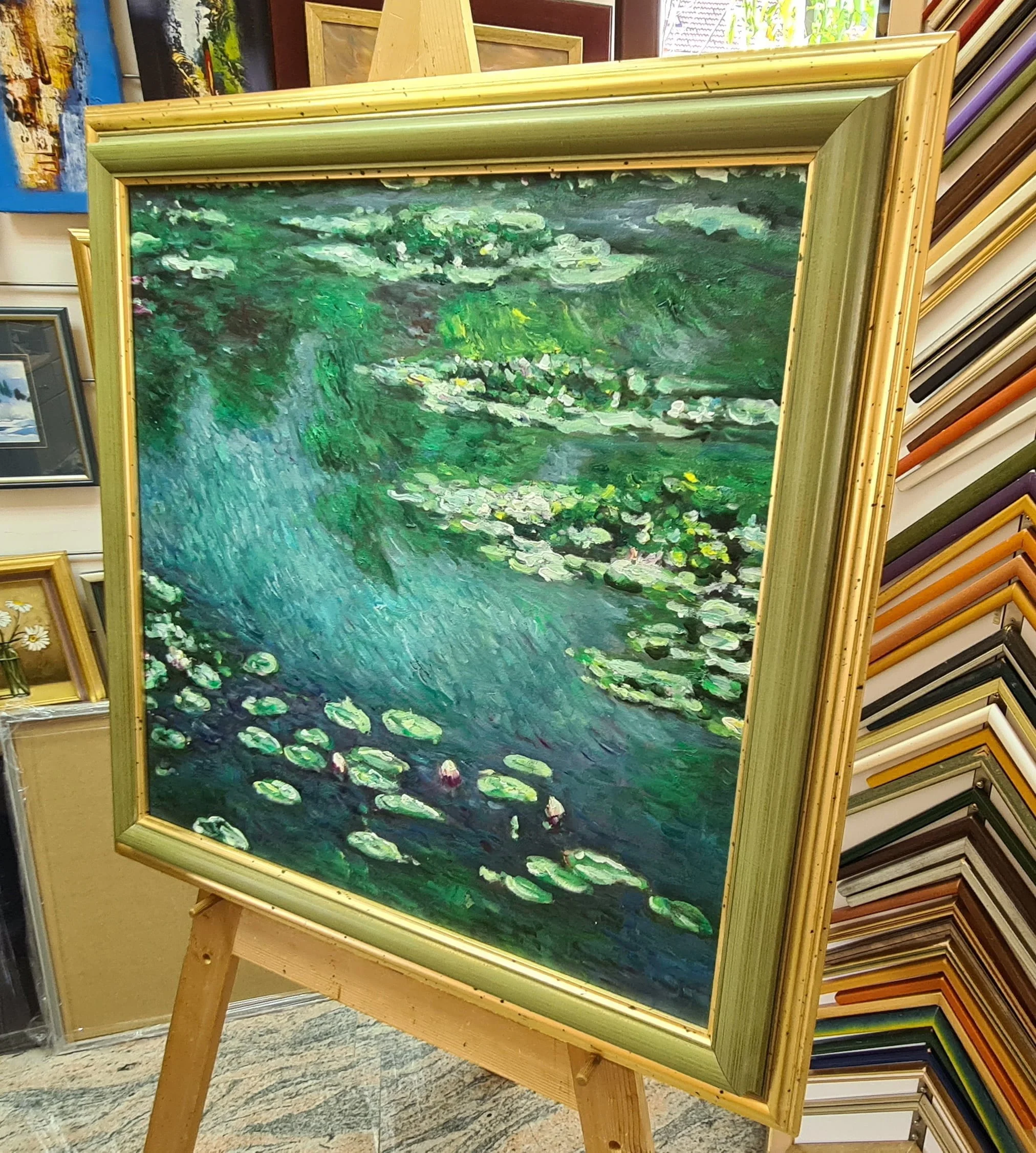
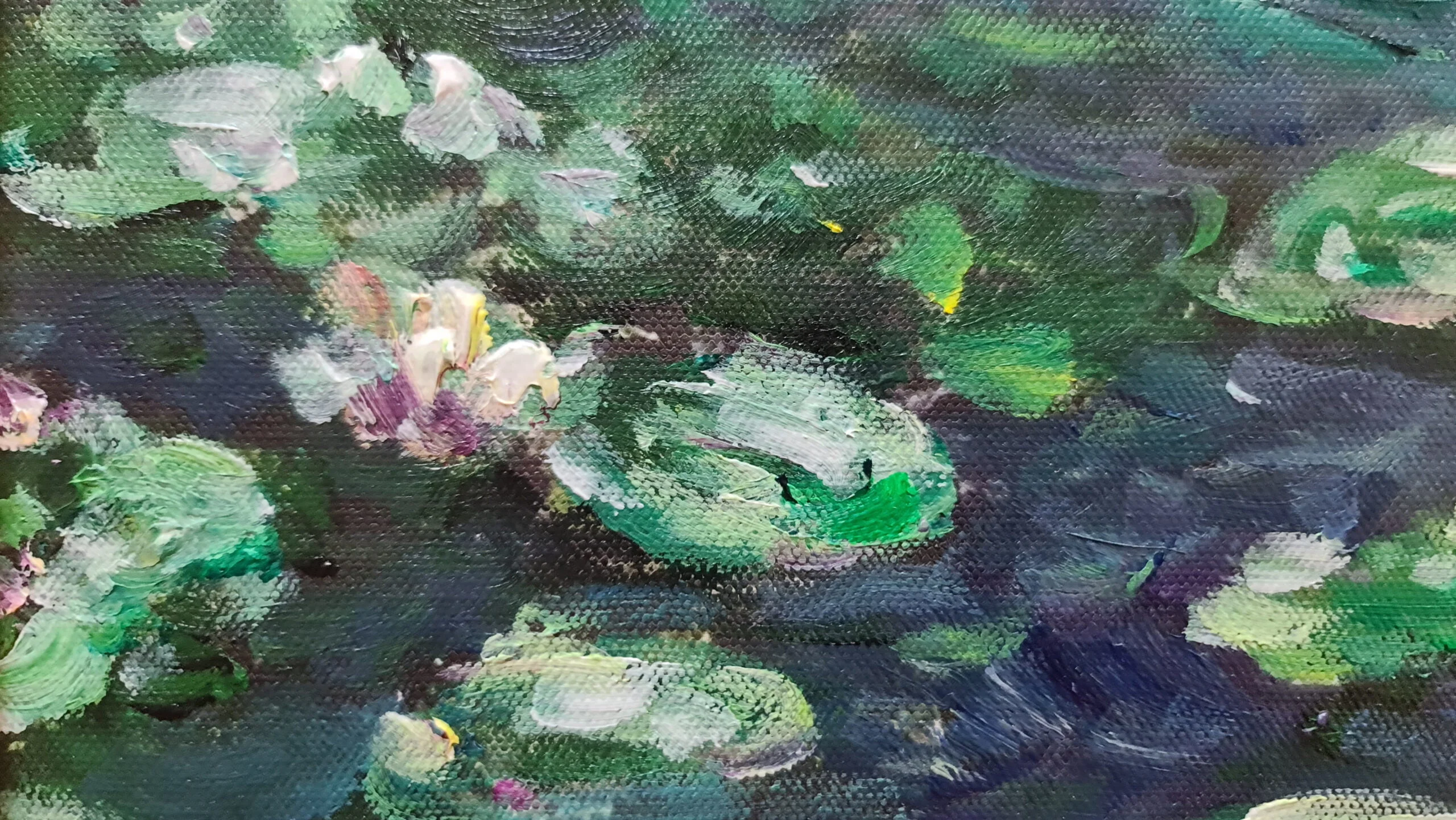
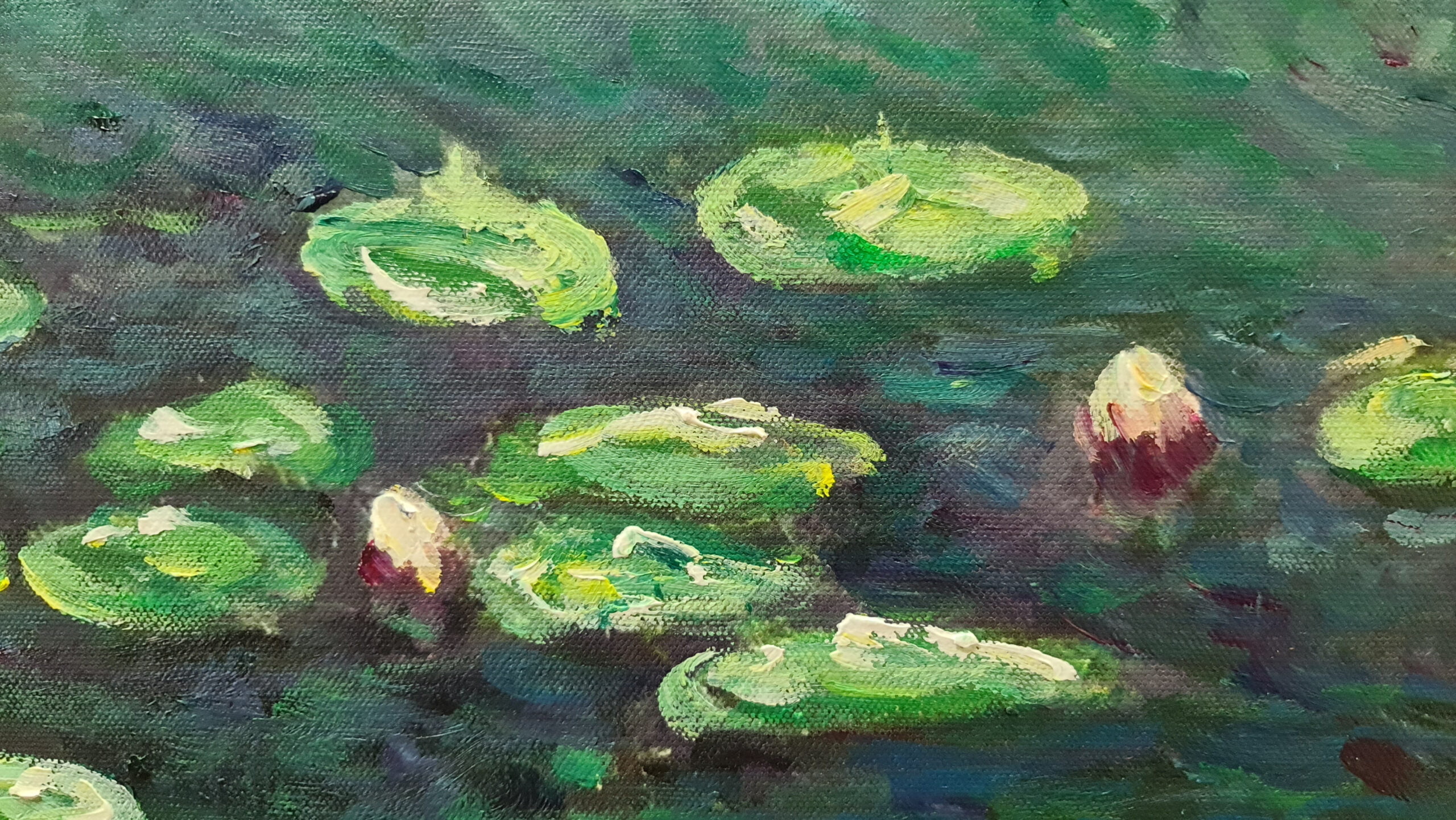
The canvas is almost square and carries no sky, no bank and no horizon — the water surface is all there is. The upper right third is filled with dense rafts of lily pads, painted in light green and cream patches with yellow accents; the pads gather into horizontal bands that pack tightly towards the top edge. Upper left the water is darker, close to pine green, with a few pale pads and small pink flecks. Across the middle runs a broad diagonal band of open water from the lower left corner towards the right, in long, slightly curved strokes of blue-green and turquoise; it reads as a slow current. In the lower third separate round pads float, much larger than those above, with five or six dark red buds among them, and along the bottom edge the water darkens to blue-violet. The fifth and sixth photographs under the description were taken close up on our own canvas and show those two applications: the pads in thick touches, the water in a thin dragged layer.
Why does this painting matter?
Because it shows where Monet left landscape behind. Seven years earlier he painted the same pond with the Japanese bridge and with a bank: The Water-Lily Pond of 1899 in the National Gallery, London, measures 88.3 x 93.1 cm, the bridge closes off the view and the planting marks the edge of the water. On this 1906 canvas there is no bridge, no bank and no sky — only the surface remains. As an impressionist painting that is an extreme step: without a horizon there is no line against which to measure distance, and the subject reads as surface and depth at once, carried by the size of the pads alone — broad and separate below, small and crowded above.
Why does the accession number start with 1933?
Because the work did not come to the museum straight from the studio. According to the note in the museum file, the New York gallery Durand-Ruel sold the canvas on 10 February 1914 to the Chicago collector Martin A. Ryerson for $5,000; the receipt lists it as no. 3768, Les nymphéas, paysage d’eau, 1906 — which is where the other title in the table above comes from. Ryerson died in 1932 and the picture reached the museum with his bequest in 1933. Hence 1933.1157, an accession number opening with a year twenty-seven years after the work was painted, and the credit line Mr. and Mrs. Martin A. Ryerson Collection. It hangs today in Gallery 243.
Which Monet water lilies are these?
Monet painted the water garden again and again, so it helps to know which canvas you are looking at. This is the Chicago version: almost square, 94.1 x 89.9 cm, no bridge and no bank, rafts of pads upper right and a diagonal band of open water across the middle, dated 1906. Anyone looking for the bridge wants The Water Lily Pond (Japanese Bridge). The version that still shows the planted bank is The Water Lily Pond. How far Monet later pushed the subject into pure colour is shown by The Water Lilies – Green Reflections and Blue Water Lilies.
How is our hand-painted version made?
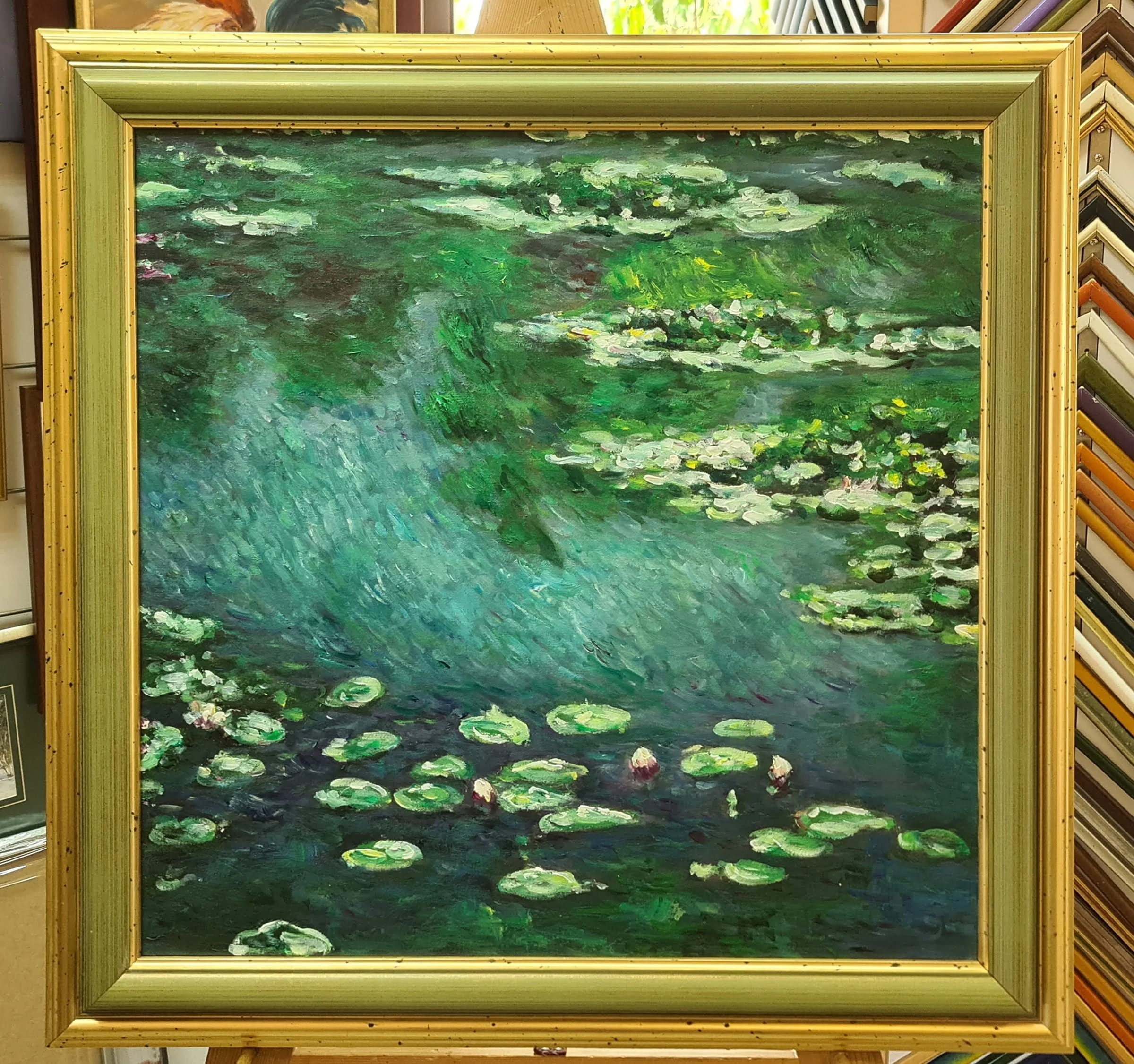
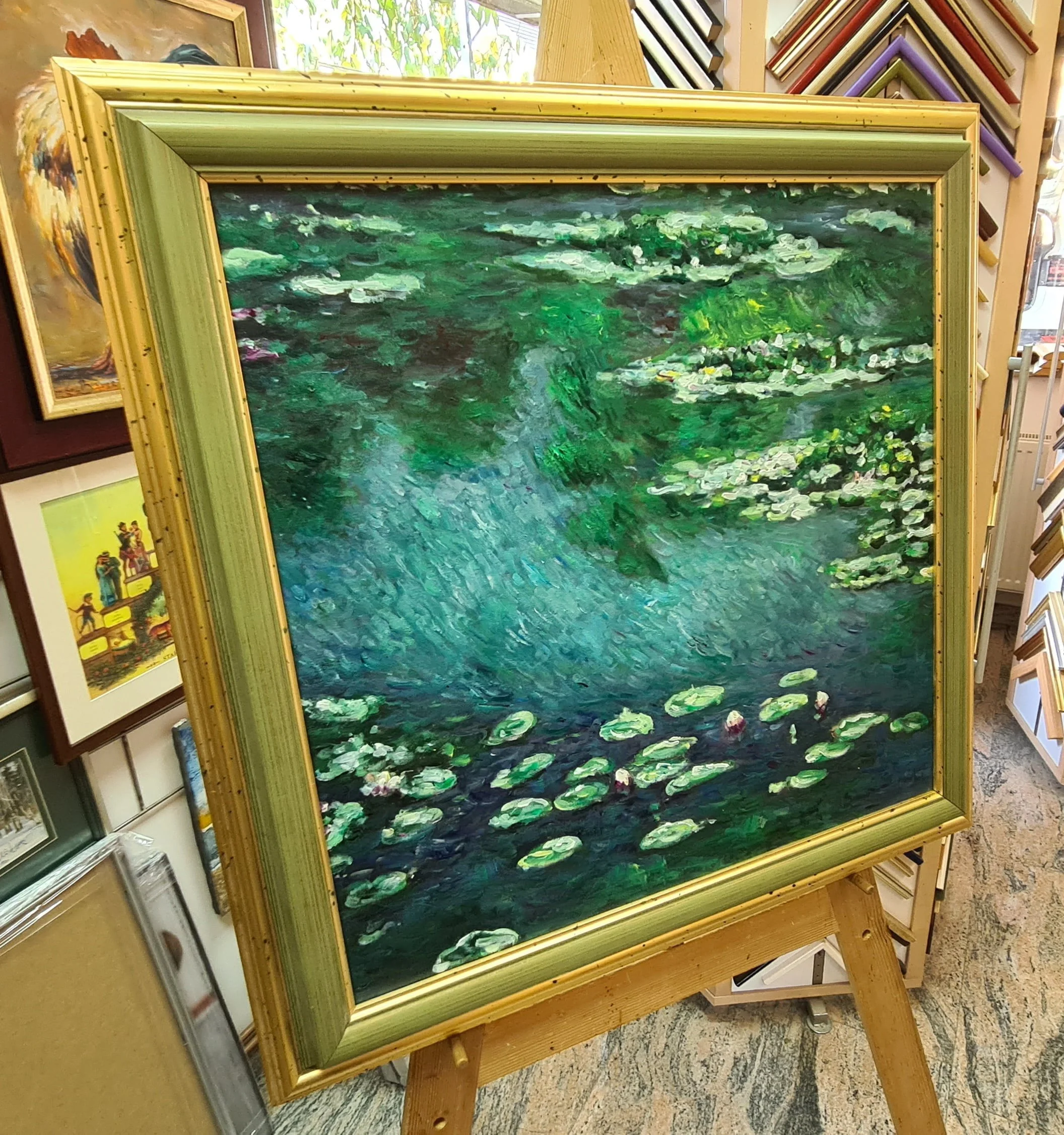
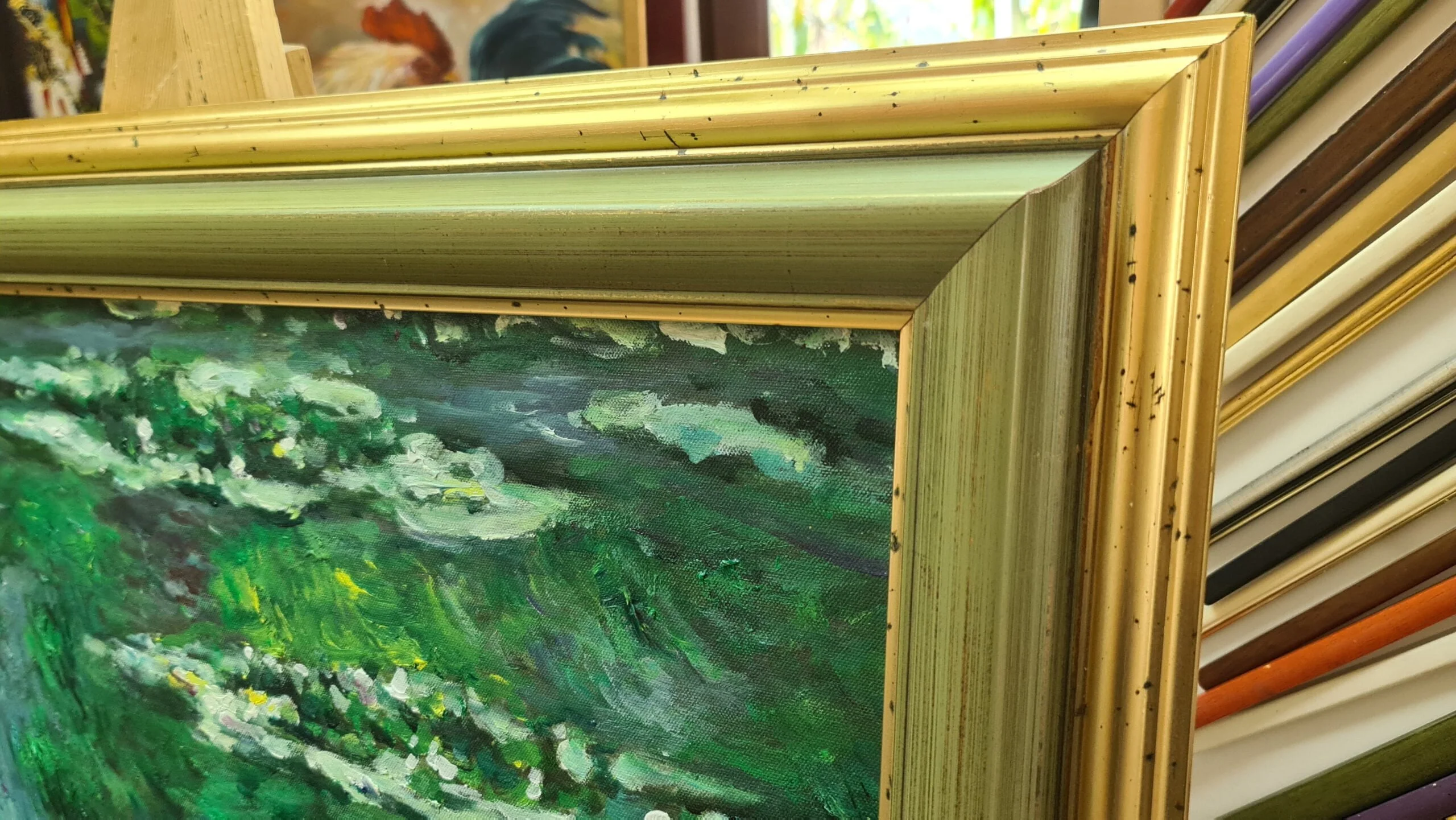
The painter works with a brush and oil colour, not a printer, and builds the surface at two speeds: the open water laid in broadly with long dragged strokes, then the pads and buds as a denser application over it. In the first photograph the finished canvas stands framed in a gold moulding on the easel in our workshop, shot head on. The second and third photographs are taken from the side, left and right, so that the profile and depth of the moulding are visible. The fourth photograph shows the top right corner close up: the edge of the canvas with the paint carried over it, and the weave under the application. That relief is what a print cannot give, because there is nothing on an impression to cast a shadow. Each copy is made separately, so a hand-painted copy is always a work of its own; every oil painting reproduction that leaves the studio differs a little from the last, and it is photographed in daylight before dispatch.
Which size for which wall?
If you are unsure: 93 x 88 cm. That size is the closest to the original, which measures 94.1 x 89.9 cm, and is therefore the most faithful choice. The small sizes 50 x 50 cm and 60 x 60 cm belong in a hallway or between two windows; 70 x 70 cm and 80 x 80 cm sit well above a chest of drawers. From 110 x 100 cm upwards you are on large walls: 130 x 120 cm and 150 x 140 cm take the whole field of view. Because the range is dark and green, this kind of impressionist wall art lives best on a light wall and in enough light; over dark furniture it closes up. It holds no story, which is why this Monet reproduction settles a room rather than accenting it, and why as a painting for living room walls it is easy to live with.
How high to hang the painting: centre at eye level, roughly 145–150 cm from the floor; over a sofa 15–25 cm above the back. The almost-square format also takes a slightly lower hanging.
Made to measure, stretcher and frame
If none of the eight sizes fits your wall, we paint the work to your measurements; that is our painting made to order. Because the original is almost square, we keep the ratio of the sides in custom measurements too, so the pads and the band of water are not stretched. Every copy arrives on a wooden bar frame, ready to hang. For the frame, use our 3D application: on this subject it shows all our mouldings — gold, silver, black, white and natural wood side by side. It is for choosing the frame only and does not show the work in your room; for that there is our separate room-placement service.
Delivery and guarantee
Every copy is made to order in our studio in Slovenia, so allow 15 to 45 days, depending on the size; the two largest are usually at the top of that range. We ship it stretched and protected for transport, framed if you chose a frame, within Slovenia and the EU with no customs. Before dispatch you receive a photograph of the finished work to approve, and every order is covered by our returns policy. The full range is in the Claude Monet gallery, the painter’s path in the article on Claude Monet.
If the painting is a gift and you are unsure of the size, there is a wall art voucher: the recipient chooses the size and the subject.
Frequently asked questions
Where is the original?
At the Art Institute of Chicago, accession number 1933.1157, in the Mr. and Mrs. Martin A. Ryerson Collection: oil on canvas, 94.1 x 89.9 cm, on view in Gallery 243.
What year is it from?
1906. The museum gives that year without qualification, so we give it without qualification too.
How many Water Lilies did Monet paint?
Around 250. The water lilies of his garden at Giverny were Monet’s main subject for roughly the last thirty years of his life; this canvas of 1906 belongs to the group in which he had already left out the horizon altogether.
What do Monet’s Water Lilies mean?
Water, sky and flowers merge into one surface. They are often read as a place of calm and reflection; Monet himself wanted the large canvases to offer a refuge of peaceful meditation.
Why did Monet paint water lilies?
Because the pond was his own creation: from 1899 until his death in 1926 he painted the water garden at Giverny about 250 times, chasing the changing light on the water.
Where did Monet paint the water lilies?
In his water garden at Giverny in Normandy, beside the pond he had dug across the road from his house.
- Subject: nothing but the water surface at Giverny — lily pads upper right and a diagonal band of open water across the middle, 1906.
- Original: 94.1 x 89.9 cm, oil on canvas, Art Institute of Chicago (inv. 1933.1157), Gallery 243.
- Our version: hand-painted oil on canvas, eight sizes from 50 x 50 to 150 x 140 cm, 93 x 88 cm closest to the original.
- Worth knowing: seven years earlier the same pond still had a bridge and a bank.