





Description
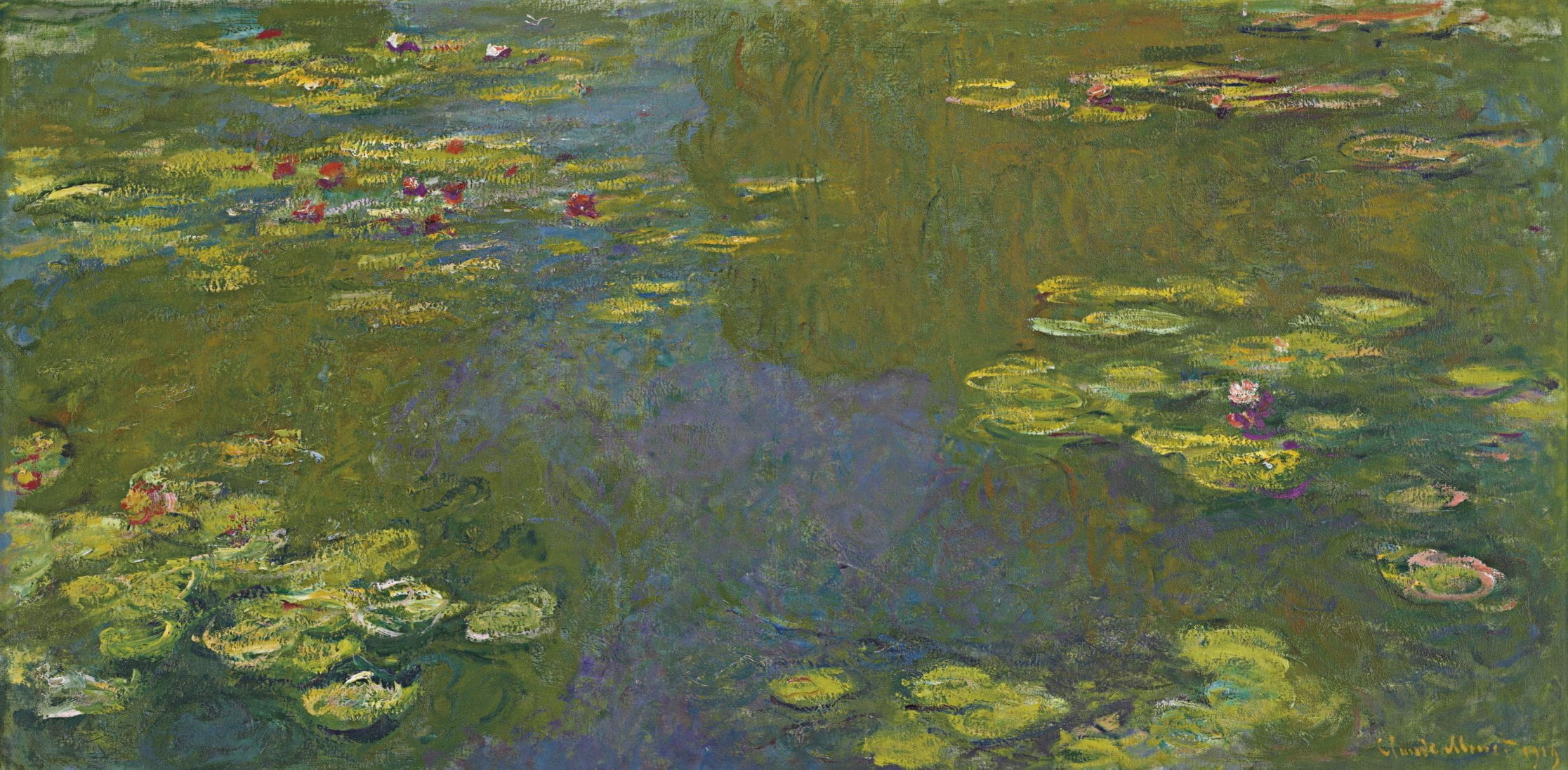
The Water Lily Pond is Monet’s canvas of 1919: twice as wide as it is tall, no sky and no bank, only the water surface with lily pads and flowers. The original measures 201 x 100.4 cm, is oil on canvas, and is signed and dated lower right “Claude Monet 1919”. The catalogue lists it under number 1890 and places it in a private collection, not a museum. With us it is hand-painted in oil on canvas at 201 x 100 cm, as wide as the original and 4 mm shorter, or to your own measurement; before dispatch you receive a photograph of the finished work for approval.
| Title: | The Water Lily Pond |
| Other titles: | Le Bassin aux nymphéas · The Water-Lily Pond · Der Seerosenteich |
| Painter: | Claude Monet (1840–1926) |
| Year painted: | 1919, signature “Claude Monet 1919” lower right |
| Original size: | 201 cm x 100.4 cm (the catalogue gives the format as 200 x 100 cm) |
| Original technique: | Oil on canvas |
| Painting style: | Impressionism |
| Located at: | In a private collection — not in a public collection and not on display (Wildenstein catalogue, no. 1890) |
| Our reproduction: | Hand-painted oil on canvas, 201 x 100 cm or made to measure |
The Water Lily Pond – Claude Monet
What is on the canvas?
The format is markedly horizontal, twice as long as high, with no sky, no bank and no horizon. Only the water surface is visible, seen from above. The ground tone is olive green, yellow-green in places; towards the lower centre a broad blue-violet band of deeper water opens up. The pads lie in loose horizontal islands: upper left a dense island with crimson and red flowers, lower left a large group of broad yellow-green pads, along the right edge two or three bands with single pink flowers between them. Upper centre, a darker vertical reflection of the bankside trees comes down from the top edge — the only vertical in the scene. Between the islands the water stays open, in long thin horizontal strokes. Lower right the canvas is signed in yellow.
Where and when did the scene come about?
At Giverny, in the painter’s own water garden, 1919. The year is not a guess: the canvas is signed and dated lower right, and the catalogue records the signature exactly — “Claude Monet 1919”. It is a late work: Monet was seventy-nine and working on the large formats that would end in the wall decorations. That is why there is neither bridge nor bank here: the motif has shrunk to what the painter saw looking straight down into the water. An impressionist painting of such a motif was made beside the pond, not in the studio: the light on the surface changes too fast for memory.
Why does this canvas matter?
Because of the format. Two to one was not an obvious choice: it is the measurement of a group of canvases from which the great wall decorations grew. The catalogue notes that from this canvas onward the previous one’s characteristics recur on the one-by-two-metre format. Ours is one of the first of that line, standing at the crossing between a painting hung on a wall and a painting that becomes the wall.
What does the scene mean?
The scene is built on two opposing directions. The pads lie horizontally and pull the eye across the width; a single vertical reflection of the trees interrupts that movement and divides the surface in two. With no sky and no horizon, the viewer loses the usual footholds. The reflection is the only thing that betrays that anything is above the surface, and carries more weight than so soft a stroke would suggest. An oil painting with this balance is not empty, though there is literally nothing on it but water.
The path of the work, as the catalogue records it
We give the record of owners as written, without supplementing it. In November 1919, still in the year it was made, Bernheim-Jeune bought it from Monet. In January 1921 Bernheim-Jeune and Durand-Ruel held it jointly, in 1922 Durand-Ruel alone. After that the catalogue records it with Jean d’Alayer in Paris, Sam Salz in New York, and around 1968 Mr and Mrs Norton Simon in Los Angeles. Their collection was sold at Parke Bernet in New York on 5 May 1971, the work as lot 41; from there the catalogue names only a private collection. Who owns it today is not publicly recorded, so we do not claim it. It was exhibited three times: Bernheim-Jeune, Paris, 1921; Art and Science in Gardens at the Carnegie Institute, Pittsburgh, 1922; and Durand-Ruel, New York, 1924. The volume is publicly available in digitised form, at the page carrying this entry.
This motif among the water lilies and with us
The same pond exists with us in several versions: in the square format Water Lilies, in the horizontal one with cloud reflections Water Lilies I. When architecture enters, the result is The Water Lily Pond (Japanese Bridge); a wider and looser cut of the same subject is The Water Lilies – Green Reflections. Our original is not in a museum, but a canvas from the same year can be seen: the Metropolitan Museum in New York holds Water Lilies of 1919, oil on canvas of 200 x 101 cm, on view in Gallery 822. The same year, the same proportion, one centimetre of difference. Monet’s own flower garden at Giverny, with rows of purple irises leading towards the house, is The Artist’s Garden at Giverny.
How is our hand-painted version made?
This is a painting on canvas made with brush and oil colours, not a printer. With this motif the order matters. The painter starts with the olive-green and blue-violet ground, in long horizontal strokes across the full width. Only when that is dry does the vertical reflection go on, and it must stay soft: the moment it acquires an edge it turns into an object and the scene loses depth. The pads come last and carry the thickest paint, in flat touches casting a fine shadow above the weave. The flowers come at the end and are few: too many and the canvas turns decorative. Because this is handwork, every copy differs a little and is its own.
Which size for which wall?
The format is panoramic and asks for a long, unbroken wall — above a sofa, a bed, or a low chest of drawers. 80 x 40 cm and 90 x 45 cm suit a narrow bed or a hallway accent; 100 x 50 cm and 120 x 60 cm a two-seater, 140 x 70 cm and 160 x 80 cm a three-seater. 180 x 90 cm already calls for an empty wall. 201 x 100 cm is as wide as the original and 4 mm shorter and in the regular range, unusual for a work of this width. The palette is warm and earthy, so such a painting quietens a room and sits well with wood.
How high to hang the painting: the centre of the canvas 145 to 150 cm from the floor, above a sofa 20 to 30 cm above the back. A little lower is better than too high.
Made to measure, stretcher and frame
If none of the listed sizes suits, we paint the work in the size you set: send the width and height and we will tell you the price and the time. A reproduction to measure is ordinary with us. We recommend keeping the proportion: if the canvas narrows towards a square, the islands of pads crowd together. The canvas is stretched on a wooden stretcher and the edges painted, so it does not look unfinished even without a frame. A 3D application is available for choosing the frame — for that only, and it does not show the work in your room. Seeing the work on your own wall is a separate room-placement service.
Delivery and guarantee
The work is made to order in our studio, so the making time is 15 to 45 days, nearer the upper limit at larger sizes. We send it stretched, in protective film and firm packaging, framed if you chose a frame. Before dispatch you receive a photograph of the finished work for approval: if something is not right, we correct it while it is still with us. Our returns policy applies to every order. Other motifs by Monet are in the Claude Monet gallery; we write about the painter and choosing a motif on our blog.
If the painting is a gift and you are unsure of the size, there is a gift voucher: the recipient chooses the size and the subject.
Frequently asked questions
Where is the original?
Not in a museum. The catalogue records it in a private collection, last publicly recorded in 1971 at the Norton Simon sale at Parke Bernet in New York.
What year is it from?
1919, as it is signed and dated at the lower right. It is one of Monet’s late, large canvases of the water garden.
Why did Monet paint water lilies?
Because the pond was his own creation: from 1899 until his death in 1926 he painted the water garden at Giverny about 250 times, chasing the changing light on the water.
Where did Monet paint the water lilies?
In his water garden at Giverny in Normandy, beside the pond he had dug across the road from his house.
Is the original for sale, and what is it worth?
The original is in a private collection and not on the market, so it has no public price. Canvases from this late series have fetched tens of millions of dollars at auction.
What does “The Water Lily Pond” mean?
Its meaning lies in what is left out. With no sky, no bank and no horizon the viewer loses the usual footholds, and a single reflection of the trees is the only sign of anything above the water. Monet wanted his large water-lily canvases to offer a refuge of peaceful meditation.
- Motif. Only the water surface, no sky or bank, lily pads in bands and one vertical reflection down the middle.
- Original. Oil on canvas, 201 x 100.4 cm, 1919, signed and dated lower right, private collection, catalogue no. 1890.
- Ours. Hand-painted oil on canvas at 201 x 100 cm, as wide as the original and 4 mm shorter, or to your measurement.
- Worth knowing. The catalogue says that from this canvas onward the motif recurs on the one-by-two-metre format — out of which the great wall decorations grew.