





Description
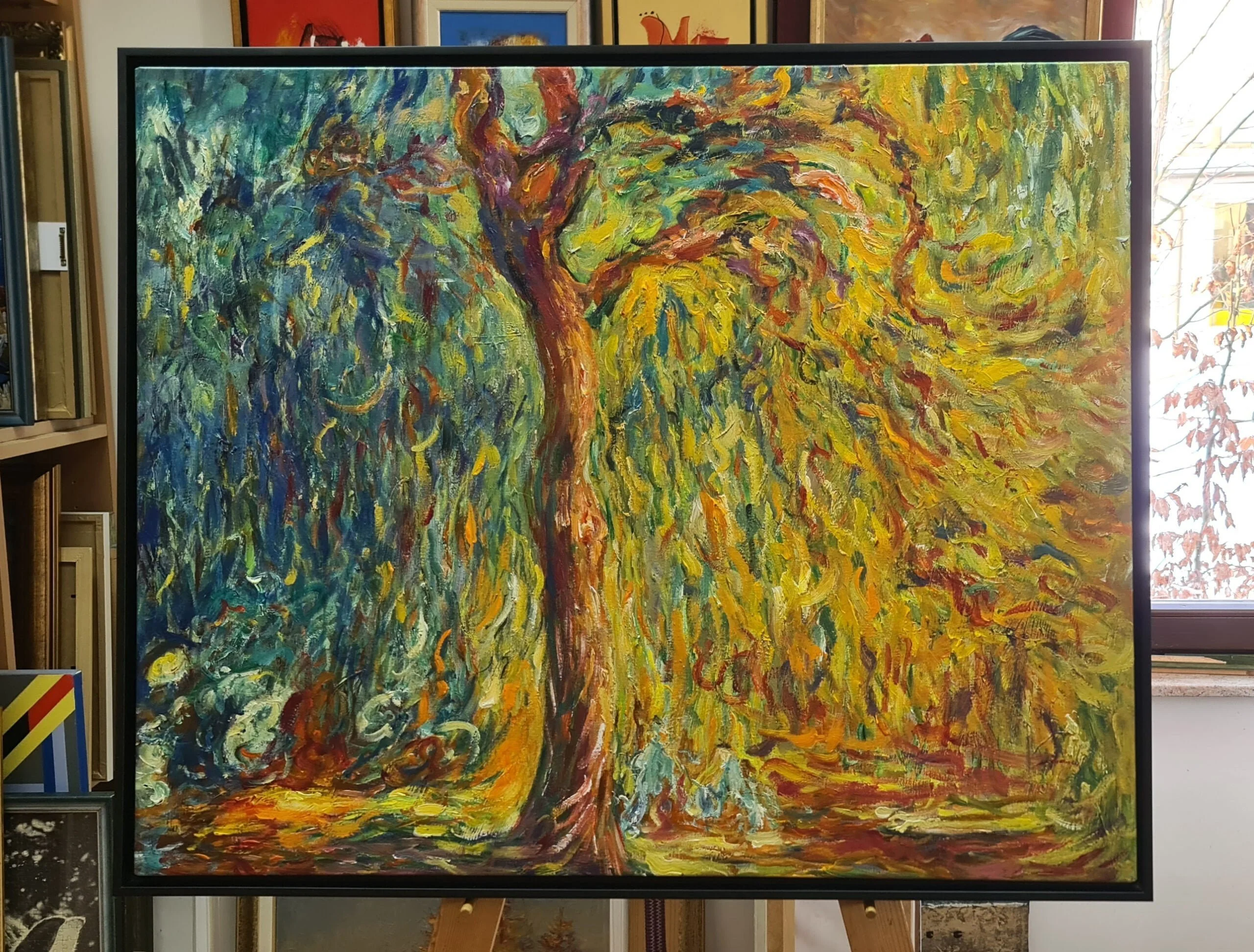
| Title: | Weeping Willow |
| Painter: | Claude Monet |
| Original technique: | Oil on canvas |
| Our reproduction: | Hand-painted oil on canvas, eight sizes or made to measure |
Weeping Willow is a late motif of Monet’s from the garden at Giverny: a single tree, seen so close that no sky, no horizon and no water are left on the canvas — only the trunk, the branching crown and a curtain of hanging withies across the whole surface. We make it as a hand-painted copy in oil on canvas, in eight sizes or to your own measurement, with a photograph of the finished work sent for approval before dispatch.
Weeping Willow – Claude Monet
What is shown?
A single weeping willow, painted from a few paces away. Monet brought the tree so close that the crown never ends: branches fall past the top edge, foliage closes both sides, and only a narrow band of ground is left along the bottom. There is no sky. There is no water either, although the willows stood at the very edge of his pond. This canvas painting therefore shows no place, only the tree — and because no horizon, no building and no figure appears, a viewer has nothing to judge scale against. What is left is the surface.
What is on the canvas?
The trunk rises left of centre and, at a good third of the height, divides into branches that swing in a wide arc to the right. It is painted in red, brick and violet, not in brown. To the left of the trunk the crown is cool: dark blue, blue-green and grey weave into a shadow with yellow flashing through it here and there. To the right the same crown turns gold — long, almost vertical strokes of yellow, orange and ochre fall like a curtain to the foot of the canvas. Along the bottom edge a band of orange-red earth closes the whole. An impressionist painting is ordered here by colour rather than by drawing: one cool half, one warm half, and the trunk standing between them as a vertical.
Why does this work matter?
The willows are Monet’s late subject. By the time his sight had failed and he often knew his colours by their place on the palette rather than by their look, he painted what was within reach: the pond, the water lilies and the trees beside them. It is with the willow that he moved furthest from description. The stroke became broad, dense and openly visible, and the form dissolved into a rhythm of verticals. Anyone who knows only his pale, thinly painted views of water will be surprised here: the paint stands thick, almost kneaded, and this oil painting reproduction has to carry that.
What does the willow mean?
In France the weeping willow is an old sign of mourning — planted on graves and drawn on memorial sheets. Monet painted his willows while the country was at war and in the months just after, and they are often read as a quiet act of remembrance rather than as a garden scene. He never wrote that down himself. What is genuinely visible on the canvas is the contrast: shadow on the left, light on the right, the same tree once cool and once warm. In a room the work behaves exactly that way — serious, but not gloomy.
Which of Monet’s willows is this?
What we deliberately do not state here: Monet painted the willow more than once, and the surviving canvases differ in size and format, so which of them is the original behind this particular reproduction is not established. You will therefore find no year of execution, no collection name and no accession number on this page. We say what is visible on the canvas and nothing beyond it.
Square, upright, wider than they are tall — these canvases already part company on format. Our photographs show a wide, horizontal arrangement with the trunk left of centre, the cool side on the left and the gold on the right — more than one canvas answers that description, so we do not name the original. The motif itself belongs to a larger group: the same pond without a tree is Water Lilies, the view from the bank is The Water Lily Pond, the bridge across it is The Water Lily Pond (Japanese Bridge), and the most dissolved version of all is The Water Lilies – Green Reflections.
How is our hand-painted version made?
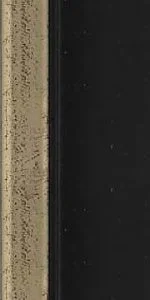
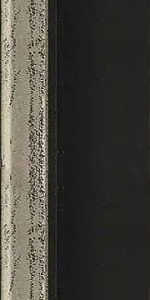
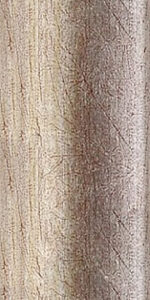
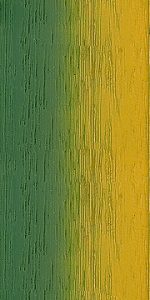
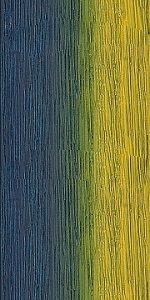
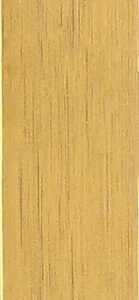
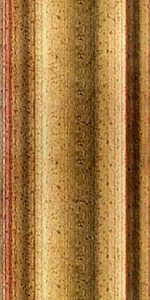
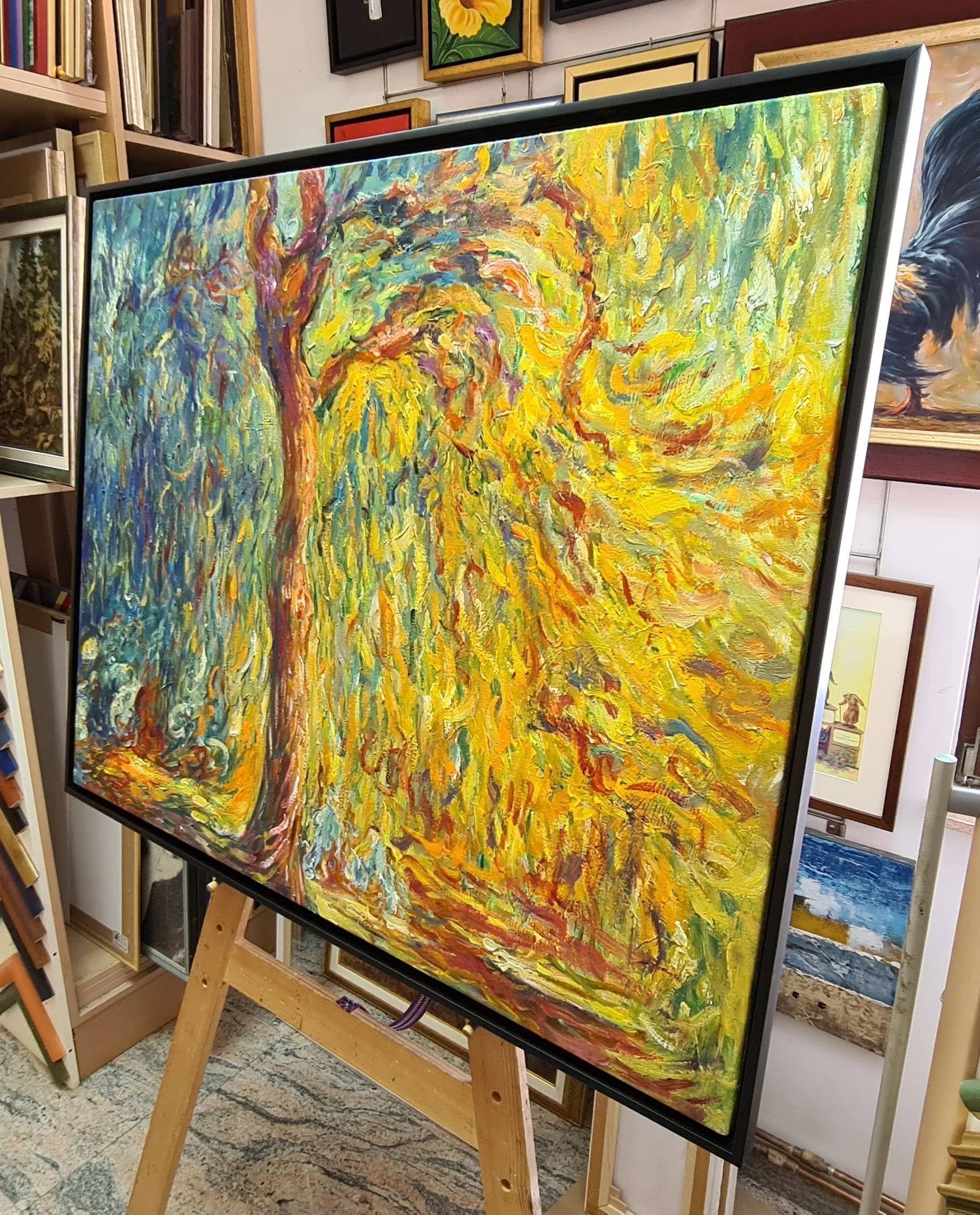
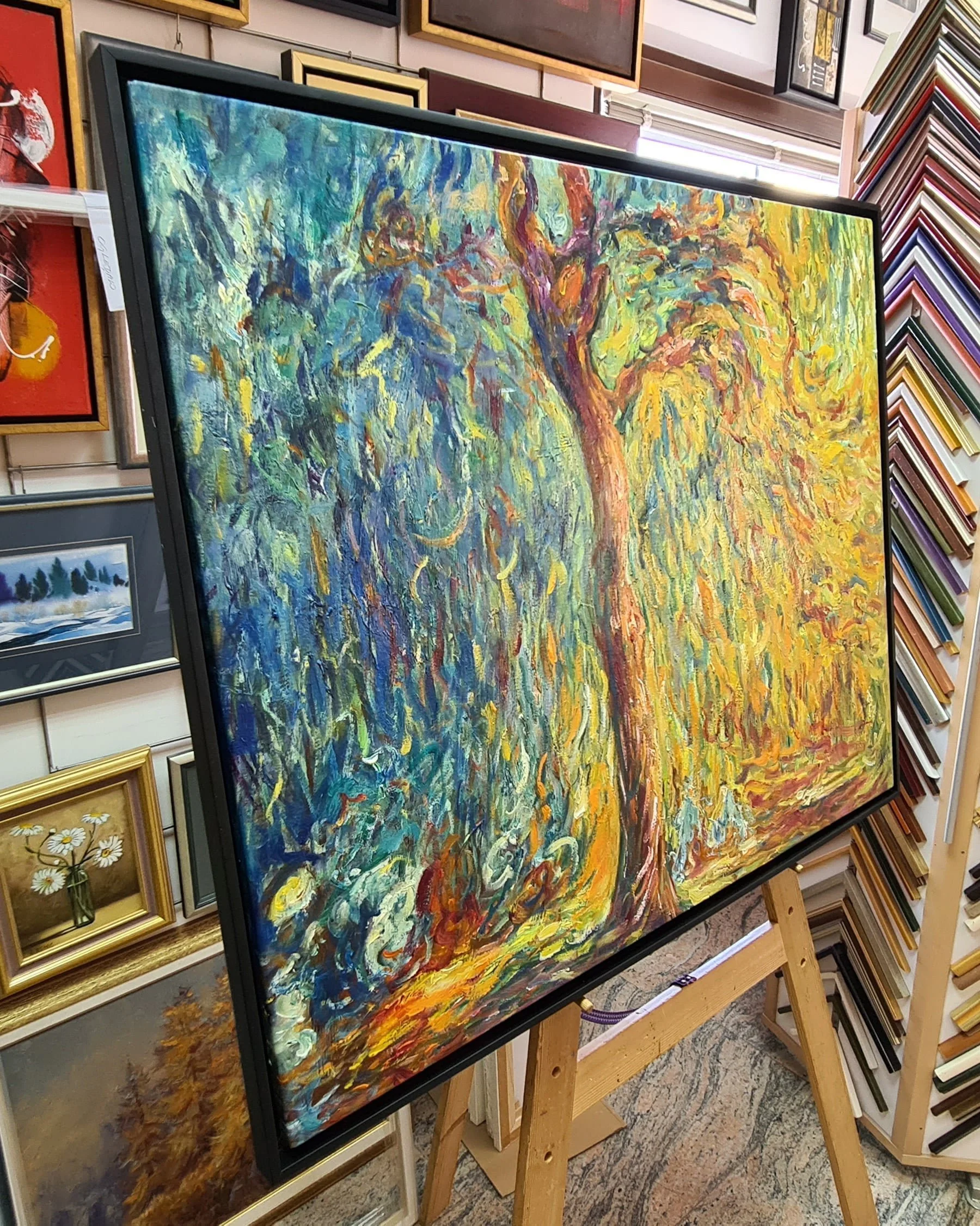
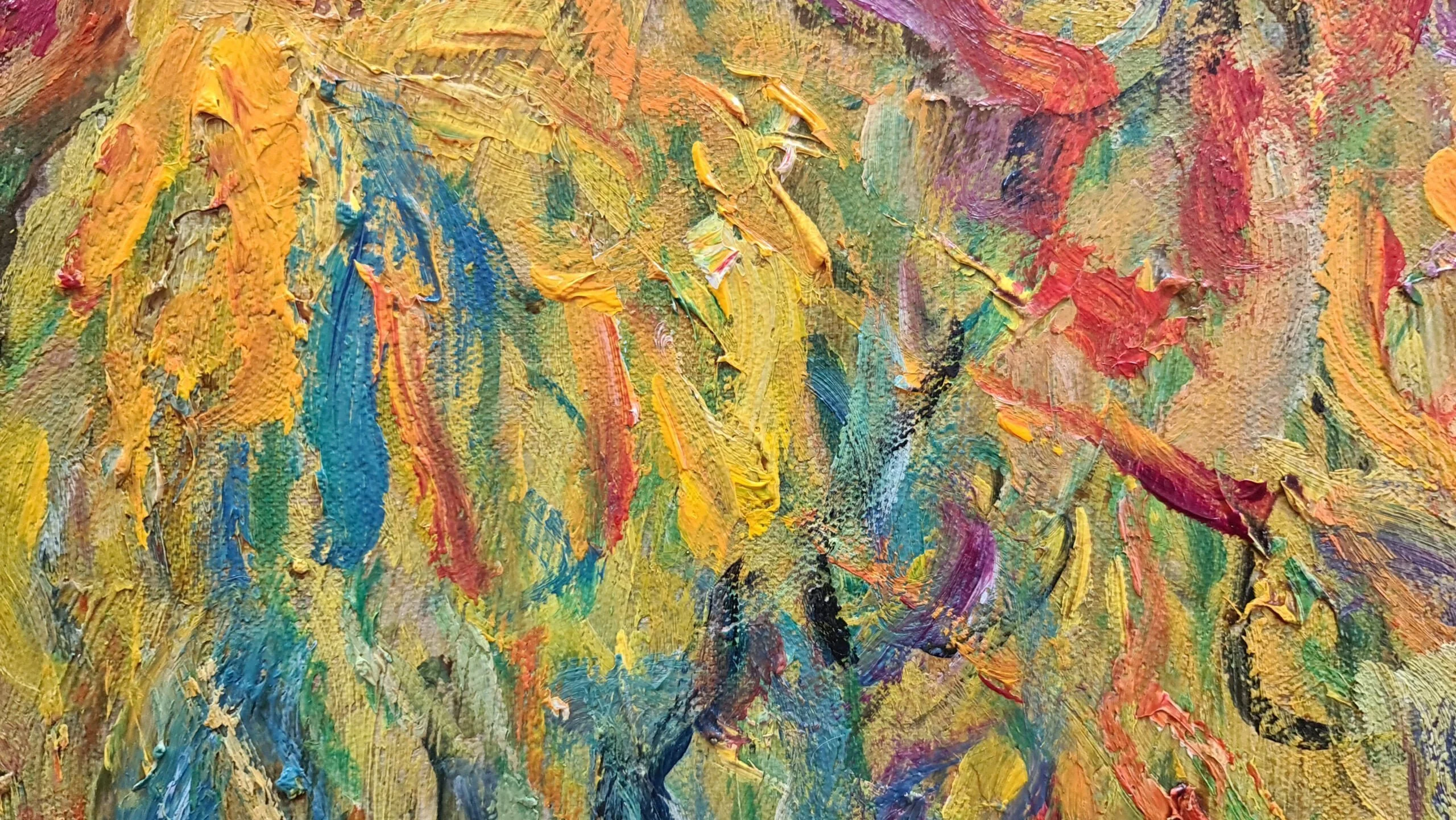
The painter starts from the distribution of colour, not from a drawing: the cool left side first, then the golden right, and the trunk last, because it has to lie across both. In the first photograph the work is shot head on, in a black floater frame, on the easel in our workshop, so you can see the whole arrangement and the ratio of the sides. In the second photograph the same canvas is caught at an angle from the left, so that you can see how thickly the paint stands and how light runs over the ridges. In the third photograph the work stands in front of the rack of moulding samples the frame is chosen from. In the fourth photograph the surface is shot from very close: yellow, orange, blue and crimson strokes lie side by side, and between them the weave of the canvas shows through in places. None of those strokes can be printed — each one is laid on separately.
The paint is laid on thickly and the ridges stay visible from the side as well, which the second and the fourth photographs show best. That belongs to the motif and is not a fault.
Which size for which wall?
Short answer: 100 x 120 cm for a living room, 80 x 100 cm for a narrower wall, 150 x 180 cm for a large open one. A painting for living room walls should take up roughly two thirds of the width of the sofa or sideboard below it; smaller and it gets lost, larger and the wall cannot carry it. The small sizes, 60 x 70 and 70 x 80 cm, are meant for a hallway, a staircase or an office, where people stand close and value the density of the paint. The middle sizes, 90 x 110, 110 x 131 and 120 x 140 cm, cover most bedrooms and dining rooms. As impressionist wall art this motif also holds a darker wall, because the golden half is strong enough to lift away from it.
How high to hang the painting: put the centre of the canvas about 150 cm above the floor. Above a sofa, leave around twenty-five centimetres of air between the backrest and the bottom edge.
Made to measure, stretcher and frame
If none of the listed sizes suits, we paint to measure — send the width and the height and we will quote a price and a lead time. The canvas is stretched over a wooden stretcher and the edges are painted, so the work does not look unfinished without a frame. A frame is not required: in the photographs the work sits in a black floater frame that leaves a narrow gap between canvas and moulding, but you can choose any moulding from our workshop, or hang it bare.
Delivery and guarantee
We ship to the United Kingdom, Ireland and across the EU, wrapped in protective film and packed in a rigid box. Before dispatch we send a photograph of the finished work; if something on it is wrong, it is corrected before the piece leaves the workshop. Lead time depends on the size and on how full the workshop is. Every other Monet reproduction we paint is in the Claude Monet gallery, and we write about painting and about choosing a subject on the blog.
If the painting is a gift and you are unsure of the size, there is a wall art voucher: the recipient chooses the size and the subject.
Frequently asked questions
What year is it from?
We do not give the year either, for the same reason. It is known to be a late motif from the garden at Giverny; a closer date, without a secure identification of the canvas, would not be honest.
What does the weeping willow mean?
It is often read as mourning for the dead of the First World War: Monet painted the willows in 1918 and 1919, when he was almost eighty.
How many weeping willows did Monet paint?
About ten canvases, in 1918 and 1919, in the garden beside the pond at Giverny.
Is the original for sale, and what is it worth?
No. The original is in a museum collection and is not for sale, so it has no market price. Monet’s major canvases are among the most expensive paintings ever sold at auction: one of his Haystacks paintings (Meules, 1890) sold at Sotheby’s in May 2019 for 110.7 million dollars.
- Painted by hand. Oil on canvas, no print and no machine application.
- Eight sizes or made to measure. From 60 x 70 to 150 x 180 cm, otherwise to your own measurement.
- A photograph before dispatch. You see the finished work before it leaves the workshop.
- Said honestly. What is not established about the original, we do not write down.