







































Description
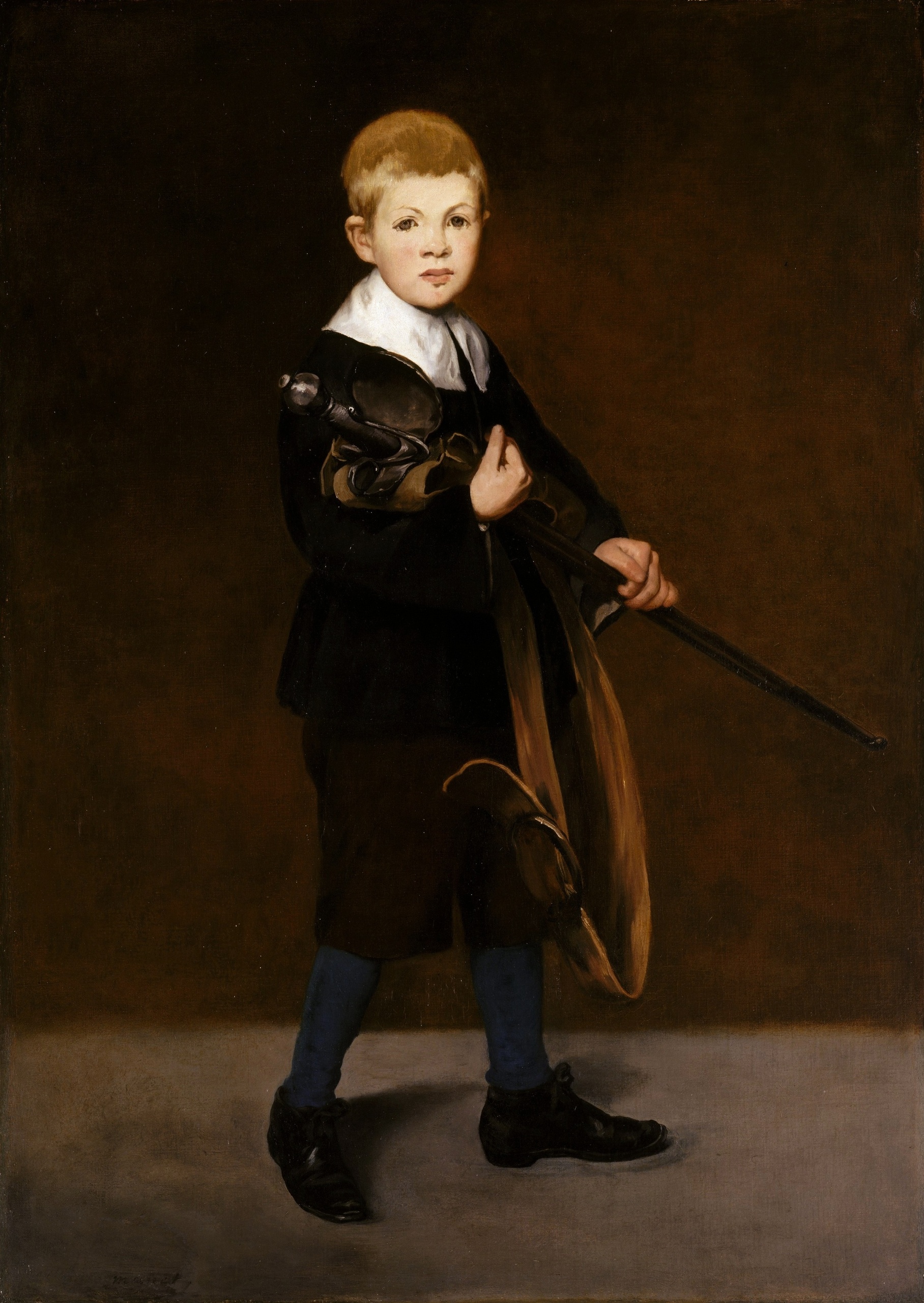
Boy Carrying a Sword is a painting Édouard Manet made in 1861: a fair-haired boy in a black velvet jacket with a wide white collar, dressed as a seventeenth-century Spanish page, holds a heavy sword and its brown leather belt with both hands. The original, oil on canvas measuring 131.1 x 93.4 cm, belongs to The Metropolitan Museum of Art in New York. One of our painters paints it for you by hand in oil on canvas, in 8 portrait sizes from 31 x 42 to 130 x 190 cm, or made to measure. Before shipping, you see the finished boy and his sword in a photograph we send you.
| Title: | Boy Carrying a Sword |
| Other titles: | L’Enfant à l’épée (French title) |
| Painter: | Édouard Manet (1832–1883) |
| Year painted: | 1861 |
| Original size: | 131.1 cm x 93.4 cm (height x width) |
| Original technique: | Oil on canvas |
| Painting style: | Realism and Impressionism |
| Located at: | The Metropolitan Museum of Art, New York, United States |
| Our reproduction: | Hand-painted in oil on canvas, 8 sizes or made to measure |
Boy Carrying a Sword – Édouard Manet
What does Boy Carrying a Sword show?
In the middle of the tall canvas stands a boy with short-cropped fair hair who looks about nine years old. He wears a black velvet jacket with a broad white collar, dark knee breeches, blue stockings and black shoes. His head is turned slightly, and he looks straight at us, serious and a little guarded.
In his hands is a sword plainly too big for him. He rests the hilt against his shoulder and grips the scabbard with his other hand, so that it slants down and away. A wide belt of brown leather hangs from the sword and falls in a loop to his knees.
The background is an even, dark brown, with no furniture and no landscape; the floor is only a pale grey surface on which the boy casts a short shadow. The signature sits at the lower left.
Who was the boy, and why does he carry a sword?
The model was Léon Leenhoff, who became Manet’s stepson in 1862, when the painter married his mother, Suzanne. Some sources say Léon may have been Manet’s own son, though the painter never acknowledged him as such.
Here he is dressed as a page of the Spanish court in the seventeenth century. The sword and belt are full-sized, which is exactly why the gap between the slight body and the heavy weapon is so striking.
French Wikipedia offers one reading: the overly heavy sword might stand for the absent father and a secret hard to keep. That is an interpretation, not a fact.
Why is this painting so admired?
Émile Zola wrote that the work is typical of the influence of the Spanish painters and shows how strongly Diego Velázquez and Frans Hals were shaping Manet at the time. The black clothes against a dark ground, lit only by the face and the collar, recall the portraits Manet copied in the Louvre as a young painter.
Édouard Manet (1832–1883) was born into a wealthy Paris family, trained under Thomas Couture and became a pivotal figure between Realism and Impressionism. This canvas came two years before the uproar at the Salon des Refusés and shows the young painter building his style on the old masters.
An etching was later made after the painting, with the Dijon painter and etcher Alphonse Legros taking part. A short Wikipedia article on the painting, in English, gives the basics.
Where is the original today?
The original, oil on canvas measuring 131.1 x 93.4 cm (height x width), belongs to The Metropolitan Museum of Art in New York, under accession number 89.21.2.
It entered the museum’s collection in 1889 together with Manet’s Young Lady in 1866. According to French Wikipedia, these were the first works by Manet to enter any museum collection.
Boy Carrying a Sword or another Manet?
This is a canvas painting for anyone who likes serious portraits of children, deep blacks and a calm, uncluttered figure. The upright format fills a narrow wall in a hallway, by the stairs or between two windows.
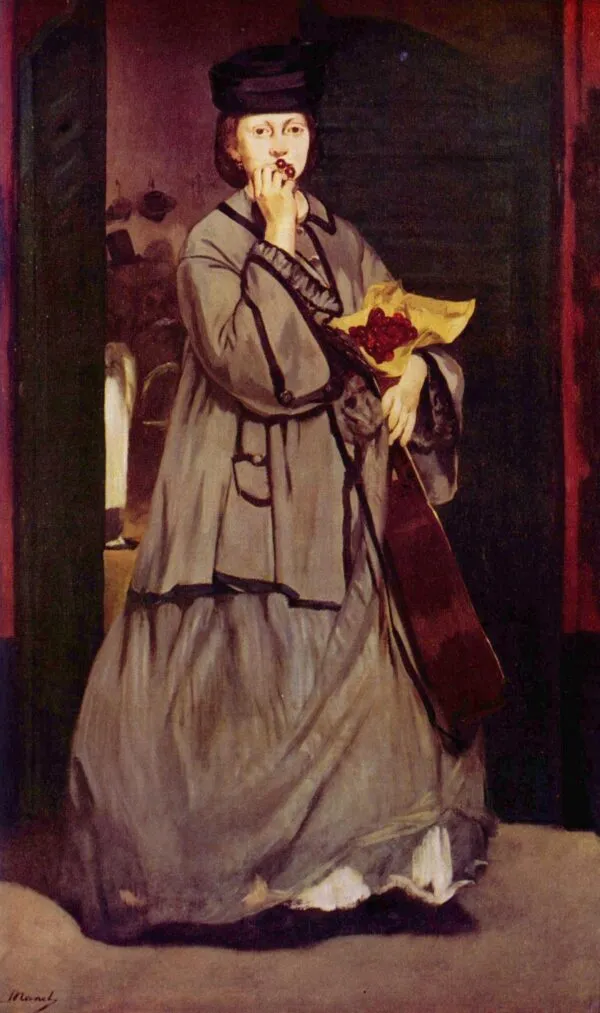
The same Léon appears in The Reading, where as a young man he reads aloud to his mother Suzanne in her white muslin dress. A quite different Manet shows in The Dead Christ with Angels, one of his rare religious works, and in Oysters, his first still life. A woman at a café with an illustrated paper is the subject of Woman Reading.
The whole range of famous Manet paintings that our painters make to order is on the Édouard Manet page.
How do we hand-paint Boy Carrying a Sword?
Manet’s original is an oil on canvas 131.1 cm high and 93.4 cm wide. Yours will be an oil painting reproduction worked by hand: the painter paints in oil on fresh canvas, in the size you pick, laying the colour on in several layers.
He first places the outline of the boy on the brown ground and finds the right proportion between the small figure and the long sword. Then come the warm browns of the background, the grey of the floor and the deep black of the velvet, which in Manet is never flat but has soft transitions.
Last come the light accents: the face, the white collar, the blue stockings, the metal gleam of the hilt and the brown leather of the belt. He sets them down with firm, full strokes.
Which size suits which wall?
In short: 31 x 42 or 40 x 55 cm for a shelf or a narrow wall, 45 x 65 and 60 x 81 cm above a chest of drawers or in a child’s room, 65 x 95 and 83 x 120 cm in a hallway or by the stairs, and 105 x 150 or 130 x 190 cm for a tall wall in the living area.
We paint it in 8 portrait sizes (width x height): 31 x 42, 40 x 55, 45 x 65, 60 x 81, 65 x 95, 83 x 120, 105 x 150 and 130 x 190 cm. The original measures 93.4 x 131.1 cm (width x height), so the six sizes up to 83 x 120 cm are smaller, with 83 x 120 cm coming close, while 105 x 150 and 130 x 190 cm are larger than the original.
As a painting for the living room it works best at 83 x 120 or 105 x 150 cm: there the boy is about as large as in the original, or larger.
Can I order another size or a frame?
Yes. If your wall needs other proportions, we keep the boy, the sword and the belt whole and adjust only the width of the brown background and the grey floor. Send us the size you need for the boy and his sword, and we will reply with a price and a delivery date.
We ship it rolled, stretched on a stretcher bar or framed; our workshop in Slovenia does the stretching and framing and packs each painting carefully for the journey. The moulding for this portrait is chosen in our 3D app, which serves only to pick the frame; seeing the painting on your own wall is a separate service.
Slim black moulding suits the dark tones; warm gold lifts the brown ground.
When will my painting arrive?
The painter starts once you confirm the order, and the painting is ready to leave within 15 to 45 working days. Before packing, you get a photograph of the canvas and can ask for changes.
The parcel with the boy and his sword travels within Slovenia and across the EU with no customs duties, and every order is covered by our returns policy.
The boy dressed as a Spanish page makes a fine gift for admirers of Velázquez and Manet, or for a family furnishing a child’s room. Unsure which wall he will hang on? A wall art voucher lets the recipient pick the size for the boy.
Frequently asked questions
Where can I see the original?
At The Metropolitan Museum of Art in New York, accession number 89.21.2.
Who is the boy in the painting?
Léon Leenhoff, son of Suzanne Leenhoff, who became Manet’s stepson after their marriage in 1862.
Is this a print?
No. You receive a hand-painted copy, done with brushes in oil on canvas.
How big is the original?
It measures 131.1 x 93.4 cm (height x width); our 105 x 150 and 130 x 190 cm sizes are larger.
Can I order a size that is not listed?
Yes. Tell us the width and height your wall calls for, and we will price the boy in that size and give a delivery time.
How long does it take to make?
Between 15 and 45 working days; a photograph of the finished boy reaches you before he ships.
Would the boy suit a child’s room, or make a good gift?
Yes. The calm portrait of the boy suits a child’s room, a hallway or a living room, and as a present it pleases anyone who loves classical painting.
What does the oversized sword mean?
French Wikipedia reads it as a possible sign of the absent father and a heavy secret; no one can say for certain.
- Subject: a fair-haired boy in black velvet with a wide white collar holds a heavy sword with a brown leather belt.
- Original: oil on canvas, 1861, 131.1 x 93.4 cm, The Metropolitan Museum of Art, New York.
- Ours: an Édouard Manet reproduction hand-painted in oil on canvas, in 8 portrait sizes from 31 x 42 to 130 x 190 cm, or made to measure.
- Worth knowing: the model was Léon Leenhoff; in 1889 it was among the first Manet works to enter a museum.