







































Description
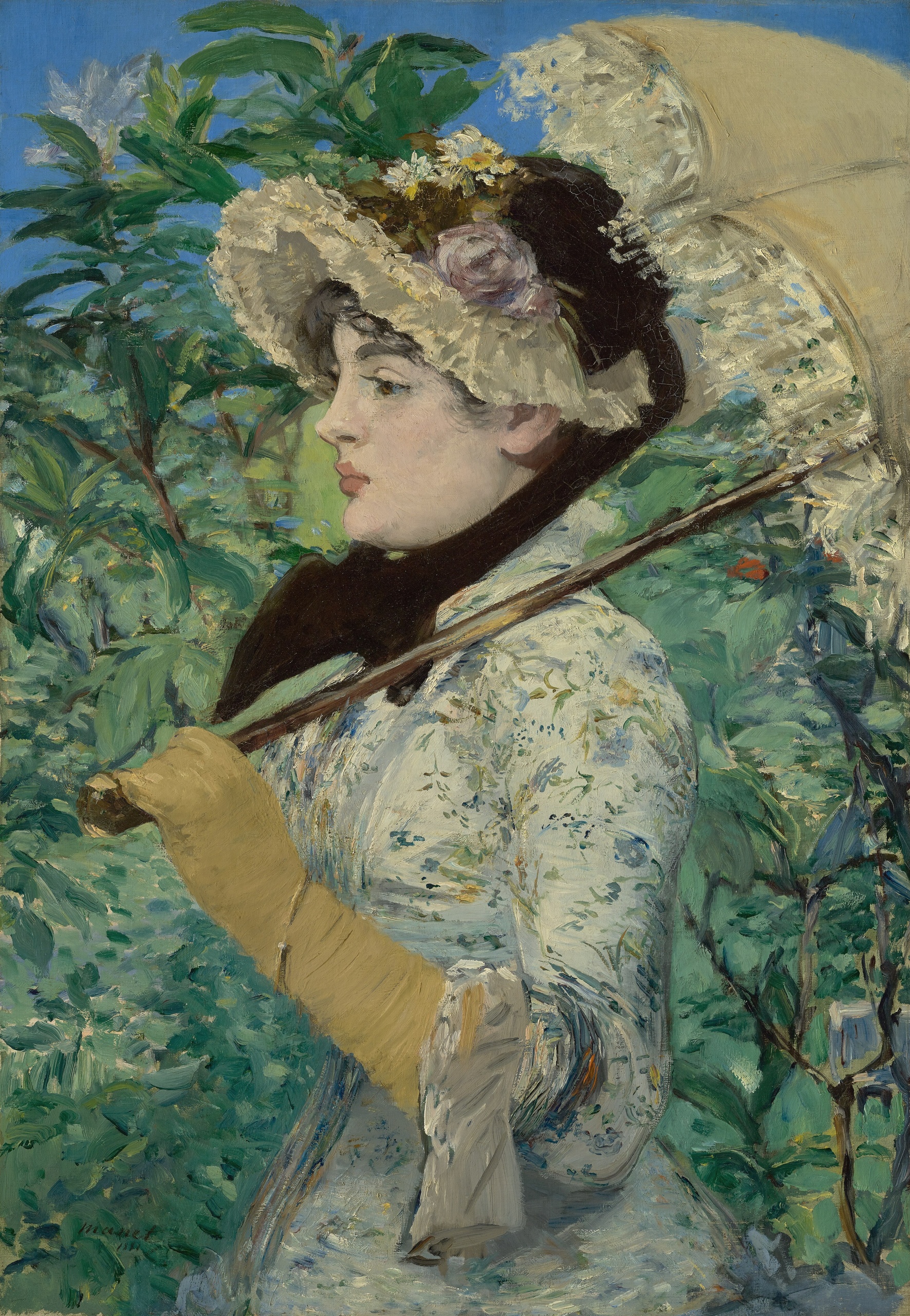
Spring (Jeanne) is a portrait of a young Parisienne whom Édouard Manet painted in 1881 as the embodiment of the season: in profile, in a flowered dress, with a straw bonnet, yellow gloves and a pale parasol, against lush leaves and blue sky. The original is oil on canvas, 74 x 51.5 cm, and it belongs to the J. Paul Getty Museum in Los Angeles. Our painter paints it for you by hand in oil on canvas, in 8 portrait sizes from 30 x 45 to 128 x 191 cm, or made to measure. You see the finished Jeanne in a photograph before she leaves us.
| Title: | Spring (Jeanne) |
| Other titles: | Le Printemps (French title) · Spring |
| Painter: | Édouard Manet (1832–1883) |
| Year painted: | 1881 |
| Original size: | 74 cm x 51.5 cm (height x width) |
| Original technique: | Oil on canvas |
| Painting style: | Realism and Impressionism |
| Located at: | J. Paul Getty Museum, Los Angeles, United States |
| Our reproduction: | Hand-painted in oil on canvas, 8 sizes or made to measure |
Spring (Jeanne) – Édouard Manet
What does Spring (Jeanne) show?
The young woman is painted to the waist, in pure profile, her face turned towards the left edge of the canvas. She has pale skin, rosy lips, long lashes and dark hair escaping in small curls from under her bonnet.
The pale straw bonnet carries white frills at the front and, on top, small yellow and white flowers with a mauve rose. A broad dark brown ribbon runs down her neck and is tied in a bow under her chin. Her close-fitting white dress is scattered with blue and yellow flowers and green leaves; towards the lower edge the pattern dissolves into short, quick strokes.
Her hand, in a long yellow glove with a thin gold bracelet at the wrist, grips the stick of a cream parasol that rests on her shoulder like a rifle. The lace-edged parasol fills the top right corner. Behind her grows a dense bush of green leaves with blue sky showing through, and at the top left a white blossom opens. At the bottom left, in the green, Manet signed his name with the year 1881.
Why is Jeanne painted as spring?
The idea came from Antonin Proust, a school friend of Manet. He suggested a series of the four seasons, each one personified by a chic Parisian woman in the latest fashion. Spring (Jeanne) was the first painting of the set; the second, Autumn, Manet painted the same year with Méry Laurent as his model. The series was never finished, as the painter died in 1883 after a long illness.
His model was Jeanne Demarsy, then about sixteen, who later appeared as an actress on the Paris stage. Manet did not paint her outdoors, as the bush behind her might suggest, but indoors in Paris, on the rue d’Amsterdam.
The clothes mattered to him as much as the sitter. He bought the flowered bonnet specially from the well-known milliner Madame Virot and chose the dress fabric himself. He even borrowed the dress after the sittings to keep painting the fabric without her.
Why is Spring (Jeanne) so well known?
Manet, born in Paris in 1832, was among the first 19th-century painters to depict modern city life, and he stands at the turning point between Realism and Impressionism. After years of rejection at the Salon, this picture brought him rare approval.
He showed it at the Paris Salon of 1882 alongside A Bar at the Folies-Bergère, and critics received both works warmly. English Wikipedia calls it the greatest and final public success of his Salon career.
That same year Charles Cros made a colour print of it with his three-colour photographic process; according to Wikipedia it was the first work of art ever published in colour. A short Wikipedia article on the painting, in English, sums up its story.
Where is the original today?
The original, oil on canvas, is 74 cm high and 51.5 cm wide, a fairly small work. Since 2014 it has belonged to the J. Paul Getty Museum in Los Angeles, accession number 2014.62.
Manet sold it to Antonin Proust in January 1883. The opera singer Jean-Baptiste Faure bought it in 1902, and through the Paris dealer Durand-Ruel it reached the New York collector Oliver Hazard Payne in 1909.
The Payne family kept it for over a century, lending it from 1993 to 2014 at the National Gallery of Art in Washington, after which the Getty Museum acquired it.
Spring (Jeanne) or another Manet?
Spring (Jeanne) suits anyone who loves light colours, flowers and fashion: a canvas painting for a room that could use some fresh green.
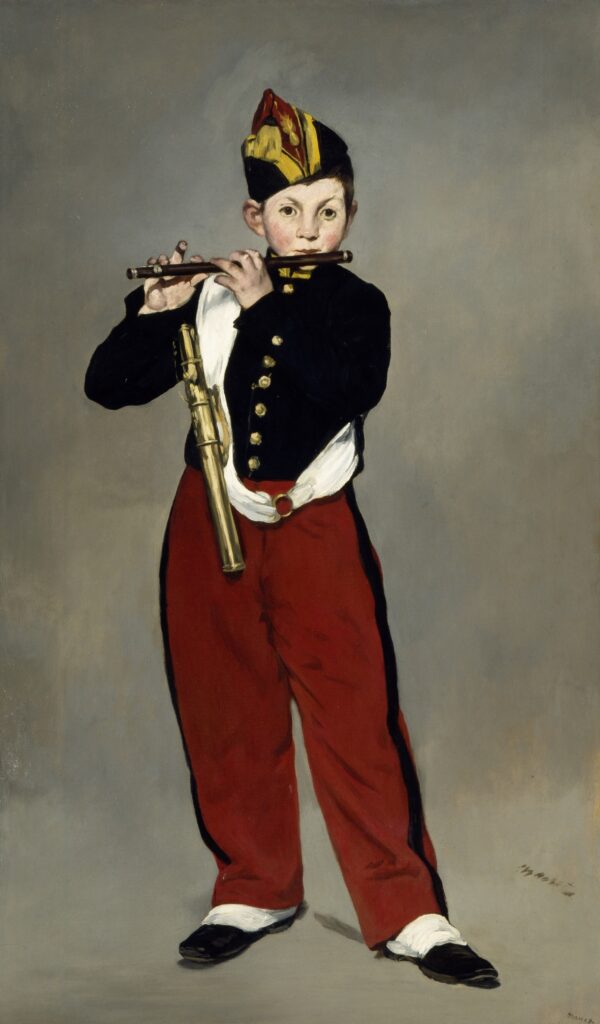
Manet’s Paris out of doors fills Music in the Tuileries, a fashionable crowd under tall trees. A couple in white and blue on deep blue water appears in Boating, and his friend Monet, working under the awning of his floating boat, is the subject of Claude Monet Painting on His Boat. If you prefer a strict upright format, look at The Fifer, a boy in uniform against plain grey.
You will find all our famous Manet paintings, each made to order, on the Édouard Manet page.
How do we hand-paint Spring (Jeanne)?
Manet’s original is a mid-sized oil on canvas, 74 cm high. We make an oil painting reproduction of it on new canvas, painted by hand in oil on canvas at the size you order and built up coat by coat.
He first draws the profile, the bonnet brim, the parasol stick and the line of the shoulder, because that diagonal holds the whole composition. Then come the sky and the leaves, the white dress, and last the bonnet flowers, the fabric pattern, the yellow glove and the lace.
Which size suits your wall?
In short: 30 x 45 or 40 x 55 cm for a shelf, beside a bedside table or on a narrow wall between windows, 45 x 65 and 59 x 81 cm above a chest of drawers or in a bedroom, 72 x 105 and 80 x 120 cm above a sofa, and 105 x 145 or 128 x 191 cm for a tall wall or a hallway.
We paint it in 8 portrait sizes (width x height): 30 x 45, 40 x 55, 45 x 65, 59 x 81, 72 x 105, 80 x 120, 105 x 145 and 128 x 191 cm. The original measures 51.5 x 74 cm (width x height), so 30 x 45, 40 x 55 and 45 x 65 cm are smaller than it, 59 x 81 cm is already slightly larger, and every size above that is larger than the original.
As a painting for the living room it looks best at 72 x 105 or 80 x 120 cm, where the face, the flowers on the bonnet and the dress pattern read from across the room.
Can I order another size or a frame?
Yes. For other proportions we keep the profile, bonnet, glove and parasol intact and adjust only the foliage at the edges. Send us the size you have in mind, and we will reply with a price and a delivery date.
We ship it rolled, stretched on a stretcher bar or framed, with stretching and framing done by our workshop in Slovenia. You choose the moulding in our 3D app, which is meant only for picking the frame; seeing the painting on your own wall is a separate service.
When will my painting arrive?
Work on the profile and parasol begins once you confirm, and Jeanne is ready to travel within 15 to 45 working days. Before packing we send you a photograph of the finished work and touch it up if you wish.
Delivery within Slovenia and to the rest of the EU carries no customs duties, and our returns policy applies to every order.
She makes a lovely gift for a spring birthday or for anyone who loves fashion and flowers. If you do not know her walls, give a wall art voucher and let her choose the size herself.
Frequently asked questions
Where can I see the original?
At the J. Paul Getty Museum in Los Angeles, accession number 2014.62.
Who is the woman in the painting?
Jeanne Demarsy, a young Parisian who later became an actress; she sat for Manet at about sixteen.
Is this a print?
No. It is a hand-painted copy, worked with a brush in oil on canvas by our painter.
How big is the original?
It is 74 cm high and 51.5 cm wide; all our sizes from 59 x 81 cm upwards are larger.
Can I order it in another size?
Yes, send us the width and height you need and we will prepare an offer with price and timing.
How long do painting and delivery take?
The painting is ready in 15 to 45 working days, and you see a photograph of it before it ships.
Is Jeanne right for a bedroom or as a present?
Yes. Its light colours and gentle subject sit well in a bedroom, and as a present it pleases anyone who loves spring.
What does the title mean?
Jeanne personifies spring, the first of four seasons that Manet planned to paint as Parisian women.
- Subject: a young Parisian woman in profile with a flowered bonnet, yellow glove and parasol, against green leaves and blue sky.
- Original: oil on canvas, 1881, 74 x 51.5 cm, J. Paul Getty Museum, Los Angeles.
- Ours: a hand-painted Édouard Manet reproduction in oil on canvas, 8 sizes from 30 x 45 to 128 x 191 cm, or made to measure.
- Worth knowing: the first painting of a planned series of the seasons; praised by critics at the 1882 Salon.