







































Description
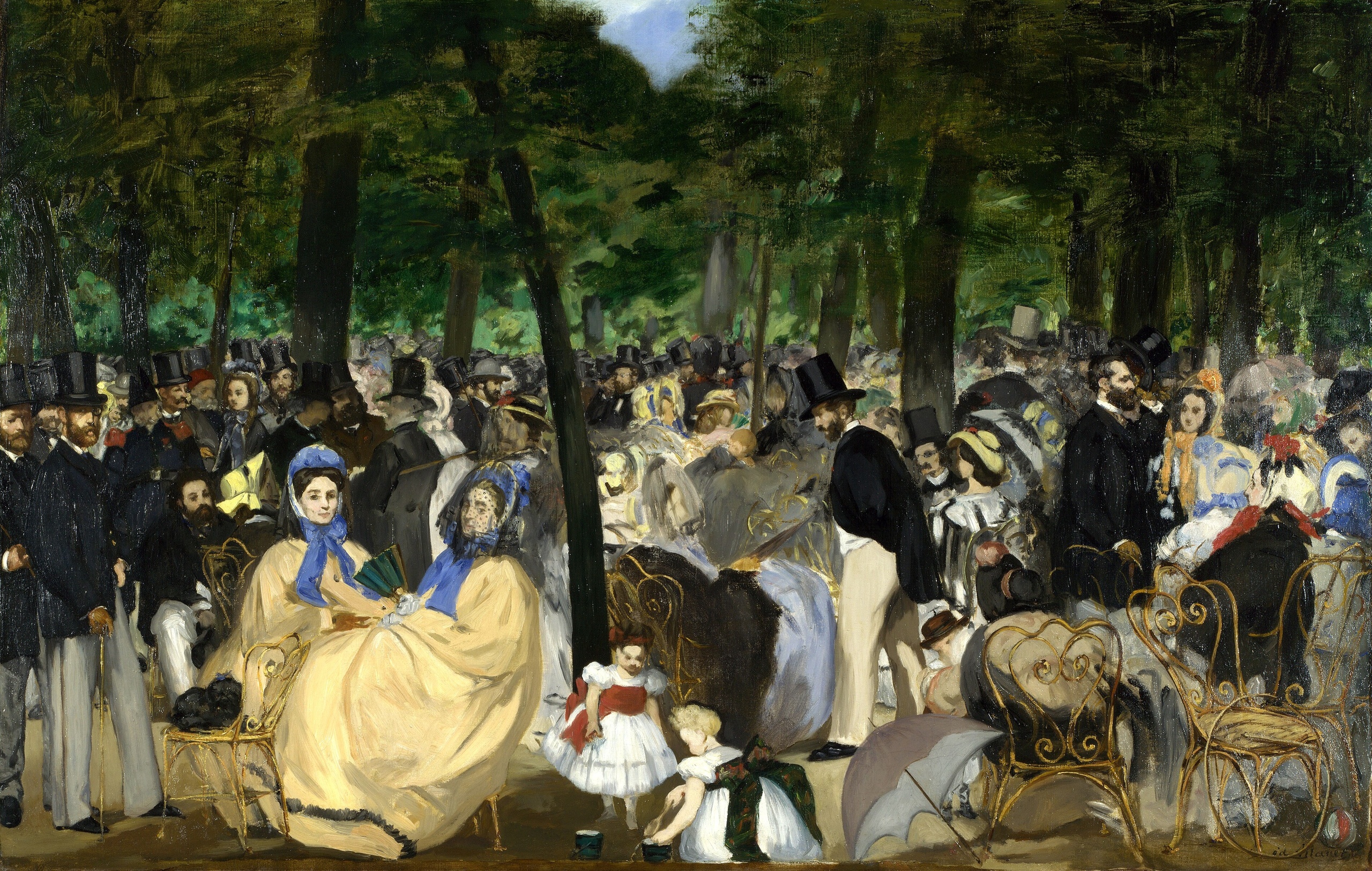
Music in the Tuileries is one of Édouard Manet’s first masterpieces, dated 1862: under the tall trees of a Paris park a fashionable crowd gathers, gentlemen in black top hats, ladies in pale dresses with blue bonnets, and children playing on the sandy path. The original, oil on canvas measuring 76.2 x 118.1 cm, belongs to the Lane Bequest, shared by the National Gallery in London and the Hugh Lane Gallery in Dublin. Our painter paints it for you by hand in oil on canvas, in 8 landscape sizes from 45 x 30 to 200 x 135 cm, or made to measure. You receive a photograph of the finished work before we ship it.
| Title: | Music in the Tuileries |
| Other titles: | La Musique aux Tuileries (French title) · Music in the Tuileries Gardens |
| Painter: | Édouard Manet (1832–1883) |
| Year painted: | 1862 |
| Original size: | 76.2 cm x 118.1 cm (height x width) |
| Original technique: | Oil on canvas |
| Painting style: | Realism and Impressionism |
| Located at: | The National Gallery, London, United Kingdom |
| Our reproduction: | Hand-painted in oil on canvas, 8 sizes or made to measure |
Music in the Tuileries – Édouard Manet
What does Music in the Tuileries show?
Dark green foliage and the trunks of tall trees fill the upper half of the canvas, opening only at the top centre onto a small patch of blue sky.
Below, a dense crowd of Parisians stands, sits and chats. The men wear black coats and tall black top hats that run like dark marks across the whole width.
Left of centre, two ladies in full, pale yellow dresses sit on iron garden chairs. Both wear blue bonnets tied under the chin, with veils, and one holds a green fan.
Children play in the very front: a little girl in a white frock with a red sash, and a fair-haired child crouching on the ground with a small spade. On the right a grey parasol lies open on the ground, with a hoop beside the chairs. For all the music in the title, not a single musician appears.
Who can you find in the crowd?
The scene shows Parisians gathering for the weekly concerts in the Tuileries Garden near the Louvre.
Manet filled the throng with his own circle of artists and writers and put himself in too. He stands at the far left, with the painter Albert de Balleroy beside him and the sculptor and critic Zacharie Astruc seated to their right. His brother Eugène Manet, in white trousers, stands in the foreground right of centre.
The composer Jacques Offenbach, with glasses and moustache, sits against a tree on the right; the critic Théophile Gautier, in a brown suit with a full beard, leans against a trunk, and the poet Charles Baudelaire is to his left. Further left the bearded Henri Fantin-Latour looks out at us, and the fair-haired child in the centre is Léon Leenhoff.
Several of the sitters were prominent French Wagnerians, which has led to speculation that the music playing was by Richard Wagner. The iron chairs in front were new as well: in 1862 they had only just replaced the wooden ones in the garden.
Why does this painting matter so much?
Édouard Manet (1832–1883) was one of the first 19th-century painters of modern life and a pivotal figure between Realism and Impressionism. This work ranks among his first masterpieces and is an early example of his loose, painterly handling, inspired by Frans Hals and Diego Velázquez.
Outdoor leisure in contemporary Paris became his lifelong subject, and the scene encouraged Monet, Renoir and Bazille to paint similar large groups of people.
It drew much attention, most of it hostile. Manet had painted his own social circle rather than heroes or gods, and a public used to the fine brushwork of Ernest Meissonier found his thick strokes crude and unfinished. Some visitors even threatened to destroy it; Eugène Delacroix was among its few defenders. The Wikipedia article on the painting, in English, tells the story in more detail.
Where is the original, and how did it get there?
The original measures 76.2 x 118.1 cm (height x width) and carries the accession number NG3260 at the National Gallery in London, which shares the Lane Bequest with the Hugh Lane Gallery in Dublin.
In January 1883, shortly before his death, Manet sold the canvas to the opera singer and collector Jean-Baptiste Faure. The dealer Paul Durand-Ruel bought it in 1898, and the collector Sir Hugh Lane in 1903.
Lane died in 1915 when the Lusitania was sunk. An unwitnessed codicil to his will left the painting to Dublin, but it was ruled invalid, and in 1917 a court decided in favour of London. In 1959 the two galleries agreed to share the works of the bequest.
Music in the Tuileries or another Manet?
This is a canvas painting for anyone who loves summer shade, city company and scenes where every corner is full of people and colour.
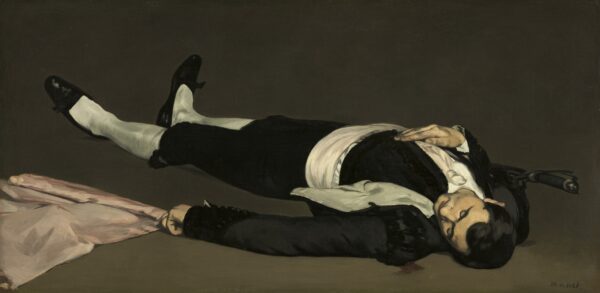
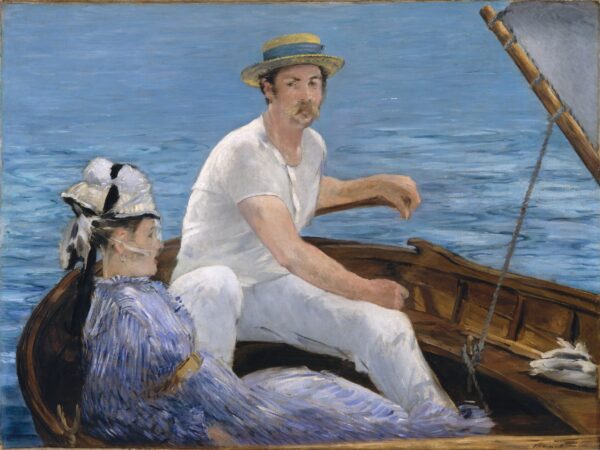
The same year produced The Old Musician, a large canvas of an old violinist among children under a cloudy sky. Quieter are The Fifer, a boy in military uniform against a grey ground, and Boating, a couple in a sailing boat on deep blue water; the most sombre is The Dead Toreador.
Our Édouard Manet page gathers more famous Manet paintings, each one painted to order.
How do we hand-paint Music in the Tuileries?
Manet worked in oil on a canvas just over 118 cm wide. Ours is an oil painting reproduction on fresh canvas, which the painter carries out in oil on canvas, in the size you choose, building it up in layers.
He first places the trunks, the top hats and the two seated ladies, then lays in the muted ochres and dark foliage, and ends with the pure colours: blue bonnets, the girl’s red sash, the yellow dresses.
Manet painted the large areas in subdued ochres and the brightest accents in almost pure pigments such as cobalt blue, vermilion and chrome orange.
Which size suits which wall?
In short: 45 x 30 or 60 x 38 cm for a shelf or narrow wall, 70 x 44 and 90 x 57 cm above a chest of drawers or a bed, 116 x 73 and 130 x 82 cm above a sofa, and 160 x 108 or 200 x 135 cm for a large wall.
We paint it in 8 landscape sizes (width x height): 45 x 30, 60 x 38, 70 x 44, 90 x 57, 116 x 73, 130 x 82, 160 x 108 and 200 x 135 cm. The original measures 118.1 x 76.2 cm (width x height), so the four sizes up to 90 x 57 cm are much smaller, 116 x 73 cm is just under it, 130 x 82 cm slightly larger, and 160 x 108 and 200 x 135 cm clearly larger than the original.
As a painting for the living room it works best at 130 x 82 or 160 x 108 cm, where the faces in the crowd, the fan and the children in front can be made out.
Can I order another size or a frame?
Yes. For other proportions we keep the ladies and children whole and trim the edge of the trees. Send us the measurements you need, and we reply with a price and a date.
We ship it rolled, stretched on a stretcher bar or framed; stretching and framing are done by our workshop in Slovenia. The moulding for this park scene is picked in our 3D app, which serves for frame choice alone; seeing the painting on your own wall is a separate service.
When will my painting arrive?
Once you confirm the order, the painting is ready to ship within 15 to 45 working days. Before packing you get a photograph and can ask for changes.
There are no customs duties within Slovenia and the rest of the EU, and our returns policy covers every order.
An Édouard Manet reproduction of a Paris park full of music and talk makes a lovely gift for anyone fond of Paris. Not sure about the wall? Then a wall art voucher leaves the choice of size to whoever receives it.
Frequently asked questions
Where can I see the original?
It is part of the Lane Bequest, shared by the National Gallery in London (NG3260) and the Hugh Lane Gallery in Dublin.
Did Manet paint himself into the scene?
Yes, he stands at the far left, next to the painter Albert de Balleroy.
Is this a print?
No. A hand-painted copy is made with brushes, in oil on new canvas.
How big is the original?
76.2 x 118.1 cm (height x width); our sizes from 130 x 82 cm upwards are larger.
Can I order a size that is not listed?
Of course. Send us the width and height, and we will quote a price and a date.
How long does it take to make?
Between 15 and 45 working days, and we send you a photograph of the finished painting before shipping.
Is the park scene right for a bedroom, or as a gift?
Yes. The calm green shade of the trees suits a bedroom, and as a present it pleases anyone who loves Paris.
Why are no musicians shown?
Manet painted the listeners, not the orchestra: people gathered for the weekly concerts near the Louvre.
- Subject: Paris society under the trees of the Tuileries: ladies in blue bonnets, gentlemen in top hats, children at play.
- Original: oil on canvas, 1862, 76.2 x 118.1 cm, National Gallery, London (Lane Bequest, NG3260).
- Ours: painted by hand in oil on canvas, 8 sizes from 45 x 30 to 200 x 135 cm, or made to measure.
- Worth knowing: the crowd includes Manet himself, the poet Charles Baudelaire and the composer Jacques Offenbach.