







































Description
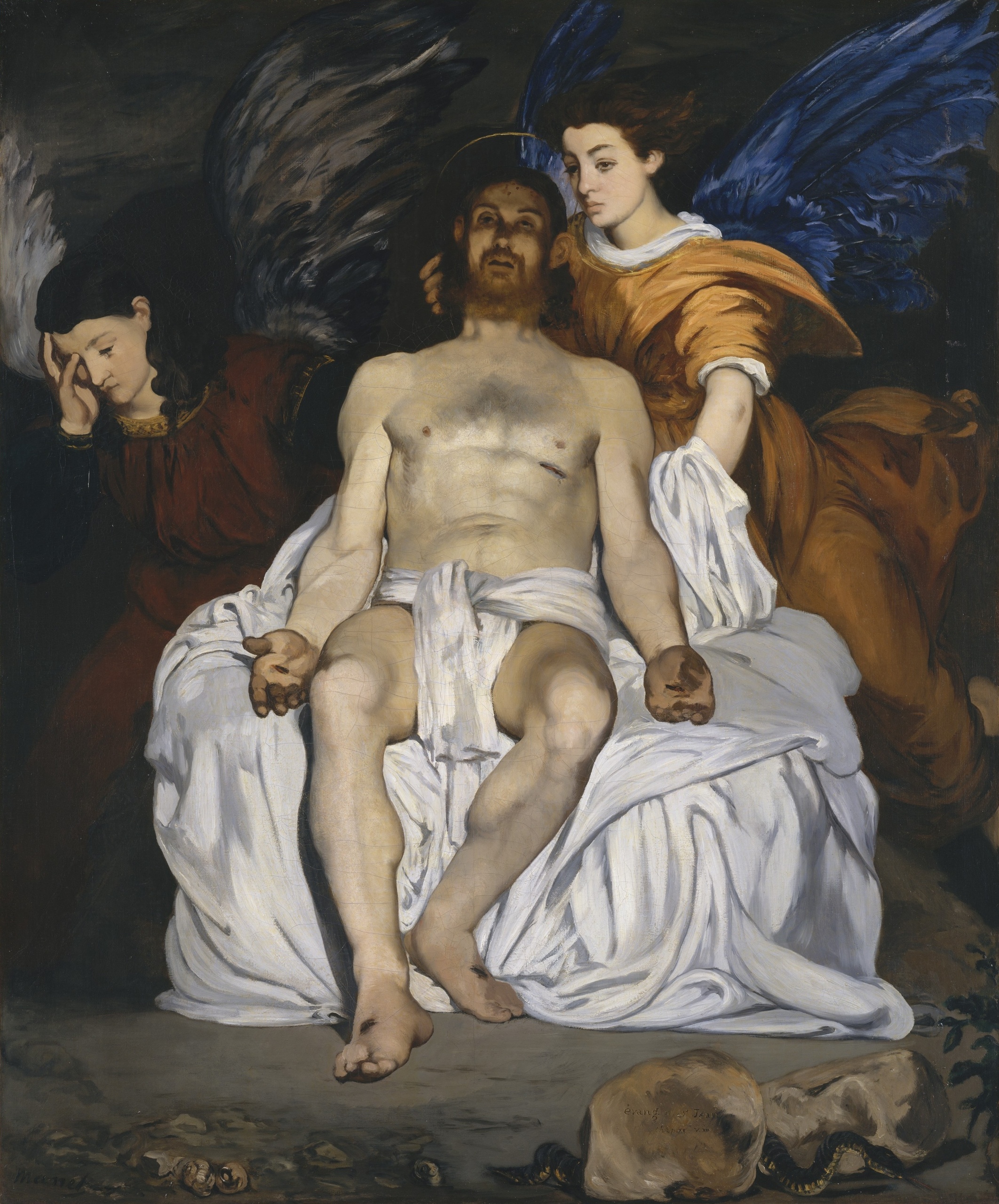
The Dead Christ with Angels is a large religious painting by Édouard Manet from 1864: the pale body of Christ sits propped against a rock on a white shroud, his head fallen back, while two angels hold him from behind, one in red and one in orange. The original is oil on canvas, 179.4 x 149.9 cm (height x width), and it belongs to the Metropolitan Museum of Art in New York. Our painter paints it for you by hand in oil on canvas, in 8 portrait sizes from 36 x 43 to 160 x 190 cm, or made to measure. You see the finished Christ and his angels in a photograph before we pack them.
| Title: | The Dead Christ with Angels |
| Other titles: | Le Christ mort et les anges (French title) |
| Painter: | Édouard Manet (1832–1883) |
| Year painted: | 1864 |
| Original size: | 179.4 cm x 149.9 cm (height x width) |
| Original technique: | Oil on canvas |
| Painting style: | Realism and Impressionism |
| Located at: | The Metropolitan Museum of Art, New York, United States |
| Our reproduction: | Hand-painted in oil on canvas, 8 sizes or made to measure |
The Dead Christ with Angels – Édouard Manet
What does The Dead Christ with Angels show?
At the centre the dead Christ sits against a rock in a dark tomb cave, a white cloth around his hips and a broad shroud spilling beneath him to the ground. His head has dropped back, and a thin golden halo glints faintly around his hair.
Behind him kneels an angel in orange-yellow with deep blue wings, steadying his head and looking down in sorrow. On the left a second angel in dark red, with dark grey wings, leans her head into her hand.
Below lies bare grey ground with two stones on the right, one inscribed with a chapter of the Gospel of John, and a small snake winding between them. At the lower left are a few shells and Manet’s signature.
Which Gospel scene did Manet choose?
The painting draws on John 20:12: Mary Magdalene enters the tomb and sees two angels, but the body of Jesus is gone. Manet turned the story around: his body is still there, and the angels mourn beside it.
The colours depart from the text as well. The Gospel describes the angels in white, yet Manet dressed them in vivid red and orange. Vladimir Gurewich suggests this was meant to heighten the drama of the scene.
The inscription gives the chapter, but the verse is debated: the small v reads either as the Roman five or as the French vers (verse), so the scene is John 20:5-12 or John 20:12 alone.
The work is often linked with Ernest Renan’s Vie de Jésus of 1863, which denied the resurrection and leaned on this very verse. The grieving angels, who announce nothing joyful, are often cited as a trace of that influence.
Why did the painting raise so many questions?
Manet (1832–1883), a painter of modern Paris life and a pivotal figure between Realism and Impressionism, seldom turned to religious subjects.
John Hunisak speculates that, after hostile reactions to his modern subjects, Manet hoped a traditional story with a contemporary twist would please supporters and critics alike at the Salon of 1864.
It did not work out: critics and many of his supporters were confused. The bright angels stand against a neutral background and are not aligned, the cloth is realistic in places and almost abstract in others, and the blurred hands and feet carry Manet’s typical movement.
Manet put the side wound on the wrong side of the body and noticed only after sending the canvas to the Salon. Readings of it as a mirrored Christ are speculation, since accounts call the slip unintentional. To read further, see the English-language Wikipedia article on the painting.
Where is the original today?
The original, oil on canvas measuring 179.4 x 149.9 cm (height x width), belongs to the Metropolitan Museum of Art in New York, under accession number 29.100.51.
First shown at the Paris Salon of 1864, it was followed in 1866 or 1867 by Manet’s etching with aquatint after it, impressions of which belong to the Art Institute of Chicago, the Cleveland Museum of Art and other collections.
The Dead Christ with Angels or another Manet?
This canvas painting suits anyone looking for a serious, contemplative work: a quiet study, a reading corner, a home chapel or a collector’s wall of sacred subjects. Be aware that it is a solemn picture of mourning, not a cheerful decoration.
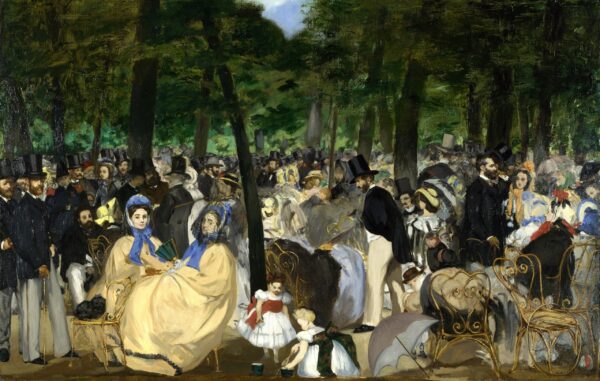
From the same years comes Vase of Peonies, pink, white and dusky red blooms in a porcelain vase; Manet’s first still life is Oysters, with a cut lemon and a jug of butter. Domestic calm returns in Madame Manet at the Piano, the painter’s wife Suzanne at the keys, and in Woman Reading, a young woman at a Paris café with an illustrated paper.
Portraits, still lifes and Paris scenes: the famous Manet paintings we make for you are waiting on our Édouard Manet page.
How do we hand-paint The Dead Christ with Angels?
Manet’s original is a large oil on canvas, almost 180 cm tall; ours is an oil painting reproduction on fresh canvas, built up in oil on canvas, layer upon layer, at the size you pick.
He first sets down the body, the rock and both angels so the seated figure holds the centre, then the dark cave and grey ground, then the pale skin in cool greys and warm yellows.
The shroud gets broad white strokes and the blue wings quick, feathery touches. We leave the hands and feet soft, because that softness belongs to Manet’s handwriting.
Which size suits which wall?
In short: 36 x 43 or 46 x 55 cm for a reading corner or a home chapel, 54 x 65 and 68 x 85 cm for a study, 90 x 103 and 100 x 120 cm above a chest of drawers or in a hallway, and 127 x 150 or 160 x 190 cm for a tall wall or a collection.
We paint it in 8 portrait sizes (width x height): 36 x 43, 46 x 55, 54 x 65, 68 x 85, 90 x 103, 100 x 120, 127 x 150 and 160 x 190 cm. The original measures 149.9 x 179.4 cm (width x height), so all seven sizes up to 127 x 150 cm are smaller than it, and only the largest, 160 x 190 cm, reaches it and slightly exceeds it both ways.
As a painting for the living room it works only if you want a quiet, serious accent there, say at 100 x 120 cm on a calm wall with no other works around it.
Can I order a different size or a frame?
Yes. If your wall needs other proportions, we keep Christ and both angels whole and adjust the dark edge of the cave and the ground. Send us the measurements of your wall, and we will come back with a price and a date.
This upright canvas travels rolled, stretched on a stretcher bar or already framed, with the stretching and framing done by our workshop in Slovenia. You pick the moulding for this sacred work in our 3D app, which is for choosing the frame alone; a view of the painting on your own wall is a separate service. A gilt moulding echoes the halo.
When will the painting arrive, and how is it shipped?
The painter starts on the cave, the body and the angels as soon as you confirm, and the painting is ready to leave within 15 to 45 working days; before packing we send you a photograph and adjust what you ask.
The parcel with Christ and his angels crosses Slovenia and the rest of the EU with no customs duties, and the order falls under our returns policy.
As a gift it suits a believer, a collector of sacred art or an admirer of Manet. Unsure of the wall? A wall art voucher lets the recipient pick the size of the Christ and angels.
Frequently asked questions
Where can I see the original?
At the Metropolitan Museum of Art in New York, under accession number 29.100.51.
Whom are the two angels holding?
The dead Christ, seated on a white shroud in the tomb cave while the angels mourn him.
Is this a print?
No. Every fold of the shroud and every feather of the wings comes from a brush, because you receive a hand-painted copy in oil on canvas.
How large is the original?
It measures 179.4 x 149.9 cm (height x width); our largest size, 160 x 190 cm, is slightly bigger.
Can I order Christ and the angels in a size that is not listed?
Certainly: give us your wall’s width and height, and we will quote a price and a lead time.
How long does it take to make?
Between 15 and 45 working days, and before dispatch you receive a photograph of the finished painting.
Would it work in a bedroom or as a present?
Not in a bedroom, as it is too grave; as a present it pleases a believer or a collector.
What does the inscription on the stone mean?
It cites chapter 20 of the Gospel of John; the verse can be read as 5 or as 12.
- Subject: the dead Christ on a white shroud, held in a dark cave by angels in red and orange.
- Original: oil on canvas, 1864, 179.4 x 149.9 cm, The Metropolitan Museum of Art, New York.
- Ours: an Édouard Manet reproduction painted by hand in oil on canvas, 8 sizes from 36 x 43 to 160 x 190 cm, or made to measure.
- Worth knowing: a rare religious work by Manet, first shown at the Paris Salon of 1864.