







































Description
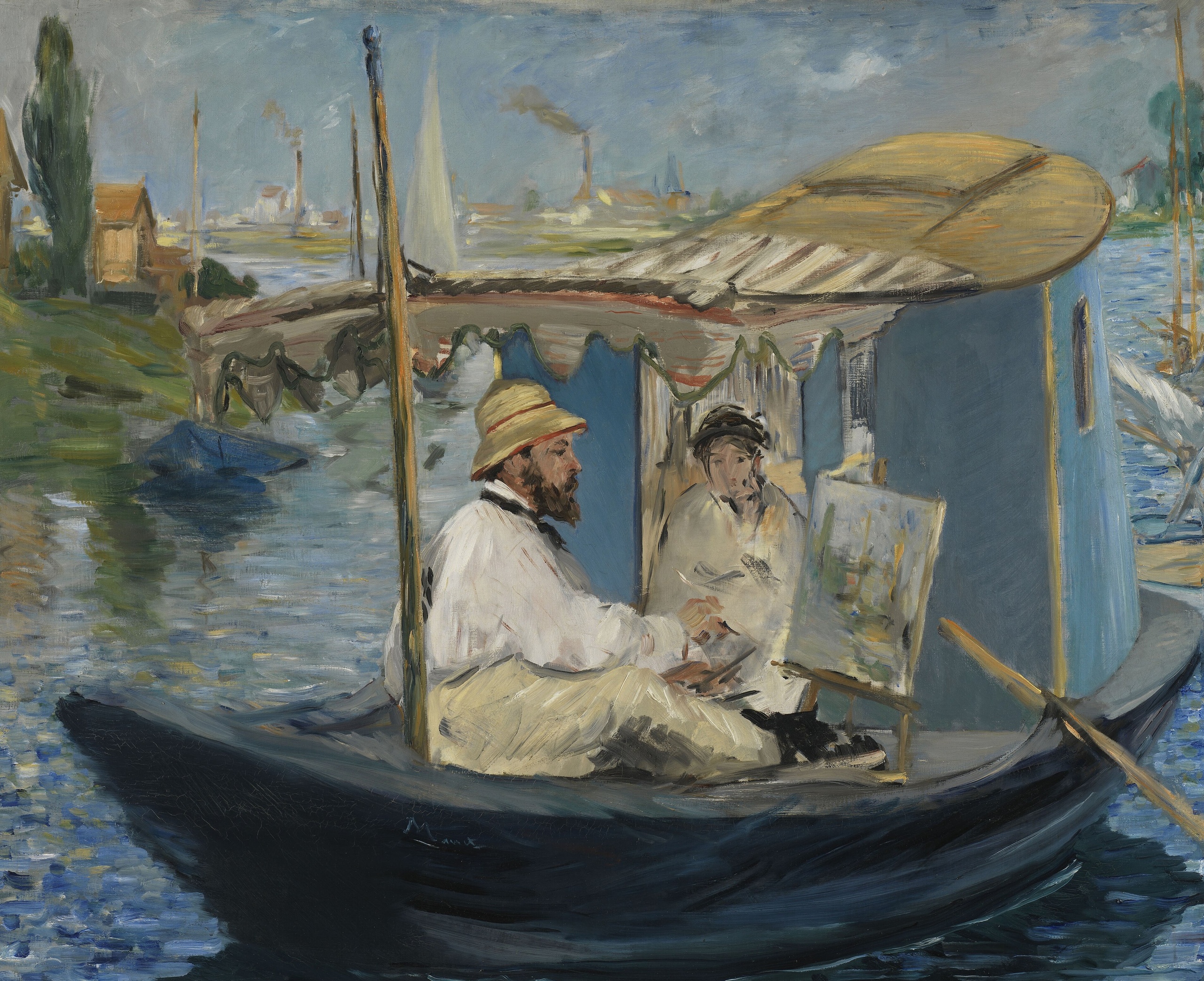
Claude Monet Painting on His Boat is a work by Édouard Manet from the summer of 1874: his friend Claude Monet, in a straw hat, sits under the striped roof of his boat in mid-river and paints at an easel, while his wife sits in the cabin behind him. The original is oil on canvas, 82.7 x 105 cm, and it belongs to the Neue Pinakothek in Munich. Our painter paints it for you by hand in oil on canvas, in 8 landscape sizes from 40 x 30 to 200 x 159 cm, or made to measure. Before it ships, you receive a photograph of the finished painting.
| Title: | Claude Monet Painting on His Boat |
| Other titles: | Monet in his Boat · Die Barke (German title) |
| Painter: | Édouard Manet (1832–1883) |
| Year painted: | 1874 |
| Original size: | 82.7 cm x 105 cm (height x width) |
| Original technique: | Oil on canvas |
| Painting style: | Realism and Impressionism |
| Located at: | Neue Pinakothek, Bavarian State Painting Collections, Munich, Germany |
| Our reproduction: | Hand-painted in oil on canvas, 8 sizes or made to measure |
Claude Monet Painting on His Boat – Édouard Manet
What is happening on Monet’s boat?
In the middle of the canvas floats a small dark boat with a cabin. A striped awning arches over it, capped by a round, straw-coloured roof with a wavy green fringe hanging from its edge. Beneath it sits Claude Monet, bearded, dressed in pale clothes, with a black scarf at his throat and a straw hat with a red band. An easel with a half-finished canvas stands before him; his right hand touches it with a brush, and his left holds more brushes.
Behind him, in the shade of the blue-painted cabin, sits his wife in a light dress and a small dark hat, turned towards the canvas. A thin mast rises from the boat, and on the right a long oar dips at a slant into the water. On the dark hull, Manet’s name is written in bluish paint.
Beyond the boat a broad river opens out. On the left bank stand houses and a tall, slender tree, and a little blue rowing boat is moored by the water. Sailing boats with white sails glide past, and on the far bank grey smoke drifts from factory chimneys. The water is bright and alive, built from strokes of blue, white and pale yellow.
Why did Monet paint out on the water?
The boat was an old one that Monet had bought around 1871 or 1872. From it he painted and watched the light changing on the Seine. A floating place to work was not entirely new: the painter Daubigny already had a boat of his own, called the Bottin.
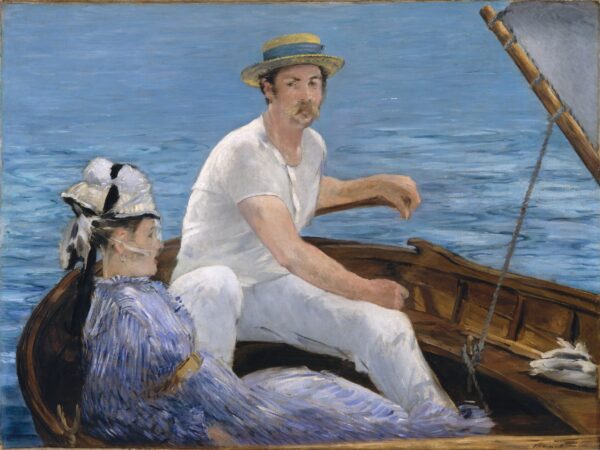
Manet spent the summer of 1874 with Monet at Argenteuil. Several of his works date from those months, among them The Monet Family in their Garden and Argenteuil, and he also painted a number of boating subjects that year. From the same weeks comes Boating, a man in a straw hat at the tiller of a sailing boat with a woman in a striped dress beside him.
Why is this work so admired?
Édouard Manet (1832–1883) was among the first 19th-century painters to take up modern life, and he is a key link between Realism and Impressionism. He came to know Monet, Degas, Renoir and others through the painter Berthe Morisot, yet he never exhibited with the Impressionists, preferring the official Salon.
They influenced him all the same, Monet and Morisot above all. After the early 1870s he used dark backgrounds less often and lightened his colours, while keeping his black as a signature. You can see it here: river and sky are bright, while the hull and Monet’s scarf stay deeply dark.
Manet painted directly, wet into wet, with opaque paint on a light ground, which let him finish a canvas in a single sitting; the Impressionists took up the method. A short Wikipedia article on this painting, in English, also names other works from that summer.
Where can you see the original today?
The original, oil on canvas measuring 82.7 x 105 cm (height x width), belongs to the Neue Pinakothek in Munich, part of the Bavarian State Painting Collections, under inventory number 8759.
Manet was born in Paris in 1832 into a wealthy family; his father was a judge. After failing the naval examination twice, he trained under the painter Thomas Couture and copied Velázquez and Titian in the Louvre. He received the Légion d’honneur in 1881 and died in Paris two years later, after a long illness.
Claude Monet Painting on His Boat or another Manet?
Pick this canvas painting if you love water, summer light and small scenes from artists’ lives.
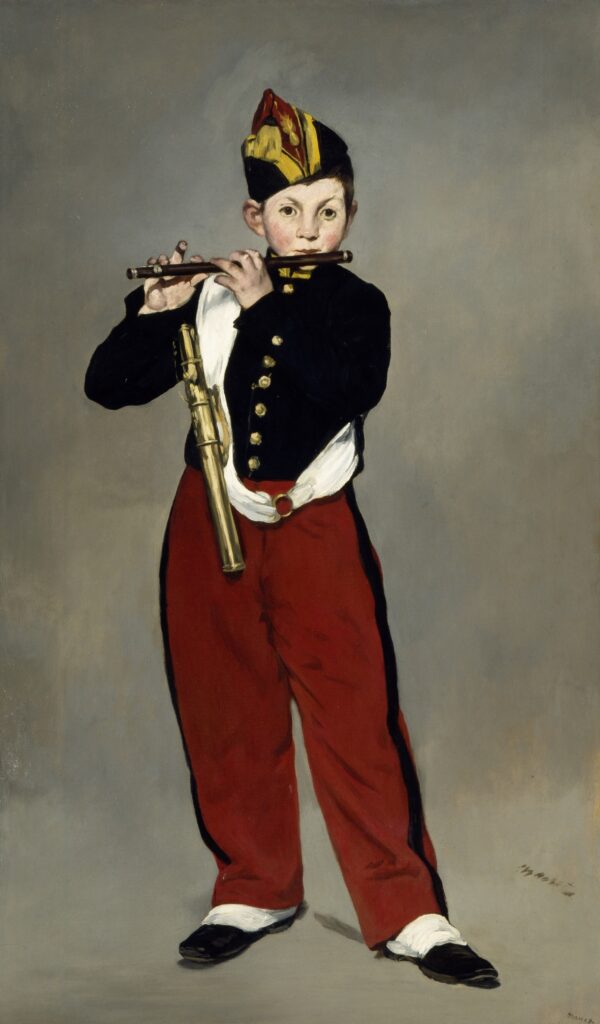
If Paris draws you more, look at Music in the Tuileries, an elegant crowd under tall trees. A boy in a military uniform against a grey ground is the hero of The Fifer, while a quieter, graver mood belongs to The Dead Toreador.
Every one of the famous Manet paintings we paint to order, this boat included, is on our Édouard Manet page.
How do we hand-paint Monet on his boat?
Manet’s original is an oil on canvas 105 cm wide. Ours is an oil painting reproduction on new canvas: the painter works it in oil on canvas, in the size you choose, building it up layer by layer.
He first draws the boat, the cabin and the round roof, then places Monet and the easel, since the whole composition rests on them. Next come the dark hull, the blue cabin and the pale clothes, and only then the river, the sails and the far bank. The water stays in short, quick strokes, as Manet left it.
Which size suits which wall?
In short: 40 x 30 or 50 x 38 cm for a shelf or a narrow wall, 65 x 49 and 80 x 63 cm above a chest of drawers or in a bedroom, 100 x 79 and 125 x 99 cm above a sofa, and 160 x 123 or 200 x 159 cm for a large wall.
Monet’s boat comes in 8 landscape sizes (width x height): 40 x 30, 50 x 38, 65 x 49, 80 x 63, 100 x 79, 125 x 99, 160 x 123 and 200 x 159 cm. The original measures 105 x 82.7 cm (width x height). The first five sizes are smaller, with 100 x 79 cm very close to it, while 125 x 99, 160 x 123 and 200 x 159 cm are larger than the original.
As a painting for the living room it looks best at 125 x 99 or 160 x 123 cm above the sofa, where Monet’s hat and the sparkling water read clearly.
Can I choose another size or a frame?
Yes. If your wall needs different proportions, we keep the boat, Monet and his wife whole and adjust only a strip of river and sky at the edges. Tell us the size you need, and we will reply with a price and a delivery date.
We ship it rolled, stretched on a stretcher bar or framed; our workshop in Slovenia does the stretching and framing and packs each piece with care. You choose the frame in our 3D app, which serves only to pick the frame; seeing the painting on your own wall is a separate service. A light wooden moulding echoes the straw roof; a dark one repeats the hull.
When will my painting arrive?
The painter begins as soon as you confirm the order, and the painting is ready to ship within 15 to 45 working days. Before packing we send you a photograph of the finished boat scene and make any changes you want.
Within Slovenia and to every other EU country we ship without customs duties, and each order is covered by our returns policy.
This summer river scene makes a fine gift for anyone who paints, rows or has a weekend place by the water. Not sure which wall it will hang on? A wall art voucher lets the person you give it to choose the size.
Frequently asked questions
Which museum holds the original?
The Neue Pinakothek in Munich, under inventory number 8759.
Who is sitting in the boat?
The painter Claude Monet at his easel, and behind him in the cabin his wife.
Is this a print?
No. It is a hand-painted copy: our painter lays every stroke with a brush, in oil on canvas.
How large is the original?
It measures 82.7 x 105 cm (height x width); our sizes from 125 x 99 cm upwards are larger.
Can I order Monet’s boat in a size not listed here?
Of course. Tell us the width and height, and we will send an offer with a price and a delivery time.
How long does it take to make?
Usually 15 to 45 working days; a photograph of the finished painting reaches you before it ships.
Is it right for a bedroom, or as a gift?
Yes. The calm scene of water and light colours suits a bedroom, and as a present it pleases anyone who loves to paint or to row.
What did Monet use the boat for?
He painted from it and watched the light on the Seine; he had bought it around 1871 or 1872.
- Subject: Claude Monet painting under the striped roof of his boat, his wife behind him, a river with sails and chimneys beyond.
- Original: oil on canvas, 1874, 82.7 x 105 cm, Neue Pinakothek, Munich.
- Ours: hand-painted in oil on canvas as an Édouard Manet reproduction, in 8 sizes from 40 x 30 to 200 x 159 cm, or made to measure.
- Worth knowing: painted in the summer of 1874, when Manet worked alongside Monet at Argenteuil.