







































Description
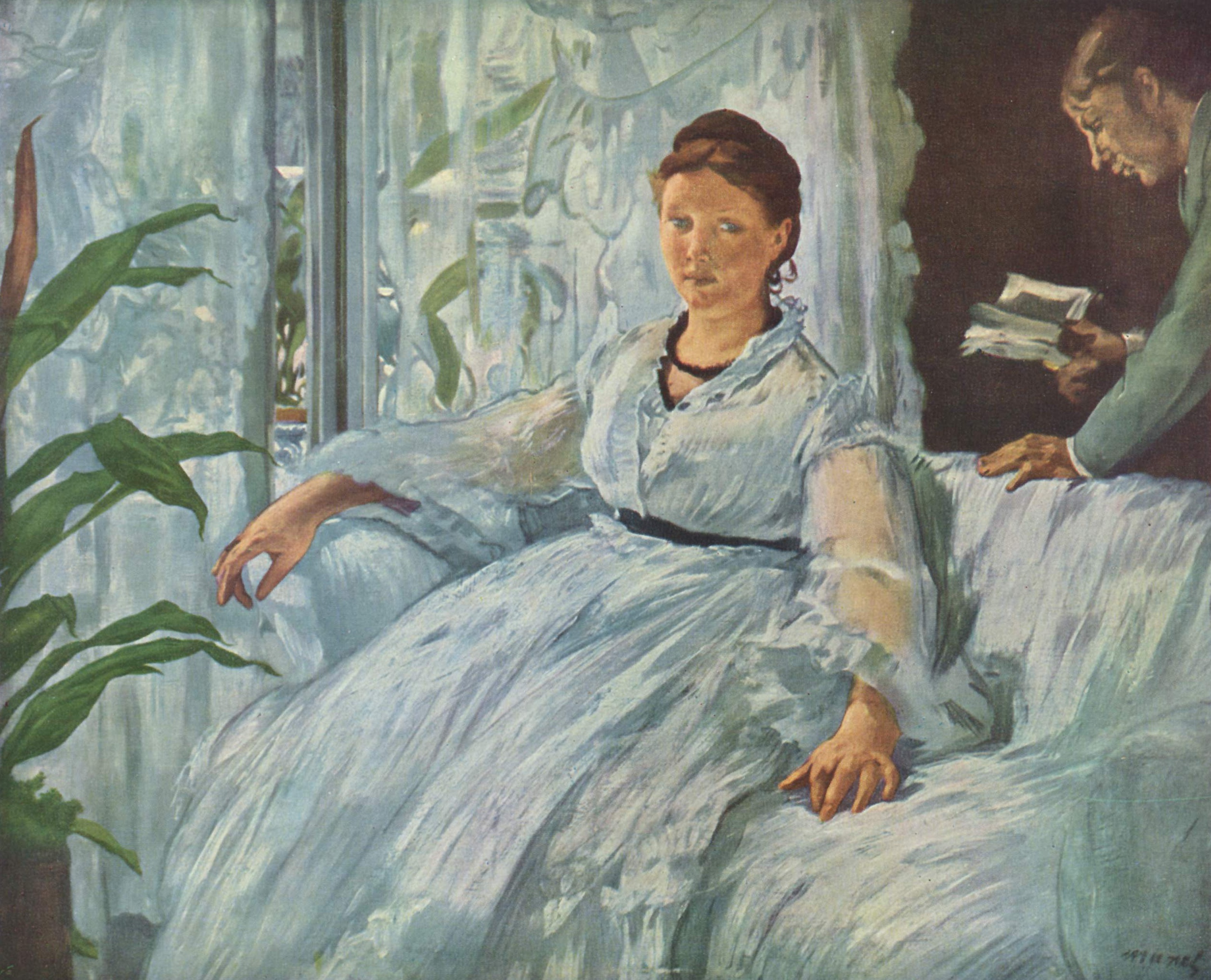
The Reading is a family scene by Édouard Manet, begun around 1865 and reworked until about 1873: the painter’s wife Suzanne sits on a white sofa by a window in an airy white dress, while her son Léon stands behind her reading aloud from a book. The original is oil on canvas, 61 x 73 cm, and hangs in the Musée d’Orsay in Paris. We hand-paint it for you in oil on canvas, in 8 landscape sizes from 40 x 32 to 190 x 151 cm, or made to measure. You see a photograph of your painting before we send it.
| Title: | The Reading |
| Other titles: | La Lecture (French title) |
| Painter: | Édouard Manet (1832–1883) |
| Year painted: | c. 1865–1873 |
| Original size: | 61 cm x 73 cm (height x width) |
| Original technique: | Oil on canvas |
| Painting style: | Realism and Impressionism |
| Located at: | Musée d’Orsay, Paris, France |
| Our reproduction: | Hand-painted in oil on canvas, 8 sizes or made to measure |
The Reading – Édouard Manet
What does The Reading show?
A young woman with auburn hair pinned up sits on a white sofa. Her full dress of thin, sheer muslin, with puffed sleeves, spreads over the seat like a cloud. A narrow black velvet ribbon circles her neck and a dark belt her waist. Her right arm lies along the armrest, her left hand on the cushion, and her gaze passes us by, calm and thoughtful.
Behind her is a window hung with white lace curtains, with daylight and greenery showing through. A tall house plant with long green leaves fills the left edge. At the right edge a young man in a grey-green jacket leans over the back of the sofa, an open book in one hand and the other resting on the upholstery. The dark ground behind him makes the white of the dress look brighter still. The signature, Manet, sits at the lower right.
Who are the woman and the young man?
The woman is Suzanne Leenhoff, Manet’s wife. Dutch-born, she was a piano teacher first engaged by Manet’s father, Auguste, to teach Manet and his younger brother. The couple married in 1863, a year after his father died.
The young man is her son Léon, born in 1852. He sat for Manet eighteen times between 1859 and 1872 and is best known as the boy in Boy Carrying a Sword.
According to the French Wikipedia, Suzanne has her back to her son and listens closely as he reads to her. The painting catches an ordinary hour of family life, with no dramatic action at all.
Why is this painting so admired?
The Reading is among the best-known portraits of Madame Manet, alongside Madame Manet at the Piano. White is its real subject: dress, sofa and curtains are laid in with broad, very bright strokes, set against the dark ribbon and belt.
The art historian Peter H. Feist wrote that Manet responds here with more sensitivity than usual, looking above all at the shades of white. Diana Seave Greenwald suggests it may have been inspired by Whistler’s Symphony in White, No. 1: The White Girl.
Manet (1832–1883) was among the first painters of his century to take modern life as his subject, and he stands at the turn from Realism to Impressionism. He was a friend of the Impressionists but preferred to show at the Salon. The English Wikipedia article on the painting, written in English, gives its history in brief.
Where is the original, and how did it get there?
The original, oil on canvas measuring 61 x 73 cm (height x width), belongs to the Musée d’Orsay in Paris, accession number RF 1944 17.
Manet first showed it in 1880 at one of the solo exhibitions he mounted himself, where he worked. In 1884, a year after his death, it hung in the great posthumous exhibition of his work.
It later belonged to Winnaretta Singer, Princess Edmond de Polignac. After her death it was given to the French State in 1944 and placed in the Louvre. In 1947 it moved to the Galerie nationale du Jeu de Paume in the Tuileries garden, and in 1986 to the new Musée d’Orsay with the rest of the Louvre’s Impressionist canvases.
The Reading or another Manet?
This canvas painting suits anyone who loves light, white fabric and quiet hours at home. The gentle, undramatic scene sits well in a bedroom, a reading corner or a home library.
Another woman lost in print appears in Woman Reading, a young Parisienne in a hat leafing through an illustrated paper at a café. If still lifes appeal more, look at Oysters, Manet’s first still life, or Vase of Peonies, with pink, white and dark red blooms. The Dead Christ with Angels strikes a graver note as one of Manet’s rare religious works.
Our Édouard Manet page gathers the famous Manet paintings we paint to order.
How do we hand-paint The Reading?
Manet’s original is a mid-sized oil on canvas, 73 cm wide. Our version is an oil painting reproduction that the painter builds up in thin layers, in oil on canvas, in the size you choose.
He first places the outlines of the sofa, the window and both figures, then turns to the main task: the whites. He separates dress, curtains and sofa cover by warmth, because the white here is bluish, there greyish and elsewhere almost pink. Last come the dark ribbon and belt, Suzanne’s face, the green leaves and Léon’s book.
Manet put the white down in broad, quick strokes. Our painter leaves those strokes visible, so the dress stays light and sheer on your wall rather than smoothed flat.
Which size suits which wall?
In short: 40 x 32 or 50 x 42 cm for a bedside table, a shelf or a narrow wall, 65 x 52 and 74 x 59 cm above a chest of drawers or a bed, 90 x 78 and 115 x 96 cm above a sofa, and 150 x 120 or 190 x 151 cm for a large empty wall.
The Reading comes in 8 landscape sizes (width x height): 40 x 32, 50 x 42, 65 x 52, 74 x 59, 90 x 78, 115 x 96, 150 x 120 and 190 x 151 cm. The original measures 73 x 61 cm (width x height), so 40 x 32, 50 x 42 and 65 x 52 cm are smaller, 74 x 59 cm is about as wide, and the four largest sizes, from 90 x 78 cm up, are larger than the original.
As a painting for the living room it works best at 115 x 96 or 150 x 120 cm above the sofa, where the white dress lights up the whole wall. The smaller sizes suit a bedroom or a reading corner.
Can I order a different size or a frame?
Yes. If your wall needs other proportions, we keep Suzanne, Léon and the window whole and adjust only the edge of the curtains or the sofa. Send us the size you need, and we reply with a price and a date.
We ship the painting rolled, stretched on a stretcher bar or framed; our workshop in Slovenia does the stretching and framing. Our 3D app lets you try mouldings and choose one; it is for the frame alone, and seeing the painting on your own wall is a separate service.
A slim white or silver moulding picks up the white of the curtains, while darker wood brings out the ribbon and belt.
How and when does the painting arrive?
Work on the canvas begins as soon as you confirm, and your painting is ready to leave within 15 to 45 working days. Before packing, we email you a photograph of the finished Suzanne and Léon and make any changes you request.
There are no customs duties within Slovenia or anywhere in the EU, and every order falls under our returns policy.
This quiet scene of mother and son makes a lovely gift for book lovers, a young family or a new home. Not sure which wall it is for? Then give a wall art voucher, and the size becomes their choice.
Frequently asked questions
Where can I see the original?
At the Musée d’Orsay in Paris, accession number RF 1944 17.
Who is in the painting?
Manet’s wife, Suzanne Leenhoff, and her son Léon, who reads aloud to her.
Is this a print?
No. Your hand-painted copy is made with brushes, in oil on canvas, by our painter.
How big is the original?
It measures 61 x 73 cm (height x width); our sizes from 90 x 78 cm up are larger.
Can I order a size that is not listed?
Of course. Send us the width and height you want, and we will prepare an offer with a delivery time.
How long does it take to paint?
From 15 to 45 working days, and we send a photograph of the finished work before dispatch.
Would The Reading suit a bedroom, or work as a present?
Yes. Its soft whites and greens calm a bedroom, and as a present it pleases anyone who loves to read.
Why is there so much white in the painting?
Manet was exploring shades of white here; Diana Seave Greenwald suggests Whistler’s Symphony in White, No. 1 as a possible inspiration.
- Subject: Suzanne Manet in white on a white sofa by a window, her son Léon behind her reading aloud.
- Original: oil on canvas, c. 1865–1873, 61 x 73 cm, Musée d’Orsay, Paris.
- Ours: an Édouard Manet reproduction, painted by hand in oil on canvas in 8 sizes (40 x 32 to 190 x 151 cm) or made to measure.
- Worth knowing: until 1944 it belonged to the Princess Edmond de Polignac.