







































Description
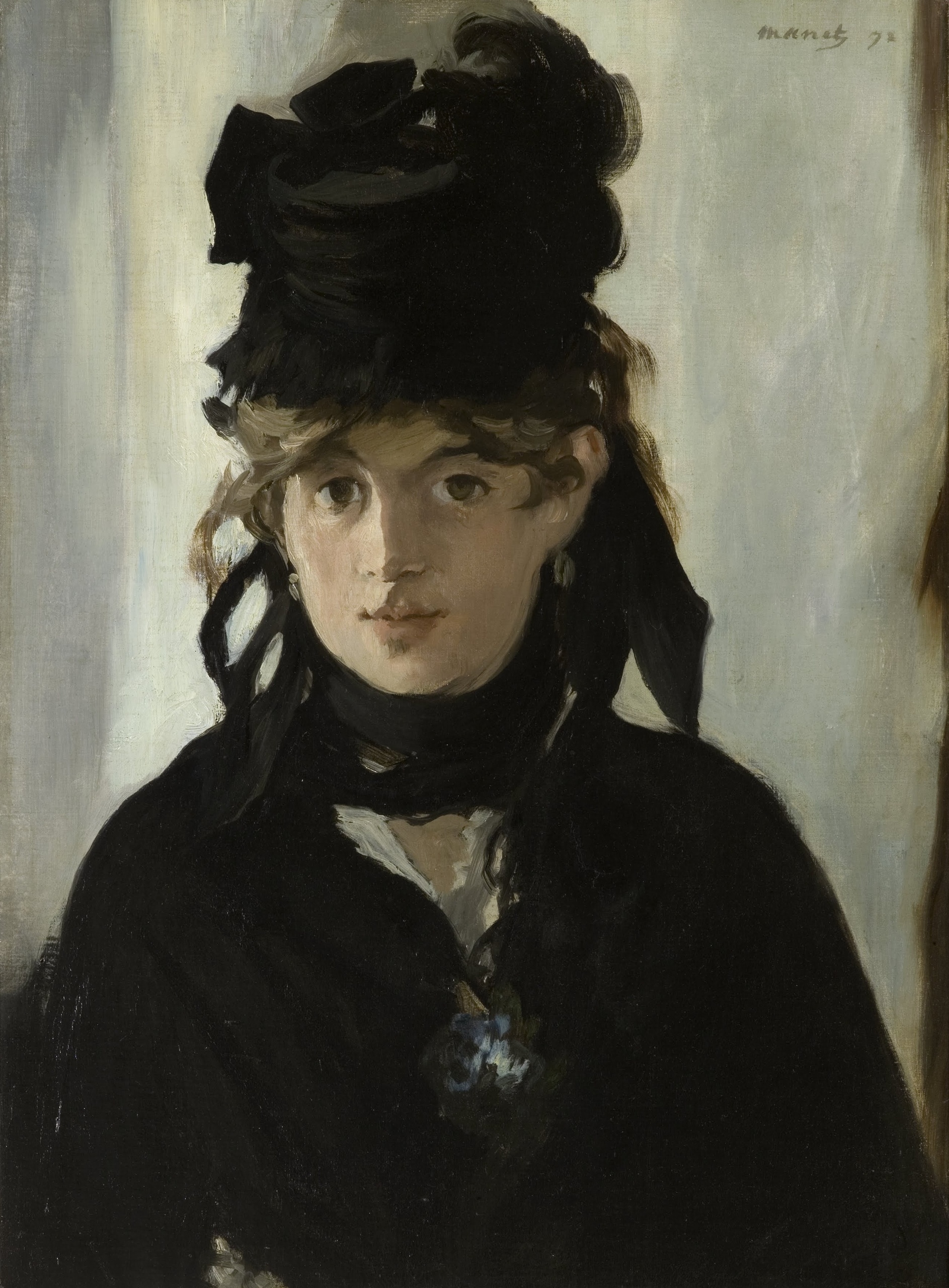
Berthe Morisot with a Bouquet of Violets is a portrait Édouard Manet painted in 1872: the painter Berthe Morisot, his friend and later his sister-in-law, looks out at us from under a large black hat with ribbons, dressed entirely in black, a barely visible posy of violets at her breast. The original is oil on canvas, 55.5 x 40.5 cm, and belongs to the Musée d’Orsay in Paris. Our painter paints it for you by hand in oil on canvas, in 8 portrait sizes from 30 x 40 to 151 x 200 cm, or made to measure. Before dispatch you receive a photograph of the finished portrait.
| Title: | Berthe Morisot with a Bouquet of Violets |
| Other titles: | Berthe Morisot au bouquet de violettes (French title) · Portrait of Berthe Morisot |
| Painter: | Édouard Manet (1832–1883) |
| Year painted: | 1872 |
| Original size: | 55.5 cm x 40.5 cm (height x width) |
| Original technique: | Oil on canvas |
| Painting style: | Realism and Impressionism |
| Located at: | Musée d’Orsay, Paris, France |
| Our reproduction: | Hand-painted in oil on canvas, 8 sizes or made to measure |
Berthe Morisot with a Bouquet of Violets – Édouard Manet
What does Berthe Morisot with a Bouquet of Violets show?
It is a bust-length portrait of a young woman whose large dark eyes are fixed straight on the viewer. Chestnut, slightly curling strands escape from under a tall black hat, and black ribbons fall from it beside her cheeks. A broad black scarf wraps her neck, and a white shirt shows at the neckline of her black dress.
At the bottom of the neckline, in the middle of her chest, a small bunch of violets is pinned, suggested with a few strokes of blue and violet. Easy to miss at first glance, it still gives the work its name.
The background is a light, warm grey, almost white in places. At the right edge it turns into a darker band, and at the top right Manet added his signature and the date with a fine brush: “Manet 72”.
Why is half of her face in shadow?
Manet’s portraits usually have an even light, but here it falls from one side. Her right cheek is brightly lit, her left sinks into deep shadow, and the dividing line runs straight down her nose.
The canvas is really a study in black. Hat, ribbons, scarf and dress are painted in countless shades of black, against which her pale skin glows all the more.
Berthe Morisot actually had green eyes, but Manet painted them black. The dark eyes and black clothes may allude to his impression that she looked Spanish.
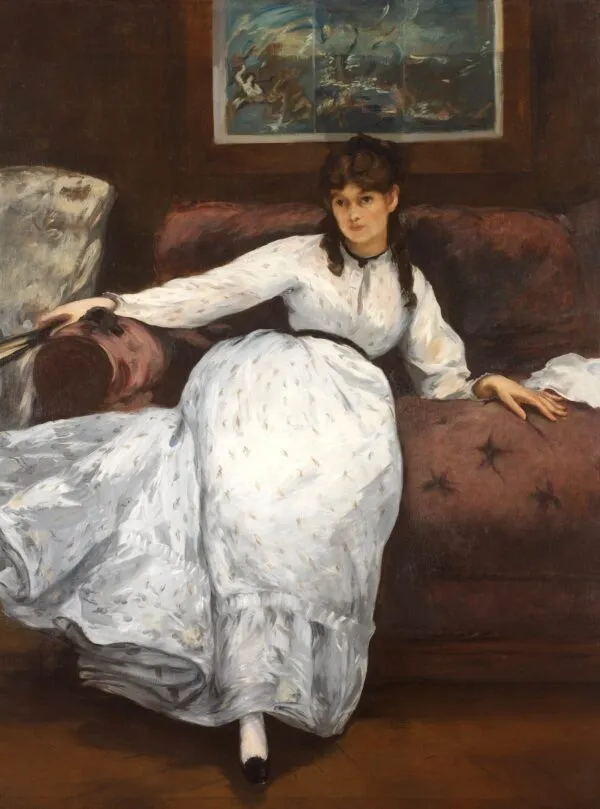
Between 1872 and 1874 he portrayed her in black several times, among others with a pink shoe, with a fan and veiled. Mourning is a known reason only for the 1874 portrait, made after the death of her father, Edmé Tiburce Morisot.
Why is it considered a masterpiece?
It was soon counted among Manet’s finest works. Édouard Manet (1832–1883) was one of the first 19th-century artists to paint modern life and a pivotal figure in the move from Realism to Impressionism. Through Berthe Morisot he befriended Degas, Monet and Renoir, yet never exhibited with the Impressionists.
The French essayist Paul Valéry, married to Morisot’s niece Jeannie Gobillard, knew the painting well. In the catalogue of the 1932 Manet centenary show at the Orangerie in Paris, he compared it to Vermeer’s Girl with a Pearl Earring and ranked nothing in Manet’s work above it.
Between 1872 and 1874 Manet also made an etching of it with the pose reversed, and two lithographs. More is in the Wikipedia article on the painting, which is in English.
Where is the original, and who was Berthe Morisot?
The original, oil on canvas measuring 55.5 x 40.5 cm (height x width), has belonged since 1998 to the Musée d’Orsay in Paris, where it carries inventory number RF 1998 30.
Berthe Morisot was a painter and a grand-niece of Fragonard. She and Manet met in 1868 and influenced each other’s work. He painted her many times, including in The Balcony, and in 1874 she married his brother Eugène.
Manet sold or gave the portrait to the collector and critic Théodore Duret. When Duret’s collection went to auction in 1894, Berthe Morisot herself bought it. After her death her daughter Julie Manet kept it until 1966, and then her son Clément Rouart. In 1998 it was acquired for the Musée d’Orsay with funds from the Fonds du Patrimoine, the Meyer Foundation, the China Times Group and sponsors rallied by the Nikkei newspaper.
Berthe Morisot with a Bouquet of Violets or another Manet?
This is a canvas painting for anyone who loves quiet portraits, where a single gaze says everything.
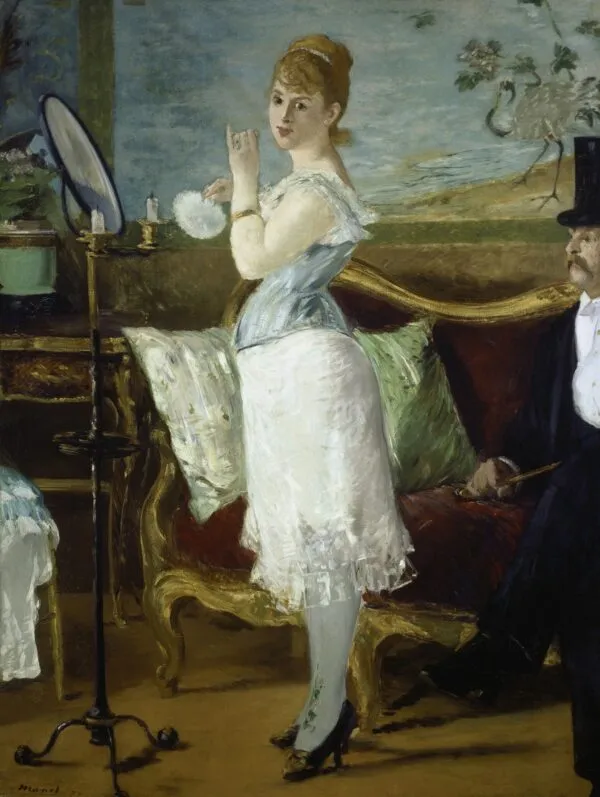
For Manet out of doors, by the water and in lighter colours, see On the Beach, where a veiled woman reads on the sand, and Argenteuil, a couple on a landing stage before the blue river. A young woman lost in thought at a café table appears in The Plum, while The Absinthe Drinker is his first major painting.
Our Édouard Manet page gathers more famous Manet paintings, each painted to order.
How do we hand-paint Berthe Morisot with a Bouquet of Violets?
Manet’s original is an oil on canvas of only 55.5 x 40.5 cm. Ours is an oil painting reproduction: the painter lays the oil colour onto fresh canvas in layers, at the size you have chosen.
He begins by sketching the hat, shoulders and face, then lays in the light grey ground, against which the dark figure has to stand out clearly. The layers of black follow, from dress and scarf to ribbons and hat, told apart only by tone and the direction of the stroke.
The face gets special care: the edge between the lit and the shaded half must stay soft, the eyes dark and alive. The violets come last, a few blue strokes, as sparing as Manet’s own.
Which size fits which wall?
In short: 30 x 40 or 40 x 55 cm for a shelf or a narrow wall, 47 x 62 and 60 x 81 cm above a chest of drawers or a bed, 74 x 104 and 95 x 128 cm above a sofa, and 120 x 160 or 151 x 200 cm for a tall wall or a stairwell.
We paint the portrait in 8 portrait sizes (width x height): 30 x 40, 40 x 55, 47 x 62, 60 x 81, 74 x 104, 95 x 128, 120 x 160 and 151 x 200 cm. The original measures 40.5 x 55.5 cm (width x height), so 30 x 40 cm is smaller, 40 x 55 cm is almost the same, and all six sizes from 47 x 62 cm upwards are larger than the original.
As a painting for the living room it works best at 74 x 104 or 95 x 128 cm, where Berthe Morisot’s gaze greets everyone who walks in.
Can I have a different size or a frame?
Yes. If your wall needs other proportions, the face, the hat and the violets stay whole and we adjust only the light background at the edges. Send us the size you need, and we will reply with a price and a completion date.
The portrait travels rolled, stretched on a stretcher bar or ready framed. Our workshop in Slovenia does the stretching and framing and packs each painting carefully for the journey. You choose the moulding in our 3D app, which is only for choosing the frame; seeing the painting on your own wall is a separate service.
How long do painting and delivery take?
The portrait is ready to ship 15 to 45 working days after you confirm the order. Before we pack it, we send you a photograph of the finished painting and adjust details if you ask.
Within Slovenia and to every other EU country it travels without customs duties, and every order is covered by our returns policy.
It makes a lovely gift for an art lover or anyone fond of violets. If you are unsure which size to pick, give a wall art voucher and let the recipient choose.
Frequently asked questions
Where can I see the original?
At the Musée d’Orsay in Paris, under inventory number RF 1998 30.
Who is the woman in the hat?
The painter Berthe Morisot, a friend of Manet, who married his brother Eugène in 1874.
Will I get a print?
No. Every stroke is laid by our painter with a brush, in oil on canvas, so this is a hand-painted copy.
How big is the original?
It measures 55.5 x 40.5 cm (height x width), so most of our sizes are larger.
Is there a size beyond the eight listed?
Yes. Write to us with the width and height you need, and we will send an offer with a price and a date.
When will my parcel arrive?
The painting is ready to travel within 15 to 45 working days, and before dispatch you get a photograph of it.
Is it right for a bedroom, or as a gift?
Yes. The calm colours and upright format suit a bedroom or a study, and as a present it pleases anyone who loves portraits.
Why are her eyes dark when they were really green?
Manet painted them black, perhaps because Berthe Morisot struck him as looking Spanish.
- Subject: Berthe Morisot in black, with a tall hat and a posy of violets at her breast, against a light grey ground.
- Original: oil on canvas, 1872, 55.5 x 40.5 cm, Musée d’Orsay, Paris.
- Ours: an Édouard Manet reproduction painted by hand in oil on canvas, 8 sizes from 30 x 40 to 151 x 200 cm, or made to measure.
- Worth knowing: Paul Valéry ranked nothing in Manet’s work above this portrait.