







































Description
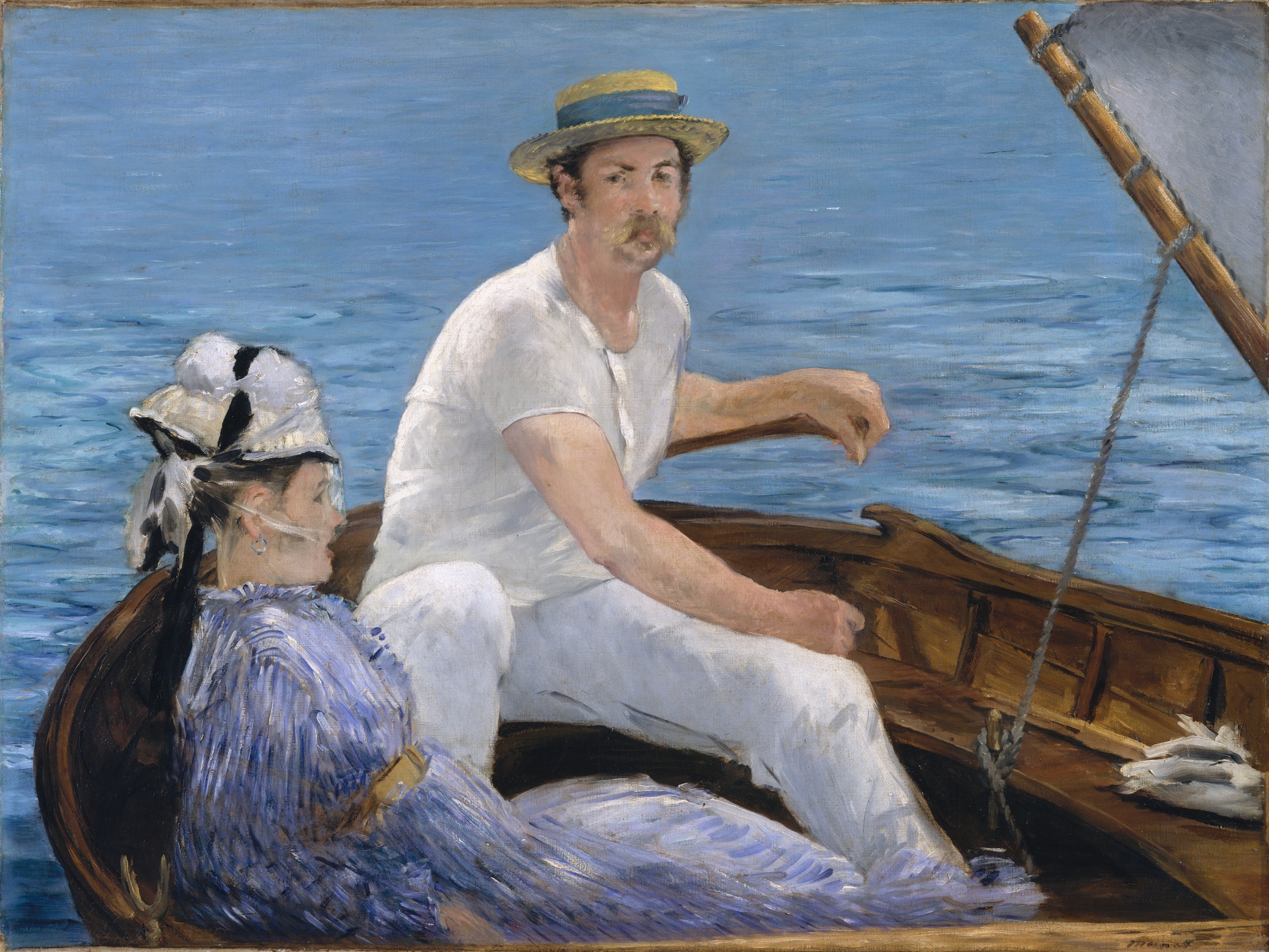
Boating is a summer painting by Édouard Manet from 1874: a man in a white shirt and straw boater sits at the stern of a sailing boat, one hand on the tiller, looking at us, beside a woman in a blue-and-white striped dress and veiled hat, with deep blue water behind them up to the top edge. The original is oil on canvas, 97.2 x 130.2 cm, and it belongs to the Metropolitan Museum of Art in New York. We paint it for you by hand in oil on canvas, in eight landscape sizes from 40 x 30 to 160 x 115 cm, or made to measure. Before the boat sails your way, we send you a photograph of the finished painting.
| Title: | Boating |
| Other titles: | Im Boot (German title) · In barca (Italian title) |
| Painter: | Édouard Manet (1832–1883) |
| Year painted: | 1874 |
| Original size: | 97.2 cm x 130.2 cm (height x width) |
| Original technique: | Oil on canvas |
| Painting style: | Realism and Impressionism |
| Located at: | Metropolitan Museum of Art, New York, United States |
| Our reproduction: | Hand-painted in oil on canvas, 8 sizes or made to measure |
Boating – Édouard Manet
What does Boating show?
At the stern of a wooden boat sits a man with a thick moustache, all in white, in a short-sleeved shirt and pale trousers, with a blue band on his straw boater. One hand rests on the tiller; he has turned his head and looks straight out at us.
Beside him, at the left edge, a woman in a full blue-and-white striped dress leans against the side of the boat. She wears a white hat with a black ribbon, a veil drawn tight across her face and an earring, and she gazes off to the right, not at the man.
There is no background as such: the water is a single intense blue surface up to the top of the canvas, with no shore or sky. At the right the mast and a piece of grey sail lean in, with a rope running down into the boat; a white cloth lies on the bench, and Manet’s signature sits at the lower right.
Who are the man and the woman in the boat?
The man is Rodolphe Leenhoff, Manet’s brother-in-law and a sculptor. He often posed for Manet, first in Le Déjeuner sur l’herbe; Manet wanted natural postures rather than academic poses, so he liked to paint non-professionals.
The woman’s identity has long been debated. At first she was taken for Manet’s wife Suzanne, whose hat she wears, but her black hair and brown eyes do not match, and the hat is now thought to have been borrowed from Suzanne’s collection. The art historian Mary Mathews Gedo believes she is Camille Monet, Claude Monet’s wife.
Manet called himself a “hat man” and liked to paint women in lavish clothes and striking hats. The scene tells no story: it is an ordinary summer day on the water.
Why does this painting matter so much?
Boating is often cited as Manet’s step into Impressionism, for its brushwork and its subject, and counts among his most important Impressionist works, though he never called himself an Impressionist and preferred the Salon.
He also borrowed from Japanese art: a flat, two-dimensional composition, lighter colour and a cropped field of view. The boat is cut off on purpose, and the harsh blue of the water is also said to be Japanese in spirit; Stéphane Mallarmé wrote that this framing defines the whole scene.
Édouard Manet (1832–1883), a pupil of Thomas Couture, was among the first 19th-century painters of modern life and a pivotal figure on the road from Realism to Impressionism. At the Salon of 1879 the painter Mary Cassatt called this canvas “the last word in painting.” More on the sitters is in the Wikipedia article on Boating, which is in English.
Where is the original, and how was it made?
The Metropolitan Museum of Art in New York owns the original, an oil on canvas of 97.2 x 130.2 cm (height x width), accession number 29.100.115.
Manet painted it in the summer of 1874, while staying on his family’s property at Gennevilliers and working with Claude Monet at Argenteuil. X-rays show that he reworked the canvas many times, changing the man’s pose; he seems to have worked partly on the boat itself and partly indoors.
He had first hoped to paint Monet and Camille on Monet’s floating boat; that proved harder than expected, so he found other models. After the Salon of 1879 it went to the banker and collector Victor Desfosses, director of Gil Blas, and later to Louisine and Henry Osborne Havemeyer, friends of Mary Cassatt, who left it to the museum.
Boating or another Manet?
This canvas painting is for anyone who loves summer and water: a day on a boat, set down without pose or flattery.
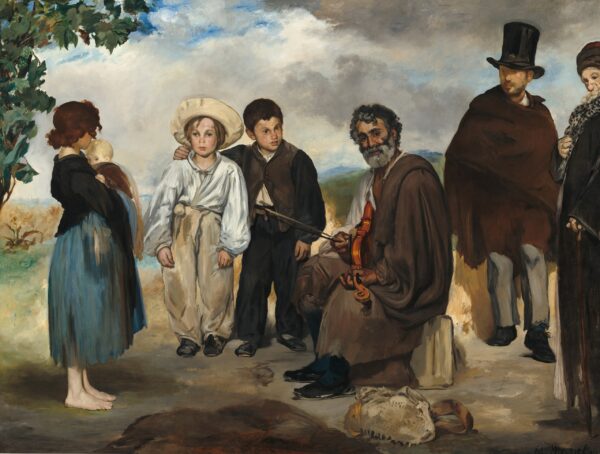
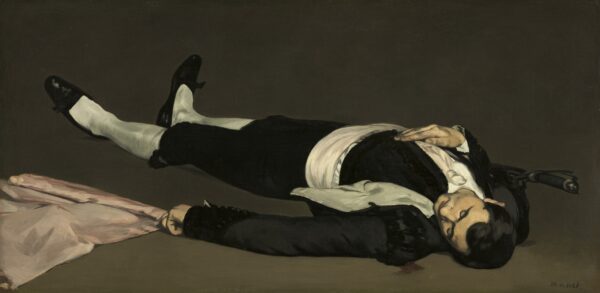
To see what Manet hoped to paint that summer, look at Claude Monet Painting on His Boat, where Monet works at an easel under the striped awning of his boat. A bright female figure fills Spring (Jeanne), while the darker, graver Manet waits in The Old Musician and The Dead Toreador.
Our Édouard Manet page gathers all the famous Manet paintings we paint to order.
How do we hand-paint Boating?
We make an oil painting reproduction of the 130.2 cm wide oil-on-canvas original on new canvas, hand-painted in oil on canvas at the size you order, layer by layer.
He first draws the long diagonal of the hull and places the two figures, then covers the upper field with blue water in short horizontal strokes of several shades, flat yet alive.
He paints the white clothes and the striped dress in long, quick strokes left visible as Manet left them, then works the faces, hats and wooden hull more carefully, adding the rope, veil and earring last.
Which size suits which wall?
The short answer: small sizes up to 60 x 43 cm for a shelf, a hallway or beside a window, 74 x 55 and 87 x 62 cm above a chest of drawers or a bed, 110 x 80 and 125 x 90 cm above a sofa, and 160 x 115 cm for a large empty wall.
There are 8 landscape sizes (width x height): 40 x 30, 45 x 35, 60 x 43, 74 x 55, 87 x 62, 110 x 80, 125 x 90 and 160 x 115 cm. The original measures 130.2 x 97.2 cm (width x height), so all seven sizes up to 125 x 90 cm are smaller, 125 x 90 cm only slightly, and 160 x 115 cm is the one size larger than the original.
As a painting for the living room it works best at 110 x 80 or 125 x 90 cm, where the blue fills the wall above the sofa.
Is a custom size or a frame possible?
Yes. Because the water is a single surface, the scene adapts easily to other proportions: the figures and the boat stay whole, and only the blue changes. Send us the size you need, and we will reply with a price and a delivery date.
Your boat scene travels rolled, stretched on a stretcher bar or ready framed; our workshop in Slovenia does the stretching and framing. You choose the moulding in our 3D app, which is only for picking the frame; seeing the painting on your own wall is a separate service. Light wood suits the summer light, dark wood echoes the boat.
When will the painting arrive, and how is it shipped?
Once you confirm the order, the painter lays in the boat and its two passengers, and within 15 to 45 working days the painting is ready to ship. Before packing, we send you a photograph and make any corrections you ask for.
There are no customs duties within Slovenia or anywhere in the EU, and our returns policy covers every order.
This summer scene makes a fine gift for sailors or for a house by the sea or a lake. If you do not know the walls it will hang on, a wall art voucher lets the recipient choose.
Frequently asked questions
Where can I see the original?
At the Metropolitan Museum of Art in New York, accession number 29.100.115.
Who is the man in the straw hat?
Rodolphe Leenhoff, Manet’s brother-in-law and a sculptor, who often posed for the painter.
Is this a print?
No. It is a hand-painted copy, laid onto the canvas stroke by stroke with brushes and oil paint.
How big is the original?
It measures 97.2 x 130.2 cm (height x width); only our largest size, 160 x 115 cm, is bigger.
Can I order a size that is not listed?
Yes. Send us the width and height, and we will send an offer with a delivery time.
How long does it take to make?
The painter needs 15 to 45 working days, and you see the finished boat scene in a photograph before it ships.
Is it right for a bedroom, or as a gift?
Yes. The calm blue scene suits a bedroom, and it pleases anyone who spends summer on the water.
Where did Manet paint this scene?
At Argenteuil in summer 1874, alongside Monet, partly on the boat and partly indoors.
- Subject: a man in white with a straw boater and a woman in a striped dress in a sailing boat, blue water behind them.
- Original: oil on canvas, 1874, 97.2 x 130.2 cm, Metropolitan Museum of Art, New York.
- Ours: an Édouard Manet reproduction hand-painted in oil on canvas, eight landscape sizes from 40 x 30 to 160 x 115 cm, or made to measure.
- Worth knowing: shown at the Salon of 1879; Mary Cassatt called it “the last word in painting.”