







































Description
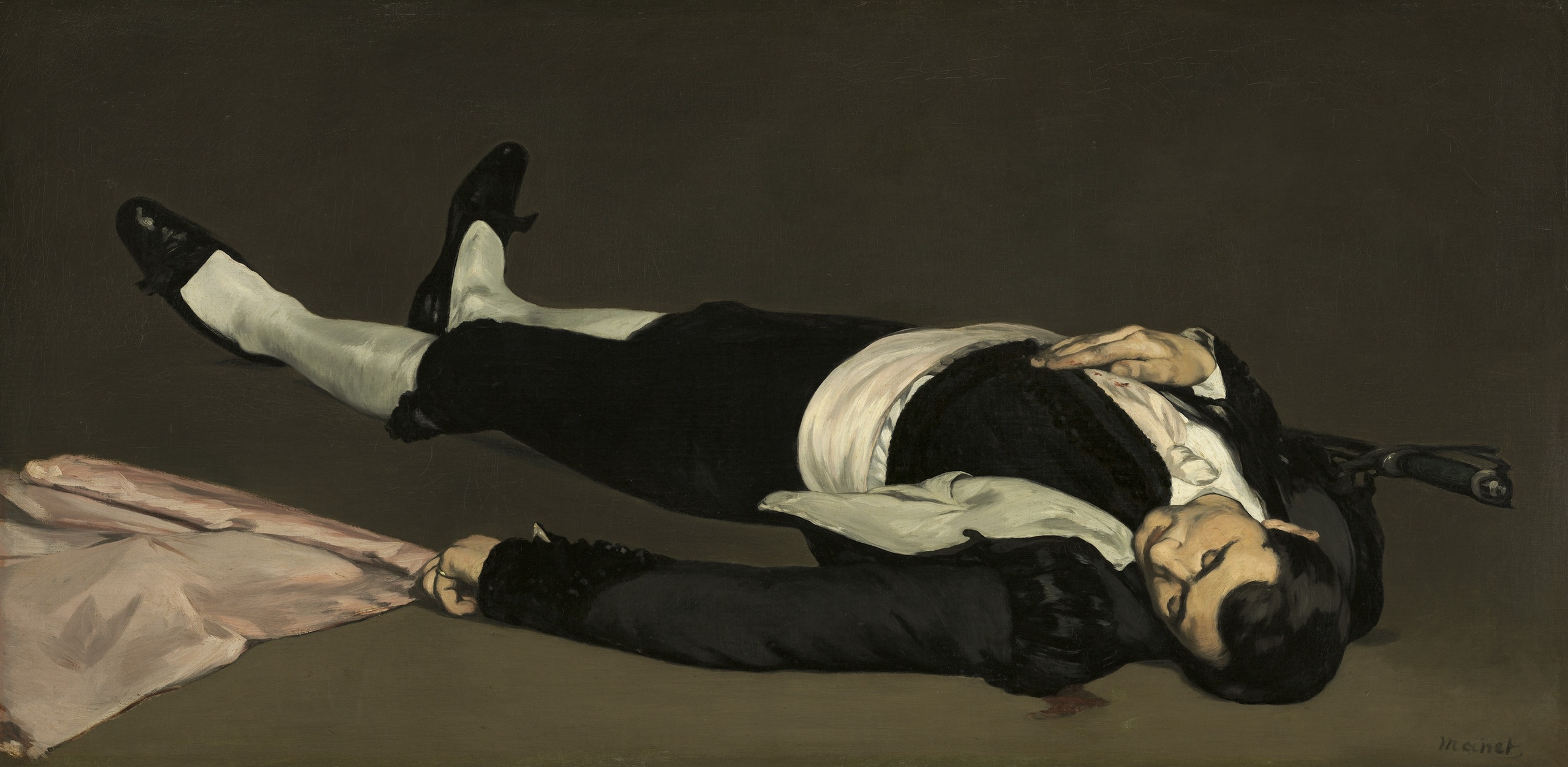
The Dead Toreador is a work by Édouard Manet from 1864: a young bullfighter in a black costume with a white shirt and sash lies on his back across almost the full width of the canvas, a pink cape beside him. The original, oil on canvas measuring 75.9 x 153.3 cm, belongs to the National Gallery of Art in Washington. Our painter paints it for you by hand in oil on canvas, in 8 very wide landscape sizes from 50 x 25 to 200 x 95 cm, or made to measure. You see the finished canvas in a photograph before it is packed.
| Title: | The Dead Toreador |
| Other titles: | Le Torero mort (original French title) · The Dead Man (L’Homme mort) |
| Painter: | Édouard Manet (1832–1883) |
| Year painted: | 1864 |
| Original size: | 75.9 cm x 153.3 cm (height x width) |
| Original technique: | Oil on canvas |
| Painting style: | Realism and Impressionism |
| Located at: | National Gallery of Art, Washington, United States |
| Our reproduction: | Hand-painted in oil on canvas, 8 sizes or made to measure |
The Dead Toreador – Édouard Manet
What does The Dead Toreador show?
On a dark, brownish-grey ground lies a man in a bullfighter’s costume. His body stretches almost from one edge of the canvas to the other, legs slightly apart, head turned towards us and tilted a little to one side. His eyes are closed and his face is pale and still.
He wears a short black jacket with embroidered edges, black knee breeches, pale stockings and flat black shoes. The white shirt and the white sash at his waist are the lightest areas of the composition. One hand rests on his chest; the other lies outstretched and still holds the pink cape spread along the left edge. Below his shoulder the hilt of a sword shows, and near his chest and on the ground there is a small red trace of blood.
There is almost no setting: no arena, no bull, no crowd, no horizon, only an even dark ground against which black and white stand sharply apart. Manet signed at the lower right.
How did this work come about?
The Dead Toreador began as part of a larger composition that Manet showed at the Paris Salon of 1864 as Episode from a Bullfight. It drew directly on Goya’s La Tauromaquia and on the bullfight scenes of Alfred Dehodencq. In those years Manet was strongly drawn to Spain, to Velázquez and Goya, and to the bullfight.
The Salon accepted the canvas, but critics mocked it for its lack of relief, the poor proportions of its figures and its unreal space. Stung by the reviews, Manet cut the canvas up, kept two parts and reworked the lying figure into an independent work.
To give it a more universal character, he renamed it The Dead Man and readied it under that title for the Salon of 1867. The other surviving fragment is now called The Bullfight; Manet’s signature was added to it only after his death.
Why is this painting so well known?
Édouard Manet (1832–1883), born in Paris into a wealthy family, trained under Thomas Couture and copied Velázquez and Titian in the Louvre. He was one of the first 19th-century artists to paint modern life, and two of his paintings, shown in 1863 and 1865, caused great controversy.
This canvas is one of the clearest records of his Spanish phase. At the Salon of 1864 critics saw in it the influence of A Dead Soldier, then attributed to Velázquez but possibly by a Neapolitan artist, and later acquired by the National Gallery in London. Théophile Thoré-Burger even claimed Manet had copied it, a charge Baudelaire firmly rejected; the main influence was most likely Velázquez himself.
The bullfight fascinated Manet: in 1865 he wrote to Baudelaire that it was among the most beautiful, curious and terrible spectacles one could witness. In 2007 Herman Braun-Vega took the figure into a painting that traces the lines from Velázquez and Goya to Manet and Monet. The full story is in the English Wikipedia article on The Dead Man, written in English.
Where is the original today?
The National Gallery of Art in Washington holds the original under accession number 1942.9.40; it is oil on canvas and measures 75.9 x 153.3 cm (height x width).
The very wide, low canvas is what remains of the larger composition Manet cut up after the Salon of 1864, and the work is known by both titles today.
The Dead Toreador or another Manet?
This is a canvas painting for anyone who values restraint, dark tones and a single strong figure on an almost empty ground.
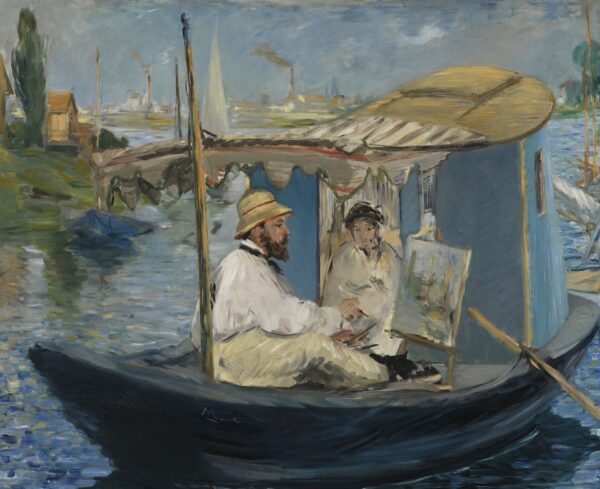
If you want a brighter scene by Manet, look at Music in the Tuileries, an elegant crowd beneath the trees, or Spring (Jeanne), a young actress with a parasol against green leaves. From the same early 1860s comes The Old Musician, a violinist with children in open country, while a summer on the river is the subject of Claude Monet Painting on His Boat.
You will find the other famous Manet paintings we paint to order on our Édouard Manet page.
How do we hand-paint The Dead Toreador?
Manet’s original is an oil on canvas a little over one and a half metres wide. Ours is an oil painting reproduction made on new canvas, worked in oil on canvas by our painter at the size you order and built up in layers.
He first lays in the long diagonal of the body, the head and the cape, because on such a wide format the proportions carry the whole composition. Then come the warm grey-brown ground and the deep black of the costume, built from several shades so it never goes flat. Last he adds the white shirt and sash, the pale face and hands, the pink cape and the small highlights on the shoes, keeping the broad, confident strokes Manet used.
Which size suits which wall?
In short: 50 x 25 to 70 x 35 cm for a shelf or a narrow space above a desk, 90 x 45 and 120 x 57 cm above a chest of drawers or in a study, 130 x 66 cm above a sofa, and 170 x 85 or 200 x 95 cm for a long wall in a living area or hallway.
We paint it in 8 very wide landscape sizes (width x height): 50 x 25, 60 x 30, 70 x 35, 90 x 45, 120 x 57, 130 x 66, 170 x 85 and 200 x 95 cm. The original measures 153.3 x 75.9 cm (width x height), so the six sizes up to 130 x 66 cm are smaller than it, while 170 x 85 and 200 x 95 cm are larger than the original.
As a painting for the living room it works best at 130 x 66 or 170 x 85 cm above a long sofa or low sideboard.
Is another size or a frame possible?
Yes. For other proportions we keep the figure and cape whole and adjust only the empty dark ground around them. Send us your custom size, and we will reply with a price and a date.
It travels to you rolled, stretched on a stretcher bar or framed and ready to hang; our workshop in Slovenia does the stretching and framing. The moulding is chosen in our 3D app, which handles frame choice and nothing else; a view of the painting on your own wall is a separate service.
A narrow black or dark wood moulding repeats the black of the costume, while a gilt one warms the brownish ground.
When does the ordered painting arrive?
Work on the long figure begins as soon as you confirm, and the toreador is ready to leave us within 15 to 45 working days. Before packing we show you the finished work in a photograph and make any changes you ask for.
Delivery within Slovenia and to the rest of the EU carries no customs duties, and our returns policy covers every order.
If you do not know the wall it will hang on, a gift voucher leaves the size to the recipient.
Frequently asked questions
Where can I see the original?
At the National Gallery of Art in Washington, accession number 1942.9.40.
Who is the man lying on the ground?
A bullfighter in a black costume with a white shirt and sash, lying on his back beside his pink cape.
Is this a print?
No. Each one is a hand-painted copy, worked with brushes in oil on canvas.
How big is the original?
It is 75.9 cm high and 153.3 cm wide; only our 170 x 85 and 200 x 95 cm sizes are larger.
Could you paint it in a size that is not on the list?
Of course. Tell us the width and height, and we will quote a price and a completion date.
How long does it take to make?
15 to 45 working days, with a photograph of the painting before it ships.
Is it suitable for a bedroom or a living room?
Its serious subject suits a living room, library or study better than a bedroom.
What does the title The Dead Man mean?
It is the name Manet gave the work for the Salon of 1867, to give it a more universal character.
- Subject: a dead bullfighter in a black costume lies on his back beside a pink cape, against a dark, empty ground.
- Original: oil on canvas, 1864, 75.9 x 153.3 cm, National Gallery of Art, Washington.
- Ours: an Édouard Manet reproduction hand-painted in oil on canvas, in 8 sizes from 50 x 25 to 200 x 95 cm, or made to measure.
- Worth knowing: a fragment of a larger bullfight scene that Manet cut up after the Salon of 1864.