







































Description
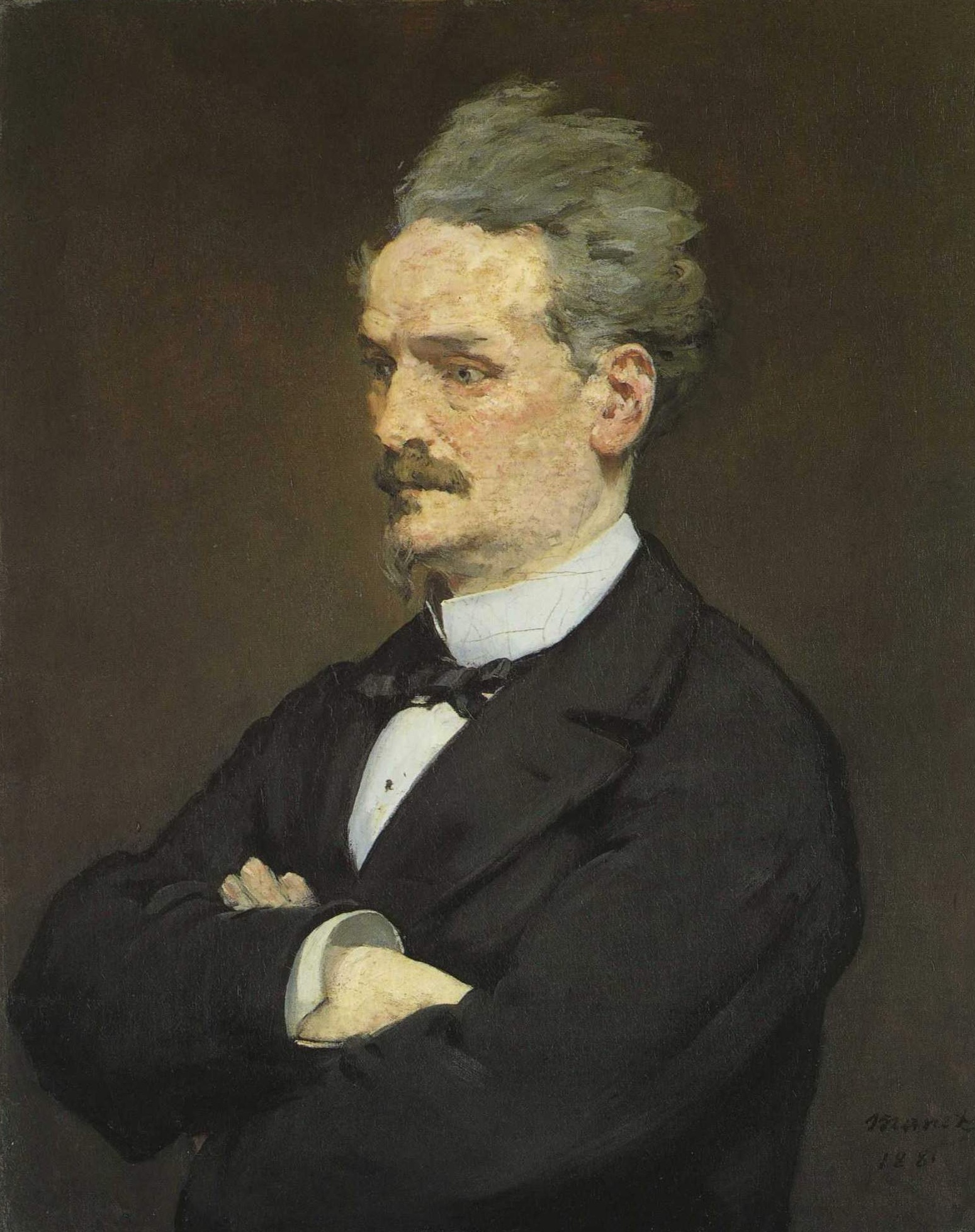
Portrait of Henri Rochefort is a work by Édouard Manet from 1881: the grey-haired journalist and politician Henri Rochefort, in a black suit, white stand-up collar and black bow tie, stands with his arms crossed against a dark brown ground, looking past us to the left. The original, oil on canvas measuring 81.5 x 66.5 cm, belongs to the Hamburger Kunsthalle in Hamburg. Our painter paints it for you by hand in oil on canvas, in 8 portrait-format sizes from 33 x 42 to 130 x 162 cm, or made to measure, and you see a photograph of your Rochefort before it ships.
| Title: | Portrait of Henri Rochefort |
| Other titles: | Portrait d’Henri Rochefort (French title) |
| Painter: | Édouard Manet (1832–1883) |
| Year painted: | 1881 |
| Original size: | 81.5 cm x 66.5 cm (height x width) |
| Original technique: | Oil on canvas |
| Painting style: | Realism and Impressionism |
| Located at: | Hamburger Kunsthalle, Hamburg, Germany |
| Our reproduction: | Hand-painted in oil on canvas, 8 sizes or made to measure |
Portrait of Henri Rochefort – Édouard Manet
What does Portrait of Henri Rochefort show?
A middle-aged man is shown half-length, turned towards the left edge of the canvas. His arms are folded firmly across his chest, and his gaze slides past the viewer to a point beyond the left edge.
His hair, in greys and browns, is swept up and back as if caught by the wind. He has a thick moustache and a sparse, thin goatee. Of his hands, only the right wrist with its white cuff and three fingertips of the left are visible.
The background is an almost uniform dark ochre grey, lit slightly beside the face and shadowed behind the head. At the lower right are the signature Manet and the year 1881.
Who was Henri Rochefort, and how did the portrait come about?
Henri Rochefort, whose full name was Victor Henri, Marquis de Rochefort-Luçay, was a writer, journalist and politician. Under the Second Empire he made his name as a sharp pamphleteer and a determined opponent of Napoleon III. For his active part in the Paris Commune he was deported in 1873 to a penal colony in New Caledonia, made a much-publicised escape in 1874 and lived in exile.
He returned to France only in 1880, under the amnesty for the Communards granted by Léon Gambetta’s government for the national holiday. A delighted Manet, no friend of the imperial regime either, decorated a letter to Isabelle Lemonnier with two French flags and “Vive l’amnistie”.
The two men probably met in person only then. Manet wanted to paint the escape and asked the etcher Marcellin Desboutin, a relative of Rochefort, to arrange a meeting; he also offered Rochefort a portrait. The sitter agreed reluctantly and later refused the finished canvas as a gift, preferring more traditional art.
In later years Rochefort joined the Boulangists and wrote in a nationalist and, during the Dreyfus affair, antisemitic vein; the art historian Françoise Cachin saw a first hint of that change in the carefully arranged hair.
Why is the portrait so highly regarded?
Two ways of painting meet here. The black-clad upper body is largely realistic, following the rules of the Academy, while the brushwork of the face is clearly shaped by Impressionism. Small dabs of grey and blue build the pockmarked skin, long strokes the hair, and the fingertips stay a sketch.
The art historian Josef Kern stressed the forceful, slightly defiant pose. Setting a black-clad figure against a dark ground, a device portraitists used long before Manet, gives the body its volume. Gustave Courbet and Giovanni Boldini painted Rochefort in a very similar way, but without the crossed arms or the scarred skin.
Manet (1832–1883), who painted this portrait two years before his death, was among the first artists of the nineteenth century to paint modern life, and a pivotal figure between Realism and Impressionism. There is no English article, but a German Wikipedia article, written in German, tells the story of the sitter and the canvas.
Where is the original, and how did it reach Hamburg?
The original, oil on canvas measuring 81.5 x 66.5 cm (height x width), belongs to the Hamburger Kunsthalle, inventory number HK-1564.
Manet sold the portrait with four other works, among them In the Conservatory, to the baritone Jean-Baptiste Faure. Through the Paris dealer Paul Durand-Ruel it came to Berlin in 1906, where Paul Cassirer offered it for sale.
There, in October 1906, Alfred Lichtwark, director of the Hamburger Kunsthalle, preferred it to another Manet on offer. In 1907 it became the museum’s first Manet, and Lichtwark called it the most spiritual thing he knew by the painter.
Portrait of Henri Rochefort or another Manet?
This is a canvas painting for lovers of portraits, history and journalism: one man, a black suit, a dark ground and a gaze that does not give way.
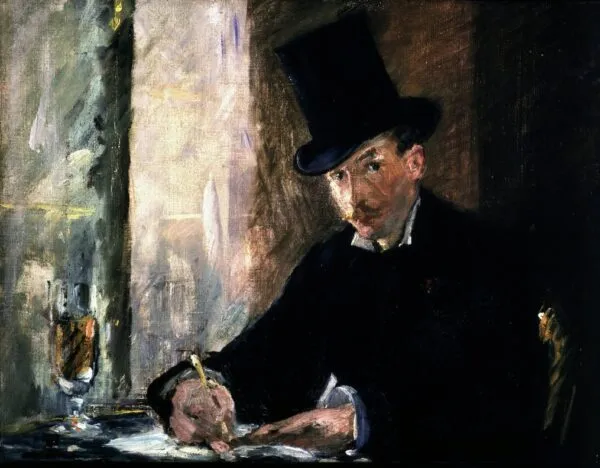
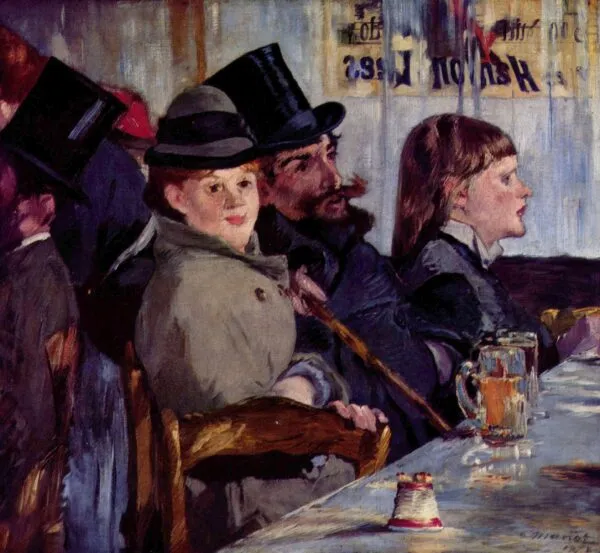
Another portrait of a man from Manet’s Paris is George Moore at the Café, an unfinished oil sketch of the Irish writer in a bowler hat at a café table. Softer in mood is Madame Manet in the Conservatory: the painter’s wife Suzanne in grey silk before a wall of leaves and flowers.
For light on water, choose The Grand Canal, Venice (Blue Venice), a black gondola among striped mooring poles, or Banks of the Seine at Argenteuil, with Camille and Jean Monet watching sailing boats. Manet also painted Rochefort’s escape, which we paint to order too. More famous Manet paintings are on our Édouard Manet page.
How do we hand-paint Portrait of Henri Rochefort?
Manet’s original is an oil on canvas 81.5 cm high. Ours is an oil painting reproduction on fresh canvas, worked by the painter in oil on canvas in the size you choose, layer by layer.
He first sets down the folded arms and the tilt of the head, then the dark ground and the black jacket, which may differ by only a shade; the white collar, cuff and shirt come last.
The face gets small warm, grey and blue touches, as Manet left them, the hair quick long strokes, and the fingertips stay sketchy.
Which size fits which wall?
In short: 33 x 42 or 43 x 53 cm above a desk, 48 x 60 and 64 x 76 cm for a home office or library, 70 x 87 and 90 x 107 cm above a chest of drawers or sofa, 99 x 125 or 130 x 162 cm for a tall wall.
We paint it in 8 portrait-format sizes (width x height): 33 x 42, 43 x 53, 48 x 60, 64 x 76, 70 x 87, 90 x 107, 99 x 125 and 130 x 162 cm. The original measures 66.5 x 81.5 cm (width x height), so the four sizes up to 64 x 76 cm are smaller, 70 x 87 cm is only slightly larger, and 90 x 107, 99 x 125 and 130 x 162 cm are clearly larger than the original.
As a painting for the living room it works best at 90 x 107 or 99 x 125 cm, where Rochefort’s face reads clearly even from the sofa.
Can I have another size or a frame?
Yes. For other proportions we keep the head, the folded arms and the signature whole and adjust only the width of the dark ground. Tell us the size you need for Rochefort, and you get a price and a delivery date back.
Rochefort can travel rolled, on a stretcher bar or framed; the stretching and framing are done by our workshop in Slovenia. You pick the frame in our 3D app, which serves only that purpose; seeing the work on your own wall is a separate service.
When will the painting arrive, and how is it delivered?
Work on your portrait begins once you confirm the order, and it is ready to leave within 15 to 45 working days. Before packing we send you a photograph of the finished Rochefort and correct anything you want changed.
Within Slovenia and the rest of the EU the portrait travels without customs duties, and every order falls under our returns policy.
Rochefort with his folded arms makes a fine gift for a journalist, a lawyer or a history lover. Unsure of the size? A gift voucher leaves that choice to them.
Frequently asked questions
Where can I see the original?
At the Hamburger Kunsthalle in Hamburg, inventory number HK-1564.
Who is the man in the painting?
Henri Rochefort, a French journalist and politician who opposed Napoleon III.
Is this a printed copy?
No. You receive a hand-painted copy, made with brushes in oil on canvas by our painter.
What are the dimensions of the original?
81.5 x 66.5 cm (height x width); our sizes from 70 x 87 cm upwards are larger.
Can I have Rochefort painted in a size you do not list?
Yes. Give us the width and height, and we send an offer with a delivery time.
How long does it take to make?
15 to 45 working days, plus a photograph of the painting before it ships.
Does it suit a home office, or work as a gift?
Yes. This calm, serious portrait suits a home office or library and pleases anyone who loves history.
Why did Rochefort refuse the portrait?
He preferred more traditional art and owned a portrait by Giovanni Boldini and busts by Jules Dalou and Auguste Rodin.
- Subject: Henri Rochefort in black, arms folded, against a dark ground.
- Original: oil on canvas, 1881, 81.5 x 66.5 cm, Hamburger Kunsthalle, Hamburg.
- Our painting: an Édouard Manet reproduction hand-painted in oil on canvas, in 8 sizes from 33 x 42 to 130 x 162 cm, or made to measure.
- Worth knowing: Rochefort declined it as a gift; in 1907 it became the Hamburger Kunsthalle’s first Manet.