







































Description
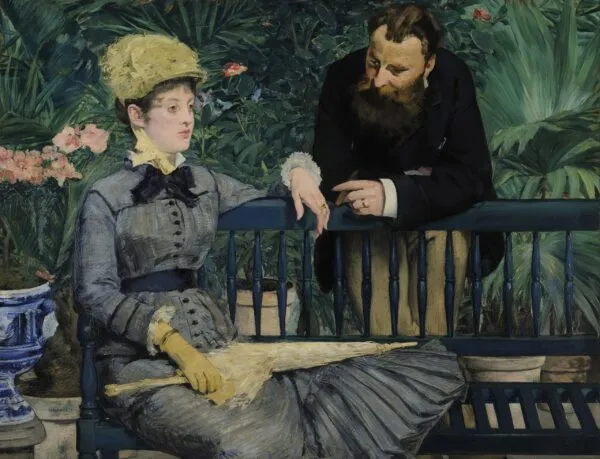
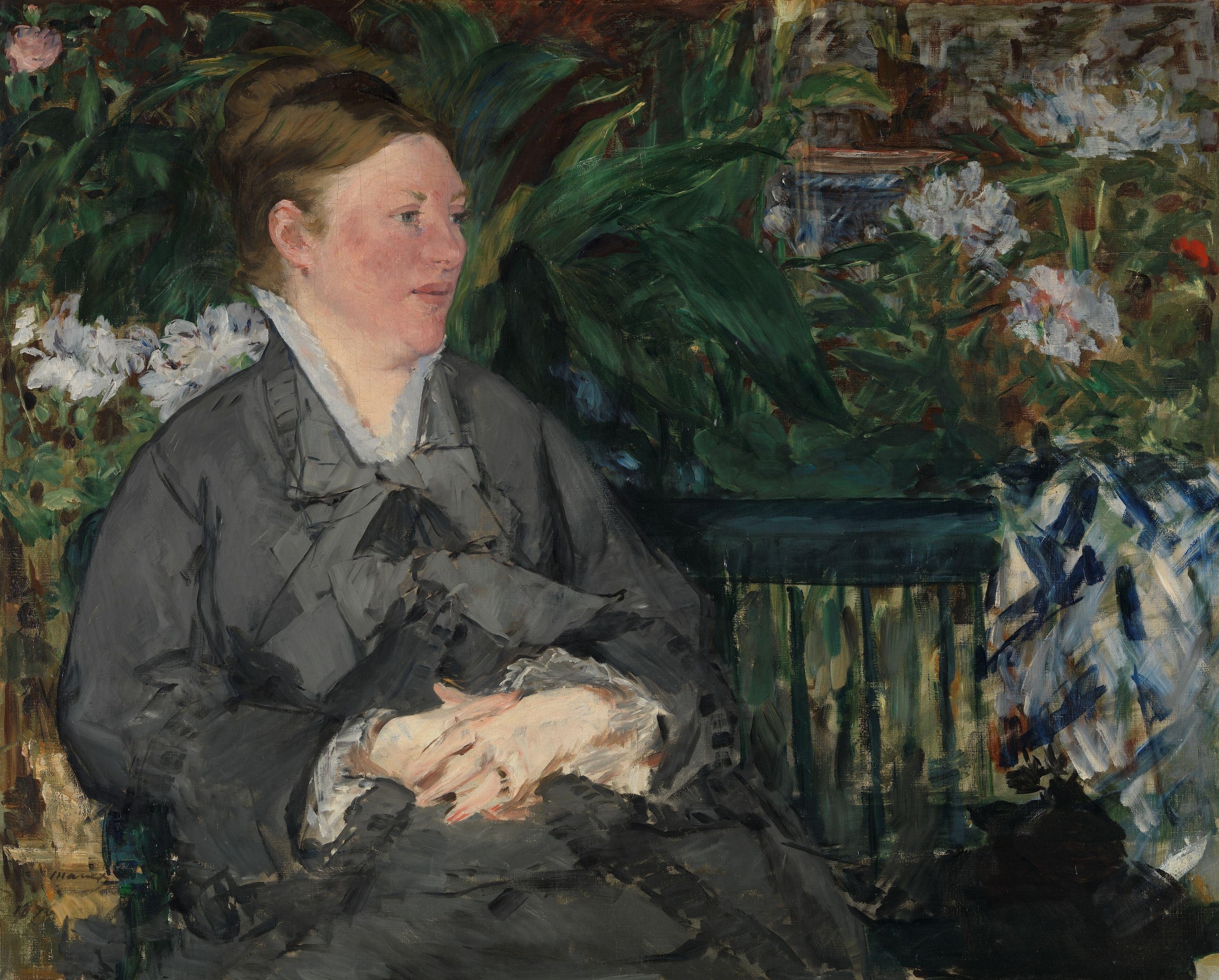
Madame Manet in the Conservatory is Édouard Manet’s 1879 portrait of his wife Suzanne: in a grey silk dress with a large bow at the neck she sits on a dark green bench, hands folded in her lap, against a dense wall of leaves and flowers. The original is oil on canvas, 81.5 x 100 cm, held by the National Museum of Art, Architecture and Design (Nasjonalmuseet) in Oslo. To your order, our painter paints it by hand in oil on canvas, in one of 8 landscape sizes between 40 x 31 and 200 x 159 cm, or made to measure. Once it is finished, we send you a photograph of it before dispatch.
| Title: | Madame Manet in the Conservatory |
| Other titles: | Madame Édouard Manet dans la serre (French title) |
| Painter: | Édouard Manet (1832–1883) |
| Year painted: | 1879 |
| Original size: | 81.5 cm x 100 cm (height x width) |
| Original technique: | Oil on canvas |
| Painting style: | Realism and Impressionism |
| Located at: | Nasjonalmuseet, Oslo, Norway |
| Our reproduction: | Hand-painted in oil on canvas, 8 sizes or made to measure |
Madame Manet in the Conservatory – Édouard Manet
What does Madame Manet in the Conservatory show?
On a bench of dark green slats sits a full-figured woman with auburn hair pinned high on her head. Her cheeks glow pink, and her gaze drifts slightly to the right, past the viewer.
She wears a grey silk dress with a large bow under the chin and a white collar, and lace cuffs peep from her sleeves. Her hands rest quietly in her lap, fingers interlaced.
Behind the bench rises thick greenery of broad leaves, with pink and white flowers opening among them. On the right a blue-and-white patterned cloth falls over the backrest, and higher up a blue-and-white pot shows between the plants. Manet’s signature sits in the lower left corner.
Who was the woman on the bench?
The sitter is Suzanne, Manet’s wife. He painted her in 1879 in the conservatory where she often came to help him with the sittings for his In the Conservatory.
Here she is the subject herself. There is no costume and no story, only a calm woman in an everyday dress among the plants.
Manet does not flatter her: the face is painted frankly, with colour in the cheeks, and the dress stays a plain grey amid the lush green. That simplicity gives the portrait its warm, domestic tone.
Why do so many people love this painting?
Édouard Manet (1832–1883) ranks among the first nineteenth-century painters to take modern life as a subject, and he is a pivotal figure between Realism and Impressionism. His Le Déjeuner sur l’herbe and Olympia caused great controversy in the 1860s and are now seen as the starting point of modern art.
He was a friend of Monet, Renoir and Degas, yet he preferred sending his work to the Paris Salon over showing with the Impressionists. In 1881 he received the Légion d’honneur.
This portrait shows the quieter, private side of a painter known for bold large canvases. A short Wikipedia article on the painting, in English, also follows what became of the canvas later.
Where is the original, and how did it reach Oslo?
The original, oil on canvas measuring 81.5 x 100 cm (height x width), belongs to the National Museum of Art, Architecture and Design in Oslo, under accession number NG.M.01286.
Suzanne parted with it reluctantly in August 1895, because she needed money. The buyer was the collector Maurice Joyant, a childhood friend of Toulouse-Lautrec, who sold it on to Georges Bernheim in July 1911. In 1918 the Friends of the National Gallery of Norway acquired it.
Suzanne is believed to have had her nephew Édouard Vibert paint a copy before the sale. When he made it is not known; it stayed with her until her death in 1906. Later it circulated in Germany for many years as a genuine Manet, until it was finally recognised as a copy.
Madame Manet in the Conservatory or another Manet?
Choose this canvas painting if you prefer calm to drama: one woman, a soft grey dress and greenery that fills the whole space.
A family afternoon outdoors fills The Monet Family in Their Garden at Argenteuil, where Camille and little Jean rest on the lawn while Claude Monet bends over his flower bed. Quite different, a history scene, is The Execution of Emperor Maximilian, with its firing squad before a high wall, and for a male portrait there is Portrait of Henri Rochefort, the journalist with folded arms.
Our Édouard Manet page gathers more famous Manet paintings, all painted to order.
How do we hand-paint Madame Manet in the Conservatory?
Manet’s original is an oil on canvas 100 cm wide. Ours is an oil painting reproduction made by hand: our painter builds it up in thin layers of oil on canvas, in the size you choose.
He first lays in the outline of the woman, the bench and the edges of the greenery, then the dark leaves behind her and the grey dress. Last come the pink tones of the face, the white lace at the wrists, the flowers and the blue pattern of the cloth.
Manet worked the face and hands more carefully and left the dress and plants in broad, juicy strokes. Our painter keeps that balance, so the background stays lively and loose while Madame Manet stands out clearly from the green.
Which size fits which wall?
In short: 40 x 31 or 50 x 40 cm for a shelf or a narrow wall, 64 x 50 and 80 x 63 cm above a chest of drawers or a bed, 100 x 79 and 125 x 99 cm above a sofa, and 160 x 124 or 200 x 159 cm for a large, empty wall.
We paint it in 8 landscape sizes (width x height): 40 x 31, 50 x 40, 64 x 50, 80 x 63, 100 x 79, 125 x 99, 160 x 124 and 200 x 159 cm. The original measures 100 x 81.5 cm (width x height): the four sizes up to 80 x 63 cm are smaller, 100 x 79 cm is just as wide and almost as tall, and 125 x 99, 160 x 124 and 200 x 159 cm are larger than the original.
As a painting for the living room it is most convincing at 125 x 99 cm above the sofa, where the greenery spreads across the wall and Madame Manet’s face reads well from the far side of the room.
Can I have a different size or a frame?
Yes. If your wall needs other proportions, we keep Madame Manet and the bench whole and adjust only the edge of the greenery on the left and right. Tell us the size you need, and we will quote a price and a date for the portrait.
We ship it rolled, stretched on a stretcher bar or framed; our workshop in Slovenia handles the stretching and framing and packs each painting safely for transport. The moulding is chosen in our 3D app, built only for picking a frame; a view of the painting on your own wall is a separate service.
A slim dark green or black moulding picks up the colour of the bench, while a light wooden frame brings out the pink flowers.
When will the painting arrive, and how is it sent?
Once you confirm the order, the painter gets to work, and the painting is ready to leave within 15 to 45 working days. Before packing, you get a photograph of Madame Manet on her bench, and we make any changes you ask for.
Within Slovenia and the wider EU no customs duties apply, and our returns policy covers this portrait like every order.
A calm portrait among flowers makes a lovely present for a mother, a wedding anniversary or a new home. If water and light appeal more, look at The Grand Canal, Venice (Blue Venice), with its gondola gliding past blue-and-white poles. Not sure about the wall? Give a wall art voucher instead.
Frequently asked questions
Where can I see the original?
At the National Museum of Art, Architecture and Design in Oslo, under accession number NG.M.01286.
Who is the sitter?
Suzanne Manet, the painter’s wife, who came to this conservatory to help with the sittings for In the Conservatory.
Is this a printed reproduction?
No. Each one is a hand-painted copy, for which our painter uses oil colours and real canvas.
How large is the original?
It measures 81.5 x 100 cm (height x width); our 125 x 99, 160 x 124 and 200 x 159 cm sizes are larger.
Can I order it in another size?
Yes. Write to us with the width and height you want, and we will send an offer with a delivery time.
How long does it take to make?
Between 15 and 45 working days, and before dispatch you also receive a photograph of the finished painting.
Is this portrait right for a bedroom, or as a gift?
Yes. The quiet greys and greens suit a bedroom or a reading corner, and as a gift it pleases anyone who loves flowers and portraits.
Does the painting have a hidden meaning?
No documented one: it is a portrait of the painter’s wife in the conservatory where she helped him with sittings.
- Subject: Suzanne Manet in a grey silk dress on a green bench before a wall of leaves and flowers.
- Original: oil on canvas, 1879, 81.5 x 100 cm, Nasjonalmuseet, Oslo.
- Ours: an Édouard Manet reproduction painted by hand in oil on canvas, 8 sizes from 40 x 31 to 200 x 159 cm, or made to measure.
- Worth knowing: her nephew Édouard Vibert painted a copy that long passed for the original in Germany.