







































Description
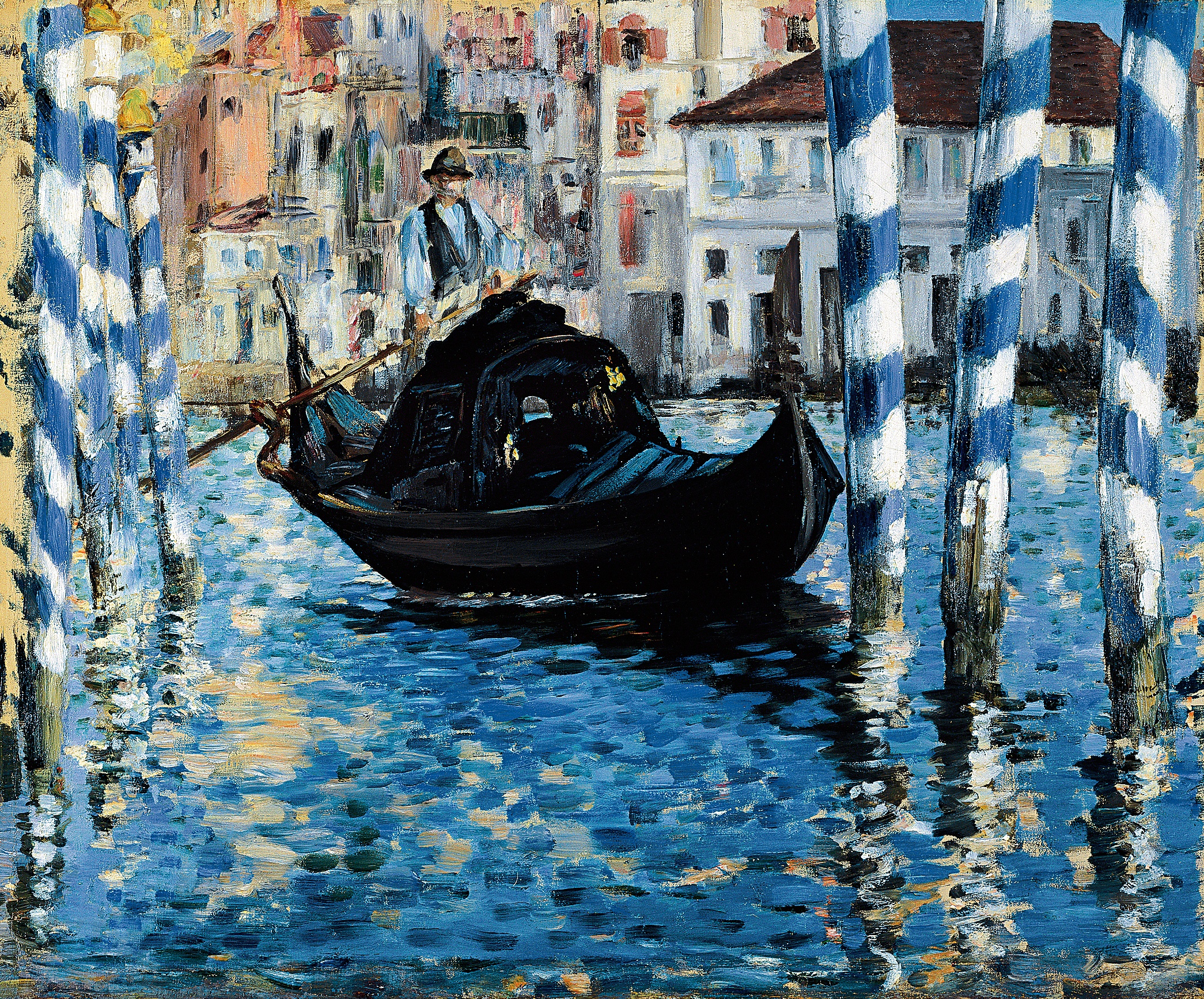
The Grand Canal, Venice (Blue Venice) is Manet’s Venetian scene of 1874 or 1875: a black gondola and its gondolier glide between tall mooring poles striped blue and white, pale palazzi with red roofs line the canal behind, and the water breaks into countless strokes of blue, white and gold. The original is oil on canvas, about 58.7 x 71.4 cm, and belongs to the Shelburne Museum in Vermont. Our painter paints it for you by hand in oil on canvas, in 8 landscape sizes from 40 x 32 to 170 x 134 cm, or made to measure. Before the gondola sets off to you, we send a photograph of the finished painting.
| Title: | The Grand Canal, Venice (Blue Venice) |
| Other titles: | Le Grand Canal à Venise (French title) · Blue Venice (name given by Louisine Havemeyer) |
| Painter: | Édouard Manet (1832–1883) |
| Year painted: | 1874 or 1875 |
| Original size: | about 58.7 cm x 71.4 cm (height x width) |
| Original technique: | Oil on canvas |
| Painting style: | Realism and Impressionism |
| Located at: | Shelburne Museum, Shelburne, Vermont, United States |
| Our reproduction: | Hand-painted in oil on canvas, 8 sizes or made to measure |
The Grand Canal, Venice (Blue Venice) – Édouard Manet
What does Blue Venice show?
A black gondola with a covered cabin moves through the centre of the canvas. At the stern stands the gondolier in a hat, a pale blue shirt and a dark waistcoat, driving the boat towards us with his long oar. Manet painted the black hull with almost no detail; a few blue glints and tiny yellow touches are all that suggest the ornaments on the cabin.
Tall mooring poles frame the scene, two on the left and three on the right. A blue-and-white spiral winds round each one, laid on in broad, quick strokes, so the poles seem to shimmer in the light.
Behind, palace fronts in white, pink and ochre rise from the water, with rows of dark windows and red tiled roofs, leaving only a thin strip of blue sky above. Water fills the lower half: patches of blue, white, green and gold mingle with the wavering reflections of the poles and the dark shadow of the gondola.
Why is it called Blue Venice?
The nickname is not Manet’s own. The American collector Louisine Havemeyer, who owned the work, gave it that name, and it stuck, since blue rules the canvas from the poles to the last ripple.
Manet painted the canvas in Venice. According to the Shelburne Museum, he likened the glitter of light on the water to champagne bottles floating upside down, and it was that sparkle he tried to catch with his brush.
The museum places the work within the myth of Venice that drew nineteenth-century artists to the lagoon city, where the play of sky, water and light fed new directions in modern art. The dating varies: the museum gives 1875, other sources 1874.
Why is this Manet so admired?
Édouard Manet (1832–1883) was among the first nineteenth-century artists to paint modern life and is seen as a pivotal figure in the move from Realism to Impressionism.
The American painter Mary Cassatt, Louisine Havemeyer’s adviser, approved the purchase and counted the work among Manet’s most brilliant.
To read more about the painter himself, see the Wikipedia article on Édouard Manet, which covers his life and work and is written in English.
Where is the original, and who owned it?
The original, oil on canvas, measures about 58.7 x 71.4 cm (height x width) according to the museum. It belongs to the Shelburne Museum in Shelburne, Vermont, under accession number 1972-69.15, and is signed with Manet’s name.
Some twenty years after it was painted, the New York collector H. O. Havemeyer bought it for his wife, Louisine. Their daughter Electra Havemeyer Webb, who founded the Shelburne Museum in 1947, inherited it and hung it in her New York apartment. After her death in 1960 that room was rebuilt in the museum’s memorial building, and in 1972 the painting entered the collection as a gift of the Electra Havemeyer Webb Fund.
On the same trip Manet painted a second Venice canvas, an upright view of the canal now in a private collection. Do not confuse the two: we paint the horizontal, blue version from Shelburne.
Blue Venice or another Manet?
This canvas painting suits anyone who loves Venice, water and a light, cool blue that brings freshness to a room.
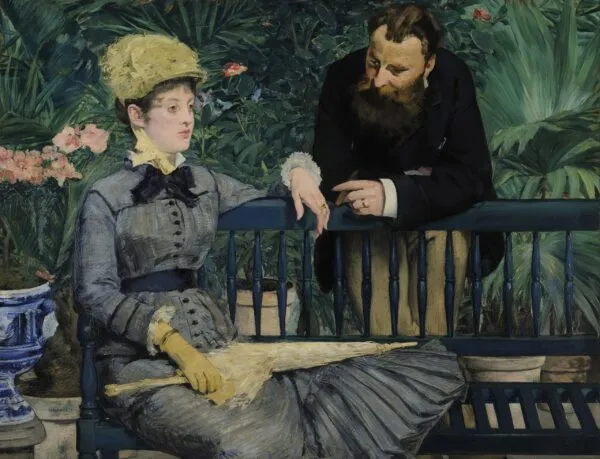
Manet painted river light in France too. Banks of the Seine at Argenteuil shows a woman and a small child on a grassy bank watching sailing boats on the glittering blue river, and The Monet Family in Their Garden at Argenteuil shows Camille Monet in white with her son Jean on the lawn while Claude Monet bends over his flower bed. A more enclosed but equally colourful world opens in Madame Manet in the Conservatory, where the painter’s wife, Suzanne, sits in grey silk before a wall of leaves and flowers.
Other famous Manet paintings, all painted to order for your home, are gathered on the Édouard Manet page.
How do we hand-paint Blue Venice?
Manet’s original is a mid-sized oil on canvas, about 71 cm wide. Ours is an oil painting reproduction that the painter works in oil on canvas, at the size you choose, layer upon layer.
He first fixes the uprights of the poles, the outline of the gondola and the line of the façades, since that framework holds the whole scene. Then come the pale palaces and the sky, next the dark hull, and last the water, built as Manet built it from separate strokes of blue, white and gold, never blended.
To see what a Manet looks like at an early stage, compare his unfinished George Moore at the Café, thin dark brush lines on bare canvas; the Venice scene, by contrast, is finished to the last dab.
Which size suits which wall?
In short: 40 x 32 or 50 x 42 cm for a narrow wall, a shelf or a hallway, 56 x 48 and 74 x 59 cm for a bedroom or above a chest of drawers, 95 x 75 and 105 x 85 cm above a sofa, and 130 x 110 or 170 x 134 cm for a large wall.
We paint it in 8 landscape sizes (width x height): 40 x 32, 50 x 42, 56 x 48, 74 x 59, 95 x 75, 105 x 85, 130 x 110 and 170 x 134 cm. The original measures about 71.4 x 58.7 cm (width x height), so the first three sizes are smaller, 74 x 59 cm is almost the same size, and every size from 95 x 75 cm up is larger than the original.
As a painting for the living room it works best at 95 x 75 or 105 x 85 cm, where the strokes on the water already read as separate dabs.
Can I order another size or a frame?
Yes. If your wall needs other proportions, we keep the gondola, the gondolier and the poles whole and adjust only the edges of water and façades. Send us the size you need for your Venice wall, and we will reply with a price and a delivery date.
We ship it rolled, stretched on a stretcher bar or framed; our workshop in Slovenia handles stretching and framing and packs each painting carefully for the journey. You pick the moulding for this Venice scene in our 3D app, which serves frame choice only; seeing the gondola on your own wall is a separate service.
When will my painting arrive?
Work on the gondola and poles begins once you confirm the order, and the Venice scene is ready to ship within 15 to 45 working days. Before packing, we send you a photograph of your Venice scene and make any changes you ask for.
Delivery within Slovenia and across the EU is without customs duties, and our returns policy covers every order.
The Venice scene makes a lovely gift to recall a trip or a honeymoon in Venice, or for a new home. Not sure about the wall? A wall art voucher lets the recipient choose their own size of Venice.
Frequently asked questions
Where can I see the original?
At the Shelburne Museum in Vermont, United States, under accession number 1972-69.15.
Who named it Blue Venice?
The collector Louisine Havemeyer, for whom her husband H. O. Havemeyer bought the work.
Is this a print?
No. What you receive is a hand-painted copy: our painter builds it with brush and oil paint on real canvas.
How big is the original?
About 58.7 x 71.4 cm (height x width). Our 74 x 59 cm comes very close, and from 95 x 75 cm up our paintings are larger.
Can you paint Blue Venice in a size that is not listed?
Yes. Send us the width and height you want, and we will quote a price and a delivery time.
How long does it take?
Between 15 and 45 working days; before dispatch a photograph shows you the finished gondola scene.
Is it right for a bedroom or as a gift?
Yes. The cool blues feel calm in a bedroom, and anyone who loves Venice will be glad to receive it.
Is this the same as Manet’s upright Venice painting?
No. Manet painted two canvases in Venice; we paint the horizontal, blue version from Shelburne.
- Subject: a black gondola and gondolier between blue-and-white mooring poles, pale palaces with red roofs behind.
- Original: oil on canvas, 1874 or 1875, about 58.7 x 71.4 cm, Shelburne Museum, Vermont.
- Ours: an Édouard Manet reproduction hand-painted in oil on canvas, in 8 sizes from 40 x 32 to 170 x 134 cm or made to measure.
- Worth knowing: the nickname Blue Venice came from the collector Louisine Havemeyer.