







































Description
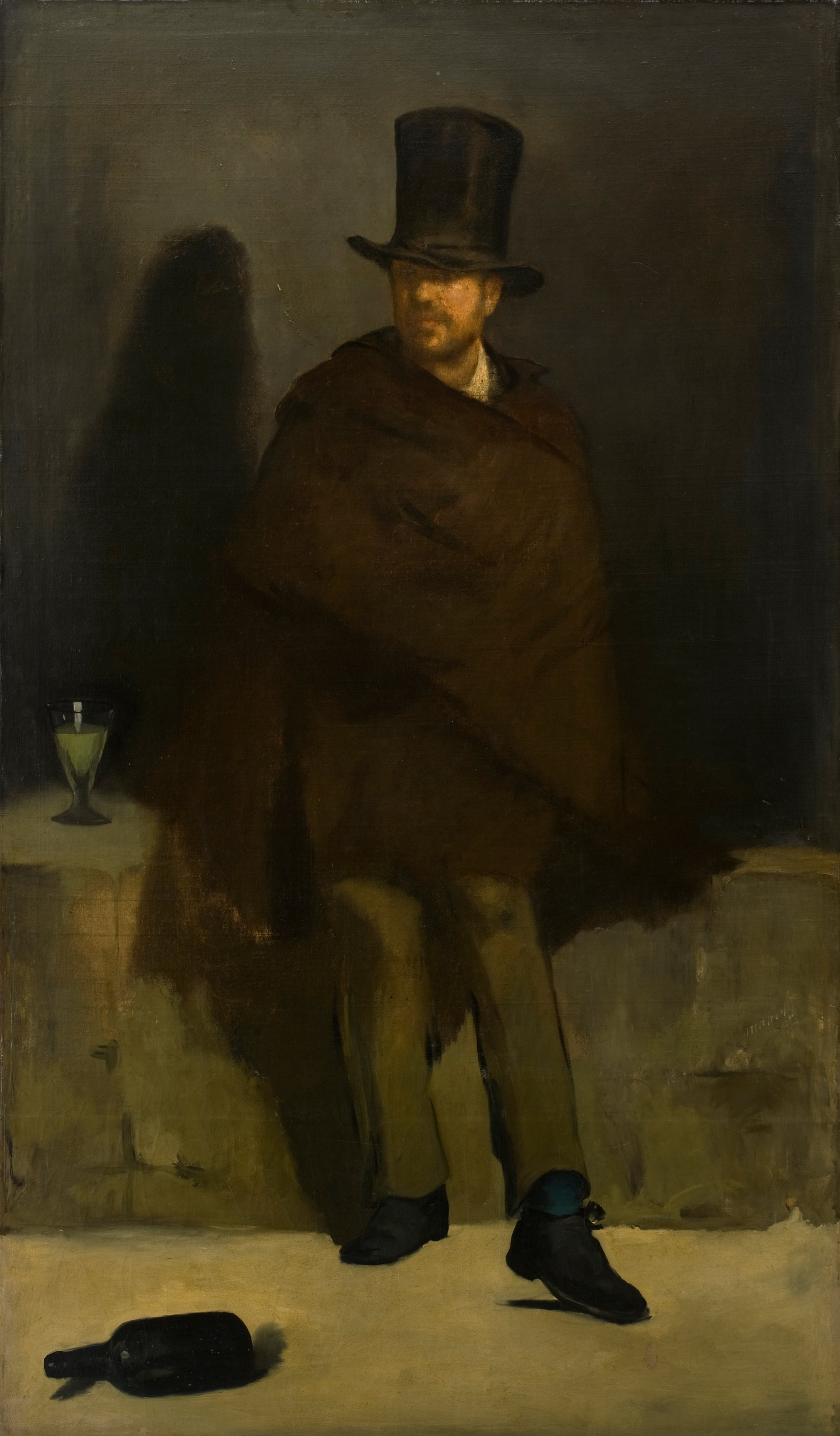
The Absinthe Drinker is Édouard Manet’s first major painting, made around 1859: a tall man in a top hat and a long brown cloak stands before a dark wall, a glass of greenish absinthe rests on the low ledge to his left, and an empty bottle lies at his feet. The original is oil on canvas, 180.5 cm high and 105.6 cm wide, and belongs to the Ny Carlsberg Glyptotek in Copenhagen. Our painter paints it for you by hand in oil on canvas, in 8 portrait sizes from 30 x 50 to 111 x 188 cm, or made to measure. Before the cloaked drinker leaves us, you receive a photograph of the finished painting.
| Title: | The Absinthe Drinker |
| Other titles: | Le Buveur d’absinthe (French title) · Der Absinthtrinker (German title) |
| Painter: | Édouard Manet (1832–1883) |
| Year painted: | 1859 |
| Original size: | 180.5 cm x 105.6 cm (height x width) |
| Original technique: | Oil on canvas |
| Painting style: | Realism and Impressionism |
| Located at: | Ny Carlsberg Glyptotek, Copenhagen, Denmark |
| Our reproduction: | Hand-painted in oil on canvas, 8 sizes or made to measure |
The Absinthe Drinker – Édouard Manet
What does The Absinthe Drinker show?
The man is painted almost life-size, half leaning on a low stone ledge that runs across the canvas. His tall black top hat is pulled low, so his bearded face stays mostly in shadow. A wide brown cloak wraps him from neck to knee and hides his arms; only a scrap of white collar shows.
Beneath it he wears olive-brown trousers and black shoes; his left foot reaches slightly forward, a dark blue sock showing above the shoe.
To his left a stemmed glass stands on the ledge, two-thirds full of a yellowish-green liquid. In the lower left corner an empty dark bottle lies on the pale ground. The light comes from the right, so the man’s shadow falls on the wall behind him, to the left. The palette keeps to browns, greys and blacks.
Who was the man in the top hat, and what does the painting say?
The model was a rag-picker named Collardet who was often seen around the Louvre in Paris. Manet painted him full-length, wrapped in his cloak like an aristocrat, giving an everyday subject a grand scale.
Manet was drawing here on the realism of Gustave Courbet. He may also have found ideas in Charles Baudelaire’s poem Le Vin des chiffonniers, from the 1857 collection Les Fleurs du mal, in Velázquez’s paintings of ordinary people, especially his Aesop and Menippus, and in Watteau’s L’Indifférent.
The painting neither preaches nor flatters. It shows the man composed, head up, as a type from the Paris streets of his day rather than a moral tale. Absinthe was then a modern drink, and the glass ties the scene to its own present.
Why does this painting matter so much?
The Absinthe Drinker is considered Manet’s first major painting and his first original work. Édouard Manet (1832–1883) was among the first 19th-century artists to paint modern life and a key figure in the move from Realism to Impressionism.
When the canvas was nearly finished, he showed it to his former teacher Thomas Couture, under whom he had trained from 1850. Couture was appalled and is said to have replied that the real absinthe drinker was the painter himself, who had lost his moral sense.
It was the first work Manet submitted to the Paris Salon, in 1859, and the jury rejected it, with only Eugène Delacroix voting in its favour. Part of the reason may have been the subject: absinthe was then thought addictive and morally degenerate, and this is one of the earliest depictions of absinthe in art.
For more on Collardet, the Salon and the changes to the canvas, read the Wikipedia article on this painting, which is in English.
Where is the original, and how did the canvas change?
The original, oil on canvas measuring 180.5 x 105.6 cm (height x width), belongs to the Ny Carlsberg Glyptotek in Copenhagen, inventory number MIN 1778.
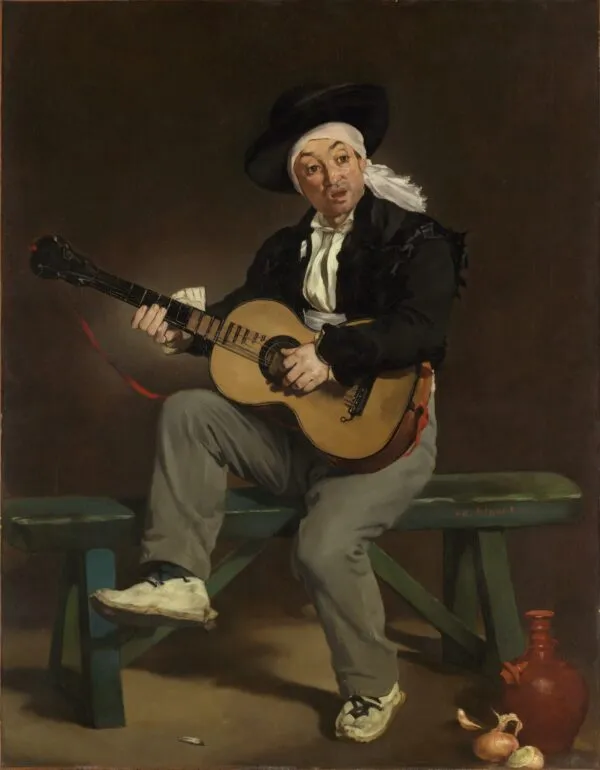
Manet kept revising the work and reused the same cloaked figure in The Old Musician of 1862. By 1867 he had cut it down to three-quarter length for a self-funded retrospective during the Exposition Universelle in Paris. The art historian Charles F. Stuckey thinks the first version may have lacked both the legs and the glass.
Between 1867 and 1872 Manet lengthened the canvas by about 40 cm at the bottom, repainted the legs and the bottle, and only then added the glass. In 1872 the dealer Paul Durand-Ruel bought it with 22 other paintings, and the opera singer Jean-Baptiste Faure owned it later. Shown in Copenhagen in 1914 and acquired for the Ny Carlsberg Foundation, it was among the first modern works in the Glyptotek.
The Absinthe Drinker or another Manet?
This is a canvas painting for anyone who likes serious, reserved portraits, dark tones and a single strong figure in a tall format.
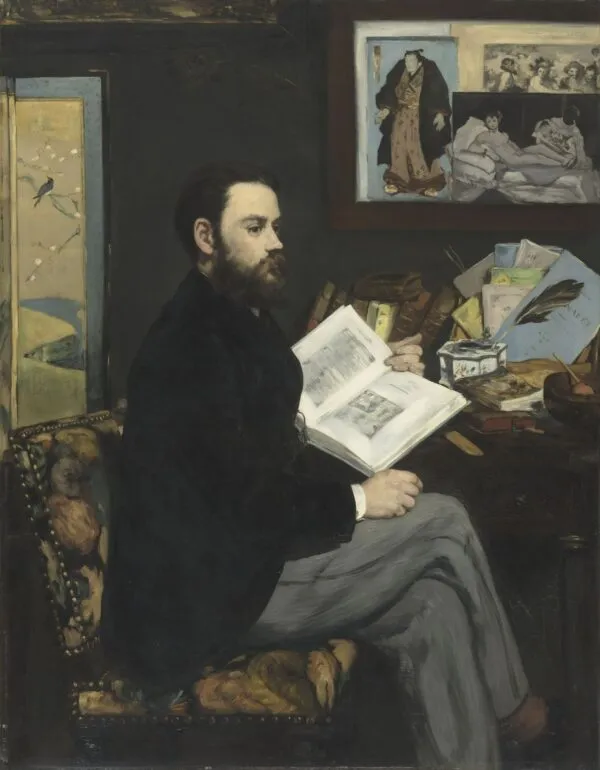
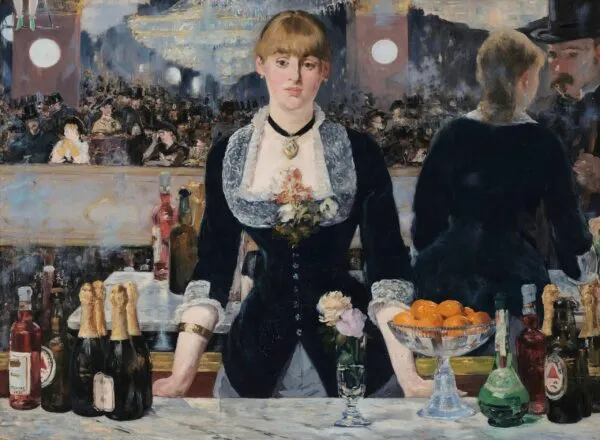
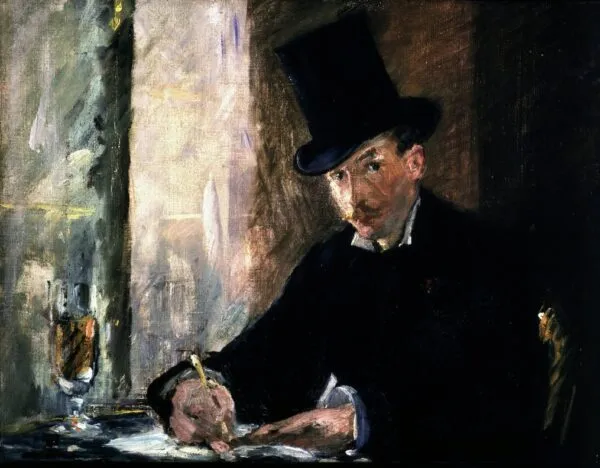
Paris café life, painted almost two decades later, fills The Plum, a young woman in pink at a marble table, and At the Café, three people over beer. A man in a top hat writes at a café table in Chez Tortoni, while On the Beach brings sea light and a woman reading on the sand.
You will find our other famous Manet paintings, each made to order, on the Édouard Manet page.
How do we hand-paint The Absinthe Drinker?
Manet’s original is an oil on canvas more than 180 cm tall. Your copy is an oil painting reproduction made on new canvas, worked by our painter in oil on canvas at the size you pick and built up in several layers.
He first fixes the figure’s vertical axis, the ledge and the hat, since the whole composition rests on one standing body. Then come the dark ground, the brown folds of the cloak and the pale floor, and last the green glint in the glass, the shine on the bottle and the blue sock. He keeps Manet’s broad, visible strokes so the surface stays alive.
Which size suits which wall?
In short: 30 x 50 or 40 x 65 cm for a narrow wall, 45 x 80 and 55 x 90 cm beside a door or in a hallway, 60 x 105 and 77 x 129 cm above a chest of drawers, and 88 x 146 or 111 x 188 cm for a tall wall or a stairwell.
We paint it in 8 portrait sizes (width x height): 30 x 50, 40 x 65, 45 x 80, 55 x 90, 60 x 105, 77 x 129, 88 x 146 and 111 x 188 cm. The original measures 105.6 x 180.5 cm (width x height), so the seven sizes up to 88 x 146 cm are smaller than it, while the largest, 111 x 188 cm, is about the same size and slightly larger.
As a painting for the living room it works best at 77 x 129 or 88 x 146 cm, where the cloaked figure commands the wall.
Can you paint it to measure and frame it?
Yes. For other proportions we keep the figure, glass and bottle whole and adjust only the dark wall around them. Tell us the size you need and we will answer with a price and a date for your drinker.
It travels rolled, stretched on a stretcher bar by our workshop in Slovenia, or framed there as well. The moulding for this tall canvas is picked in our 3D app, which serves for choosing the frame only; seeing the painting on your own wall is a separate service.
When will my painting arrive?
Work on the drinker begins once you confirm your order, and the painting is ready to leave within 15 to 45 working days. Before packing, you get a photograph of your finished drinker, and we make any corrections you request.
We deliver within Slovenia and to the rest of the EU without customs duties, and every order falls under our returns policy.
As a gift it suits lovers of art history or early Manet. Unsure of the wall? Give a wall art voucher and let the recipient choose the size.
Frequently asked questions
Where can I see the original?
At the Ny Carlsberg Glyptotek in Copenhagen, under inventory number MIN 1778.
Who posed for Manet?
Collardet, a Paris rag-picker who was often seen around the Louvre.
Is this a print?
No. Your painting is a hand-painted copy, made with brushes in oil on canvas once you order.
How big is the original?
It is 180.5 cm high and 105.6 cm wide; our largest size, 111 x 188 cm, roughly matches it.
Can I order a size that is not listed?
Of course. Write with the width and height you have in mind and we will quote a price and a time.
How long does it take to make?
Usually 15 to 45 working days, with a photograph of the finished canvas sent to you before dispatch.
Does it suit an office or a library?
Yes. Its quiet browns and greys suit an office, a library or a high hallway.
Why did the Salon reject it?
Probably for its subject, as absinthe was then seen as ruinous, and also for its uneven finish.
- Subject: a man in a top hat and brown cloak before a dark wall, with a glass of absinthe and an empty bottle beside him.
- Original: oil on canvas, about 1859, 180.5 x 105.6 cm, Ny Carlsberg Glyptotek, Copenhagen.
- Ours: an Édouard Manet reproduction painted by hand in oil on canvas, 8 sizes from 30 x 50 to 111 x 188 cm, or made to measure.
- Worth knowing: Manet’s first major painting; the 1859 Salon rejected it, with only Delacroix voting for it.