







































Description
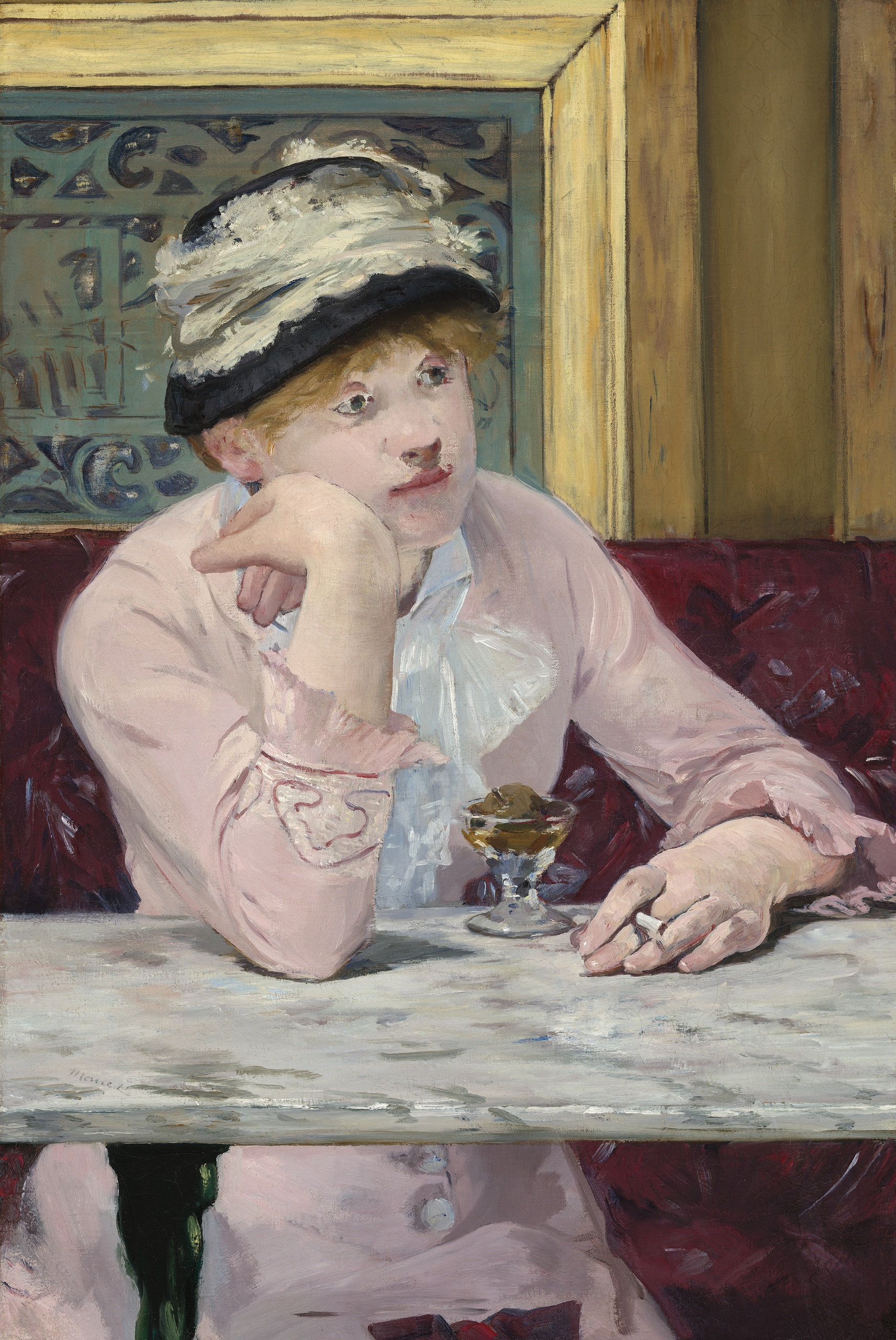
The Plum is a quiet café scene by Édouard Manet, painted about 1877–1878: a young woman in a pink dress sits at a marble table, chin propped on her hand and an unlit cigarette between her fingers, with a small glass holding a plum soaked in brandy in front of her. The original is oil on canvas, 73.6 x 50.2 cm, and belongs to the National Gallery of Art in Washington. Our painter paints it for you by hand in oil on canvas, in 8 portrait sizes from 30 x 45 to 140 x 195 cm, or made to measure. Before your Plum leaves us, we send you a photograph of it.
| Title: | The Plum |
| Other titles: | La Prune (French title) · Plum Brandy |
| Painter: | Édouard Manet (1832–1883) |
| Year painted: | about 1877–1878 |
| Original size: | 73.6 cm x 50.2 cm (height x width) |
| Original technique: | Oil on canvas |
| Painting style: | Realism and Impressionism |
| Located at: | National Gallery of Art, Washington, D.C., United States |
| Our reproduction: | Hand-painted in oil on canvas, 8 sizes or made to measure |
The Plum – Édouard Manet
What does The Plum show?
A young woman sits on a red upholstered banquette, her right elbow on the marble tabletop. Her cheek rests on the back of her right hand, and her gaze drifts past us into the distance.
She wears a pale pink dress with embroidered cuffs and a white jabot at the throat, and a black hat trimmed with cream silk and lace. Below the edge of the table you can see that the dress fastens with white buttons.
Her left hand lies loosely on the table, holding a cigarette she has not lit. In front of her stands a stemmed glass with the brandied plum, apparently untouched. Behind her head a blue-green decorative grille sits in a gilded frame, and to the right rises a wall of warm yellow wood. At the lower left a dark green iron leg shows beneath the tabletop, and Manet signed his name on the marble.
Who is the woman with the plum waiting for?
The painting is a study in loneliness. She sits alone, seen from close by, perhaps through the eyes of another customer at a nearby table. Her pose is tired and listless, yet her face shows no despair, only a kind of daydream.
Manet does not tell us who she is or whom she expects. The Wikipedia article gives two readings: she may be a prostitute waiting for a client, or a shop worker hoping for some conversation. A plum soaked in brandy was a speciality of Parisian cafés at the time and gives the work its name; Manet first painted a glass of beer in its place.
Manet may have drawn on what he saw at the Café de la Nouvelle Athènes on the Place Pigalle in Paris. The grille and its gold frame, however, do not match other depictions of that café, which suggests he painted the scene in his own workspace, where he kept a café-style marble table on iron legs.
Why is this painting so well known?
Édouard Manet (1832–1883) was a Paris painter, one of the first in the 19th century to paint modern city life, and he is now seen as the bridge between Realism and Impressionism.
The Plum is often read as a reply to Edgar Degas’s L’Absinthe of 1876, for which the same actress, Ellen Andrée, sat beside Marcellin Desboutin. Degas shows a bleak scene of despair dulled by absinthe; Manet’s is lighter and more hopeful, since his sitter’s loneliness may still be broken.
Manet paints simply and sparingly: the plum in its glass and the fingers of the left hand are just a few dabs of colour. For more on the model, the café and the painting’s history, see the Wikipedia article on the painting, written in English.
Where is the original, and who posed for it?
The original, oil on canvas measuring 73.6 x 50.2 cm (height x width), belongs to the National Gallery of Art in Washington, under accession number 1971.85.1.
The sitter was the actress Ellen Andrée, who also appears in Renoir’s Luncheon of the Boating Party of 1881.
Manet sold the work to the collector Charles Deudon around 1881. After Deudon’s death it passed to his widow, later entered the collection of Arthur Sachs in New York, and in 1961 was bought by Paul Mellon through M. Knoedler & Co; Mellon gave it to the National Gallery of Art in 1971.
The Plum or another Manet?
This canvas painting suits anyone who loves quiet moments: one face, one table, one glass and plenty of room for thought. The upright format sits well on a narrow wall, in a bedroom or beside a reading chair.
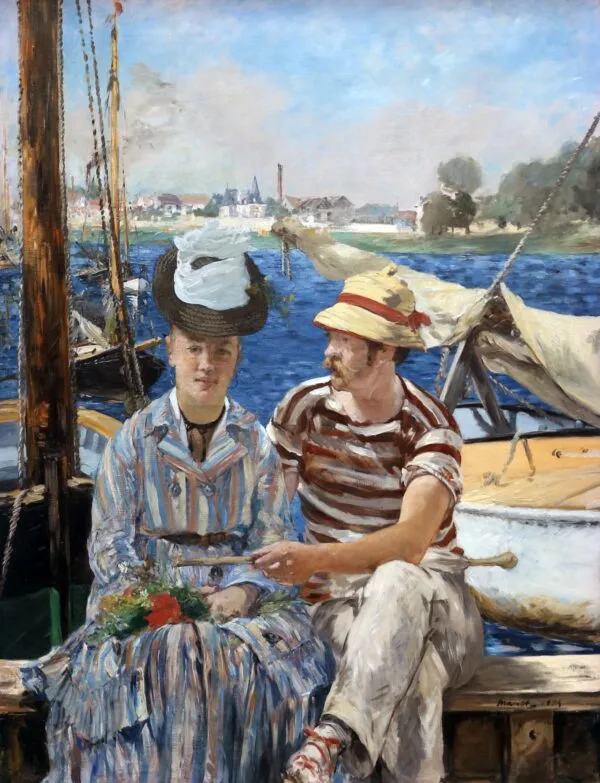
If Manet’s cafés appeal to you, look at At the Café, three customers at a similar marble table, or Chez Tortoni, a man in a top hat writing at a café table. More personal are the portrait Berthe Morisot with a Bouquet of Violets and the summer couple by the Seine in Argenteuil.
You will find our other famous Manet paintings, each painted to order, on the Édouard Manet page.
How do we hand-paint The Plum?
Manet’s original is a medium-sized oil on canvas, 73.6 cm tall. Ours is an oil painting reproduction on new canvas: the painter works it in oil on canvas, in the size you choose, layer by layer.
He begins with the table edge, the shoulders and the propped head, because the diagonal from elbow to hand holds the whole composition. Then come the red banquette, the blue-green grille and the wooden wall, next the pink dress with its white jabot, and last the glass with the plum, the cigarette and the pale lights on the marble.
Manet only suggested much of this with a few strokes, and our painter keeps them loose, adding no detail the original lacks.
Which size suits which wall?
In short: 30 x 45 or 40 x 56 cm for a shelf or bedside table, 45 x 65 and 58 x 85 cm for a bedroom or hallway, 75 x 110 and 85 x 125 cm above a sofa or chest of drawers, and 110 x 155 or 140 x 195 cm for a tall wall.
We paint it in 8 portrait sizes (width x height): 30 x 45, 40 x 56, 45 x 65, 58 x 85, 75 x 110, 85 x 125, 110 x 155 and 140 x 195 cm. The original measures 50.2 x 73.6 cm (width x height), so the three smallest sizes are smaller than it, 58 x 85 cm is already slightly larger, and every size from 75 x 110 cm up is clearly larger than the original.
As a painting for the living room it works best at 75 x 110 or 85 x 125 cm, where the face and the glass with the plum read clearly from across the room.
Can I order another size or a frame?
Yes. For other proportions we keep the woman, the table and the glass whole and adjust only the red banquette and the wooden wall at the edges. Tell us the size you need for The Plum and we will quote a price and a date.
It comes rolled, stretched on a stretcher bar or framed, and our workshop in Slovenia does the stretching and framing. The moulding is picked in our 3D app, a tool for choosing frames only; a view of the painting on your own wall is a separate service.
When will my painting arrive?
Work on your Plum begins once you confirm the order, and it is ready to leave us within 15 to 45 working days. Before packing, we send you a photograph of the finished painting and make any changes you ask for.
Shipping within Slovenia and the EU carries no customs duties, and the order falls under our returns policy.
This pensive woman with her plum makes a lovely gift for anyone fond of Paris, cafés or quiet portraits. Not sure about the wall? Give a wall art voucher so the person receiving it can decide on the size later.
Frequently asked questions
Where can I see the original?
At the National Gallery of Art in Washington, accession number 1971.85.1.
What is in the glass in front of her?
A plum soaked in brandy, a speciality of Parisian cafés at the time.
Is this a print?
No. It is a hand-painted copy, made by our painter with brushes and oil paint on canvas.
How big is the original?
It measures 73.6 x 50.2 cm (height x width); our sizes from 58 x 85 cm up are larger.
Can I order The Plum in a size not on the list?
Of course. Write to us with the width and height you need, and we will send an offer with price and timing.
How long do painting and delivery take?
Allow 15 to 45 working days until dispatch, with a photograph of your finished canvas first.
Would The Plum suit a bedroom or make a good gift?
Yes. The calm pinks and reds sit well in a bedroom, and as a present it pleases anyone who likes to linger in a café.
Who posed for the woman?
The actress Ellen Andrée, who also sat for Degas’s L’Absinthe and for Renoir.
- Subject: a pensive young woman in pink at a marble café table, a glass with a brandied plum before her.
- Original: oil on canvas, about 1877–1878, 73.6 x 50.2 cm, National Gallery of Art, Washington.
- Ours: an Édouard Manet reproduction painted by hand in oil on canvas, 8 sizes from 30 x 45 to 140 x 195 cm, or made to measure.
- Worth knowing: the model was the actress Ellen Andrée, who also sat for Degas’s L’Absinthe.