







































Description
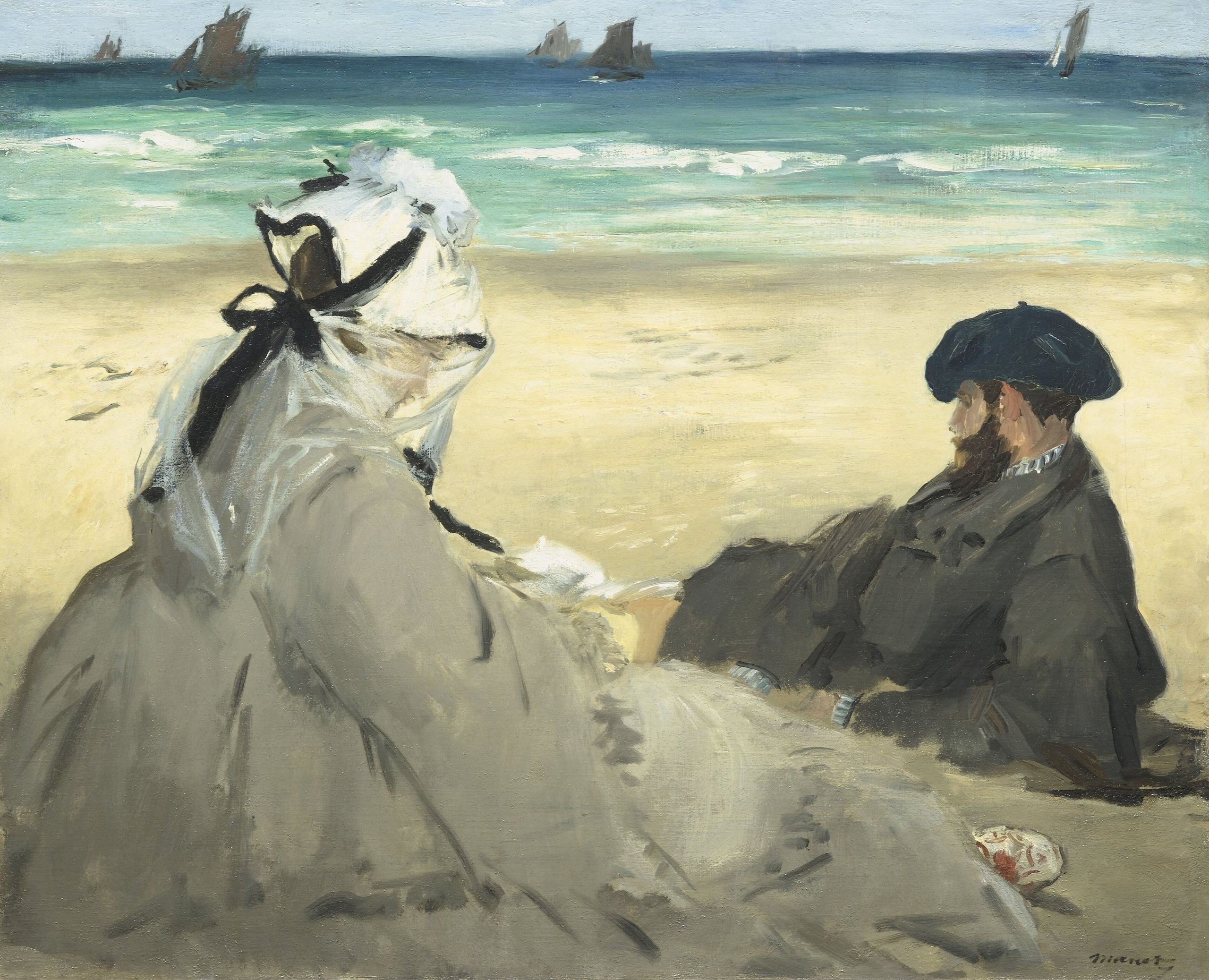
On the Beach is a painting by Édouard Manet from the summer of 1873: his wife Suzanne, in a pale coat and a hat whose veil streams in the wind, sits reading on the sand, while his brother Eugène, in a dark coat and dark cap, rests beside her on one elbow. Behind them lies a turquoise sea with white wave crests and sailing boats on the horizon. The original is oil on canvas, 59.6 x 73.2 cm, and it belongs to the Musée d’Orsay in Paris. Our painter paints it for you by hand in oil on canvas, in 8 landscape sizes from 40 x 32 to 190 x 150 cm, or made to measure. A photograph of the finished painting reaches you before we dispatch it.
| Title: | On the Beach |
| Other titles: | Sur la plage (French title) · Am Strand (German title) |
| Painter: | Édouard Manet (1832–1883) |
| Year painted: | 1873 |
| Original size: | 59.6 cm x 73.2 cm (height x width) |
| Original technique: | Oil on canvas |
| Painting style: | Realism and Impressionism |
| Located at: | Musée d’Orsay, Paris, France |
| Our reproduction: | Hand-painted in oil on canvas, 8 sizes or made to measure |
On the Beach – Édouard Manet
What does On the Beach show?
The scene is a sunny afternoon on the sandy shore at Berck, on the English Channel. The two figures fill the canvas almost from edge to edge, as if we sat on the sand beside them.
Suzanne Manet sits on the left, seen from the side and slightly from behind, in a long light-grey coat with a white-and-red summer shoe peeping out. A black ribbon tied in a bow holds her black-trimmed white hat at the nape. A sheer veil shields her from wind and sand; beneath it her face is only a shadow, bent over a book.
On the right Eugène half reclines on his bent left forearm, legs stretched towards the sea and sharply foreshortened. He wears a dark coat and a dark cap, with a blue-and-white striped shirt at collar and cuff; a full brown beard frames his face, and he gazes at the pale sand. The two have no contact at all.
Behind them the turquoise sea breaks in white lines of foam. High on the horizon glide a few boats with brownish sails and one white one, under a thin strip of pale blue sky. Manet signed his surname at the lower right.
How was it painted at Berck?
In the summer of 1873 Manet spent the holidays with his family at Berck, on the Côte d’Opale. With him were his wife Suzanne, his brother Eugène and their mother. Berck was then little more than a fishing village.
Grains of sand in the paint suggest to art historians that Manet worked on the beach itself, though the background may have been finished later in Paris.
The weeks at Berck were productive, mostly in views of the sea with sailing boats. The shadow Eugène casts to the right points to the afternoon, and sunlight flickers across the whole canvas. John Leighton sees in it Manet’s urge to hold on to a passing moment.
Why is this painting so admired?
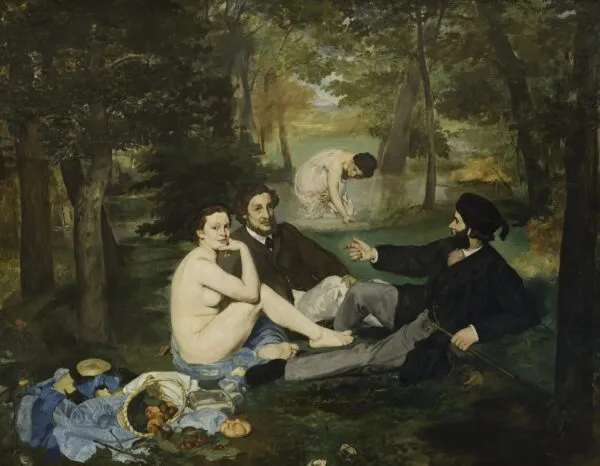
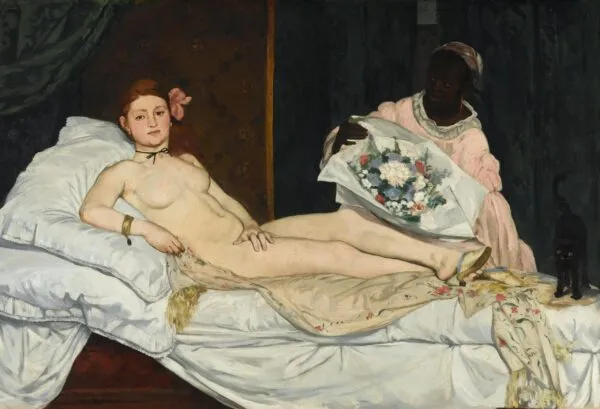
Édouard Manet (1832–1883) was among the first painters of his century to show modern life, and a pivot between Realism and Impressionism. His Le Déjeuner sur l’herbe and Olympia caused uproar in the 1860s and are now seen as the start of modern art.
Eugène Boudin and Claude Monet also painted beaches at Trouville; in 1870 Monet showed two seated people there who fill the width of the canvas. Françoise Cachin found Manet more monumental and saw Japanese prints behind the high horizon, the narrow band of sky and the flat figures.
Manet also drew on his own work: Eugène lies here in a pose much like the one he holds in Le Déjeuner sur l’herbe of 1863. He never exhibited with the Impressionists, preferring the Salon, yet a fellow painter linked him to Degas, Monet and Renoir: the woman in Berthe Morisot with a Bouquet of Violets. The English Wikipedia article on Édouard Manet, written in English, covers the painter, not this work.
Where is the original today?
The original, oil on canvas measuring 59.6 x 73.2 cm (height x width), belongs to the Musée d’Orsay in Paris, under inventory number RF 1953 24.
Manet sold it only a few weeks after finishing it. On 8 November 1873 the collector Henri Rouart bought it through Manet’s friend Théodore Duret.
It then passed to the fashion designer Jacques Doucet, who had a striking red-and-black lacquered Art Deco frame made for it, still in use today. His nephew Jean-Édouard Dubrujeaud inherited it and gave it to the Louvre in 1953; it has been at the Musée d’Orsay since 1986.
On the Beach or another Manet?
This canvas painting suits anyone who loves the sea, the wind and quiet family hours.
If Manet’s city scenes appeal to you more, look at At the Café, three customers at a marble table, or Chez Tortoni, a gentleman in a top hat writing by a café window. A young woman in a pink dress, lost in thought before a small glass with a brandied plum, appears in The Plum.
All our famous Manet paintings, each made to order, are gathered on the Édouard Manet page.
How do we hand-paint On the Beach?
Manet’s original is a medium-sized oil on canvas, 73.2 cm wide, rather than one of his large canvases. Ours is an oil painting reproduction worked by hand in oil on canvas, in the size you choose, built up in several layers.
The painter first fixes the high horizon and the outlines of both figures, each forming a triangle that carries the scene. Then come the warm sand, the turquoise sea and the dark mass of Eugène’s coat, and only at the end the white wave crests, the sails, the black ribbon and the sheer veil. Manet’s quick, loose strokes stay loose, because they carry the wind.
Which size suits which wall?
In short: 40 x 32 or 50 x 42 cm for a shelf, a bedside table or a narrow wall, 65 x 52 and 74 x 59 cm above a chest of drawers or a bed, 95 x 75 and 120 x 95 cm above a sofa, and 150 x 120 or 190 x 150 cm for a large empty wall.
We paint it in 8 landscape sizes (width x height): 40 x 32, 50 x 42, 65 x 52, 74 x 59, 95 x 75, 120 x 95, 150 x 120 and 190 x 150 cm. The original measures 73.2 x 59.6 cm (width x height), so the three smallest sizes are smaller than it, 74 x 59 cm is almost the same, and all four from 95 x 75 cm upwards are larger than the original.
As a painting for the living room it looks best at 120 x 95 or 150 x 120 cm above the sofa, where the sea and its sails open across half the wall.
Can I order another size or a frame?
Yes. For other proportions we keep Suzanne and Eugène whole and adjust the band of sand or sea, so the composition stays balanced. Tell us the size you need for the wall and we quote a price and a date.
It travels rolled, stretched on a stretcher bar or framed; our workshop in Slovenia does the stretching and framing. The moulding is chosen in our 3D app, a tool for frames only; seeing the painting on your own wall is a separate service.
When will it arrive, and how is it delivered?
Work begins once you confirm the order; within 15 to 45 working days the painting is ready to leave. Before packing, we send you a photograph of it, and anything you want changed is corrected.
We deliver within Slovenia and to every other EU country without customs duties, and each order is covered by our returns policy.
This summer sea scene makes a lovely gift for sea lovers or a holiday home. Unsure which wall awaits it? Give a wall art voucher, and they pick the size that fits their room.
Frequently asked questions
Where can I see the original?
At the Musée d’Orsay in Paris, where it carries inventory number RF 1953 24.
Who are the two people on the sand?
Manet’s wife Suzanne, who is reading, and his brother Eugène, resting beside her.
Is this a print?
No. It is a hand-painted copy, brushed in oil on canvas by our painter.
How large is the original?
It measures 59.6 x 73.2 cm (height x width), close to our 74 x 59 cm size.
Can I get a size that is not listed?
Yes. Give us the width and height, and we quote a price and a date.
How long does it take to make?
From 15 to 45 working days, and we send you a photograph before it ships.
Is it right for a bedroom or as a present?
Yes. The calm scene of two people by the sea sits well in a bedroom, and as a present it pleases anyone who misses the summer.
Why is there sand in the paint?
Because Manet most likely painted the work on the beach at Berck; the grains were later found in the paint layer.
- Subject: Suzanne Manet reads on the sand, her brother-in-law Eugène rests beside her, a turquoise sea with sails behind.
- Original: oil on canvas, 1873, 59.6 x 73.2 cm, Musée d’Orsay, Paris.
- Ours: an Édouard Manet reproduction hand-painted in oil on canvas, 8 sizes from 40 x 32 to 190 x 150 cm, or made to measure.
- Worth knowing: painted at Berck in the summer of 1873; grains of sand were found in the paint.