







































Description
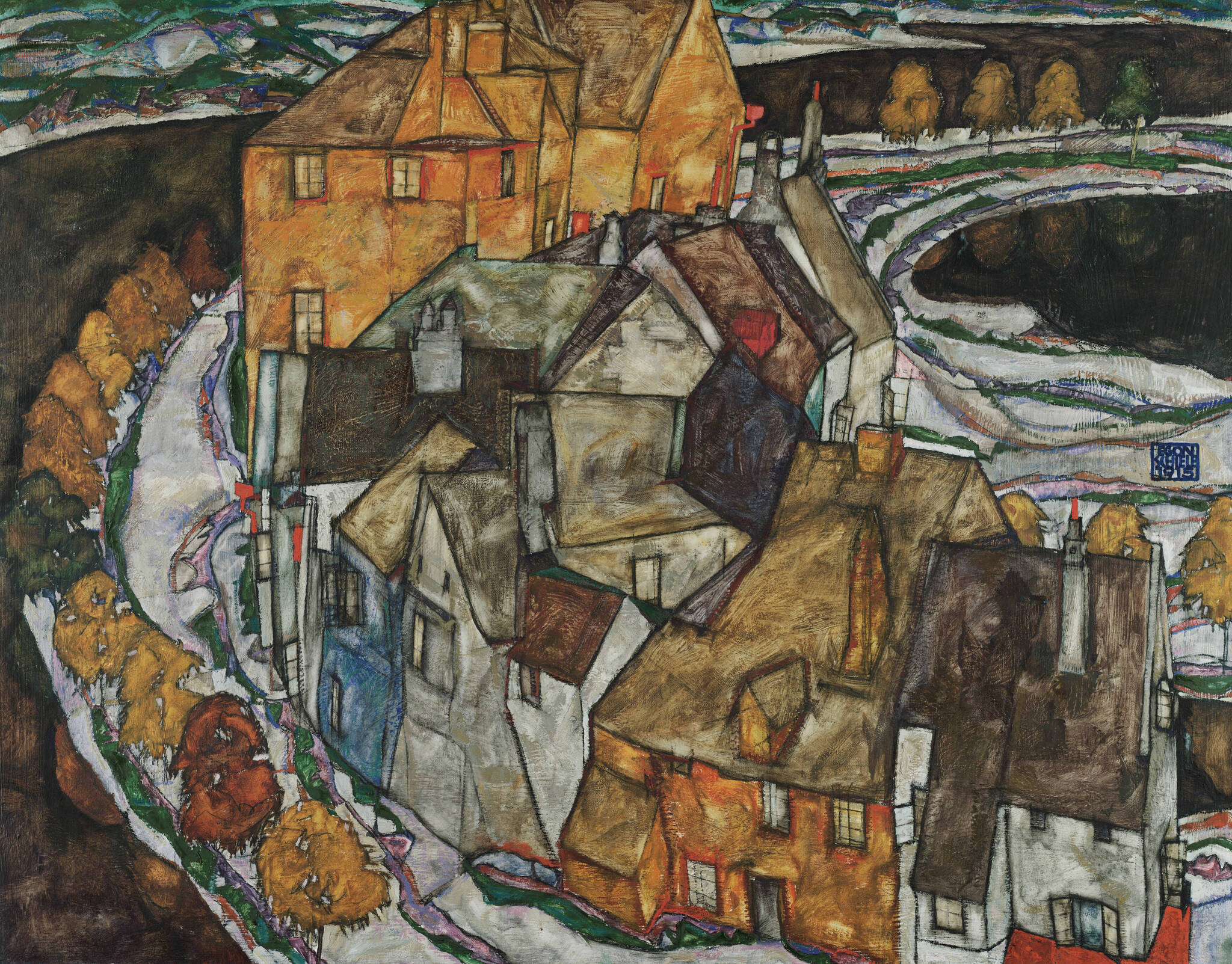
Crescent of Houses II is a 1915 painting by Egon Schiele: a dense arc of ochre, grey and brown houses curving up across the canvas, with autumn-coloured trees and a dark bend of river around them. The original, 140.5 x 110.5 cm, is in the Leopold Museum in Vienna. We paint it by hand in oils on canvas at the size you choose, and before dispatch we send you a photograph of the finished work for approval.
| Title: | Crescent of Houses II |
| Other titles: | Island Town · Der Häuserbogen II · Inselstadt |
| Painter: | Egon Schiele (1890–1918) |
| Year: | 1915, signed and dated centre right “EGON SCHIELE 1915” |
| Original size (width × height): | 140.5 cm x 110.5 cm |
| Original technique: | Oil on canvas |
| Style: | Expressionism |
| Location: | Leopold Museum, Vienna (inv. 456) |
| Our reproduction: | hand-painted oil on canvas, 6 sizes from 45 x 35 cm to 160 x 126 cm, or a made-to-measure size |
Crescent of Houses II – Egon Schiele
What does the painting show?
The houses of a small town press together in a curve that rises from the lower right towards the upper left: tall ochre and orange fronts with small dark windows, steep roofs in grey, brown and olive, a few white chimneys and here and there a patch of red between the gables. On the left a pale band winds along, edged with green and violet and lined with round trees in yellow, orange and rust red. At the upper right, behind the houses, dark water curves round, framed by broad white, grey and green stripes, and along the top edge more yellow trees stand in a row. The Austrian painter signed and dated the work at the centre right, in a small square block of letters: EGON SCHIELE 1915. The outlines are drawn in dark paint, and the surfaces are filled with loose, scrubbed strokes.
Why do people love it?
Because the town looks alive. The houses lean, overlap and crowd together like a living thing rather than a map, and the curve pulls the eye from the orange houses at the bottom up to the tall block at the top. The colours are autumn colours, ochre, rust and grey, set against white bands and almost black water, so the surface stays warm without turning heavy. Every roof has a different shape, and no two windows sit quite alike.
Where does it sit among Schiele’s works?
Among his views of Krumau (Český Krumlov), the small South Bohemian town on the Vltava where Schiele’s mother was born and to which he returned again and again in his work. The same interest in a town seen from above or across the water runs through Krumau on the Vltava (The Small Town IV), Houses on the River (The Old Town) and Town among Greenery (The Old City III). The full selection is in the Egon Schiele gallery, and there is more on his life in our article about Egon Schiele.
How is our hand-painted version made?
Each copy is a hand-painted painting made for your order, not a print: a painter builds it up in oils, stroke by stroke. Like the original, our copy is oil on canvas. The hard part here is the number of different houses: every roof and wall has its own shade of ochre, grey or brown, and they have to stay distinct while still reading as one curving mass. The dark outlines and the small signature block on the right then have to sit as they do in the original. When the work is finished we photograph it and send you the photograph for approval, and only then does it ship. We have not yet photographed this work in our workshop; photographs will be added to this page once we have them.
Which size for which wall?
The original measures 140.5 x 110.5 cm, so it is a large work, and our 140 x 110 cm comes closest to its scale. In a living room above a sofa or a sideboard, 90 x 70 cm or 120 x 95 cm lets the crowd of houses read clearly from across the room; 140 x 110 cm or 160 x 126 cm suits a large wall, a dining room or an open-plan space. For a hallway, a study or the wall above a desk, 45 x 35 cm or 70 x 55 cm gives a smaller, compact version of the town. A canvas painting with this many warm browns likes a light wall and even light. Hang it with the centre at eye level, about 145–150 cm from the floor.
Custom size, stretcher bar and frame
If none of the six sizes suits your wall, we paint the work to your own measurement. If you choose “YES” under the Stretcher option, the canvas comes stretched on a wooden stretcher bar, ready to hang. Our 3D application is for choosing a frame only. The frame is chosen separately and need not be part of the order.
Delivery and guarantee
We paint to order and deliver to sixteen countries in the European Union, among them Slovenia, Croatia, Austria, Italy, Hungary, Germany and France; the United Kingdom and Ireland are not currently among them. The work arrives protectively packed and, if you chose “YES” under Stretcher, stretched on a stretcher bar. Before dispatch we send you a photograph of the finished work to approve. Production time depends on the size and on the studio’s workload. Every order is covered by our Returns and Refund Policy.
Frequently asked questions
Which town does it show?
Krumau, today Český Krumlov, the small town in South Bohemia where Schiele’s mother was born. According to the Leopold Museum, this curving row of houses can be seen clearly from the castle hill. Schiele did not copy the view exactly: he changed the shapes of the buildings to give the mass of houses more variety.
Does it have other titles?
Yes. The museum also lists it as Island Town, in German Inselstadt, and its German title is given in the table above. In the 1952 purchase contract, when Rudolf Leopold acquired it, the work was called “Bogenförmiges Stadtende”, roughly “arched end of town”.
Is there a study for it?
Yes, the Leopold Museum mentions a preparatory sketch of 1914. For the painting Schiele left out the group of houses in the background, the bridge and the opposite bank with the Church of Saint Judoc, so that the curve of houses stands out more strongly.
When did Schiele paint it?
In 1915, the year he turned twenty-five. He signed and dated it at the centre right with EGON SCHIELE 1915, written in a small square block of letters.
Who owned it before the Leopold Museum?
The first owner was Heinrich Böhler, who kept it from 1915 to 1940. It then belonged to Mabel Böhler until 1952, when Rudolf Leopold acquired it, and in 1994 it passed to the Leopold Museum Private Foundation.
Does it work as a gift?
Yes; if you are unsure which size to choose, there is a gift voucher.