


Description
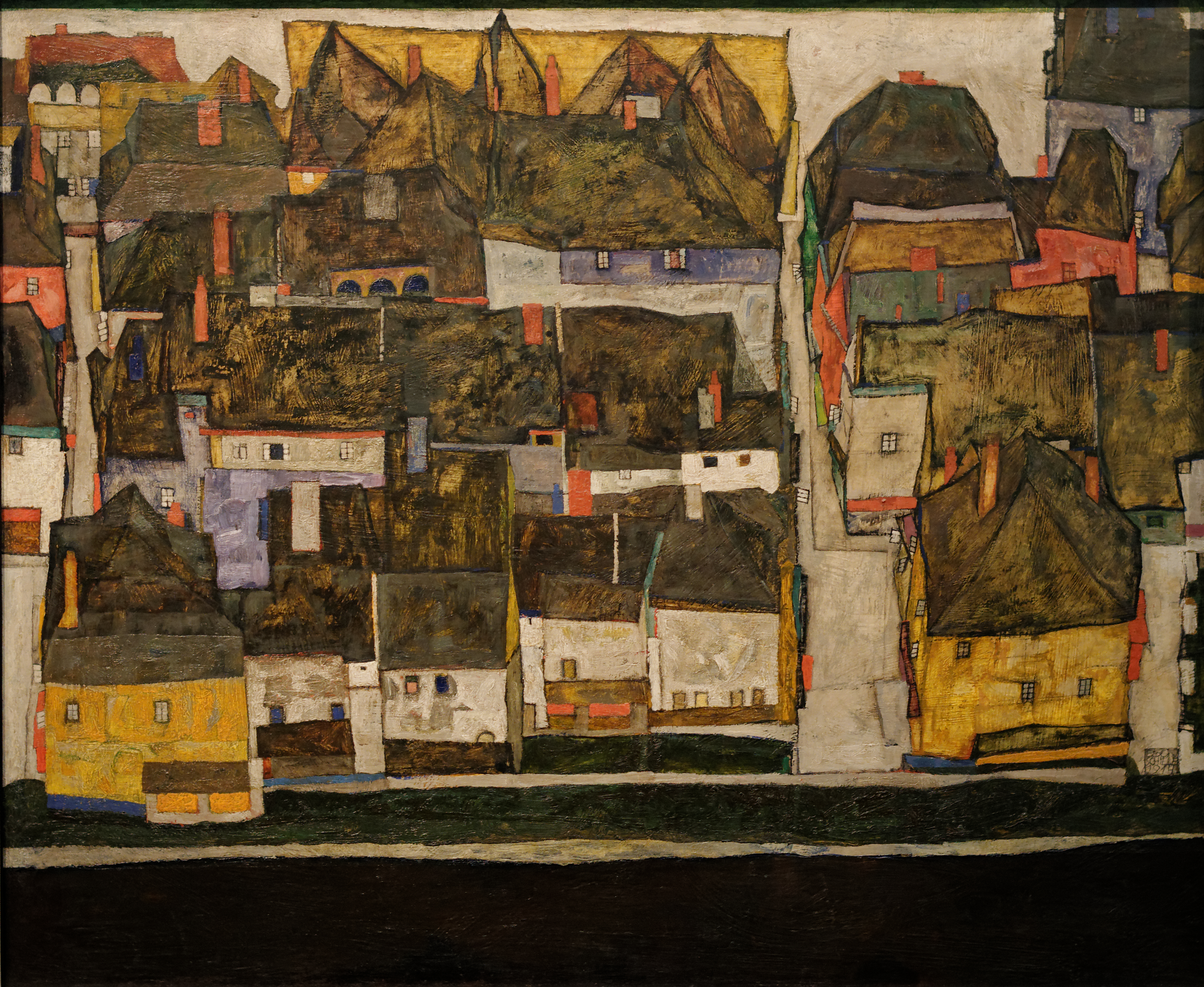
Krumau on the Vltava (The Small Town IV) is a work of 1914 by Egon Schiele: the densely packed houses of an old town seen from above, with dark roofs, small windows and a band of river along the lower edge. The original is in the Leopold Museum in Vienna under inventory number 655; it measures 120.5 x 99.5 cm. We make it as a hand-painted oil painting on canvas, in fifteen sizes or to your own measurement, and we send you a photograph of the finished work for approval before it ships.
| Title: | Krumau on the Vltava (The Small Town IV) |
| Other titles: | Krumau an der Moldau („Die kleine Stadt“ IV) · Krumau ob Vltavi (Mestece IV) |
| Painter: | Egon Schiele (1890–1918) |
| Year: | 1914; signed and dated lower right in black chalk “EGON SCHIELE 1914” |
| Original size (width × height): | 120.5 cm x 99.5 cm |
| Original technique: | Oil and black chalk on canvas |
| Style: | Expressionism |
| Location: | Leopold Museum, Vienna (inv. 655) |
| Our reproduction: | hand-painted oil on canvas, 15 sizes from 43 x 35 cm to 205 x 164 cm, or a made-to-measure size |
Krumau on the Vltava (The Small Town IV) – Egon Schiele
What does the work show?
A town with no sky. Houses fill almost the whole surface, pressed against and above one another: broad dark roofs in browns and olives, crossed by dense, visible brushstrokes, red chimneys between them, and below them façades in white, grey, lilac and ochre with small dark windows. In the upper left quarter one house opens into three round arches. Right of centre a narrow pale strip runs downwards, the only gap between the blocks, and to its right stands a larger ochre-yellow house; the house at lower left is the same colour. Beneath the houses runs a dark green band, below it a white line, and at the very bottom a broad, almost black band that takes up about a sixth of the height. There is no one in the scene.
Which town is it?
Krumau, today Český Krumlov in the Czech Republic. The museum record is more precise: Schiele painted the houses that stand opposite the castle hill in Krumau, and caught them from an extreme top view. The record lists a river among its keywords, and the title names it: the Vltava. That the dark band along the lower edge is that river is our inference from the title; the museum does not describe the band.
Why does the town look so flat?
Because it is meant to. Per the museum record, the work is considered a prime example of the flat composition that can be seen in Schiele’s work from 1913 onwards. He subjected the landscape of houses to a scheme organised along horizontals and verticals, so roofs and walls stack up as planes, without depth. That is the reading of the museum that holds the work, and we give it as theirs.
Are the colours of the houses real?
Partly not. Per the record, Schiele takes up again the variety of colour of The Small Town III from 1913, and lets the façades and windows below the brown-glazed roofs shine in sunny yellows, blues and whites that are in part purely invented. That work is in the Leopold Museum too.
What lies beneath the painting?
Another Schiele. Per the museum record, when the canvas was relined in the 1960s, Rudolf Leopold (1925–2010) discovered that Schiele’s painting Melancholia (Weltwehmut), believed lost, is hidden beneath this horizontal townscape: a nude self-portrait combined with a view of Krumau, from 1910. Why Schiele decided to paint over it, and so destroy it, is not known.
What is the original painted on?
On canvas, in oil and black chalk. That is what the museum record gives, and the signature at lower right is in black chalk too. Our reproduction is painted in oils on canvas. We do not present those as the same thing: oil with chalk on canvas and oil on canvas are not the same technique, and we name the difference.
Is the format upright or horizontal?
Horizontal. Our steps follow it in a landscape format, from 43 x 35 cm to 205 x 164 cm, with the width given first.
Can I have it at the size of the original?
Not exactly. The nearest step is 120 x 95 cm: half a centimetre narrower and 4.5 cm lower than the canvas, which measures 120.5 x 99.5 cm. The original’s ratio of sides is 1 : 1.21. Four steps come closest to it, each within one centimetre: 43 x 35 cm, 60 x 50 cm, 110 x 90 cm and 140 x 115 cm. At 80 x 65 cm and 50 x 40 cm the difference is just over a centimetre, and the other nine are lower by 2.3 to 5.3 cm. For the original’s size, choose a made-to-measure size.
Where does the work come from and where is it now?
This page carried no provenance note before, and we say so openly. What follows is the chain as the museum publishes it: Maria Hora, Vienna, 1914–1949; Brigitte Grill, née Hora, Vienna, undated; Rudolf Leopold, Vienna, 1959–1994; and from 1994 the Leopold Museum Private Foundation. The reading of it is ours. The chain begins in the year the work was painted. For Brigitte Grill the record gives no dates, and it does not say how she was related to Maria Hora; we do not assume it. Leopold’s purchase is documented by a contract of 28 May 1959, kept in the museum’s archive as a transcript of a shorthand record. The sources also list a dossier by Sonja Niederacher of 30 April 2011, Otto Nirenstein’s monograph of 1930 (no. 144), and the catalogue of the memorial exhibition for the thirtieth anniversary of Schiele’s death, held in October and November 1948 (no. 39; Neue Galerie archive at the Belvedere). The work is today in the Leopold Museum under inventory number 655.
Where does this work sit among Schiele’s works?
Among his views of houses and towns. From the same year is Houses by the Sea, an oil on canvas of almost the same size in the same collection; a year later came House Wall on the River, and a year earlier Setting Sun. The full selection is in the Egon Schiele gallery, with more on his life in our article about Egon Schiele; the museum’s holding is on the Leopold Museum’s Egon Schiele page. Schiele was a younger contemporary of Gustav Klimt, and the Vienna Secession was the milieu he came out of; Viennese Expressionism is the movement he helped define, and Austrian art of the period is still read through those two names. As an expressionist painting it shows not the people of a town but its construction out of planes.
How is our hand-painted version made?
Every canvas is painted by an artist in oils, stroke by stroke – not a machine impression but a hand-painted copy made for your order. Two things are hardest here. The first is the roofs: they are not a flat brown but dense hatched strokes, and if the painter smooths them the town loses its weight. The second is the rhythm of the windows and pale façades, which holds the composition in balance, so each has to sit where it is. When the work is finished we photograph it and send you the photograph for approval, and only then does it ship. We hold no studio photographs of this work yet – it has not been photographed in our workshop, and nothing has been removed; when it is next painted, the images will be added here. As a canvas reproduction it arrives stretched on a wooden bar, ready to hang.
Which size suits which wall?
Short answer: a wide wall, because the town needs room to spread sideways. Above a desk or in a narrow hallway 60 x 50 cm or 70 x 55 cm is enough; above a sofa or sideboard 100 x 80 cm or 110 x 90 cm; in a living room with a high ceiling 140 x 115 cm and up to 205 x 164 cm. Our smallest size, 43 x 35 cm, suits a niche or a shelf. As a canvas painting full of detail, this motif opens up with size: at the larger steps you can read it house by house.
How do I order a made-to-measure size, stretcher bar and frame?
If none of the fifteen sizes suits your wall, we paint the work to your own measurement. The canvas comes stretched on a wooden bar; our 3D application is for choosing a frame only, not for showing the work on your wall. The frame is chosen separately and need not be part of the order.
How is it delivered and what do we guarantee?
We paint to order and deliver to sixteen countries in the European Union, among them Germany, France, Italy, the Netherlands and Poland; the United Kingdom and Ireland are not currently among them. Before dispatch we send you a photograph of the finished work for approval, and if you are not satisfied we correct the work or paint it again. Production time varies with the size and the studio’s workload.
Frequently asked questions
Which town is Krumau on the Vltava?
Krumau, today Český Krumlov in southern Bohemia, in the Czech Republic. According to the Leopold Museum, Schiele painted the houses that stand opposite the castle hill, seen from an extreme top view. The Vltava named in the title flows through the old town.
Why did Schiele paint Krumau so often?
Krumau was his mother’s birthplace, and he felt closer to it than to any other town he visited. He first stayed there in 1910 and moved there with Wally Neuzil in 1911, until the townspeople’s disapproval drove the couple out. He came back to its houses and river again and again, from the Dead City pictures of 1910–1911 to this work of 1914.
When did Schiele paint Krumau on the Vltava?
In 1914; it is signed and dated lower right in black chalk “EGON SCHIELE 1914”. It is oil and black chalk on canvas, 120.5 x 99.5 cm, and it is the fourth of his Small Town pictures. The Small Town III of 1913, whose varied colours it takes up again, is in the Leopold Museum too.
What is hidden beneath Krumau on the Vltava?
Another Schiele: his Melancholia (Weltwehmut) of 1910, a nude self-portrait combined with a view of Krumau, long believed lost. Rudolf Leopold discovered it when the canvas was relined in the 1960s. Why Schiele painted over it is not known.
Where is Krumau on the Vltava today?
In the Leopold Museum in Vienna, under inventory number 655. It belonged to Maria Hora from 1914, was bought by Rudolf Leopold in 1959 and has been part of the Leopold Museum Private Foundation since 1994.
Does it work as a gift?
It does; if you are unsure which size to choose there is a gift voucher.
- Subject: the houses of old Krumau from above, dark roofs, small windows and a dark band of river.
- Original: 1914, oil and black chalk on canvas, 120.5 x 99.5 cm, signed lower right, Leopold Museum, Vienna, inv. 655.
- Ours: hand-painted in oils on canvas, 15 sizes or a made-to-measure size.
- Worth knowing: per the museum, Schiele’s Melancholia of 1910 lies painted over beneath it.