







































Description
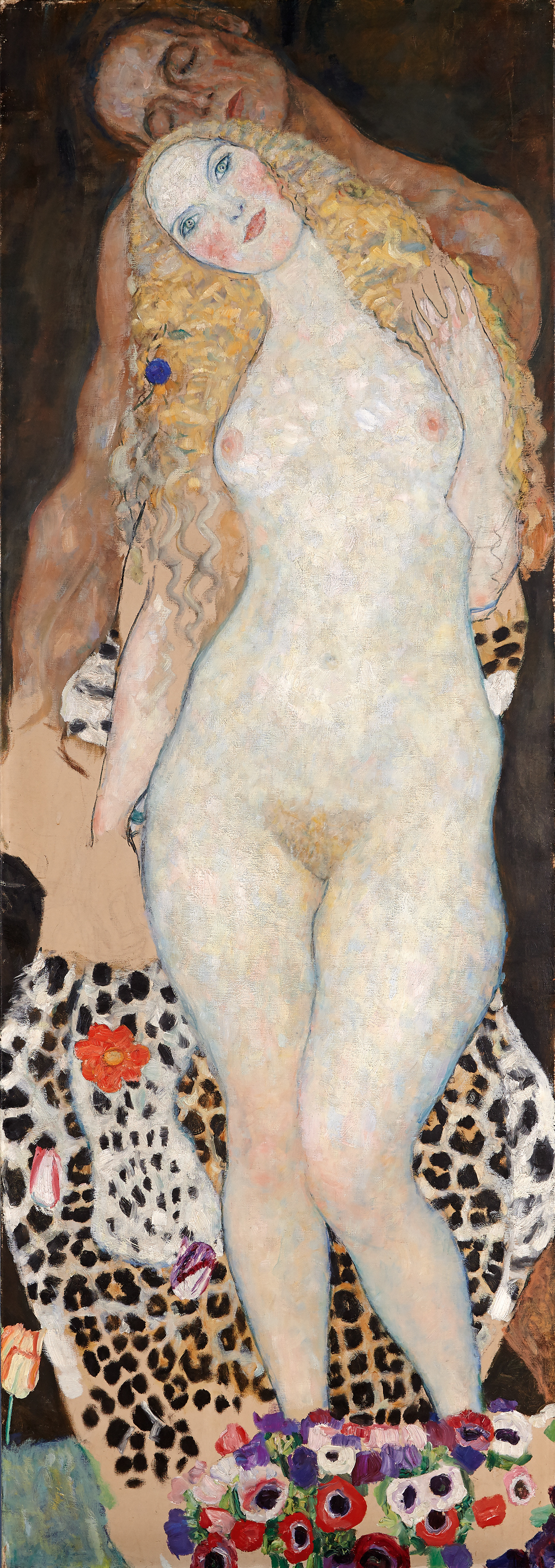
Adam and Eve is one of the last paintings Gustav Klimt worked on, between 1916 and 1918, and it was found unfinished in his studio when he died: on a very tall, narrow canvas a pale, nude Eve stands facing you, her golden hair falling over her shoulders, while the darker Adam leans his head against hers with his eyes closed. The original is in the Belvedere in Vienna. We paint it by hand in oil on canvas, in eight tall sizes from 30 x 90 to 90 x 260 cm or made to measure, and send you a photograph of the finished work for approval before dispatch.
| Title: | Adam and Eve |
| Other titles: | Adam und Eva · Adamo ed Eva |
| Painter: | Gustav Klimt (1862–1918) |
| Year painted: | 1916–1918 |
| Original size: | 173 cm x 60 cm |
| Original technique: | Oil on canvas, unfinished |
| Painting style: | Viennese Modernism, late work |
| Located at: | Belvedere, Vienna (inv. 4402) |
| Our reproduction: | Hand-painted oil on canvas, eight tall sizes or made to measure |
Adam and Eve – Gustav Klimt
What does the painting show?
Adam and Eve shows the first couple of the Bible as two nude figures, one behind the other, on a very tall and narrow canvas. Eve stands in front, facing you almost at full length. Her skin is pale, her head is tilted, her eyes are light blue and her lips red, and long, wavy golden hair falls over her shoulders. She stands in contrapposto, with her weight on one leg, and raises one hand towards Adam behind her. A dark contour encloses the soft forms of her body.
Adam is darker, with brown skin and a muscular build, and he is half hidden behind her in the upper part of the canvas. His eyes are closed and his head leans on hers, repeating its tilt. Behind Eve’s legs lies a leopard skin with black, ochre and white spots and a red flower on it, and at her feet runs a band of anemones in red, white, violet and blue. The background is dark. It is a nude, and we describe it plainly, as a museum label would.
Why was Adam and Eve left unfinished?
Because Klimt did not live to finish it. He worked on the painting from 1916 to 1918, and it is one of his last works. When he died in Vienna in February 1918, it was among the paintings found unfinished in his studio. The canvas is unsigned. Some parts are only sketched in, while others, above all Eve’s pale skin, are worked with great subtlety.
It shows Klimt at work: you can see how far he took each passage and where he stopped. Our hand-painted version reproduces the painting as it is, unfinished parts included; we do not complete what Klimt left open.
What does the painting mean?
Klimt rarely took up biblical subjects, and here, according to the Belvedere, he was not interested in the traditional story of the Fall of Man – the apple, the serpent and the expulsion from Paradise. He focused on Eve as the quintessential woman. Adam has closed his eyes, intoxicated with love, and nestles tenderly against her, tilting his head like hers. Eve, by contrast, looks straight at us.
The details carry the meaning. The anemones on the ground are emblems of fertility, and the leopard skin was, in ancient Greece, a symbol of unbridled desire. The Belvedere reads the painting so that in Klimt’s version it is Eve, not the snake, who is the temptress.
Where is the original?
The original belongs to the Belvedere in Vienna, under inventory number 4402, and the museum lists it in the Upper Belvedere. It is painted in oil on canvas, measures 173 cm in height and only 60 cm in width, and is unsigned. Before you plan a visit, check the Belvedere’s online collection to see whether it is on display.
Adam and Eve among Klimt’s works
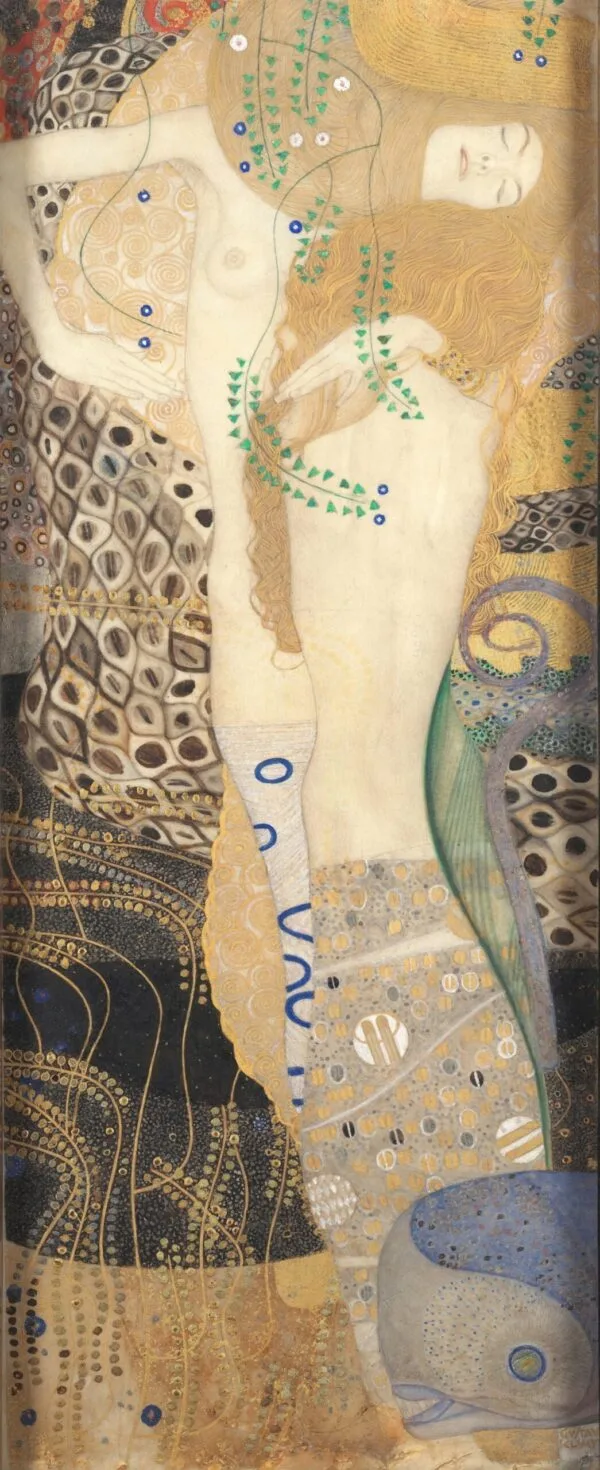
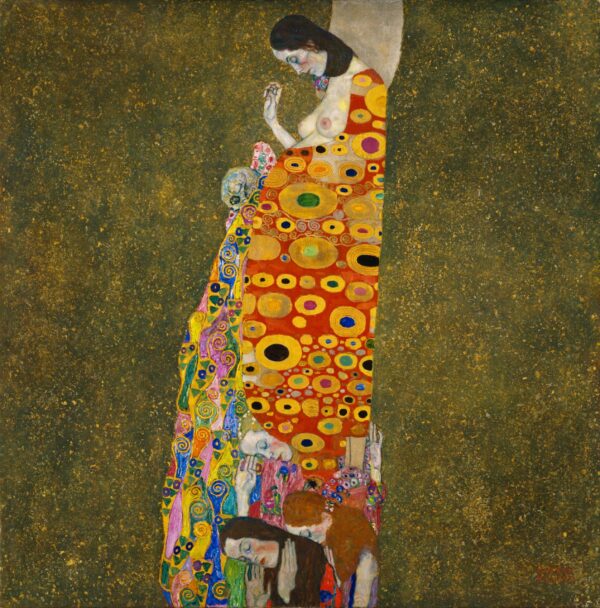
In our gallery Adam and Eve has relatives among the works in which Klimt painted the human body, love and the cycle of life. Its closest relative is The Bride: it too was left unfinished at his death. Death and Life sets a group of entwined sleeping figures beside the figure of Death, Hope I shows a pregnant woman in profile, and Danae the princess of myth, curled up as Zeus comes to her as a shower of gold.
Choose Adam and Eve if you want a tall, narrow painting with two figures and a strip of flowers, in calm, warm and dark tones and without gold; if you want a large group of figures, Death and Life suits you better, for a single figure Hope I, and for Klimt’s gold Danae. More about Klimt’s life is on Wikipedia’s Klimt page.
How do we paint Adam and Eve by hand?
The painter first draws the two figures on the canvas with a grid, so that Eve’s pose, the tilt of both heads and the band of flowers at the bottom sit exactly where Klimt placed them on the tall format. Then the dark background goes on, in thin, even layers, followed by the leopard skin with its black, ochre and white spots.
Eve’s skin is the heart of the work. The flesh tones are mixed by hand, layer over layer, so that her pale body gains soft volume within its dark contour, and the golden-blond curls are laid in with fine brushes. Adam is painted in warmer, darker browns, so that the two bodies stand apart as they do in the original. A print would flatten exactly this; in our oil painting reproduction, painted by hand, every transition in the skin is a real layer of paint. Every painting is a hand-painted copy made for your order, so no two are quite alike.
Where Klimt left the canvas unfinished, we leave it unfinished too: the sketched passages are painted as sketches. There is no gold in this painting, and none in our version – we use oil colours only, as Klimt did.
Which size for which wall?
In short: 30 x 90 or 40 x 110 cm for a narrow wall beside a door or between two windows; 50 x 140 or 60 x 173 cm for a hallway, a study or a library wall; 70 x 200 or 75 x 210 cm for a high wall in a living room; and 80 x 230 or 90 x 260 cm for a staircase, a gallery or a room with a high ceiling. The 60 x 173 cm size is the size of the original.
All eight sizes are tall and narrow, like Klimt’s canvas, which is 173 cm high and 60 cm wide – almost three times as high as it is wide. Most sizes keep that proportion almost exactly; at 30 x 90 and 40 x 110 cm it differs slightly, so the margin around the figures changes a little. As a painting for the living room, 70 x 200 cm gives the two figures real presence on a wall beside a sofa or a bookcase.
Before you order one of the largest sizes, measure the height of your room: 80 x 230 and 90 x 260 cm need a ceiling well above the usual height, or a staircase wall. Because it is a nude, think about where it will hang: it is at home in a hallway, a study, a library, a stairwell or on a collector’s wall. Hang the smaller sizes with the centre of the canvas about 150 to 160 cm above the floor; the tallest sizes are best hung with the lower edge 20 to 40 cm above the floor or above low furniture.
Custom size, stretcher and frame
If none of the eight sizes fits your wall, we paint it to measure; keep the width at roughly a third of the height, so that both figures and the band of flowers keep their place in the composition. Send us the width and height you want and we will quote the price and delivery time. Every painting we make is stretched on a wooden stretcher frame and ready to hang.
For the frame, use our 3D application: it shows every one of our frame profiles on this subject, so you can compare gold, silver, black, white and natural wood before deciding – the application is for choosing the frame only. If you would like to see how the painting will look on your own wall, that is our separate room placement service. A thin dark wood or black frame suits the dark background and keeps the narrow format calm; an old-gold frame picks up the golden hair and the ochre of the leopard skin.
Delivery and guarantee
Every painting is made to order in our studio in Slovenia, so allow 15 to 45 days depending on the size you choose. We ship it stretched and protected for transport, framed if you chose a frame, across the EU with no customs. Before dispatch you receive a photograph of the finished work to approve; if anything is not right, we correct it while the canvas is still in our workshop. Our returns policy applies to every order.
If it is a gift and you are not sure of the size, there is our gift voucher. More of Klimt’s work is in our Gustav Klimt gallery, and more about the painter in our article 10 interesting facts about Gustav Klimt.
Frequently asked questions
Where is Klimt’s Adam and Eve?
The original is in the collection of the Belvedere in Vienna, inventory number 4402, listed in the Upper Belvedere. It is oil on canvas, 173 x 60 cm, painted between 1916 and 1918, unsigned and left unfinished. Check the online collection before a visit. Our versions are painted by hand from it, to order.
Why is Klimt’s Adam and Eve unfinished?
Because Klimt died before he could finish it. He worked on it from 1916 to 1918, and it is one of his last works: at his death in February 1918 it was among the paintings found unfinished in his studio. Some parts are only sketched in. Our hand-painted version shows it exactly as it is, without completing the open passages.
What does Klimt’s Adam and Eve mean?
According to the Belvedere, Klimt was not interested in the traditional Fall of Man but in Eve as the quintessential woman. Adam closes his eyes, intoxicated with love, while Eve looks straight at us. The anemones are emblems of fertility and the leopard skin a symbol of unbridled desire; in this reading Eve, not the snake, is the temptress.
What does Adam and Eve by Gustav Klimt show?
It shows a nude Eve standing in front and looking at you, with long golden hair, light blue eyes and red lips, and behind her the darker Adam with closed eyes, his head resting on hers. Behind Eve’s legs lies a leopard skin with a red flower, and at her feet runs a band of coloured anemones. The background is dark and some parts are unfinished.
How big is the original Adam and Eve?
The original is 173 cm high and 60 cm wide, almost three times as high as it is wide. Our 60 x 173 cm size matches the original; the smaller sizes from 30 x 90 cm upwards are reductions, while 80 x 230 and 90 x 260 cm are larger than Klimt’s canvas. All eight sizes are tall and narrow.
Which size of Adam and Eve suits my wall?
For a narrow wall beside a door or between two windows, 30 x 90 or 40 x 110 cm works well. For a hallway or a study choose 50 x 140 or 60 x 173 cm, for a high wall in the living room 70 x 200 or 75 x 210 cm, and for a staircase or a high ceiling 80 x 230 or 90 x 260 cm. Measure the height of the wall first.
Which room suits Adam and Eve?
It suits a hallway, a study, a library, a stairwell or a collector’s wall, where a nude with two figures can be looked at calmly. As a canvas painting with a narrow format, it fits beside a door, between two windows or on a pillar. Its dark background goes well with dark wood and with white, grey or earth-coloured walls. Give it soft light from the side.
Is Adam and Eve a good gift?
Yes, especially for someone interested in Klimt’s late period, in Viennese Modernism or in how a painting comes into being, because the unfinished parts show the painter’s work. The story of one of his last paintings gives it something to tell. If you are not sure of the size, choose 50 x 140 cm, or give a gift voucher instead.
- Subject: a nude Eve with golden hair in front, Adam with closed eyes behind her, a leopard skin and a band of anemones at her feet.
- Original: 1916–1918, oil on canvas, unfinished, 173 x 60 cm, Belvedere, Vienna (inv. 4402).
- Our version: a Klimt reproduction painted by hand in oil on canvas, in eight tall sizes or made to measure.
- Good to know: before dispatch you receive a photograph of the finished work for approval.