







































Description
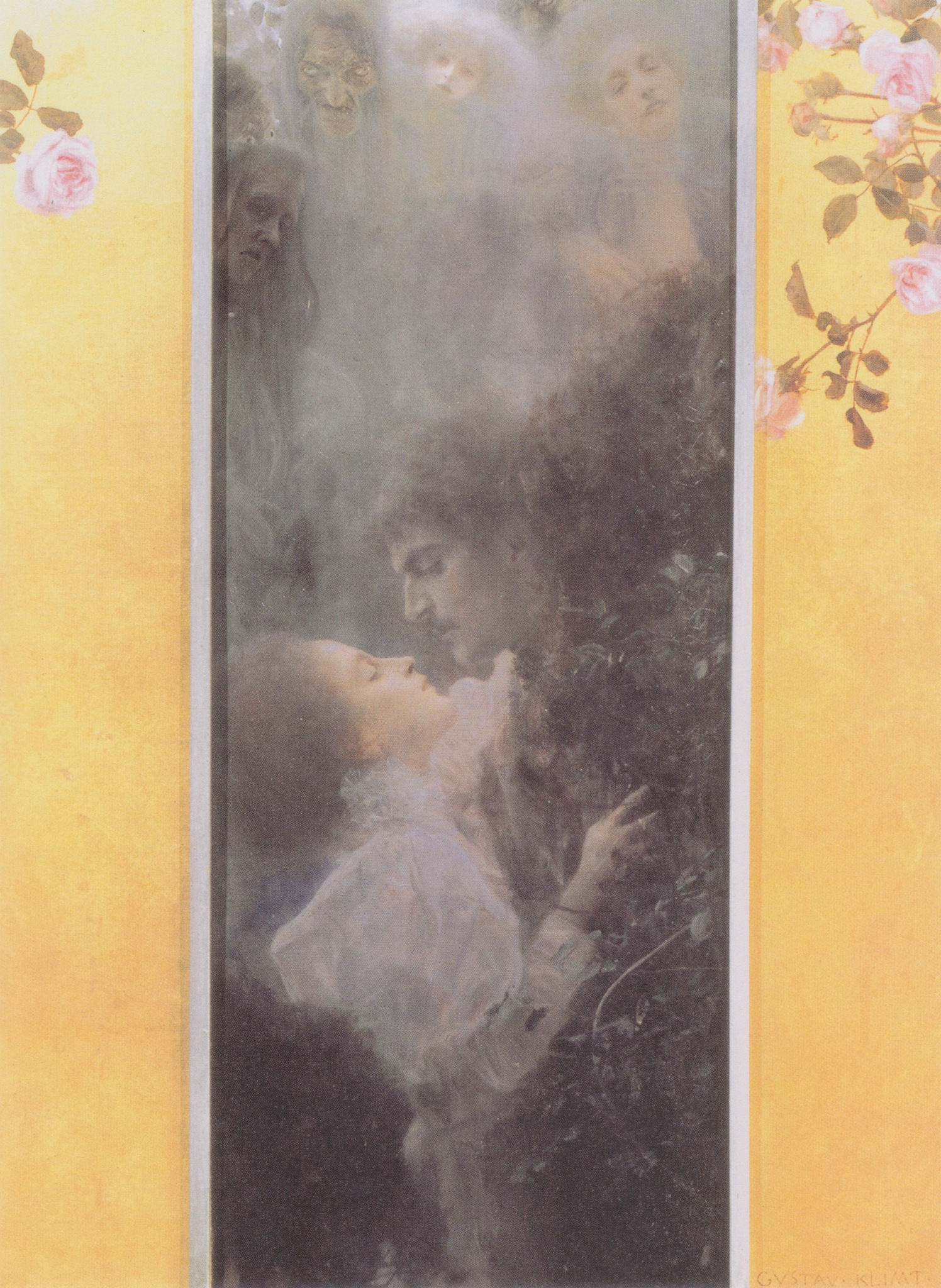
Love is a small, dreamlike painting from 1895: in a misty grey-blue panel a dark-haired man bends to kiss a young woman in a white dress, pale faces float above them in the haze, and narrow golden strips with pink roses frame the scene on both sides. Klimt painted it as a model for a book of allegories, and the original belongs to the Wien Museum in Vienna. We paint it by hand in oil on canvas, golden strips included, in four upright sizes from 60 x 80 to 120 x 160 cm or to your own measurement, and send you a photograph of the finished work for approval before dispatch.
| Title: | Love |
| Other titles: | Liebe · L’amore · Ljubezen |
| Painter: | Gustav Klimt (1862–1918) |
| Year painted: | 1895 |
| Original size: | 62.5 cm x 46.5 cm |
| Original technique: | Oil on canvas |
| Painting style: | Vienna around 1900, Symbolist allegory |
| Located at: | Wien Museum, Vienna (inv. 25005) |
| Our reproduction: | Hand-painted oil on canvas, golden side strips included, four upright sizes or made to measure |
Love – Gustav Klimt
What does the painting show?
In the middle of the painting a tall, narrow panel is filled with grey-blue mist. In it a dark-haired man bends over a young woman and is about to kiss her. She leans back into his arms with her eyes closed, and her white dress shines out of the soft greys around them.
Above the couple, pale faces float in the haze, barely more than shadows. To the left and right of the central panel run narrow golden strips decorated with pink roses, and these strips belong to the painting itself, not to its frame. Klimt signed it at the lower right, GVSTAV . KLIMT, followed by the year in Roman numerals.
Why does Love have golden strips with roses?
Klimt painted Love as a design for a printed plate, and he built it like a page: a misty scene in the middle, held between two decorative bands. The golden strips turn a small romantic moment into an ornament, a first hint of the way he later let figure and ornament meet in his golden paintings. Roses are the classic flower of love, so the border tells you the subject before you even look at the couple.
For a buyer this matters in one practical way: the strips are part of the work, so we paint them on the canvas together with the couple. Your painting therefore has its own painted border and looks finished even without a frame. A frame can still be added, and the golden strips then sit inside it like a second, inner frame.
What does Love mean?
Love is an allegory: not a portrait of two real people but an image of love itself. Klimt shows the moment just before the kiss, which is why the painting feels tense and tender at the same time. The mist around the couple separates them from the world; for that moment nothing else exists.
The faces above them are often read as the ages of life or as fate looking down on the lovers, a reminder that the moment will not last. Klimt does not explain them, and that openness is part of the appeal: you can see a purely romantic scene, or a quiet thought about time. A dozen years later he returned to the kiss in his most famous painting.
Where is the original, and how did it come about?
The original belongs to the Wien Museum, the museum of the city of Vienna, under inventory number 25005. It is a small canvas, only 62.5 by 46.5 cm. Klimt painted it in 1895 as the model for plate 46 of Allegorien, Neue Folge, a new series of the book of allegories published in Vienna by Gerlach & Schenk, which artists and craftsmen used as a source of motifs.
Eleven years earlier he had painted Idyll for the first series of the same publisher’s allegories, so the two works show how his style moved from academic painting towards the dreamy Vienna of 1900. More about the painter’s life is on Wikipedia. Our version is not a print of the museum piece: it is painted for you, by hand, at the size you choose.
Love among Klimt’s works
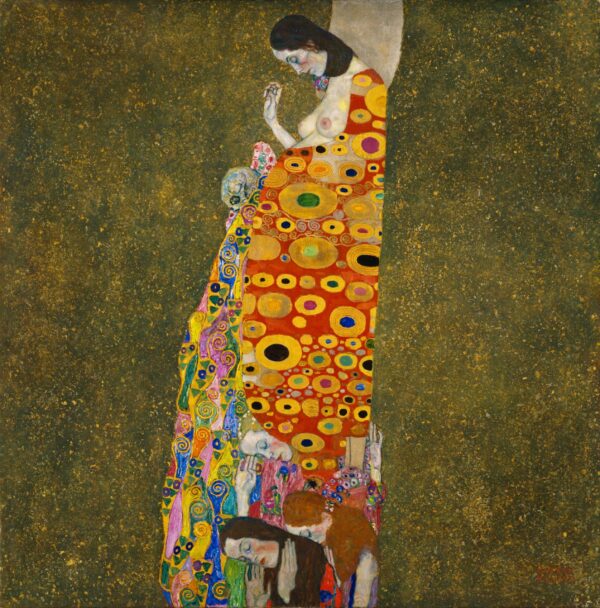
Love sits between two worlds, and our gallery lets you follow that path. It begins with Idyll of 1884, painted for the same publisher; three years after Love came Pallas Athena, often called the first work of his golden period; the kiss returns in The Kiss, and a woman surrounded by symbolic figures in Hope II.
Choose Love if you want a romantic Klimt that is quieter and more intimate than The Kiss: soft greys and white, warmed by gold and pink roses. Its upright format suits narrow walls, and its small, poetic scene works especially well in a bedroom. If you want the full glow of gold across the whole canvas, The Kiss is the stronger choice.
How do we paint Love by hand?
The painter starts by dividing the canvas into the central panel and the two side strips, so that the proportions match the original. The misty background goes on first in thin, soft layers of grey and blue, then the couple: the man’s dark hair, the woman’s face and her white dress. The pale faces above are added last and very thinly, so that they seem to dissolve into the mist.
Then come the golden strips. On our copy they are painted by hand in gold paint, never gold leaf, and the pink roses are painted over them stroke by stroke. A printed oil painting reproduction cannot show the difference between the soft mist and the shining gold; by hand, that contrast is the whole point. Every painting is a hand-painted copy made for your order, so no two are ever quite the same.
Which size for which wall?
Short answer: 80 x 100 cm above a sofa, a bed or a chest of drawers, 60 x 80 cm for a narrow wall or a smaller room, and 100 x 130 cm or 120 x 160 cm for a large wall. Even our smallest size is larger than the original, which measures only 62.5 by 46.5 cm.
There are four upright sizes: 60 x 80, 80 x 100, 100 x 130 and 120 x 160 cm, width first. They stay close to the original’s proportion of about three to four, so the central panel and the golden strips remain in balance. A painting for the living room should take up about two thirds of the width of the furniture below it; above a chest of drawers 120 cm wide, that is 80 x 100 cm. Because it is upright, Love also fits well between two windows or beside a door.
Hang it with the centre of the canvas about 150 cm above the floor, and 20 to 30 cm above a sofa or a headboard.
Custom size, stretcher and frame
If none of the four sizes fits your wall, we paint it to measure; keep it upright and close to three to four, so that the side strips are not squeezed. Send us the width and height you want and we will quote a price and a lead time. Every painting we make is stretched over a wooden stretcher and ready to hang.
For the moulding, use our 3D application: it shows every one of our frame profiles on this subject, so you can compare gold, silver, black, white and natural wood before deciding – the application is for choosing the frame only. If you would like to see how the painting will look on your own wall, that is our separate room placement service. A slim gold frame picks up the golden strips; a dark or white frame lets the painted gold do the work.
Delivery and guarantee
Every painting is made to order in our studio in Slovenia, so allow 15 to 45 days depending on the size you choose. We ship it stretched and protected for transport, framed if you chose a frame, across the EU with no customs. Before dispatch you receive a photograph of the finished work to approve; if anything is not right, we correct it while the canvas is still in our workshop. Our returns policy applies to every order.
If it is a present and you do not know the right size, there is a wall art voucher. Every other Klimt work we paint is in the Gustav Klimt gallery, and there is more on the painter in our article ten interesting facts about Gustav Klimt.
Frequently asked questions
Where is the original of Klimt’s Love?
The original belongs to the Wien Museum in Vienna, the museum of the city, under inventory number 25005. It is a small oil on canvas, 62.5 by 46.5 cm, signed at the lower right. Klimt painted it in 1895 as the model for plate 46 of Allegorien, Neue Folge, a book of allegories published by Gerlach & Schenk.
What does Klimt’s Love show?
It shows a dark-haired man bending to kiss a young woman in a white dress, who leans back with her eyes closed. The couple stands in a misty grey-blue panel, pale faces float above them, and narrow golden strips with pink roses run down both sides. It is a moment just before the kiss, painted almost like a dream.
What do the faces above the couple in Love mean?
Klimt never explained them, so there is no single answer. The faces are often read as the ages of life or as fate looking down on the lovers, a reminder that their moment will pass. That open meaning is part of why the painting stays interesting: you can see it as pure romance or as a quiet thought about time.
Are the golden strips part of Love, and is the gold real?
Yes, the golden strips with roses are part of the painting, not of the frame, so we paint them on the canvas. On our copy they are painted by hand in gold paint, never gold leaf, and the roses are added over them stroke by stroke. The gold catches the light and changes as you walk past.
When and why did Klimt paint Love?
Klimt painted Love in 1895, in his early thirties, as a model for a printed plate in a book of allegories by the Viennese publisher Gerlach & Schenk. Such books gave artists and craftsmen ready motifs. He had already painted Idyll for the same publisher in 1884, so Love shows how much his style had changed in eleven years.
How big is the original Love, and which size should I choose?
The original is small, 62.5 by 46.5 cm, so even our 60 x 80 cm is a little larger. For most rooms 80 x 100 cm above a sofa, bed or chest of drawers is the best choice. 60 x 80 cm suits a narrow wall, and 100 x 130 or 120 x 160 cm fills a large wall with the scene.
Which room does Love suit?
Love suits a bedroom best, and also a living room, a hallway or the wall between two windows. Its soft greys, white and gold go well with beige, grey and warm wood. Because the scene is quiet and intimate rather than loud, a canvas painting like this one brings a romantic, calm accent to a room without dominating it.
Is Love a good wedding or anniversary gift?
Yes, it is one of the most fitting Klimt paintings for a wedding, an engagement or an anniversary: a kiss, roses and gold, in a tender, unshowy form. It is less expected than The Kiss and fits many homes. If you are unsure of the size, choose 80 x 100 cm, or give a voucher so the couple can choose themselves.
What is the difference between Love and The Kiss?
Love is an early, small allegory from 1895: a misty grey-blue scene with a couple about to kiss, framed by golden strips with roses. The Kiss, painted a dozen years later, shows the embrace itself in a large square almost covered in gold. Choose Love for a softer, more intimate mood, and The Kiss for the full golden glow.
- Subject: a man bending to kiss a young woman in white, in a misty grey-blue panel framed by golden strips with pink roses.
- Original: 1895, oil on canvas, 62.5 x 46.5 cm, Wien Museum, Vienna.
- Ours: a Klimt reproduction painted by hand in oil on canvas, golden strips included, in four upright sizes or made to measure.
- Worth knowing: you receive a photograph of the finished work for approval before dispatch.