Description
Male Nude is a study that Gustav Klimt painted in 1883, as a student in Vienna: a bearded, dark-haired man stands unclothed in front of a grey-blue wall, his right knee resting on a stack of wooden crates covered with a pink-red cloth and his right forearm raised above his head. The Belvedere in Vienna counts it among Klimt’s earliest known paintings. We paint it by hand in oil on canvas, in seven upright sizes from 50 x 60 to 120 x 150 cm or made to measure, and send you a photograph of the finished work for approval before dispatch.
| Title: | Male Nude |
| Other titles: | Männlicher Akt · Nudo maschile |
| Painter: | Gustav Klimt (1862–1918) |
| Year painted: | 1883 |
| Original size: | 68 cm x 54.8 cm |
| Original technique: | Oil on canvas |
| Painting style: | Historicism, academic nude study |
| Located at: | Belvedere, Vienna (inv. 5992) |
| Our reproduction: | Hand-painted oil on canvas, seven upright sizes or made to measure |
Male Nude – Gustav Klimt
What does the painting show?
Male Nude shows a single model in a bare studio. A bearded man with dark hair, fully unclothed, faces the viewer. He stands on his left leg and rests his right knee on a stack of plain, light wooden crates covered with a pink-red cloth; his left hand lies on the top crate, and his right forearm is raised above his head, as if to ward off a blow. Behind him runs a grey-blue wall with a deep red band, a red drape hangs at the left, and the floor beneath him is pale and rounded.
The light comes softly from the left. It models the shoulders, chest, arms and legs in realistic flesh tones and leaves the right side of the body in gentle shadow. There is no story, no landscape and no ornament – only a body, a few crates and a wall, painted with the calm attention of a life class. It is a frank academic nude, and we present it the way a museum would: plainly, as a study of anatomy, weight and light.
Why did a student paint an academic nude in 1883?
Because painting the nude model was the core of academic training. In 1883 Klimt was about twenty and a student in the decorative painting class of the Imperial and Royal School of Arts and Crafts (Kunstgewerbeschule) in Vienna. According to the Belvedere, this gave him access to the academic training of a history painter – the painter of large scenes from myth, religion and history, who had to be able to draw and paint the human body in any position.
Works like this one were not made to be sold. They were practice pieces: the student set up the model, observed how the weight rests on one leg, how the muscles tense under a raised arm and how the light runs over the skin, and painted it all as accurately as he could. The Belvedere calls Male Nude a prime example of this academic teaching and one of the earliest known paintings by Klimt.
What does the pose of the model mean?
The pose is not a chance one. With his right hand raised in a defensive position, the model recalls the warriors carved on ancient battle sarcophagi, the stone coffins of Roman times decorated with fighting figures. Academic teaching worked with classical formulas of this kind: a student learned the poses of antiquity and then tested them against a living body.
The Belvedere notes that Klimt studied this classical formula as naturalistically as possible. Instead of an idealised marble hero, he painted a real man with a beard, real skin and real weight, kneeling on ordinary crates in a plain room. That tension between an ancient gesture and a sober, everyday studio is what makes the study more than an exercise: you see the young painter checking the old models of art against what his own eyes actually saw.
Where is the original?
The original belongs to the Belvedere in Vienna, under inventory number 5992. It is painted in oil on canvas, measures 68 cm in height and 54.8 cm in width, and is signed at the lower right “G Klimt.” At present it is not on display, so if you plan a visit, check the Belvedere’s online collection first.
Male Nude among Klimt’s works
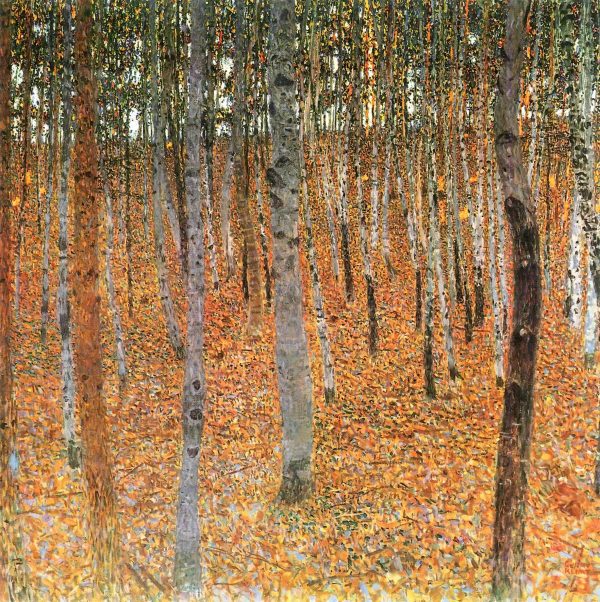
In our gallery Male Nude has relatives from the same early years and from much later. Fable (1883) and Idyll (1884) show how Klimt soon put this training to use: nude figures, studied from life, placed in allegorical compositions. Forest Floor is a small oil sketch of woodland ground from around 1881/82, another exercise of the student years, and Pallas Athena from 1898 shows where he had arrived fifteen years later: a goddess in golden armour, in the bold style of the Vienna Secession. From the same year, 1883, comes Sitting Nude Man Turned to the Left in the Leopold Museum, a quieter study of a young model seated on two crates.
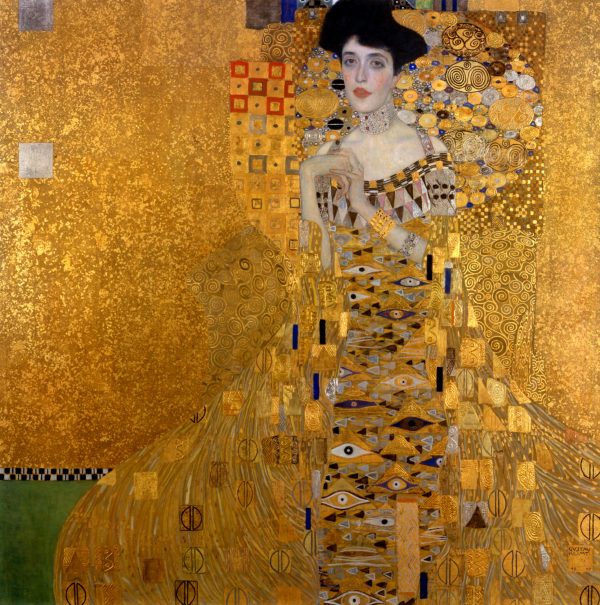
Choose Male Nude if you want a single figure, painted in a sober, realistic academic manner, with warm flesh tones against cool grey-blue and red; if you would rather have a story with several figures, Fable or Idyll suits you better, if you want nature, Forest Floor, and if you want Klimt’s gold, Pallas Athena. More about Klimt’s life is on Wikipedia’s Klimt page.
How do we paint Male Nude by hand?
The painter first draws the figure on the canvas with a grid, so that the proportions of the body, the angle of the raised arm and the stack of crates sit exactly where Klimt placed them. Then the background goes on: the grey-blue wall, the deep red band, the drape on the left and the pale floor, in thin, even layers.
The figure is built up slowly, from the shadows towards the lights. The flesh tones are mixed by hand from warm and cool colours, layer over layer, so that the chest, the arms and the legs gain volume in the soft light from the left, as in an academic study. A printed oil painting reproduction would flatten exactly what this study is about – the modelling of a body by light; painted by hand, every transition in the skin tone is a real layer of paint. Every painting is a hand-painted copy made for your order, so no two are quite alike.
There is no gold in this study, and none in our version: we use oil colours only, as Klimt did.
Which size for which wall?
In short: 50 x 60 or 63 x 79 cm for a study, a hallway or a narrow wall; 70 x 90 or 80 x 100 cm above a desk or a chest of drawers; 90 x 110 or 100 x 125 cm for a larger wall in a library or a living room; and 120 x 150 cm for a high room or a collector’s wall. The 80 x 100 cm size has the 4 : 5 proportion that comes closest to the original.
All seven sizes are upright, like Klimt’s canvas. The original is 68 cm high and 54.8 cm wide, so 50 x 60 cm is a little smaller than it, and all the other sizes are larger. 80 x 100, 100 x 125 and 120 x 150 cm, and almost exactly 63 x 79 cm, keep the 4 : 5 proportion; at 50 x 60, 70 x 90 and 90 x 110 cm the proportion differs slightly, so the margin around the figure changes a little. As a painting for the living room, 100 x 125 cm gives the figure real presence above a sofa or next to a bookcase.
Because it is a nude study, think about where it will hang: it is at home in a studio, a study, a library, a hallway or on a collector’s wall, rather than in a child’s room. Hang it with the centre of the canvas about 150 to 160 cm above the floor; over furniture, leave 20 to 30 cm between the top of the furniture and the lower edge of the canvas.
Custom size, stretcher and frame
If none of the seven sizes fits your wall, we paint it to measure; keep the upright 4 : 5 proportion, or close to it, so that the figure and the crates keep their place in the composition. Send us the width and height you want and we will quote the price and delivery time. Every painting we make is stretched on a wooden stretcher frame and ready to hang.
For the moulding, use our 3D application: it shows every one of our frame profiles on this subject, so you can compare gold, silver, black, white and natural wood before deciding – the application is for choosing the frame only. If you would like to see how the painting will look on your own wall, that is our separate room placement service. A dark wood or old-gold frame suits the nineteenth-century character of the study and its red accents; a thin black or natural wood frame gives it a plainer, studio-like look.
Delivery and guarantee
Every painting is made to order in our studio in Slovenia, so allow 15 to 45 days depending on the size you choose. We ship it stretched and protected for transport, framed if you chose a frame, across the EU with no customs. Before dispatch you receive a photograph of the finished work to approve; if anything is not right, we correct it while the canvas is still in our workshop. Our returns policy applies to every order.
If it is a gift and you are not sure of the size, there is our gift voucher. More of Klimt’s work is in our Gustav Klimt gallery, and more about the painter in our article 10 interesting facts about Gustav Klimt.
Frequently asked questions
Where is the original Male Nude by Klimt?
The original is in the collection of the Belvedere in Vienna, inventory number 5992. It is oil on canvas, 68 x 54.8 cm, dated 1883 and signed at the lower right “G Klimt.” At present it is not on display, so check the Belvedere’s online collection before you plan a visit. Our versions are painted by hand from it, to order.
When did Klimt paint the Male Nude?
Klimt painted it in 1883, when he was about twenty and a student in the decorative painting class of the School of Arts and Crafts in Vienna. The Belvedere counts it among his earliest known paintings. It came years before the Vienna Secession, the golden period and the portraits of women for which Klimt is famous today.
What does Klimt’s Male Nude show?
It shows a bearded, dark-haired man, fully nude and seen from the front, in a bare studio. He stands on his left leg, rests his right knee on wooden crates covered with a pink-red cloth and raises his right forearm above his head. Behind him are a grey-blue wall with a red band and a red drape.
Why did Klimt paint the Male Nude?
He painted it as a practice piece, not for sale. Studying the nude model was the basis of academic teaching, and as a student of decorative painting Klimt had access to the training of a history painter. The raised, defensive arm recalls figures on ancient battle sarcophagi, a classical formula that he studied as naturalistically as possible.
How big is the original Male Nude?
The original is 68 cm high and 54.8 cm wide, close to an upright 4 : 5 format. Our smallest size, 50 x 60 cm, is a little smaller than it, and all the others are larger, up to 120 x 150 cm. The 80 x 100 cm size keeps the proportion of Klimt’s canvas most closely.
Which size of the Male Nude suits my wall?
For a study, a hallway or a narrow wall, 50 x 60 or 63 x 79 cm works well. Above a desk or a chest of drawers choose 70 x 90 or 80 x 100 cm, for a larger wall 90 x 110 or 100 x 125 cm, and for a high room 120 x 150 cm. The 80 x 100 cm size has the proportion of the original.
Which room suits the Male Nude?
It suits a studio, a study, a library, a hallway or a collector’s wall, where a sober figure study can be looked at calmly; a child’s room is a less natural place for it. As a canvas painting it pairs well with dark wood, books, leather and white, grey or deep red walls. Give it light from the side to bring out the modelling of the body.
Is the Male Nude a good gift?
Yes, especially for someone who draws or paints, studies art or anatomy, or collects the early, less known side of Klimt. The story of a student’s exercise that became one of his earliest known paintings gives it something to tell. If you are not sure of the size, choose 80 x 100 cm, which keeps the original proportion, or give a voucher.
- Subject: a bearded nude man in a bare studio, his right knee on wooden crates under a pink-red cloth, his right arm raised.
- Original: 1883, oil on canvas, 68 x 54.8 cm, Belvedere, Vienna (inv. 5992).
- Our version: a Klimt reproduction painted by hand in oil on canvas, in seven upright sizes or made to measure.
- Good to know: before dispatch you receive a photograph of the finished work for approval.