







































Description
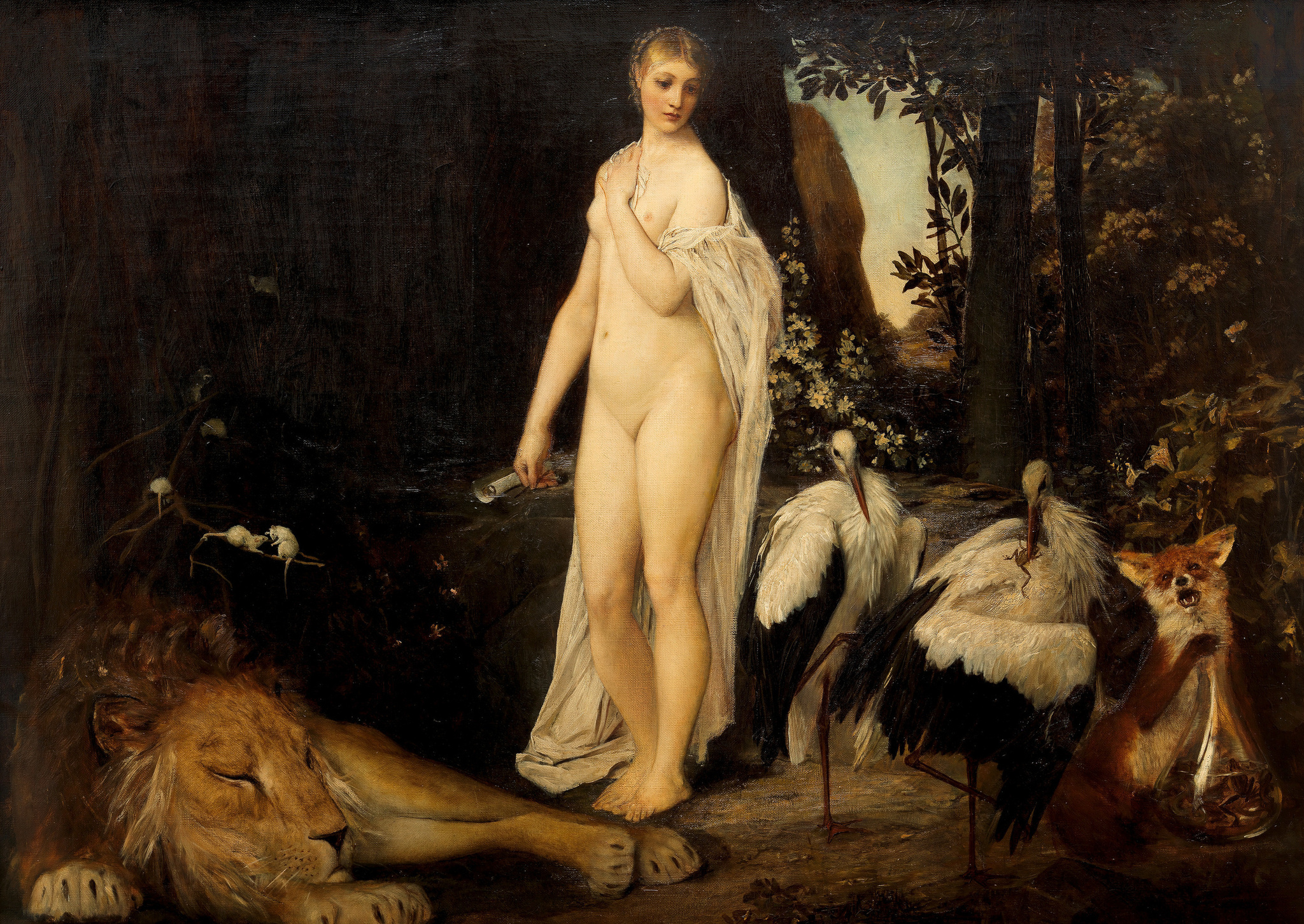
Fable is one of Gustav Klimt’s earliest paintings, made in 1883 when he was 21: a nude young woman stands in a dark forest clearing with a roll of paper in her hand, a lion lies asleep at her feet, and on the right two white storks and a fox with a glass vessel complete the scene. Klimt painted it as the design for a plate in the Viennese portfolio Allegorien und Embleme, and the original is in the Wien Museum. We paint it by hand in oil on canvas, in five sizes from 65 x 52 to 120 x 100 cm or to your own measurement, and send you a photograph of the finished work for approval before dispatch.
| Title: | Fable |
| Other titles: | Die Fabel · La favola · Basen |
| Painter: | Gustav Klimt (1862–1918) |
| Year painted: | 1883 |
| Original size: | approx. 84 cm x 117 cm |
| Original technique: | Oil on canvas |
| Painting style: | Academic historicism, allegory (early work) |
| Located at: | Wien Museum, Vienna |
| Our reproduction: | Hand-painted oil on canvas, five sizes or made to measure |
Fable – Gustav Klimt
What does the painting show?
A young woman stands in a forest clearing, nude, with her body turned towards us and her gaze lowered. In her right hand she holds a roll of paper, and with her left she keeps hold of a white cloth that falls down behind her back. Her pale skin is the brightest part of the canvas, set against dark green and brown woods, and only at the top right does a patch of light sky break through the trees.
Around her, animals take the stage. A large lion lies asleep across the front of the painting. On the right stand two white storks, and beside them a fox sits next to a glass vessel. Everything is painted with the smooth, careful detail of the 1880s: you can follow the fur of the lion, the feathers of the storks and the folds of the cloth, and the longer you look, the more small details appear in the dark undergrowth.
Which fables does the painting recall?
The animals are not there by chance. A fox and storks beside a glass vessel recall one of Aesop’s best-known fables, the fox and the stork: the fox serves the stork soup on a flat plate that only he can lick clean, and the stork pays him back by serving food in a jar with a long, narrow neck that only a beak can reach. The sleeping lion belongs to the same world of animal tales, in which strong and clever creatures teach people a lesson.
That is the idea of the whole painting. It was made for a portfolio of allegories, in which every plate gives a human figure to an idea, and here the idea is the fable itself: the young woman with the roll of paper can be read as the storyteller, surrounded by the characters of her stories. For a buyer it means there is a story in every corner of the canvas, which makes it a lovely conversation piece in a home where books matter.
Why does Fable look so different from Klimt’s golden paintings?
Because it was painted more than twenty years before The Kiss. In 1883 Klimt was 21 and at the very beginning of his career. He painted in the academic style of the time, with smooth skin, lifelike animals and a deep, dark landscape, the way the established painters of the 1880s did. There is no gold, no flat ornament and no pattern yet, only drawing, light and colour.
Seen next to his later work, Fable shows how much skill lay underneath the gold. The drawing of the body, the light on the skin and the textures of fur and feather are the foundation on which he later built his own style. Many people who love Klimt are surprised when they first see this painting, and that surprise is part of its charm: it is a Klimt that most visitors would not recognise at first sight, and a talking point for anyone who knows only his famous gold.
Where is the original?
The original, painted in oil on canvas and about 84 cm high and 117 cm wide, belongs to the Wien Museum in Vienna, the city’s own museum, which has its own Klimt collection – more about it on the Wien Museum’s Klimt collection page. It was painted in 1883 as the design for the title of the Fable plate in Allegorien und Embleme (number 75a), a portfolio of allegories published in Vienna by Gerlach & Schenk, for which the young Klimt made several designs.
If you plan a visit to Vienna, check the museum’s website first, because works are not always on display. Our version is not a print: it is painted for you, by hand, in the size you choose.
Fable among Klimt’s works
In our gallery you can see where this early allegory led. Pallas Athena and Hygieia are later allegorical women from his Secession years, already shining with gold; Judith I turns a figure from an old story into a modern portrait; and Danae retells a Greek myth with a sleeping woman wrapped in colour and gold.
Fable is the quietest and most realistic of these, painted in dark greens and browns rather than gold. Choose it if you like classical painting and stories with animals; if you want Klimt’s famous shine, Pallas Athena or Judith I will suit you better. More about Klimt’s life is on Wikipedia’s Klimt page.
How do we paint Fable by hand?
The painter starts with a careful drawing: the standing figure, the lion along the front edge, the storks and the fox on the right, so that every figure sits in the same place as in the original. Then the dark forest goes on in thin layers of green and brown, followed by the patch of sky and the first light tones of the skin.
After that comes the slow part: the soft modelling of the body, the fur of the lion, the white feathers of the storks, the shine of the glass vessel and the folds of the white cloth. A printed oil painting reproduction flattens all of that into one smooth surface; painted by hand, each layer keeps its depth, and the skin glows against the dark background as it does in the original. Every painting is a hand-painted copy made for your order, so no two are quite alike.
Klimt painted the original in oil on canvas, and so do we. There is no gold in this painting, and none in our version.
Which size for which wall?
In short: 65 x 52 or 70 x 60 cm for a small wall, a study or a reading corner; 90 x 70 cm above a desk or a chest of drawers; 100 x 80 cm above a sofa or a sideboard; and 120 x 100 cm for a large wall or a library.
All five sizes are landscape, like Klimt’s canvas, but a little less wide: the original is about 1.4 times as wide as it is high, while our sizes are about 1.2 to 1.3 times, so the scene has a little more space above and below. If you want exactly the original proportion, we paint it to measure – see the next section.
A painting with this much detail rewards a close look, so it works best where you pass by often or sit nearby. As a painting for the living room, 100 x 80 cm gives the scene real presence above a sofa. Hang it with the centre of the canvas about 150 to 160 cm above the floor; over furniture, leave 20 to 30 cm between the top of the furniture and the lower edge of the canvas.
Custom size, stretcher and frame
If none of the five sizes fits your wall, or you want the original proportion of about 1.4 to 1, we paint it to measure. Send us the width and height you want and we will quote the price and delivery time. Every painting we make is stretched on a wooden stretcher frame and ready to hang.
For the moulding, use our 3D application: it shows every one of our frame profiles on this subject, so you can compare gold, silver, black, white and natural wood before deciding – the application is for choosing the frame only. If you would like to see how the painting will look on your own wall, that is our separate room placement service. A classic gold or dark wood frame suits the academic style of the 1880s; a plain black frame makes the pale figure stand out even more.
Delivery and guarantee
Every painting is made to order in our studio in Slovenia, so allow 15 to 45 days depending on the size you choose. We ship it stretched and protected for transport, framed if you chose a frame, across the EU with no customs. Before dispatch you receive a photograph of the finished work to approve; if anything is not right, we correct it while the canvas is still in our workshop. Our returns policy applies to every order.
If it is a gift and you are not sure of the size, there is our gift voucher. More of Klimt’s work is in our Gustav Klimt gallery, and more about the painter in our article 10 interesting facts about Gustav Klimt.
Frequently asked questions
Where is the original Fable by Klimt?
The original is in the Wien Museum in Vienna, the city’s own museum, which has its own Klimt collection. It is painted in oil on canvas and measures about 84 cm high and 117 cm wide. If you plan a visit, check the museum’s website first, because not every painting is on view every day and works are sometimes lent.
When did Klimt paint Fable?
Klimt painted Fable in 1883, when he was 21 and at the very beginning of his career. It was made as the design for the title of the Fable plate in Allegorien und Embleme, a portfolio of allegories published in Vienna by Gerlach & Schenk, to which the young Klimt contributed several designs.
What does Klimt’s Fable show?
It shows a nude young woman standing in a dark forest clearing, holding a roll of paper and a white cloth that falls behind her back. A large lion lies asleep at her feet, and on the right two white storks and a fox with a glass vessel complete the scene, with a patch of light sky above.
Which fables does Klimt’s Fable recall?
The fox and the storks beside a glass vessel recall Aesop’s fable of the fox and the stork, in which the fox serves soup on a flat plate and the stork answers with a narrow-necked jar. The sleeping lion belongs to the same world of animal tales, so the whole painting reads as a tribute to storytelling.
Is Fable a typical Klimt painting?
No, and that is what makes it special. Fable comes from 1883, more than twenty years before The Kiss, when Klimt still painted in the smooth academic style of the time. There is no gold and no ornament, only careful drawing, soft skin and lifelike animals, which shows the skill that lies behind his later style.
Is there gold in Fable?
No, there is no gold in Fable. The original is painted in oil in dark greens and browns, with the pale skin of the figure, the white storks and the reddish fox as the light accents. That is why our version is painted in oil colours only, without gold paint, just as the original looks.
Which size of Fable suits my wall?
For a small wall or a reading corner, 65 x 52 or 70 x 60 cm works well. Above a desk or a chest of drawers choose 90 x 70 cm, above a sofa 100 x 80 cm, and for a large wall 120 x 100 cm. Our sizes are slightly less wide than the original; the exact proportion is available made to measure.
Which room suits Fable?
It suits a study, a library, a reading corner, a living room or a dining room – anywhere books and stories matter. As a canvas painting in deep greens and browns it pairs well with dark wood, leather, warm lighting and full bookshelves. The nude figure is painted in a calm classical manner, so it fits a grown-up room rather than a child’s bedroom.
Is Fable a good gift?
Yes, especially for someone who loves literature, animal tales or classical painting, or for a Klimt admirer who already knows the famous gold works. Because the figure is nude, think of the recipient’s taste first. If you are not sure of the size, 90 x 70 cm fits most homes, or give a voucher so the recipient can choose.
- Subject: a nude young woman with a roll of paper in a dark forest, a sleeping lion, two storks and a fox with a glass vessel.
- Original: 1883, oil on canvas, approx. 84 x 117 cm, Wien Museum, Vienna.
- Our version: a Klimt reproduction painted by hand in oil on canvas, in five sizes or made to measure.
- Good to know: before dispatch you receive a photograph of the finished work for approval.