



Description
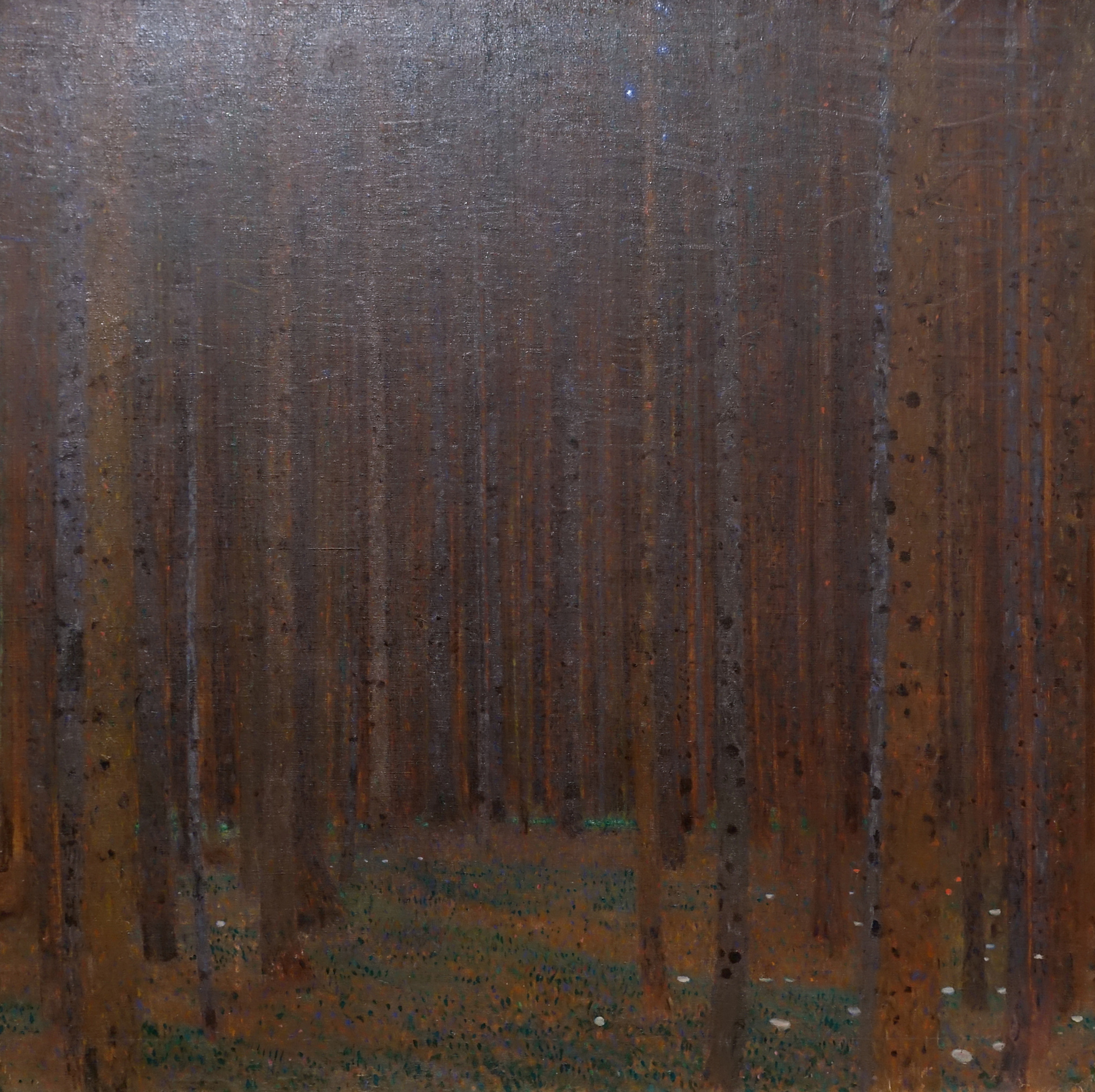
Pine Forest I is a square forest landscape that Gustav Klimt painted in 1901: tall red-brown and grey-violet trunks standing side by side across the whole canvas, no sky at all, and a blue-green mossy floor with small white flowers along the bottom. The original, oil on canvas, 90.5 x 90 cm, is in the Kunsthaus Zug in Switzerland. We paint it by hand in oil on canvas, in eight square sizes from 60 x 60 to 150 x 150 cm or to your own measurement, and send you a photograph of the finished work for approval before dispatch.
| Title: | Pine Forest I |
| Other titles: | Tannenwald I · Fir Forest I · Pineta I |
| Painter: | Gustav Klimt (1862–1918) |
| Year painted: | 1901 |
| Original size: | 90.5 cm x 90 cm |
| Original technique: | Oil on canvas |
| Painting style: | Vienna Secession, landscape |
| Located at: | Kunsthaus Zug, Zug, Switzerland – Kamm Collection Foundation |
| Our reproduction: | Hand-painted oil on canvas, eight square sizes or made to measure |
Pine Forest I – Gustav Klimt
What does the painting show?
Pine Forest I takes you straight into the middle of a forest. Tall, straight trunks stand side by side across the whole square canvas, painted in red-brown, rust and grey-violet, and the upper edge cuts off their tops, so you never see a crown, a branch against the sky or the sky itself. Between the trunks hangs a dim, violet-brown haze: the half-light of a dense wood where the sun hardly reaches the ground.
Across the bottom fifth of the canvas lies the forest floor, built up from small dabs of blue-green and moss green. Scattered over it are little white spots that read as flowers or mushrooms in the moss. There is no path, no figure and no horizon. The whole surface is painted with loose, dotted brushwork, so that the bark, the haze and the moss seem to vibrate slightly when you look at them from a little distance.
How do the two pine forests of 1901 differ?
Klimt painted two pine forests in 1901, both square and both about 90 x 90 cm. Pine Forest I, this one, is the darker and denser of the two: warm red-brown trunks fill the whole square from top to bottom, there is no sky at all, and at the bottom lies a blue-green mossy floor dotted with small white flowers. Pine Forest II is lighter in feeling: high up between the trunks a few tiny flashes of light break through, and its floor is green-grey with brighter patches.
The two paintings also live in different places today. Pine Forest I belongs to the Kunsthaus Zug in Switzerland, so it is part of a public museum collection, while Pine Forest II is in a private collection.
Why does a forest without sky feel so calm?
Because nothing in it leads you away. In a classic landscape the eye travels to the horizon or up into the sky; here the trunks close the view on every side, and the cut-off tops keep you down among them. What remains is a rhythm of vertical lines – light trunk, dark gap, light trunk – repeated across the square like the warp threads of a woven cloth.
At the same time the painting is full of small movement. Seen close up, the trunks are not smooth but made of short, broken strokes of rust, brown and violet, and the floor is a mosaic of green dabs with white points of light. From across the room these marks melt into a deep, quiet wood; from nearer they turn into a surface of pure colour. That double life, near and far, keeps Pine Forest I interesting even on a wall you pass every day.
Where is the original?
The original Pine Forest I is in Switzerland, at the Kunsthaus Zug in the town of Zug, and it is part of the Kamm Collection Foundation (Stiftung Sammlung Kamm). According to the museum’s collection record it is oil on canvas, 90.5 x 90 cm, dated 1901; in its frame it measures 94 x 93.5 cm.
If you plan a visit to Zug, check the museum’s website before you go, because works are sometimes moved or lent to exhibitions elsewhere. The other painting of the pair, Pine Forest II, is in a private collection.
Pine Forest I among Klimt’s works
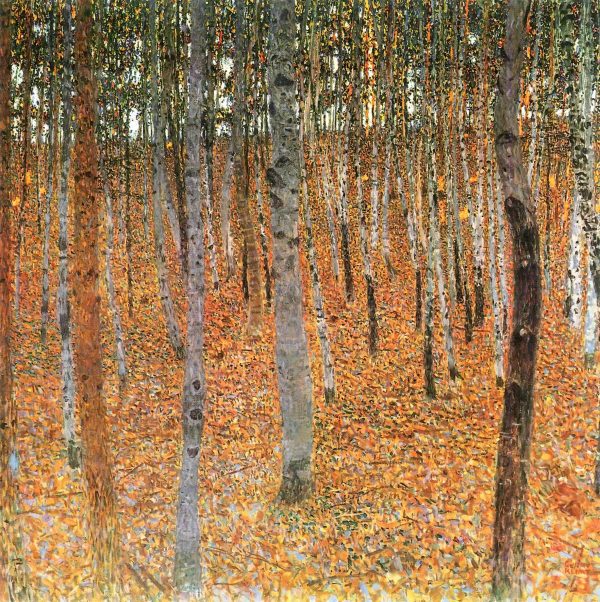
In our gallery Pine Forest I has close relatives. Pine Forest II is its companion from the same year, and Forest of Beech Trees is another square view into a dense row of trunks. Young Birches opens the wood up into a meadow with white birches, and Forest Floor is a tiny oil sketch of woodland ground that the young Klimt painted some twenty years earlier.
Between the pair, choose Pine Forest I for the darker, denser forest with no sky and a blue-green floor with small white flowers, and Pine Forest II if you want a few flashes of light between the trunks and a brighter, green-grey floor. More about Klimt’s life is on Wikipedia’s Klimt page.
How do we paint Pine Forest I by hand?
The painter starts on a square canvas and first lays out the trunks with thin lines, so that their spacing and their slight differences in width sit exactly where Klimt placed them. Then the dark ground goes on: the violet-brown haze between the trunks in thin, transparent layers, followed by the trunks themselves in red-brown, rust and grey-violet, warmer where they catch a little light, cooler where they recede.
The bark and the floor are built up from short, separate strokes and dots, as in the original, rather than smooth blends: blue-green and moss green for the floor, then the small white spots of the flowers set on top, one by one. A print would flatten these dabs into a smooth surface; an oil painting reproduction made this way has real texture that catches light from the side. Every canvas is a hand-painted copy made for your order, so no two are exactly alike.
Which size for which wall?
In short: 60 x 60 or 70 x 70 cm for a hallway, a study or a narrow wall; 80 x 80 or 90 x 90 cm above a chest of drawers, a desk or a bed; 100 x 100 or 110 x 110 cm above a sofa or a dining table; and 120 x 120 or 150 x 150 cm for a large wall or a high room. At 90 x 90 cm your painting is about the size of Klimt’s original.
All eight sizes are square, like the original, so the composition stays complete in every one. Because the trunks run from edge to edge, the larger the canvas, the more the forest surrounds you: from 100 x 100 cm up it works almost like a window into the wood. As a painting for the living room, 110 x 110 or 120 x 120 cm above a sofa gives the warm browns real presence.
Hang it with the centre of the canvas about 150 to 160 cm above the floor; over furniture, leave 20 to 30 cm between the top of the furniture and the lower edge of the canvas. Because the painting is dark, it looks best with daylight from the side or a small lamp above it, which brings out the white flowers and the rust of the bark.
Custom size, stretcher and frame
If none of the eight sizes fits your wall, we paint it to measure; keep it square or close to square, so that the trunks keep their spacing and the floor stays a narrow band at the bottom. Send us the width and height you want and we will quote the price and delivery time. Every painting we make is stretched on a wooden stretcher frame and ready to hang.
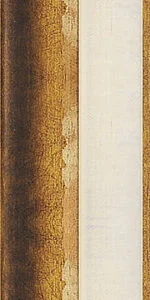
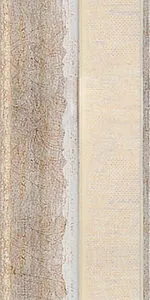
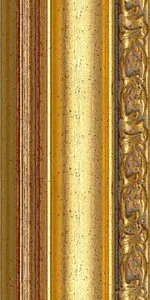
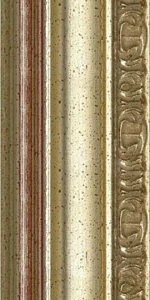
For the moulding, use our 3D application: it shows every one of our frame profiles on this subject, so you can compare gold, silver, black, white and natural wood before deciding – the application is for choosing the frame only. If you would like to see how the painting will look on your own wall, that is our separate room placement service. A dark walnut or warm brown frame picks up the colour of the trunks; a thin black frame makes the dense forest look more graphic and modern.
Delivery and guarantee
Every painting is made to order in our studio in Slovenia, so allow 15 to 45 days depending on the size you choose. We ship it stretched and protected for transport, framed if you chose a frame, across the EU with no customs. Before dispatch you receive a photograph of the finished work to approve; if anything is not right, we correct it while the canvas is still in our workshop. Our returns policy applies to every order.
If it is a gift and you are not sure of the size, there is our gift voucher. More of Klimt’s work is in our Gustav Klimt gallery, and more about the painter in our article 10 interesting facts about Gustav Klimt.
Frequently asked questions
Where is the original Pine Forest I by Klimt?
The original is at the Kunsthaus Zug in Zug, Switzerland, as part of the Kamm Collection Foundation. It is oil on canvas, 90.5 x 90 cm, painted in 1901. Because works are sometimes moved or lent to exhibitions, check the museum’s website before you visit. Its companion, Pine Forest II, is in a private collection.
What is the difference between Pine Forest I and Pine Forest II?
Pine Forest I is darker and denser: red-brown trunks fill the square from top to bottom, there is no sky, and a blue-green mossy floor with small white flowers runs along the bottom. Pine Forest II shows a few tiny flashes of light high up between the trunks and a green-grey floor with brighter patches. Both date from 1901 and measure about 90 x 90 cm.
How big is Klimt’s Pine Forest I?
The original measures 90.5 x 90 cm, almost exactly square, and 94 x 93.5 cm in its frame. Our 90 x 90 cm size is therefore about as large as the original. We also paint it smaller, from 60 x 60 cm, or larger, up to 150 x 150 cm, and to your own measurement if you need a size in between.
When did Klimt paint Pine Forest I?
Klimt painted it in 1901, the same year as its companion Pine Forest II. It belongs to the years around 1900, when Klimt began painting landscapes in a square format; Young Birches, for example, dates from 1900. The Kunsthaus Zug gives 1901 as the date in its collection record.
What does Klimt’s Pine Forest I show?
It shows the inside of a dense forest: tall, straight trunks in red-brown, rust and grey-violet stand side by side across the whole square, their tops cut off by the upper edge. A dim violet-brown haze fills the gaps between them. Along the bottom lies a mossy floor of blue-green dabs with small white spots like flowers or mushrooms.
Is there gold in Pine Forest I?
No. Pine Forest I is not one of Klimt’s gold paintings; it is painted entirely in oil colours – browns, rust, grey-violet and greens – with loose, dotted brushwork. Its glow comes from the warm trunks against the dark haze, not from metal leaf. We therefore paint our version in oil colours only, without gold paint or leaf.
Which room suits Pine Forest I?
It suits a living room, a study, a library, a bedroom or a hallway – anywhere you want the calm of a deep forest. As a canvas painting it goes well with natural wood, linen, leather and walls in green, sand or warm grey. Because its colours are dark, give it light from the side so the white flowers and the rust of the bark stand out.
Is Pine Forest I a good gift?
Yes, especially for someone who enjoys forests, walks in the woods or Klimt’s landscapes more than his gold portraits. If you are not sure of the size, choose 80 x 80 or 90 x 90 cm, or give a voucher so the recipient can choose.
How do I care for my Pine Forest I painting?
Keep it out of direct sunlight and away from radiators, fireplaces and damp walls, because heat and moisture are hard on any oil paint. Dust the surface now and then with a soft, dry brush, and never use water or cleaning products on it. Hung and cared for this way, the hand-painted canvas keeps its colours for many years.
- Subject: tall red-brown and grey-violet trunks across a square forest, no sky, a blue-green mossy floor with small white flowers.
- Original: 1901, oil on canvas, 90.5 x 90 cm, Kunsthaus Zug, Switzerland (Kamm Collection Foundation).
- Our version: a Klimt reproduction painted by hand in oil on canvas, in eight square sizes or made to measure.
- Good to know: before dispatch you receive a photograph of the finished work for approval.