







































Description
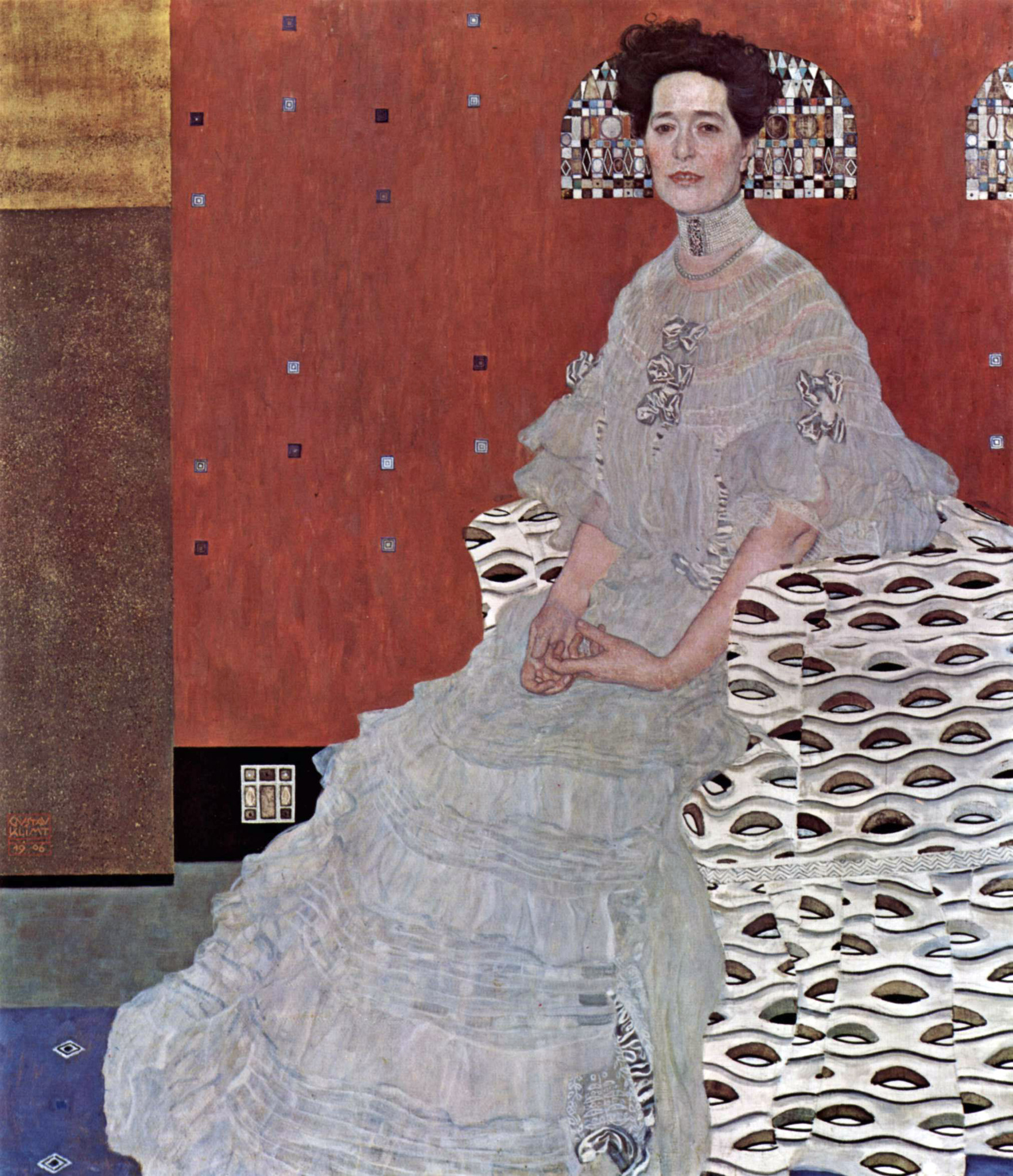
Portrait of Fritza Riedler is the 1906 portrait in which Gustav Klimt sets a finely painted, lifelike woman inside a world of flat geometric pattern: Fritza Riedler sits in an armchair upholstered with eye-like shapes, in a lilac-grey flounced dress, while a semicircle of mosaic-like colour rises behind her head like a headdress. The original hangs in the Upper Belvedere in Vienna. We paint it by hand in oil on canvas, with gold paint on the gold-brown accents, in seven upright sizes from 50 x 60 to 120 x 150 cm or to your own measurement.
| Title: | Portrait of Fritza Riedler |
| Other titles: | Fritza Riedler · Ritratto di Fritza Riedler · Portret Fritze Riedler |
| Painter: | Gustav Klimt (1862–1918) |
| Year painted: | 1906 |
| Original size: | 153 cm x 133 cm |
| Original technique: | Oil on canvas |
| Painting style: | Vienna Secession |
| Located at: | Upper Belvedere, Vienna (inv. 3379) |
| Our reproduction: | Hand-painted oil on canvas with gold paint, seven upright sizes or made to measure |
Portrait of Fritza Riedler – Gustav Klimt
What does the painting show?
A woman sits upright in a wide armchair, her hands folded in her lap. She wears a lilac-grey dress with soft flounces that spill over the seat, and her hair is dark. The upholstery of the armchair is not an ordinary fabric but a pattern of small eye-like shapes that surrounds her like a frame.
Behind her head rises a semicircle made of small mosaic-like patches of colour, like a headdress. The wall behind her is red-brown and divided into small squares, a gold-brown panel stands on the left, and a dark floor closes the composition at the bottom. The result is a portrait that is lifelike and decorative at once.
Why is the portrait half lifelike and half pattern?
Because Klimt was working out a new kind of portrait. The dress, the face and the hands are painted with great care and real detail: you can follow the fall of the flounces, the light on the skin and the way the fingers rest on one another. Everything around her, though, is reduced to abstract geometric shapes – the eyes of the armchair, the squares of the wall, the flat panel on the left, the semicircle behind the head.
The two worlds meet without blending. The woman is soft and three-dimensional; the space she sits in is flat, like an inlay or a mosaic. This contrast is what makes the painting look so modern, and it leads straight to the golden portraits Klimt painted in the following years. For a buyer it means a portrait with real presence that also works as a strong decorative accent on a wall.
What does the ornament behind her head mean?
It is a semicircle of small patches of colour, set like a mosaic on the wall directly behind her head, so that it sits on her hair like a tall headdress. Art historians often compare it with the hairstyles of the Spanish infantas painted by Velázquez, the young princesses of the court in Madrid, whose hair was framed by the same wide, fan-like shape.
Whether or not you think of Velázquez, the effect is clear: the ornament gives a woman seated in a private home the dignity of an official, almost royal portrait. It also ties her face into the pattern of the wall, so the eye travels from the head to the mosaic and back again. For many viewers this is the detail that stays in the memory.
Who commissioned the portrait, and where is it now?
The portrait was commissioned around or shortly before 1906 by Professor Alois Riedler, who asked Klimt to paint his wife Fritza, then 46 years old. Klimt completed it in 1906. The original is an oil on canvas, 153 cm high and 133 cm wide, and since 1937, when the then Staatsgalerie bought it, it has belonged to the Austrian state collection that is today the Belvedere. More about the painter’s life is on Wikipedia.
It hangs in the Upper Belvedere in Vienna under inventory number 3379. If you plan a visit, check the museum’s website first, because works are sometimes moved or lent. Our version is not a print: it is painted for you, by hand, in the size you choose.
Portrait of Fritza Riedler among Klimt’s portraits of women
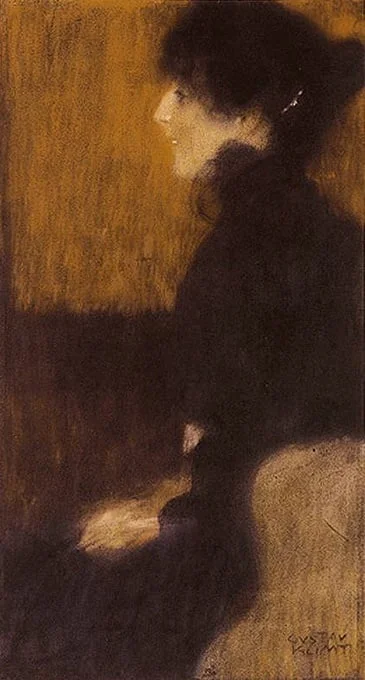
Klimt painted many society women, and our gallery lets you compare them. The soft Portrait of Sonja Knips and the elegant Portrait of Hermine Gallia are earlier portraits in pale dresses, painted with a lighter touch and almost no ornament. The famous Portrait of Adele Bloch-Bauer I, the golden portrait completed the following year, takes the pattern of Fritza Riedler much further, and the colourful Portrait of Adele Bloch-Bauer II shows his later style.
Portrait of Fritza Riedler stands between these worlds: still calm and restrained in colour, but already full of geometric pattern. Choose it if you want a portrait with a quiet, elegant presence and a touch of gold; if you want gold everywhere, Adele Bloch-Bauer I will suit you better, and if you love pure softness, Sonja Knips.
How do we paint Portrait of Fritza Riedler by hand?
The painter first draws the figure and the armchair, so that the seated pose, the tilt of the head and the semicircle behind it sit exactly as in the original. The flat areas come next: the red-brown wall with its small squares, the dark floor and the pattern of eyes on the chair, each laid in carefully and kept crisp, because the contrast with the soft figure depends on them.
Then come the dress, the face and the hands. We build up the flounces in thin, layered strokes of lilac and grey, so that the fabric moves and catches the light, and we model the face and hands slowly, as Klimt did, until they look alive against the flat wall. A printed oil painting reproduction cannot show this difference between flat pattern and soft modelling; by hand, every stroke keeps its texture. Every painting is a hand-painted copy made for your order, so no two are ever quite the same.
The gold-brown accents, including the panel on the left, are painted by hand with gold paint, so that they catch the light in your room the way they do in the original.
Which size for which wall?
Short answer: 50 x 60 or 63 x 79 cm for a small wall, a hallway or beside a bed, 70 x 90 or 80 x 100 cm above a sofa, a sideboard or a desk, 90 x 110 to 100 x 125 cm for a large living room wall, and 120 x 150 cm for an open-plan space or a staircase.
All seven sizes are upright: 50 x 60, 63 x 79, 70 x 90, 80 x 100, 90 x 110, 100 x 125 and 120 x 150 cm. In proportion they are a little narrower than the original, which is almost as wide as it is high, so the armchair and the wall beside the figure sit slightly tighter at the sides. If you want the exact proportion of the original, we paint it to measure. Because the seated figure looks calm and elegant, as a painting for the living room 90 x 110 cm above a sofa gives it room without overpowering the space.
Hang it with the centre of the canvas about 150 to 160 cm above the floor; above furniture, leave 20 to 30 cm between the top of the piece and the lower edge of the canvas.
Custom size, stretcher and frame
If none of the seven sizes fits your wall, or you would like the wider proportion of the original, we paint it to measure. Send us the width and height you want and we will quote a price and a lead time. Every painting we make is stretched over a wooden stretcher and ready to hang.
For the moulding, use our 3D application: it shows every one of our frame profiles on this subject, so you can compare gold, silver, black, white and natural wood before deciding – the application is for choosing the frame only. If you would like to see how the painting will look on your own wall, that is our separate room placement service. A gold frame picks up the gold-brown accents; a thin silver frame echoes the lilac-grey dress; a dark wood or black frame deepens the red-brown wall.
Delivery and guarantee
Every painting is made to order in our studio in Slovenia, so allow 15 to 45 days depending on the size you choose. We ship it stretched and protected for transport, framed if you chose a frame, across the EU with no customs. Before dispatch you receive a photograph of the finished work to approve; if anything is not right, we correct it while the canvas is still in our workshop. Our returns policy applies to every order.
If it is a present and you do not know the right size, there is a wall art voucher. Every other Klimt work we paint is in the Gustav Klimt gallery, and there is more on the painter in our article ten interesting facts about Gustav Klimt.
Frequently asked questions
Where is the original Portrait of Fritza Riedler?
The original hangs in the Upper Belvedere in Vienna, inventory number 3379. It is an oil on canvas from 1906, 153 cm high and 133 cm wide. It has been in the Austrian state collection since 1937, when the then Staatsgalerie bought it. If you plan a visit, check the museum’s website first, because not every painting is on display every day.
Who was Fritza Riedler?
She was the wife of Professor Alois Riedler, who commissioned Klimt to paint her portrait around or shortly before 1906, when she was 46 years old. Today most people know her through this painting: an elegant, composed woman seated in a patterned armchair, in a lilac-grey flounced dress, with her hands calmly folded in her lap.
What is behind Fritza Riedler’s head?
A semicircle of small mosaic-like patches of colour, placed on the wall so that it frames her hair like a headdress. It is often compared with the hairstyles in Velázquez’s portraits of the Spanish infantas. It gives the seated woman a formal, almost royal dignity and links her face with the geometric pattern of the room around her.
Is there gold in the Portrait of Fritza Riedler?
Our version has gold paint on the gold-brown accents, such as the panel on the left; there are no large gold areas like those in Klimt’s golden portraits. We paint these accents by hand with gold paint, so they catch the light as in the original. Everything else is oil colour: lilac-grey for the dress, red-brown for the wall and dark tones for the floor.
Why does the Portrait of Fritza Riedler look so modern?
Because Klimt combined two ways of painting on one canvas. The dress, face and hands are lifelike and finely modelled, while the armchair, the wall and the ornament are flat geometric shapes. That contrast between a real woman and an abstract setting still looks fresh today and sits well in contemporary interiors as well as classic ones.
When did Klimt paint the Portrait of Fritza Riedler?
In 1906. The commission came from Professor Alois Riedler in that year or shortly before, and Klimt painted his wife when she was 46. The portrait belongs to the same years as his best-known golden works, yet its colours are cooler and more restrained, which gives it a particular, quiet elegance.
Which size of Fritza Riedler suits my wall?
For a small wall, a hallway or beside a bed, choose 50 x 60 or 63 x 79 cm. Above a sofa or sideboard, 70 x 90 or 80 x 100 cm works well, and for a large wall 100 x 125 or 120 x 150 cm. All seven sizes are upright and a little narrower than the original; for its exact proportion, order a custom size.
Which room suits the Portrait of Fritza Riedler?
It suits a living room, a dining room, a study or an entrance hall, anywhere you want an elegant figure, calm colours and a touch of gold. As a canvas painting it looks especially good on warm white, beige or soft grey walls and with dark wood. In a hallway choose 63 x 79 cm; above a sofa, 90 x 110 cm.
Is the Portrait of Fritza Riedler a good gift?
Yes, for anyone who loves Klimt, Vienna around 1900 or elegant portraits that are not covered in gold. The calm colours suit most homes, and the seated woman gives a room a quiet, graceful presence. If you are unsure of the size, 70 x 90 cm is a safe choice, or give a voucher so they can choose themselves.
- Subject: Fritza Riedler seated in an armchair patterned with eye-like shapes, in a lilac-grey flounced dress, with a mosaic-like semicircle behind her head.
- Original: 1906, oil on canvas, 153 x 133 cm, Upper Belvedere, Vienna.
- Ours: a Klimt reproduction painted by hand in oil on canvas, with gold paint on the gold-brown accents, in seven upright sizes or made to measure.
- Worth knowing: you receive a photograph of the finished work for approval before dispatch.